Small Things [David’s blog on KS Friday]

We took a break and sat outside, soaking up the sun. Had we continued working we’d have missed the hummingbird, the first of the season. You’d have thought by our reaction to the hummingbird sighting that we just scored the winning goal in the World Cup finals. It’s what I love about how we are walking through the world. Small things are cause for big celebration.

We moved the bags of leaves to the curb for pick-up. The bags were sitting on the driveway beneath the bird feeder. After we removed the bags, Kerri spotted some wriggling worms. “It’s not a good thing to be a worm wriggling beneath a bird feeder,” she remarked, lifting them one-by-one and gently placing them in the grass away from the feeder. Small things. Big empathy.

It seems in a single day Breck’s many buds popped open as leaves. They are yet teeny-tiny but perfectly shaped aspen leaves, ready for quaking. They catch the evening light and literally glow. “You go, Breck!” we cheer our hardy aspen tree. For us, Breck is a symbol of perseverance. If at first you don’t succeed…Those new leaves are very small things but they invoke in us big, ancient hope.

We ask, “What we can possibly do in the face of the assault-from-within on our democracy?” Small things.

In the past two days I’ve seen pleas for support from several small arts organizations. The current administration has eliminated their grant money. Their survival is now tenuous at best. They are small things that could use our big support. “Theater, in particular, invites us to imagine another’s perspective, to reckon with injustice, and to practice compassion in real time. To defund it is to silence one of the sacred spaces where we learn to be human together.” ~ Chris Domig, Artistic Director, Sea Dog Theater.

Consider helping the many, many sacred art spaces in this country to survive – and perhaps thrive – in this time of silencing voices.* For them, our support is no small thing [My short list: Sea Dog Theater Company. Seven Devils New Play Foundary. Changing Faces Theater Company. Your local companies – museums, galleries, dance companies, writer’s retreats, symphonies…the storytellers, the tradition-keepers, the mirrors to power – all depend upon grants and donations. All are in danger of disappearing. Help them in any small way if you can].

We are very small things but no less capable than Breck, or the hummingbird, or the worms of inspiring hope, evoking empathy for otherness, of celebrating all that makes us human.

We are, by ourselves, small things but united we are capable of a big, loud, unified voice – we are capable to sending a potent message to those who fear and would silence the power of the arts, those who would shutter the spaces where we learn to be human together.

*non-profits, like your local food banks or social service organizations…are also under threat. Find them. Help them in any small way that you can.

Nurture Me on the album Released From The Heart © 1995 Kerri Sherwood

Kerri’s albums are available on iTunes and streaming on Pandora

read Kerri’s blogpost about SMALL THINGS

likesharecommentsupportsubscribe…thankyou.

Learn The Language of Color [on DR Thursday]

Earlier this week I wrote of DeMarcus’ notes on color made when he was a first year art student. I flipped through the fading pages before placing the notebook back on my shelf and lingered on these gems:

“If we wish to create we must learn the Language of Color.”

“Color stands for JOY in this world of seeing.”

“Through the language of COLOR, we add JOY to the world of seeing.”

His notes are from a lecture. In my mind I see some fantastic art teacher, a life teacher, standing before a class of enthusiastic hearts that included the young DeMarcus, infusing them with a purpose that demanded they pay attention to others, to their reason for creating. Bring joy. Through the language of color, speak to a world that doesn’t know how to see. Speak to a world desperately in need of Joy. Color theory as community tending. Igniting the idea in the students, the teacher then set them free to explore how, through color, to bring joy to the world. The lesson was simultaneously both practical and existential.

I wish I knew the name of DeMarcus’ instructor. I’d send a deep debt of gratitude into the universe.

It is profoundly easy to diminish the role of artists in our culture. Note the dearth of art programs in schools. The emaciated National Endowment for the Arts relative to other budget lines. What might be more important in our times than artists striving to weave togetherness through the language of color? What might be more necessary than opening eyes to see beyond grey assumptions? We diminish ourselves when we devalue our art.

I knew DeMarcus when he was in his 90’s. Those early lessons still twinkled in his eyes. Or, perhaps, a lifetime of speaking the language of color, a lifetime of offering the joy of seeing, brought a permanent twinkle to his eye . He understood artistry as more than indulgent self-expression. He understood – and helped me understand – that artistry came with a responsibility to others as well as to the self. Service. See, in order to help others see, through the language of color, joy.

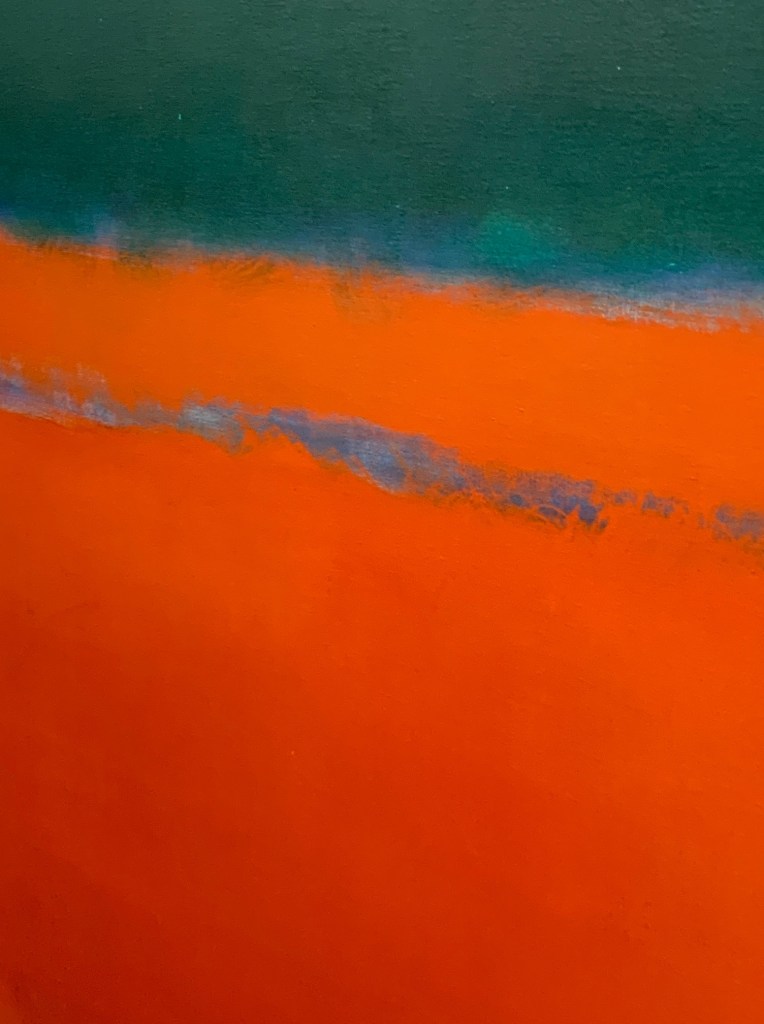
prayer of opposites, 48x48IN, acrylic on panel © 2006

my-as-yet-still-unfinished-site [I hope you’re not holding your breath]

read Kerri’s blogpost on COLOR

like it. share it. comment. buyusacoffee. thank you for reading our work.

Check The Resale [on KS Friday]

“Although Rothko lived modestly for much of his life, the resale value of his paintings grew tremendously in the decades following his suicide.”

The premise of this sentence made my jammies bunch-up. This wiki entry might have been written about Van Gogh. “Lived modestly” is a euphemism for “poor.” My favorite stereotype: the poor artist.

William Blake also lived modestly; he’d be shocked at the “resale value” of his work now. Nothing brings valuation to an artist’s work like the sudden end of the supply. Blake’s life came to a natural conclusion, so at least there’s that.

How do we know something has value? Resale, of course. Commodity. Soul reduced to a bottom line.

.003 percent of the nation’s budget goes to the National Endowment for the Arts. Valuation. If you desire to truly understand the phrase, “lived modestly,” visit your local not-for-profit arts organization. They’ll heap sincere gratitude upon you if you donate a ream of paper.

As an exercise in understanding soul, ask an actor or painter or dancer or composer the most obvious question: why do you do it?

Their answer will have nothing to do with resale value or commodity. Keep in mind, that doesn’t mean that they don’t want to be paid. Imagine Van Gogh’s answer. Or Mark Rothko’s. Emily Dickinson’s. Wouldn’t you love to know what they knew, see what they saw? Attempting to stand in their shoes, to see what they saw, is the reason that their resale value is so high. They connect us to something greater than commodity.

A caution: the next time you ask yourself, “What’s it all about?” be careful to direct your question to your inner Mary Oliver rather than your inner Elon Musk. They serve remarkably different gods.

My favorite quote of late: “And while a hundred civilizations have prospered (sometimes for centuries) without computers or windmills or even the wheel, none have survived a few generations without art.” David Bayles & Ted Orland, Art & Fear

.003%. That equates to an amount far less than Jeff Bezos’ tax bill. As a percentage, that’s much more than Kerri gets paid for a single spin of one of her pieces on your favorite streaming service (.000079 of a cent). Spotify, Pandora, and the rest are making out like bandits while the independent artists continue to “live modestly.”

What’s the real value of a nation that so desperately undervalues its art? I guess we’ll just have to wait for the postmortem resale.

Kerri’s albums are available on iTunes and streaming on Pandora

read Kerri’s blogpost about ROTHKO

every breath/as it is © 2004 kerri sherwood