A More Powerful Force [David’s blog on KS Friday]

Do you wonder, as I do, what has ever been achieved through war? Pick any war from the many, many, many that populate human history and ask, “What was gained?” Really? What was gained? How were we made better?

Certainly there have been useful technological advances. War has been a driver for innovation but I question whether we might have arrived at the same advances without the carnage. Could the advances in medicine been the result of goodwill? The desire to make lives better? And, have all of the technological advances really been advances? Wouldn’t our schools and our children be safer in a world without automatic weapons? Might we solve our differences as readily if war was not an option? Is cooperation and collaboration as potent a force in the world as conflict? Might they be more powerful?

I will be the first to admit that order inspires chaos and chaos necessitates order. It’s a cycle but I wonder if chaos really requires bloodletting?

Putin blames Ukraine for the aggression, Netanyahu blames the Palestinians for the aggression just as the current occupant of the White House blames Iran for the aggression. Hitler blamed the Jews and Pol Pot blamed the intellects. What has any of it achieved? Security? Certainly not. Prosperity? Well, weapons manufacturers are grateful for the business just as oil companies are applauding record profits from the ongoing closer of the Strait of Hormuz. Are we really that shallow? Is it really so impossible to share resources? Do we really need to learn again and again how interconnected our economies – our resources – our planet -our lives – really are?

Kerri took a photo of the storm clouds gathering in the sky. It is made beautiful by the safety of home. Home looks like a place but it is in actuality a wide web of supportive relationships. Home does not exist in isolation.

Elie Wiesel wrote that solidarity is essential for existence, “Alone we disappear.” Solidarity: unity, agreement, fellowship. Are these not also essential forces in the world? Martin Prechtel writes of community as “mutual indebtedness”. Is it not incumbent upon me to make sure you have food to eat, and you to ensure that I have fresh water to drink? If I poison the well will not I also suffer? Isn’t the imperative to bridge our loneliness – the necessity to reach across the void to each other – a more powerful force than war? Why else do we send probes into outer space? Rather than war, doesn’t it make more sense to reach across oceans to say, “We are here,” and ask, “How can we get to know you?”

Is it so hard to imagine?

YOU MAKE A DIFFERENCE © 2003 Kerri Sherwood

*This song was the first contact I had with a woman named Kerri Sherwood. I’d written a newsletter entitled, “You Make A Difference” and a few days after publishing my newsletter an email popped in my box with this song. She wrote that my words had touched her and she hoped that her song of the same title would touch me. Well…

Kerri’s music-that-can-change-your-life is available on iTunes and streaming on Pandora

read Kerri’s blogpost about POSSIBILITY

likesharecommentsupportthankyou

Active Gratitude [David’s blog on Merely A Thought Monday]

I think we have it all wrong and that’s why we are now in trouble. Even in the dictionary this word, “community” gets an antiseptic scrubbing. Community is so much more than “people living in the same place,” or “people having a particular characteristic in common”. It is so much more than “a feeling of fellowship,” or “sharing common interests, attitudes, and goals.” All of those aspects are certainly important but they are superficial.

These definitions omit the soul of the communal body.

I found a startlingly simple yet profound definition of community in Martíin Prechtel’s book, Long Life, Honey In The Heart. I discovered my definition of community in his definition of “adulthood”. In his village, adulthood is not something that just happens. Adulthood is not simply a product of aging. It is not a legal definition. It is something that is learned and earned. One is not considered an adult until they embody and live each day from a real-to-the-bone understanding of mutual indebtedness.

Mutual indebtedness. People who are accountable to and for each other. People who are responsible for the well-being of their neighbors. People who know without doubt that their neighbors are accountable to them and responsible for their well-being. Reciprocal generosity.

No one walks this path alone. No one is truly independent. Everyone is reliant upon the gifts, skills and labor of others. Take a walk through a grocery store and try to try to grok how many people, how much labor and love it took to get the potatoes to the shelf. Or, if that’s too abstract, consider how many people were involved in the making of the screen you are presently using; how many generations of thought and imagination, how many hours and hours of someone else’s labor did it take for you to scroll and click? How many people all over the world did it take to mine the minerals and make the chips and manufacture and assemble the components and ship the unit across seas and over roads before you powered on and individualized your device?

Are we or are we not denying responsibility for the well-being of the people who each and everyday serve our needs? Or, as I fear, as is apparent in our current hubris, are we so deluded that we think we can exploit the lives and labor of others without the inevitable blow-back and ultimate societal collapse that “every man for himself” necessitates?

Bullies occupy playgrounds and make deals using big sticks – evidence of a childish mind. Adolescence is self-serving and simplistic.

Our current republican government’s dedicated enemy-creation and fact-free-demonization of others is the antithesis of community. It is, in fact, the intentional destruction of community.

Adulthood comes with the dawning recognition of interdependence. Mutual indebtedness. Responsibility to and for others. Labor as service. Governance as service. Artistry as service. Life as service. As the Beatles sang it, “The love you take is equal to the love you make.”

Community is an action, a verb and not a noun. It is a practice rooted in service to others. It is the adult recognition that a better world for me is only possible when I dedicate myself to the betterment of others. Well-being is a shared intention, something we owe to each other. I eat the food you grow and pick. You use the technology that I develop. We enjoy the fruits of each other’s labor. We survive and thrive because of the efforts of others. We are indebted to each other.

The soul of community is active gratitude.

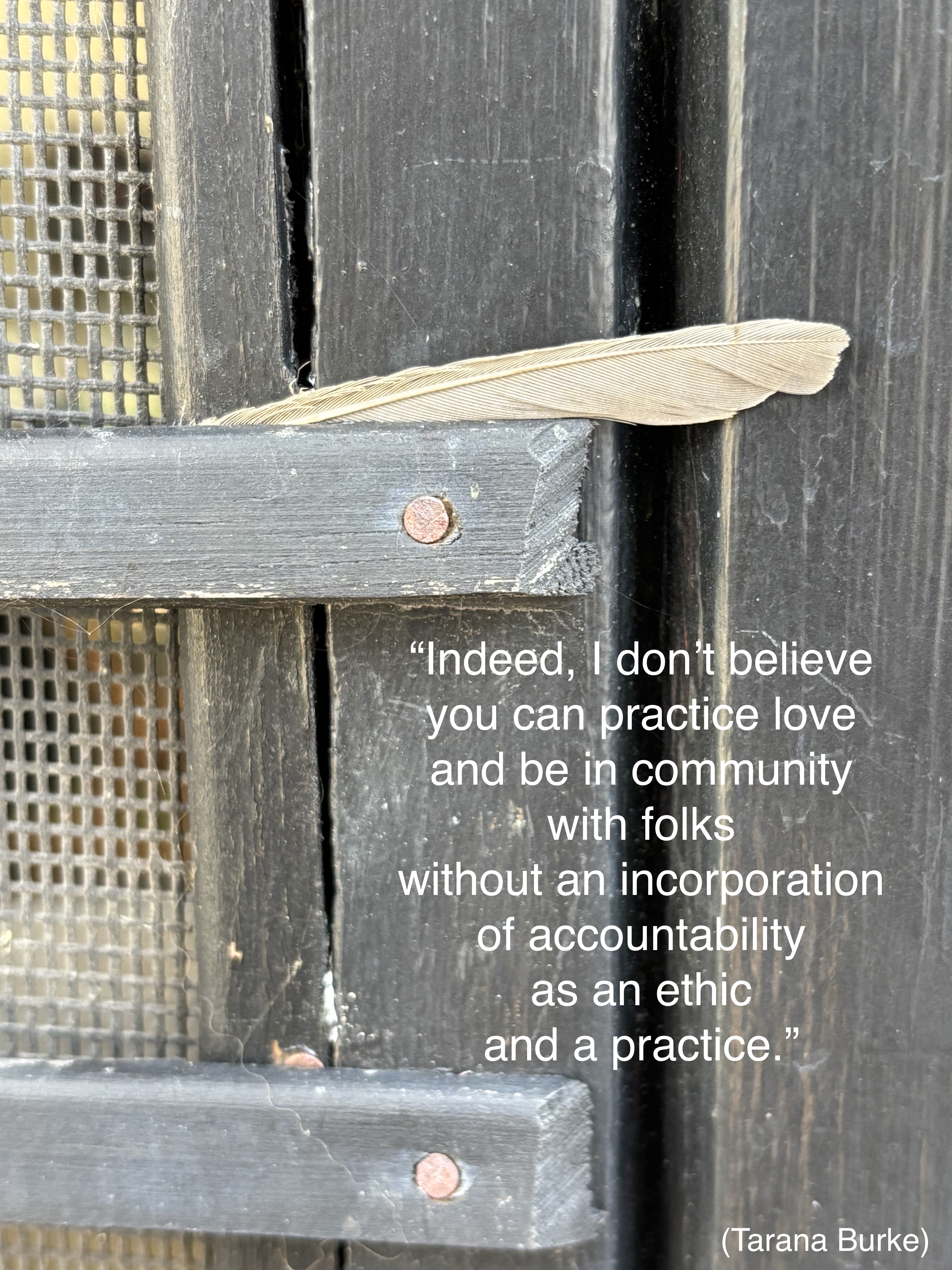
“Indeed, I don’t believe you can practice love and be in community with folks without an incorporation of accountability as an ethic and a practice.” ~ Tarana Burke, Unbound

read Kerri’s blogpost about ACCOUNTABILITY

likesharesupportthankyou.