Reach Back To Move Forward [on Two Artists Tuesday]

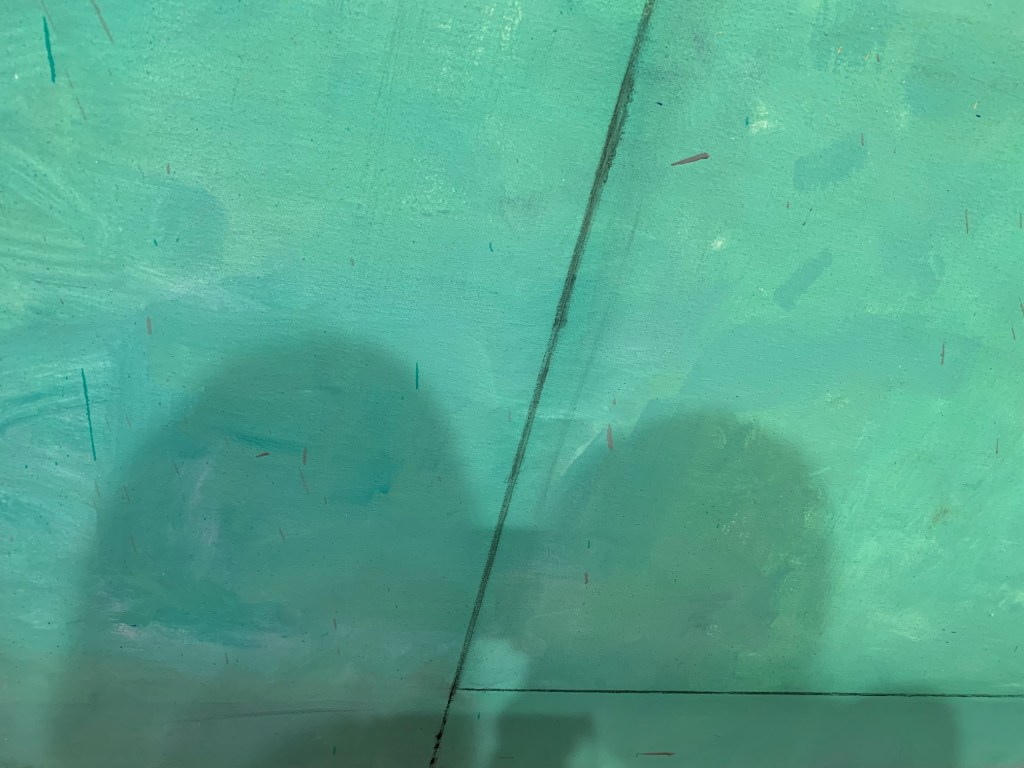
I wrote with great derision of the day I went to the Museum of Modern Art in NYC and watched people line up to take selfies with Van Gogh’s Starry Night. So, more than 15 years later, I howled with laughter at myself when Kerri beckoned me to stand with her so we might take a shadow shot with Diebenkorn’s painting, Ocean Park #68. “We’ll call it ‘Richard and Us!” she smiled.

Kerri recently challenged me to let go of my figurative work, release the image and paint my feelings. The moment before she beckoned me to take the shadow shot, I was having a minor revelation. There’s a reason I have stood in front of this painting for hours. There’s a reason it “talks with me” about simplicity and courage. Early in his life Richard Diebenkorn was a figurative painter. Even earlier, his work was abstract and resembled the paintings of the masters he admired. As his work matured it circled back to abstraction. He didn’t “let go” of his figurative work; he grew through it. He reached through it. In Ocean Park, he fulfilled his unique voice.

I read that his Ocean Park series was greatly influenced by the work of Henri Matisse. I imagined Richard Diebenkorn standing in front of his favorite Matisse, having a quiet conversation about simplicity and the courage to explore. In the gallery light, his shadow cast upon the painting as he moved forward to study the brushstrokes. He leaned in. He reached back to Henri to move forward. Had he lived in the age of cell phones and easy shots, I’m certain he’d have taken a shadow-selfie so he might remember the moment his shadow touched Henri’s.

We were alone in the gallery when Kerri took our shadow-selfie with Richard. We had him all to ourselves. We leaned in. I thought it especially poignant, our shadows cast upon a painting, an artist, who has cast his long shadow upon me. We caught the moment our shadow touched Richard’s. Reaching back to move forward,

read Kerri’s blogpost about RICHARD AND US

Trace The Line [on Merely A Thought Monday]

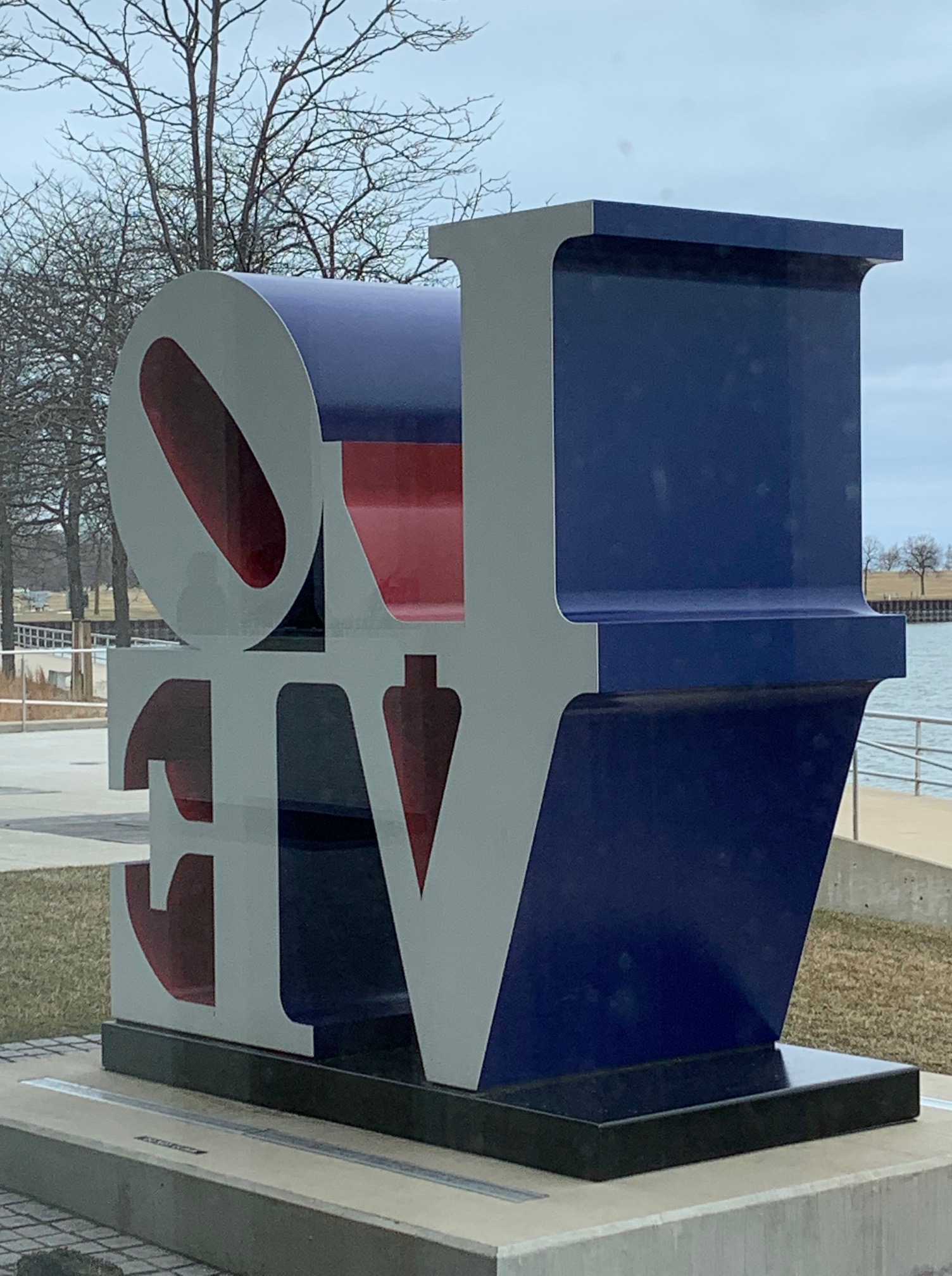
Love has a lineage. Without Piet Mondrian there would be no Ellsworth Kelly. Without Ellsworth Kelly there would be no Robert Indiana. For that matter, without Georges Seurat or Henri Matisse there would be no Piet Mondrian. Without the invention of the camera and the science of optics there would be no Georges Seurat. Of course, I’m referring to Robert Indiana’s sculpture, Love. We are rarely aware of how many lives influence our thoughts and give shape to our passing moments.

Love, the non-sculpted variety, follows the same principle in every life. It has a lineage. Chose any moment – any emotion – and follow the thread. An amazing web of interconnectivity emerges that stretches beyond…beyond. Sometimes I stop on a trail and wonder how I came to be walking through the woods in Wisconsin holding this woman’s hand. A tumble of choices. An immensity of influences and circumstances that quickly become impossible to comprehend. It’s no wonder destiny is such an attractive notion! Phew!

Four simple letters. Stacked symbols designed into another symbol. An aspiration? A graphic design? History placed Love in the box called Pop Art, thereby giving it a location-in-time. A starting point. A relative nod to lineage.

Standing in the museum, gazing out the window at Love, Dale Chihuly’s color explosion to my right, Kerri taking a photograph of the sculpture over the shoulder of a biker seated at a cafe table, the guard lost in his thoughts, a school tour echoing in the next gallery, a mural behind me that I’ve not yet taken in though it’s tapping me on the shoulder…meaning being made and shared and expressed all around me! How is it possible that we ever think we originate on our own? How is it possible that we ever think we walk this path alone?

read Kerri’s blogpost about LOVE

Climb The Ladder [on Merely A Thought Monday]

Very few images are as potent as Tom Mck’s story of finding his 90 year old aunt Bunty on the roof of the farmhouse. There had been a storm. She’d hooked her cane on a rung and climbed the rickety ladder to make sure the shingles were intact, “Papa put a fine roof on this house,” she said, staring down at her alarmed nephew. Bunty was a farm woman. She saw no reason why she should not be on the roof. As the elder of the family, she was the keeper of the legacy. The house and ranch were the tangible creations of her ancestors and she was the steward.

Years later, when Bunty was gone and Tom was the ancestral steward, his task was untenable. The city was spreading like a fire, gobbling up farm land. He knew it was only a matter of time before the ranch was consumed. A Walmart was being built and he could almost see it from the porch. “What am I going to do?” he asked, knowing that he was the end of the line. His question was rhetorical. Sometimes the steward’s job is to close the door on an era. He knew what he had to do.

After Tom passed and the ranch was sold, I imagined him, like Bunty, standing on the roof of the farmhouse. He made sure that, as the land was lost, the legacy remained intact. He was strong, like Bunty. His ladder was rickety but he climbed it none-the-less. He made sure the shingles were intact. He met his task without self-pity.

I learned from him that life can forge you into strong metal or, if you choose, if you feel sorry for yourself, it can break you into tiny pieces. Jonathan told me that a tree must split its bark to grow and I understood that as a metaphor for aging. The bark splits because the spirit outgrows the body’s capacity to contain it. Beaky was like that. And, Dorothy. Mike. Grandma Sue. H. I admire them. Bodies break down. Aging hurts. Spirits, on the other hand, need not wither.

I’m told that, in her elderhood, Margaret stopped what she was doing each day to go out back and watch the sun set over the desert. She was made hardy by a hard life. She was made kind by how she chose to live within her hard life. Drying her hands, stepping out on the back porch, the sky electric with peach and pink, she met each sunset with gratitude. Intentional thankfulness for the day.

Gratitude is not a soft thing. It is an attribute of the strong. Hard won from a long life of choices. Bitterness is easy, a lazy thing. Climbing the ladder, standing on the roof, feeling the aches and the loses, facing the running sands with a smile and admiring the day’s end, celebrating the shingles that held fast through the storm and those who placed them, that takes grit. Courage. And, an understanding of the connected power and responsibility of standing in the long line of ancestry.

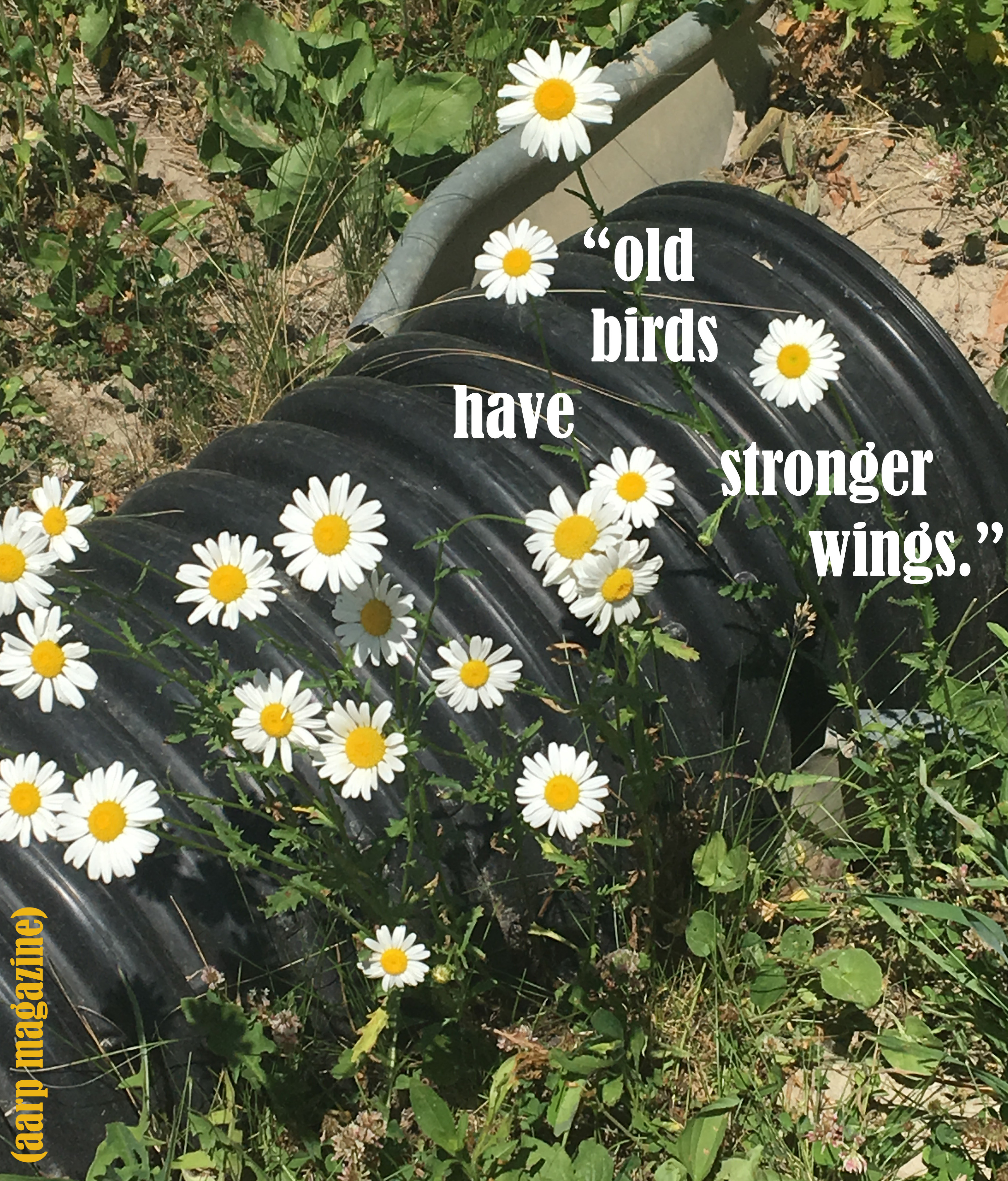
read Kerri’s blog post about STRONG WINGS