Fill Your Paintbox [David’s blog on DR Thursday]

I know a bank where the wild thyme blows,
Where oxlips and the nodding violet grows,
Quite over-canopied with luscious woodbine,
With sweet musk-roses and with eglantine:
There sleeps Titania sometime of the night…

[A Midsummer NIght’s Dream by William Shakespeare. Act 2, scene 1]

I played Oberon for the Walden Theatre Company at the Kentucky Center for the Performing Arts when I was way too young to play the role. I said the words and, although I did my research, I only had an abstract grasp of wild thyme and luscious woodbine. I had no depth of understanding of relationship and the mischief it invokes.

Now, those things are visceral. I know them to my core.

Luscious woodbine climbs and covers the fence beside our driveway. The leaves turn to fire in the fall, and when they drop, they reveal the blue berries, toxic to humans but delicious to birds. In a few days, the berries disappear. Woodbine symbolizes the bond of love since it entwines and embraces trees and other plants. And fences. The locals call it Virginia Creeper.

I was witness to the great actor, Jim Edmondson, play Lear for the first time. He was astonishing. After the performance, he said, “I don’t have enough colors in my paint box yet to play this role.” I sometimes wonder, as he aged, if he found the colors he felt he lacked. The intimate depth of understanding of growing old, of losing power, of being shelved. Loss upon loss. Leaves turn to fire and fall. All that remains is the vine.

I’m growing to understand the paradox of life: none of us has enough colors in our paint box when we are young and moving through the complexity. The colors are cumulative. How many times have I said, “Man, if I only knew then what I know now.”

“I know a bank where the wild thyme blows…” Yes. I do. At last.

read Kerri’s blogpost about WOODBINE

like. share. comment. support. smell the sweet musk-roses. we do.

buymeacoffee is a place where nodding violets grow and artists find a way to live another day.

Reach Through The Trees [on DR Thursday]

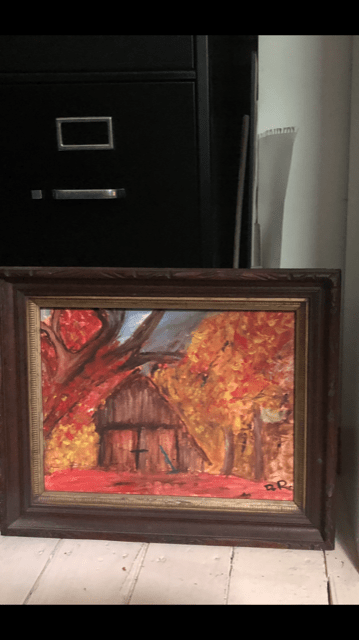
When my time on the planet could be counted in single digits, I drew the same picture over and over and over again. A cabin in the forest. A tree in the foreground. Among my first oil paintings was the cabin-in-my-mind.

For years, my cabin hung on my grandfather’s wall. When we traveled to Iowa for a visit, I was pleased to see it nested in a modest frame in his home office. It may be my first painting to make an appearance beyond the walls of my boyhood home. When he passed, my parents claimed the painting and it circled back to their house, where I painted it.

Last year, with my dad in assisted living, while moving my mom into her new apartment, I brought the painting back with me to Wisconsin. Full circle. We put it in a new frame. It rests in my office, sitting on the floor against the file cabinet because we can’t decide where we want to hang it. Each day, standing at my desk, I am, for a moment, pulled back in time to the boy who had to draw this cabin again and again.

Why? I certainly didn’t feel as if I was inventing it as a drawing exercise. From this vantage point I remember it as a recall, the invocation of a memory. My child-brain never questioned it. My cabin, as if I lived in a world before photographs and was trying to record what once was, trying to reach through the trees to what could no longer be touched. I had to draw it so I might remember it.

Now, with hundreds of paintings between me and my cabin in the woods, I wonder if every painting I’ve ever painted comes from the same impulse, reaching through the trees to what cannot be touched. Canvas on the easel has always pulled me into it, like a good story pulls a reader into a book.

It’s also a great definition of art and artistry. Just try and wrap your fingers around King Lear or grasp the deep well of Martha Graham. Kerri’s piano bounces when she plays it; she is little and her piano is grand. The force that comes through is beyond comprehension.

I laughed when my doctor told me that we rationalize things because we want to control them and, sometimes there is no rational explanation. No way to control it. Art regularly blows through the question “Why?”.

read Kerri’s blogpost about REACHING THROUGH THE TREES

Look Out [on Two Artists Tuesday]

bcat in the window romper room copy

I was one of those teachers who encouraged my students to stare out of the window. Visiting administrators occasionally admonished me for allowing my students to “daydream.” Imagination, I would explain, requires much more expanse than a classroom can provide. Looking out the window let the imagination-horses run free.  At graduation, I would remind the administrator, they would almost certainly endorse the graduates to follow their dreams so facilitating the pursuit of dreaming was, perhaps, the most useful skill they may ever acquire. Besides, keeping noses perpetually focused on the grindstone can be a great dream killer.

Mike wrote that Shakespeare penned King Lear while in quarantine for the Black Plague. “Any takers?” he challenged. What do you do when you can’t really go out and play? My bet is that good William stared out of his window between ink dips and parchment scratching. I’m finding, as we move deeper into our home stay, that I am repelled by electronic things that fill my time. Things that pull my focus down and in. I find that I want to stare out of the window. I want to go out and walk.

There are plays I want to write. There are paintings I want to paint. There are the necessities of life banging at my door (where will the next work come from?) Uncertainty surrounds us. I know there is no point in fretting; fretting and worry are inverse forms of imagination. Hornets buzzing inside the head because they haven’t enough space to become horses and run free. The best thing to do when your head is full of hornets? Find a good window and dream.


read Kerri’s blog post about THE MAGIC MIRROR


rhode island website box copy