The Real Promise [David’s blog on Not So Flawed Wednesday]

“Too many of us still believe our differences define us.” ~ John Lewis

I confess, it has been a life-long fascination. Seriously, since I was a little kid, I’ve been amused, confused, and periodically gobsmacked by the swirling contradiction of identity-messaging in these un-United States.

Because we are the single most individualistic culture on the planet, we place high importance on being unique. We are encouraged to stand out. And yet, the first lesson I learned in school was how to stand quietly in line. We buy clothes that are meant to express our own distinct style while hyper-market-pressured to fit our image to the latest trend.

I spent years and years working with people who spent thousands of dollars outfitting home art studios so that they might express their own unique artistry…and then froze in their newly built temple, so fearful of what others might think of their creation. How many times have I heard someone, dressed smartly in their latest Ralph Lauren, tell me that they were looking for their voice?

It’s untenable. It’s no wonder we are perpetually self-discombobulated. The dreadful shadow of our national commitment to bewilderment is the game drawn along the color line that we’ve played since our nation’s inception: If they gain, we lose. If we gain, they lose.

We-the-people wrestle by placing the accent on the hard line of our differences. We wrestle with reaching across the hard line of difference to find our common ground: most recently our reaching has been known as DEI. Diversity. Equity. Inclusion. We strive to be one in our campaign to be individual.

If there is one universal truth I learned in my life as an artist, in my work with people struggling to find their novelty and power, it is this: unique voice is found in service to others. Unique expression is available when the self-serving ego gets out of the way. It’s a paradox.

Personal voice is meaningless unless it helps other people. To guide. To question. To recognize. To join. Actors perform to unite us in a shared story. Poets write to open us to universal truths. Musicians play to bring us together in a common experience. The real power, the promise available in these United States is no different than the promise bubbling inside each individual. Rare and special voice is found in service to the common good.

Artistry and governance share this trait: grace and power is always found in uniting and is invariably lost in dividing. We may someday realize the great promise in these United States if/when we at long last lay down the tired game of manufactured division and find our true, unique and powerful voice by uplifting all unique, diverse, and beautiful voices, a chorus in service to a common center called democracy.

read Kerri’s blogpost about THE BLACK SHEEP
likesharesupportcommentsubscribethankyou

Trouble Maker [David’s blog on Merely A Thought Monday]

“The truly creative mind in any field is no more than this: A human creature born abnormally, inhumanly sensitive.” ~ Pearl S. Buck

“What did you take a picture of?” he said enthusiastically, crossing our path on the trail!

“The cattails,” she answered, showing the stranger her photograph. “They’re glowing!”

“Ah! You’re seeing! Most people walk these trails to get through them. Very few people are curious enough to learn. It’s only when you see that you can learn. It’s only when you learn that you can see!”

His name was George. I couldn’t place his accent. We guessed his age to be near 80 though he was more spry and alive than people half his age. Pulling up his AllTrails app, he shared stories of the local trails that he’d walked. “This one is gorgeous!” he exclaimed.

As we parted he turned and shouted, “Remember, you’ll never get in trouble if you are learning! Only ignorance will get you into trouble!”

And odd parting sentiment. An apt parting sentiment for our times. I wondered if we just had a happy visitation from a wizard. A forest sprite. A wise hermit.

For the rest of our walk I thought about his parting sentiment. Trouble. John Lewis said, “Get in good trouble.” There is a kind of trouble that only comes when you see – when you learn. Artists and academics, seekers of truth, are problematic for authoritarians and bullies. Seeing – truth – learning – is problematic for purveyors of lies and promoters of ignorance. John Lewis got into plenty of good trouble in his life and our lives are better for it.

Kerri and I both have been branded “troublemakers” at various points in our lives. We are too sensitive, some have said,”… too sensitive for our own good.” We have artist natures. As premises go, George’s parting comment is accurate: ignorance always leads to a whole bunch of trouble. Ignorance is loud and, these days, wears a red hat.

It is equally as accurate that learning, calling out ignorance, speaking quiet truth, brings its own brand of trouble. Good trouble. The kind of trouble that actually makes people’s lives better.

read Kerri’s blogpost about TROUBLEMAKER

like. share. comment. support. many thanks.

Look With Honest Eyes [on Not So Flawed Wednesday]

We were sharing pandemic survival stories, the worlds that we explored in our isolation that we otherwise might never have entered. We told Keith of Joey Coconato and how his back country backpacking trips were a nightly fascination. I’m particularly drawn to his hikes through the canyon lands. Keith became animated, saying, “You have to check out the Millennial Farmer!”

I know nothing about farming. Once, sitting on the back porch of a farmhouse Air-B-N-B in Iowa with my dad, I listened intently to his stories from childhood working on the various farms in the community. Had he been able to script his life differently, I think he might have written a farmer’s story. He loved the outdoors. He loved growing things. He always kept a garden and tended flowers. He knew what he was doing! Somehow, I gleaned nothing from his green-thumb-knowledge. I am a plant killer.

In the first short installment of The Millennial Farmer, Zach Johnson tells his audience that he’s making his videos because people know so little about farming and what farmers actually do. He’s a fifth generation farmer in Minnesota. I was, as he predicted, completely gobsmacked watching The First Day Of Planting 2016. I pushed play expecting dirt clods and the rumpled pages of the Farmer’s Almanac and, instead, entered the space age. His tractor was akin to the deck of the Starship Enterprise. His nuanced explanation of the monitors in his cab was enlightening. He’s driving a computer (actually, it mostly drives itself).

My stereotype was completely shattered. I had no idea. And, isn’t that the point of taking a peek into the lives of others? Recognizing that we have no idea about the realities of others lives? Isn’t that the opportunity?

This morning I pondered aloud about how we’ve changed in the months since COVID began. “I don’t know anyone who hasn’t changed.” One of the most profoundly sad awakenings for me during this time of division and dedicated ignorance is how resistant we are – and I believe always have been – of taking a peek into the lives of others in our nation. We simply don’t want to know, so great is the fear of what we will find there.

John Lewis famously said, “We are one people, we are one family, we are one house. And we must keep this house together.” By “keep” he meant to tend. We might become one family when we are willing and able to look with honest eyes into the lives of those who share this house. Our stereotypes, our almanac ideas, keep us fragmented.

Joey and Zach. Both live lives immersed in nature but from diametrically opposed intentions. Both have popped open my eyes to new experiences and bodies of wisdom that I might otherwise never have encountered. Both are following their personal star and sharing what they find on their paths.

As part of our summer planting and backyard oasis, we bought two tomato plants and some basil. Our Boomer farm is not extensive but it is well loved. “Do you think, if we tagged The Millennial Farmer, our tomatoes would stand a better chance?” I asked.

Kerri considered it for a moment, her hands busily potting the basil plants. “It couldn’t hurt.”

read Kerri’s blog post about BOOMER FARMERS

See And Speak [on Not So Flawed Wednesday]

there comes a time when silence copy

We were sitting on a concrete wall, taking a break, when he asked the question. I’ve been asked this very question more times than I care to count and I did what I always do: I took a breath. When you facilitate conversations on diversity and culture change, this question is always lurking somewhere in the room, waiting for a break, a side conversation, so it can be given voice without ramification. Truth often steps forward at the water cooler. It was the question that illuminated for me the real problem with race in America and the mountain we need to move. “Don’t you think black people cause their own problems?” he suggested.

Breathe.

No. I don’t. I believe privilege is blind to itself. And, isn’t this the very conversation we need to have happen in the middle of the room and not at the margins? The mark of institutional racism is that it is utterly invisible to the privileged class.

In the United States we hear a lot these days about tribes and information bubbles as if they were a new phenomenon.  They are not new. Our bubbles, like all bubbled history, is meant to cleanse the narrative to justify the indefensible, to hide the ugly behind a noble mask. Here’s a phrase from our history: The ruling class responded [to Bacon’s Rebellion] by hardening the racial caste of slavery in an attempt to divide the two races from subsequent united uprisings with the passage of The Virginia Slave Codes of 1705.

If you are white in America this might not yet have pierced your bubble. Note these phrases relative to the history you learned in school. It might help to understand the system at play in our current historical attempt to change systemic racism: Ruling class. Harden the racial caste of slavery [yes, a created caste system. The system of slavery was erected and black Americans were legally defined as lesser beings]. Divide the two races [black & white]. The point of the black/white division was and is to prevent subsequent uprisings against the ruling class. Ruling class.  The division we wrestle with was intentional, crafted for a specific purpose, and systematized. It serves the same institutional purpose to this day.

Another tidbit worth gnawing on: According to the Oxford English Dictionary, the first appearance in print of the adjective white in reference to “a white man, a person of a race distinguished by a light complexion” was in 1671. Colonial charters and other official documents written in the 1600s and early 1700s rarely refer to European colonists as white.

If we are learning anything in these days of fox propaganda and pandemic tales it is the power of people to entrench in their narrative despite data, fact, and personal experience that disputes the narrative. Systematize a narrative and it is nearly impossible to challenge. No see, no hear, no speak. Systems, as I learned in school, are living things – not mechanical – and will fight to the death to keep themselves alive. We are currently watching the fight of a systemic challenge.

The question at the water cooler, “Don’t you think black people create their own problems?” was always asked in earnest. It revealed the successful hardening of racial caste, the power of the mechanism preventing the uniting of the races so as to ensure no possible subsequent uprisings. Us. Them. Bubbles. A vicious cycle.

It’s hard to see a mountain when you are sitting on it. We The People. Ruling class. These two phrases are incompatible but co-exist through the successful creation of division. It’s black and white.

We have a long history and have worked very hard not to see what is right before our eyes. The second rule of systems change: if you know where you are going then it is not change but repetition. Rearranging the deck chairs on the Titanic.

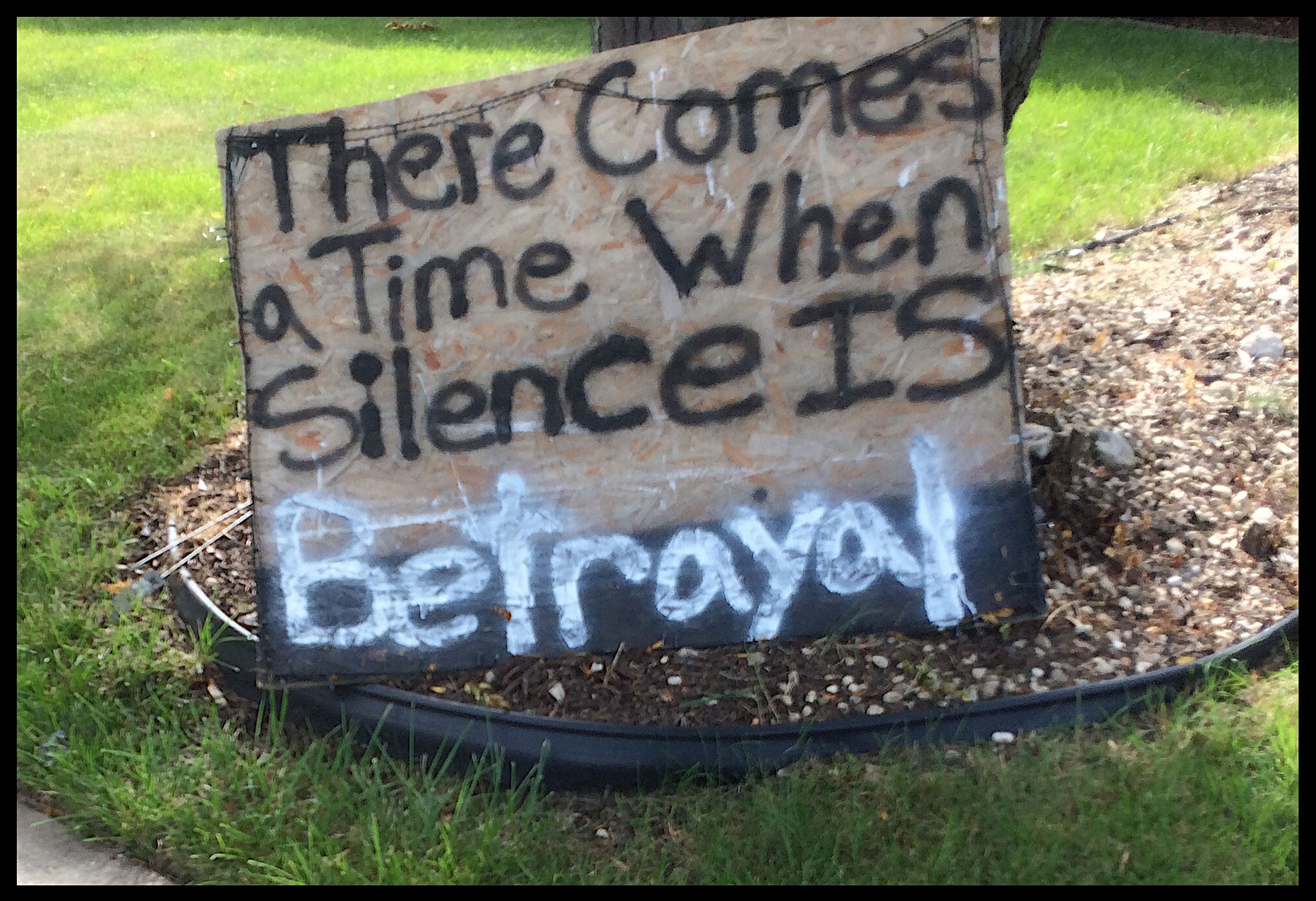
The opportunity for change is, once again, upon us. The conversation needs to move to the center of the communal square and we need to muster the courage to step into unknown territory. Silence and denial are not now nor ever have been valid excuses for perpetuating an ugly system. We betray ourselves.

“When you see something that is not right, not fair, not just, you have to speak up. You have to say something. You have to do something.” ~ John Lewis


read Kerri’s blog post about SILENCE


sunrisewebsite copy