Move Your Words

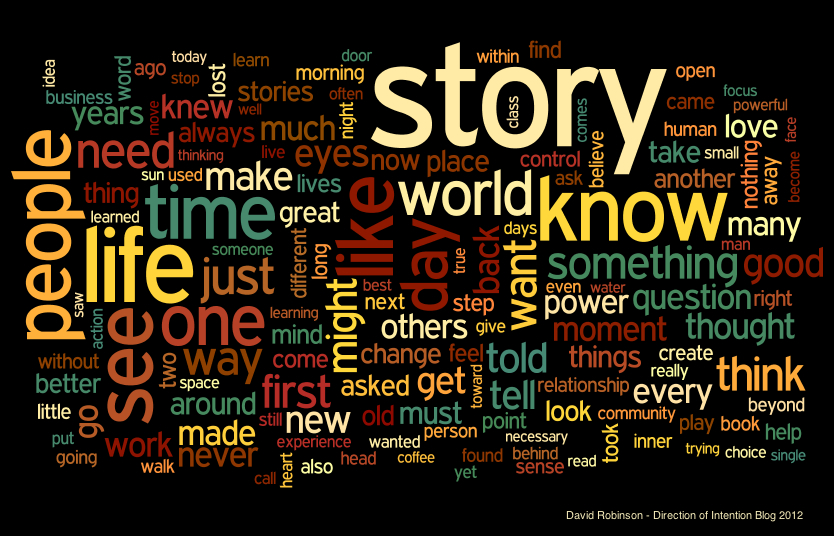
My friend, Mark, made this Wordle of my blog

My friend, Mark, made this Wordle of my blog

I am working with words again today but in another aspect entirely. Now that The Lost Boy has the minimum funding necessary for a production I am working on the play in earnest. Tripper Dog-Dog-Dog cocks his head and wrinkles his brow in wonderment as I talk to myself or dance the words. Sometimes he confuses my work method as an invitation to play and he leaps, catching the cuff of my shirt and pulls me to the ground. “Not now!” I cry out as Dog-Dog stretches my sleeve so that it might fit a giant (a side note: Dog-Dog has altered all of my shirts – he regularly mistakes my work for play. If I do not roll them, my shirt sleeves look as if I am small child wearing an adult extra-large).

I am a kinesthetic learner and realized years ago that working on a script was easier and more productive if I moved or danced the words as I worked with them. To borrow a phrase from a lost friend, my years at school were “fresh hell” because sitting in a desk was painful, it hampered my learning. If I want to have an insight or gain an understanding of something, the best thing for me to do is take a walk. If I move it, I can break down a script in no time. I can memorize anything if I can physicalize the intentions. For me, language, word use, and sense-making are a physical affair.

It is a physical affair for everyone. Try to speak without breathing (an impossibility); breath is movement. Speech is physical. For a real laugh, try to communicate without gesturing. Limit your movements and you will inhibit your capacity to communicate. For more fun, Google the latest statistic about how much of our communication is really non-verbal (we primarily read body language; listening to what is being said is a distant second). The deep mastery of a storyteller is found, not in the words, but the punctuation of a moment: the turn of the head, the intake of breath, the smallest of gesture, the connection made through the eyes; the fire of imagination is fanned when the storyteller, no matter how subtle, dances the story.

Last night I was reminded again of the power of language – the real kinesthetic of it. B is disturbed by the violence and darkness she sees in the world and asked, “How do we push back on it.” I challenged her verb. When we choose our language we also choose a “metaphor path”. Language choices come with images and images are not passive. They define what we see. They define the available options. They are a root for movement. To push back is a verb of resistance. It is counter force, a choice of aggression. “Why push against what you don’t want?” I asked. “Why not put your energy, effort, and imagination into creating what you actually want?”

To push. To create. Which verb will move you?

title_pageGo here to buy hard copies (and Kindle) of my latest book: The Seer: The Mind of the Entrepreneur, Artist, Visionary, Innovator, Seeker, Learner, Leader, Creator,…You.

The PoetFor fine art prints of my paintings, go here.

Aim For The Field

An illustration from my children's book, Play To Play

An illustration from my children’s book, Play To Play

Lately, Saul the Tai Chi master has been much in my thoughts. It is now September and it has been a year since he taught me a lesson that has become the new mantra of my life: orient to your own concern. Actually, he said that I should look beyond my opponent into the field of possibilities and orient to my own concern. “In this way,” he instructed, “you will no longer have an opponent.” He used the word “opponent” loosely. Any limitation or form of internal resistance is the opponent.

Beyond the opponent is a wide-open field of possibilities.

In the intervening year I have learned that I have been both my greatest opponent and the one who can look into the field of possibilities. Isn’t this true of all people? All stories worth telling (and hearing) are ultimately tales of transcending the inner opponent. If you need help identifying your personal mythic journey simply listen to the areas in life in which you say to yourself, “I can’t.” In that place you will find your opponent. You will also be surprised to find that your inner opponent is most often an orientation to other people’s concern; the fear of what others might think is a mighty inner-monster creator.

I’ve also learned that Saul’s lesson has come to me in many forms throughout the course of my life. For instance, many years ago I directed plays and, because I am also a visual artist, I was often in the position of designing the sets as well. With great love and humor, another terrific mentor watched as I struggled with my dual role. He gently showed me that I was orienting my designs according to the budget and construction limitations I perceived. I was working in the wrong order, asking “how” before lingering in the potential.   He told me that I needed to “Live first in the possibilities.” Design/orient according to the potential and not the limitations.

To live first in the possibilities is to walk the imagination without a leash. It is to let the imagination run wild. What is beyond your capacity to imagine? What is possible beyond the boundaries of belief? At one point in my life cell phones were science fiction. Today, they are ordinary.

Look beyond the opponent. Orient to your own concern. Imagine how life might change if instead of asking, “Can we do this?” we began by asking, “What’s possible?” And then aim for the field.

title_pageGo here to buy hard copies (and Kindle) of my latest book: The Seer: The Mind of the Entrepreneur, Artist, Visionary, Innovator, Seeker, Learner, Leader, Creator,…You.

Go here for all digital forms of The Seer.

Yoga Series 7Go here for fine art prints of my paintings

Open To Belief

another from the Yoga series by David Robinson

another from the Yoga series by David Robinson

I’m having one of those days ripe with revelations and have been scrambling to capture the insight ripples before they rush down my thought river, around the bend, and out of mind.

One of the ripples has to do with the “As if….” The “As if…” is a tool for actors, self-growth seekers, and human beings in general. For an actor, to act “As if…” opens the door to belief in a character. For the seeker of self-growth, to act “As if…” opens the door to belief in his or her capacities, as if they were a character in the play of their own lives. The “As if” serves as a bridge into a possible future when belief is hard to come by.

When I was younger, a favorite “As if” mantra imparted to me by adults was, “To dress for the job I wanted, not the job I was applying for.” In other words, dress as if I already had the job I wanted. In my case it was lousy advice because donning pants and shirts spattered with paint was not the ladder climbing attire they wanted me to embrace. For me, the elders needed a different premise beneath their “As if” advice. There was no ladder in my paradigm. Dressing for any job felt like self-betrayal on my way to soul death. Of course, years later, having lost my mind, I actually put on a suit and lace-up shoes to coach my first executive client.  He laughed heartily as I writhed in my new suit. He advised me to show up as I am, not as what I thought he wanted me to be. Great advice! His quote, “You are an unmade bed and need to own it. It’s why I hired you – because you are different.” As if!

I’ve understood for years that people perform themselves. “As if” can be a kick-starter for a belief-filled performance. It is an illusion-seed that, when watered and tended, grows into the identity you wish to inhabit. In other words, perform the person you want to become and not the one you currently believe yourself to be. Invoke “As if…” and sooner or later you may start to believe in your performance. Sooner or later you may become who you imagine yourself to be.  The roles we play are not fixed identities and much more fluid than we pretend! Becoming who you imagine yourself to be is called growth and requires a wee bit of acting.

One of my favorite lessons from the theatre is that character (the role you play, like Hamlet or Juliet) is not something you pretend, it is found in how you do what you do. Characters in plays want something; how they go about getting what they want reveals who they are. So, when building a character, swim upstream.  The character will reveal itself through you (the actor) if you identify and take action: craft how he or she does what they do. Young actors have to transcend the notion that acting is pretending. It is not. Action and pretense are two different things. A musician does not pretend to play music and an actor does not pretend to play a character. An actor pursues intentions. An actor acts (thus, the moniker). Actions are the notes an actor plays. Hamlet is the consummate student. He seeks truth. He tests hypotheses. How he goes about seeking and testing determines what we see as a character.

The same might be said of you and me. A human being pursues intentions. We take actions everyday and so, perform ourselves. How we go about our pursuit reveals what we believe. When we have little belief and big, big fear, we have the option of acting “As if…” It’s a loop. “As if…” leads to belief and belief leads to “As if…” Life off the stage is just like life on the stage: it is a cycle of belief and dis-belief. “As if…” is an ongoing growth process. Imagination knows no outcome.

In a recent workshop, after remembering a favorite childhood game, a man in the workshop said, “My imagination opened me to my belief.” Yes. That’s it exactly!

Go here to get my latest book, The Seer: The Mind of the Entrepreneur, Artist, Visionary, title_pageSeeker, Learner, Leader, Creator…You.

Go here for hard copies (Amazon)

Learn To Fly

724. Join me in inspiring truly powerful people. Each day I will add a new thought, story or idea to support your quest and mine.

“I have a song in my heart and I’m not flying!” He was waving his arms up and down like a bird like all of the other children, his eyebrows knit, with a pout on his face. The other children were flying. Their eyes were closed, faces to the sky, arms riding the imaginary thermals. By the look on their faces they were flying high above the trees and soaring to the clouds.

We were having a storytelling. In our story a little girl (she’s a princess but doesn’t know it) must move from the country to the city with the kind old man and old woman she believes to be her parents. She is terribly sad because in the country she spends her days singing with the birds. In the city, she no longer sings. In the city she pines for the birds. She sits in her bedroom looking out of the window. Concerned for her, the old man and woman buy the girl a yellow bird.

The girl soon realizes that, just like her, the yellow bird never sings. She asks the bird, “Why don’t you sing?” and to her surprise, the bird answers her, “I’m not supposed to be in a cage. Why don’t you sing?” Together the little girl and the bird help each other learn to sing again. The bird finds her song when the little girl sets her free. The girl finds her song when the bird teaches her to fly with a song in her heart.

All the children in the classroom, save one, were flying like the little girl and the bird. “I have a song in my heart,” he insisted, “and I’m not flying!”

“Close your eyes!” someone suggested. “Then you’ll hear your song better. Then you’ll be flying!”

He closed his eyes, arms flapping, and a smile replaced his pout. “I can fly!” he exclaimed and swooped above the treetops and soared into the clouds. A little girl soared over to where I was sitting, perched and whispered to me, “Flying is easy with a song in your heart.”

Yes. Yes, it is.

Play For Meaning

705. Join me in inspiring truly powerful people. Each day I will add a new thought, story or idea to support your quest and mine.

Horatio took me on a whirlwind tour today. We met his art teacher, Jo, and I listened as they discussed artists like Sylvia Plath and Diane Arbus, artists whose work explores the darker shades of life. Both women killed themselves. Horatio posits that their artistry in some ways chronicled their march toward an inevitable conclusion. Like a raft caught in the current, hurtling toward a waterfall, they determined that there was nothing to be done, no greater meaning to be found, and went over the falls.

Horatio and I often stray into the topic of meaning making. What’s it all about? What is the greater purpose and meaning of this experience of life? I’ve decided that meaning is something we make and not something we find. Meaning is something we bring to the dance. However, we come to the dance with great expectations. We look for someone to dance with, we look for an experience that might lift us from the ordinary routine, we yearn for someone to notice us, we want food to eat, a future to create; we seek experiences. We want more. Life is made sweet in the yearning.

We get lost when we think someone else has what we need or that someone else can fulfill our yearning. Our job is to engage life; no one can do that for us. Our job is to bring our selves to life (I intend the double meaning of that phrase). Our job is not to fulfill another person’s need just as their job is not to fulfill ours. The meaning is in what we bring to the dance; if we bring joy there will be joy. If we bring blame there will be blame.

Tonight Horatio and Teru made a lovely dinner and had a cake for my birthday (coming soon!). Their daughter Nina and her beau Keith came along with Nina’s 4 year-old daughter, Jordan. I spent much of the evening learning from Jordan how to play Chutes and Ladders and a cupcake game. The first rule is that there are no rules. The second rule is that because there are no rules things like winning and losing are ridiculous. The only thing that mattered was that we played. She showed up and I showed up and the rest was imagination and wonder. You’ll be surprised to know that in a single evening I played the role of Santa Claus AND was placed forever on the naughty list (my name is written on the list in magenta crayon). It is an existential dilemma of massive proportion that required the creation of a third rule: naughty and nice are relative terms and who needs lists anyway? Meaning is never found in the list and always found in the play. So, as Jordan taught me tonight: play and the meaning will soon follow.

Receive

704. Join me in inspiring truly powerful people. Each day I will add a new thought, story or idea to support your quest and mine

“Your task is not to seek for love, but merely to seek and find all the barriers within yourself that you have built against it.” Rumi

In the past several weeks I have traveled many places. I’ve spent some time in the house where I grew up. I walked the streets of my boyhood and revisited the sacred sites of my childhood. The houses in the neighborhood seem so small. I’ve had the opportunity to revisit memories, to stand in spots where life seemed to bring overwhelming experiences; these, like the houses, now seem so small. I’ve chuckled more than once at monsters that I used to tote and how, from this vantage point, they seem like stuffed animals, cuddly toys. That is the power of memory, our great capacity to re-member our lives with every visit to the past.

In my walk-about I am consciously pulling down the barriers. I am surrounded by people who love me and whom I love. I am astounded by a generosity of spirit that greets me everywhere I go. I am learning to receive and the curious thing about receiving is that you need do nothing but open or perhaps surrender. The only requirement to receive love is that you show up. Who knew!

During this period of wandering I’ve been working again with the Parcival story and thinking about the moment in the story when Parcival removes his armor. Armor protects but it also restricts. Armor is a great way to not be seen. In order to want to take off your armor you must first put down your sword; you must change your idea of the world and your place in it. Carrying a sword is a great way to keep love away. After dropping your sword, you must be lost for a while and break your rules. Parcival’s sword shatters and he weeps. He removes his armor and follows a hermit into the woods. He stops seeking, stops trying to prove, suspends the fight and starts living moment to moment. And, when he’s forgotten about roles and knights and proving, the Grail castle reappears. He steps inside unprotected and claims his inheritance. He becomes the Grail. Love finds him when he stops looking for love.

Sometimes we wear our past like armor. We hang onto injustice, we identify ourselves by the trauma, and we claim our limitations as if we were born to bear them. I’m learning that these are the barriers we erect against love. To drop the armor all that is required is to let go of the past and re-member. The love, like the Grail castle, is waiting for us. As the hermit says to Parcival when he turns and discovers the castle, “Boy, it’s been there all along.”

Thank Melissa

673. Join me in inspiring truly powerful people. Each day I will add a new thought, story or idea to support your quest and mine.

Avalon disappeared into the mists of time. It is there, or so we are told, but it is out of reach to we mere mortals. In the age of reason the mystery retreated to the other side of the veil. I thought of that as this afternoon we drove through fields shrouded in fog towards a rural elementary school. We were visiting Melissa’s classroom; a place alive with magic and excitement and the vitality that is present wherever true learning is taking place. If magic survives beyond the veil then Melissa’s classroom is a portal to that sacred place.

Tom once told me, “You will know when you are doing important work by the size of the tide that rises against you.” Melissa is doing important work and is standing tall despite the towering wave that crashes over her (and every teacher in the nation) everyday when she asks, “Why are we doing this? What does this test or this shabby curriculum have to do with learning?” She asks and others turn away. She is the voice in the crowd that says, “This emperor has no clothes!” And like the child in the story, the truth-teller is shunned initially, hushed by the adults who are too afraid to say, “We know. We see it, too.”

There are plenty of teachers and administrators and parents and business leaders that see it, too. There are many conversations about fixing things. There are endless strategies and punitive measures to raise standards though no one is certain what standards we are raising (hint: test scores have nothing to do with learning; neither do lists or rankings or any other from of measurement). On the surface we are expert at finger pointing and assigning blame and still the emperor prances naked through the streets.

And beneath it all is Melissa and scores of educators like her that know the system as dictated to them is doing the opposite of what it professes. So, she wades into the muck everyday and ignites imaginations and encourages her students to explore, pursue, experiment and make messes. Her students make choices (they control themselves because she teaches them to be powerful): they are engaged in a quest of discovery. Her students are excited to come to school because what they do is real; unlike most of the adults who should be lobbying for their betterment, they are very clear and vocal about what has merit and what has little or no value.

Meet At The Edge

665. Join me in inspiring truly powerful people. Each day I will add a new thought, story or idea to support your quest and mine.

On the plane today I read a short piece on edges and it reminded me of the power of this simple reality. The place where two elements come together, the place where two currents meet, the place where two cultures intersect, the place where the clearing meets the forest, the place where the world drops off: these places either teem with life or fire the imagination. It is at the edges where we become uncomfortable. It is at the edges where we say, “I don’t know” and thus, learning becomes possible.

There are internal edges as well as external edges. I work with people all the time who tell me they’ve hit a wall, come upon a block, or run into a limit that feels like an abyss. Internal edges are just the same as external edges: they either teem with new life in the form of ideas and pursuit or they evoke discomfort and resistance. Edges are present when we say, “I’m lost,” or “I don’t know what to do,” or “I’m frozen and can’t move.” Edges are present when we shout, “That was incredible!” Edges are supposed to generate instability: movement.

You know you are at an edge when you judge: judge some one or something else and it’s a good bet that you aren’t comfortable. Judge yourself and it’s a good bet that you’ve found an edge. If, in the moment of judgment, you realize that you are at an edge and suspend your judgment, you are instantly capable of learning. If, at the moment of judging, that you invest in the judgment, you’ve shut down the learning. Judgment is merely a way of establishing a location, a false “known” so you can get away from the unknown: it is an oddity human development that it easier to call yourself or others an idiot (thus, locating yourself or them) than it is to say, “I don’t know….”

Edges are everywhere. Kichom Hayashi sends his students out in the world to find as many edges as they can. Try it. You’ll find there are edges everywhere: grass meets concrete, brick meets brick, glass meets steel, earth meets water, sky meets horizon, hand meets hand, idea meets idea: the possibilities are endless. See them and then imagine the edges define connectivity instead of separation. If you reinforce the connectivity, you will walk toward your edges every time; the discomfort will call you and fire your imagination. If you see separations, the edges will frighten you and drive you back into the comfort of judgment. It all depends on what you choose to see.

Step Into Your Food Trap

612. Join me in inspiring truly powerful people. Each day I will add a new thought, story or idea to support your quest and mine.

As teeth go, I have always been fortunate. Mine are hitchy-screw but mostly cavity free. I’ve never had root canals or bridges or caps. Only once in my life has the good doctor had to stick a needle into my gums and she was diligent in numbing my gum before using the needle. I thought, “Cool. No pain.” My dad has not been so lucky. He’s a cavity factory, a root waiting to be canaled. After every pain free visit to the dentist I think of calling my dad to tell him that I’m still skating in front of the grim tooth reaper. And, every time I pick up the phone to torture my dad with my good tooth fortune, I think, “Don’t do it! There will be dental blow back.” I return my phone to my pocket and pretend that I never had the thought.

So, you can imagine my surprise when my dentist told me that I have a food trap in my mouth. Now, it is impossible for me not to jump with both feet into that image opportunity. I saw packs of animals and varieties of vegetables roaming around in my mouth completely unaware of the pit they were about to step into; a loop of rope ready to snare their food-feet and launch them into the air, suspended until I (who else?) would come along and eat them. Having a food trap in my mouth posed a good question: Why have a food trap in your mouth? One of the primary uses of a mouth is to trap food. What is the sense of having a trap in my trap? My dentist rolled her eyes but did not answer my query.

After rolling her eyes she brought out the drill. Once again, she was diligent in numbing me before needling me and was very concerned about my comfort during trap removal. No Pain! I am, more than ever, grateful that I did not dial the phone and torture my father. Today very well could have been blow back day. I was a bit disappointed when no steel trap, cage, or hidden rope came out of my mouth. Apparently a food trap is akin to a tiger pit and all the drilling and sanding was to knock down the spikes so she could fill in the pit. She told me it was a standard procedure. It seems many of us roam around with food traps lurking in our mouths. Thank goodness I have an un-caged imagination. What would my day in the dentist chair have been if I had not let my imagination roam as freely as the packs of animals roaming in my mouth; what would I have experienced had I not made the whole thing up?

Truly Powerful People (474)

474.
Join me in inspiring truly powerful people. Each day I will add a new thought, story or idea to support your quest and mine.

When I was a kid I used to draw the same cabin nestled in the same meadow next to the same tree. I became an expert at drawing that place. It was imagined. I never saw that cabin in that meadow by that tree but I liked going there. So, I drew it again and again and again.

As I drew, I allowed my imagination to fill in details and over time my imagining became sensual and specific. It was a log cabin and the tree rings were visible at the end of each log. I counted the rings. I ran my fingers over them, weathered and cracked, they told me that the cabin was built in another time, a time before electricity and power tools. My cabin was made of some very fine old guardians! There was a particular knot in the wood next to the doorframe. I loved the way the place smelled. There was a small porch and I could stand on that porch for hours. I can still feel the texture of the wood beneath my fingers, the creak of wood beneath my feet. Often, in my mind, I ran my hand along the logs, tracing the path from corner to window, window to door.

My favorite spot (it was the point of view of the drawings) was just beyond the tree. It was the place I could sit and look across the meadow to the cabin. The tree was very old and wise and I liked sitting beneath it. I liked walking through the leaves in the fall. It must have been an oak tree though I didn’t know that when I was drawing it. I sat there for hours and imagined my life as I lived in the woods. I liked the quiet of the place. I liked the wind moving through the trees, the rustle of the grasses, the symphony of bird and insect musicians. I was a boy Thoreau.

It is a place as rich and specific as any place I’ve visited outside of my imagination (if that is possible). Earlier today I read this phrase in a story from Patricia: “art is the only thing that makes sense to me…,” and it brought me up short. As I rethink my life I am revisiting my past and that is why I visited my cabin. It’s been a long time. And as I sat on the porch, remembering, I know that for me it is also true: art is the only thing that makes sense to me; it is the only way I know to make sense of the world.