Posted on September 5, 2025 by davidrobinsoncreative
“Your pain is the breaking of the shell that encloses your understanding.” ~ Kahlil Gibran, The Prophet
Lately we’ve been walking an out-and-back that takes us south along the water. The turn around point is the Southport Beach House. It is a sacred place for us; ten years ago, on a beautiful October day, we held our wedding reception there.
Although not consciously intentional, there is something essential about our near-daily walks to the beach house. As we approach our tenth anniversary, we find that we are reaching back. In reminiscing, we make contact with our origin story. We are appreciating the distance we’ve traveled, the hardships we’ve endured, the support we’ve enjoyed, and the profound changes we’ve realized.
In our time together, life has taken a hard rock to our shell and we are better for it. We are more capable of standing in fire. Try as it might, circumstance cannot pull us from center. We know how to discern substance from nonsense. We are no longer in a hurry “to get there” and are more than content “to be where we are”.
A seagull stands watch on the light post. It’s greeted us each time we’ve take the steps down to the beach on the path circumnavigating the beach house. In symbol, a seagull represents “the spirit of exploration and boundless freedom”. I like what that bodes. I have come to expect to meet this messenger on our path and why not?
I’ve had plenty of experience focusing on the hardship and bemoaning the pain. Why not now expect to meet each day the spirit of exploration? Why not assume boundless freedom? Isn’t this the very realization that now pours forth, the understanding that was once imprisoned in the hard armor that our life-pain has opened?
Posted on November 1, 2021 by davidrobinsoncreative
The sun was setting as we drove away from the memorial service. A celebration of life. We were quiet, lost in our thoughts. “I don’t know if I’ve ever before been to a celebration of life where I LEARNED something about life,” Kerri said. I was thinking the exact same thing. I’d just received a master class on how to live a good life. I just learned about the untenable nature of love.
It was Nancy’s service. Her husband of many years spoke. Her daughters spoke. Her stepchildren sang and read poetry. She was a longtime member of the church so the pastor told stories about her. The service was alive with laughter and with tears. Both. People applauded at the end of the slideshow, a photographic journey of a life that began in 1933.
We are inundated with notions that ‘the good life” should have no pain. It should be above hardship. Nancy’s life did not support that half-narrative. She experienced canyons of loss. As her daughter said, “She could have become hardened and bitter.” But, she didn’t. She didn’t ignore her pain or deny it, she allowed it. It was part of the color of her life. She did as the Buddhists recommend: joyfully participated in the sorrows of the world. She participated. She chose. She decided. She created.
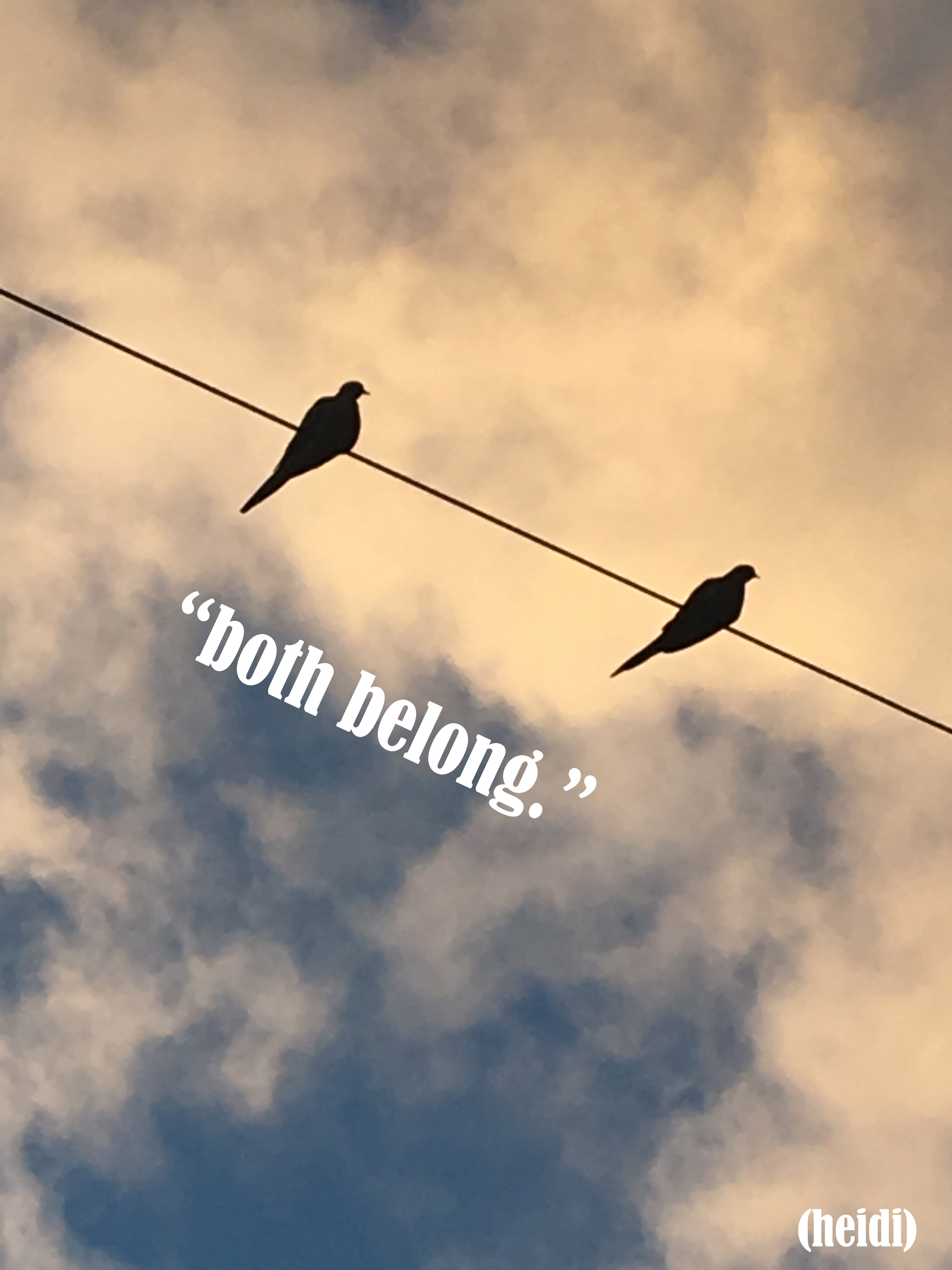
She surrounded herself with flowers and loved her garden. She made her table a magnet for family and friends. She did not sit and complain, she had no time for woe-is-me. She found opportunities to give and engage. Story after story of a woman, even in the heat of cancer, while awaiting the results of the latest scans that would determine the number of days she would have on earth, turned trips to the doctor into opportunities to shop with her daughters. Lunches. Expeditions to a beloved bakery. Create the extraordinary in the simple moment, regardless of the circumstance. We heard again and again these companion phrases, “She chose love.” The pain and the love, “Both belong,” Heidi said.
In an intentional life, one does not negate the other. Tragedy and triumph. Devastation and joy. It’s a decision. Where we focus will determine our experience of life. Nancy stood in her pain and uncertainty; she had every opportunity to become bitter. Instead, she focused on love. She created it. Nurtured it. Grew it. Offered it. She didn’t deny her pain. She held space for it in a greater container.
It was apparent in the laughter evoked in the stories told, it was apparent in the generosity of the service we experienced. This was not a Hallmark movie. It was a celebration of a life of texture, of impossible mountains to climb and of enormous blessings. It was the lesson Nancy lived because it was woven through every story told about her. “It’s what she taught me,” Heidi said, “Both belong.”
Posted on August 19, 2021 by davidrobinsoncreative
strange sky
“Can a shallow mind appreciate beauty?…When the mind is merely concerned with itself and its own activities, it is not beautiful; whatever it does, it remains ugly, limited, therefore it is incapable of knowing what beauty is.” ~Krishnamurti,Think On These Things
What accounts for the strange color of the sky? Smoke from the fires? A coming storm?
The quote above is only half of the thought. It is the set up for the real point to be made. A shallow mind is concerned only for itself. And, while consumed with the lesser, it misses the greater. It is the unintentional theme that emerged for me this week: losing the greater for the lesser. The baby goes out with the bathwater.
It is a matter of perception, of focus placement.
Yesterday I wrote about the judge questioning the potential juror about his capacity to experience hardship in order to keep the system going and growing. The juror entered the exchange with a self-focus and exited, admonished, with perhaps the possibility of seeing something beyond his own agenda. Perhaps.
I read that Rome fell when the luxuries became more important than the essentials. Societies fall when they can no longer discern between what is important and what is not, when the lesser is protected at the expense of the greater.
Years ago, during a facilitation, a young woman pulled herself from and exercise. She sat on the sidelines and brooded. After the exercise, during the debrief, she claimed that she was discriminated against because her team did not listen to her ideas. Initially, her team scrambled to apologize – one does not want to be accused of discrimination. We asked the team to explore the situation a bit further. Because the young woman’s idea was rejected, was she truly a victim of discrimination? It was an illuminating conversation. The problem – the real problem – arises when we can no longer discern between what is discrimination and what is not? There is terrible discrimination in our world and needs to be addressed. It can’t be seriously confronted if we are incapable of distinguishing between the rejection of an idea and laws that prevent citizens of color from voting.
In a pandemic, a mask is not a breach of personal freedom. It is not the state ripping away control of your body. It is a minor inconvenience to ensure the mitigation of a virus that is killing scores of fellow citizens. Despite the rhetoric otherwise, the fearmongering and tribe-building, wearing a mask is something done for the health of the whole. It is not unlike jury duty.
It is a matter of perception. Of focus placement. Self or other? Lesser or greater?
The rest of the quote: “Whereas, a mind that is not concerned with itself, that is free of ambition, a mind that is not caught up in its own desires or driven by pursuit of its own success – such a mind is not shallow, and it flowers in goodness. Do you understand? It is this inward goodness that gives beauty, even to a so-called ugly face.”
Pay attention to the verb. Beauty is given. Concern for the well-being of the other is a sentiment expressed and championed in every corner of the world, by all the figures we quote, elevate, and sometimes emulate. Martin Luther King, Ghandi, Abraham Lincoln, Mother Teresa,…it’s a very, very long list.
Communities thrive when they are capable of enduring hardship for each other, for the benefit of the whole. They also thrive when they hold boundaries and protect the rights of the individuals. Those two seemingly different actions are, in fact, one and the same.
Societies fall when shallow minds prevail, when they can no longer discern between essentials and luxuries, privileges and responsibilities. When personal comfort takes precedence over enduring ideals.
It’s a matter of perception. Of focus placement, and make no mistake, focus is easily led. Just like a package of pastrami mistaken for a strange colored sky.
Posted on August 18, 2021 by davidrobinsoncreative
It was a national campaign of the US Department of Homeland Security. If you see something, say something. The enemy is here. It is us. We pulled it from an episode of Grace & Frankie. Old folks have hair that grows in places it ought naught. Frankie plucks a hair from Grace’s chin. “How long has that been there?” Grace exclaims. “Frankie, if you see something, say something!”
Yesterday, I had a collision of experiences at the courthouse during my jury pool swim. First, I read an article in The Atlantic, by Tom Nichols, Afghanistan Is Your Fault. He wrote, “The soldiers who served overseas in those first years of major operations soon felt forgotten. ‘“America’s not at war” was a common refrain among the troops. “We’re at war. America’s at the mall.”’
He continued, “A serious people—the kind of people we once were—would have made serious choices, long before this current debacle was upon them. They would today be trying to learn something from nearly 2,500 dead service members and many more wounded. They would be grimly assessing risk and preparing both overseas and at home for the reality of a terrorist nation making its way back onto the international map.
Instead, we’re bickering about masks. We’re holding super-spreader events. We’re complaining and finger-pointing about who ruined our fall plans.”
Next, I was among the many chosen for voir dire (the jury selection process). I was in the last group selected so the odds of my serving on the jury were slim. I sat in the courtroom and watched an amazing moment unfold. The judge said something that all Americans should hear. It aligned perfectly with Tom Nichols’ thoughts. A potential juror, a young man, claimed serving on a one-day trial would create hardship. He’d miss a day of work. The judge questioned him to get more context and then sat back, considered for a moment, and said this:
“Democracy is hard work. When I was young, there were three things that we had to do: pay taxes, honor the draft if called, and serve on a jury if called. All of those things create hardship. Taxes aren’t easy. The draft changed the lives of thousands of young people. Serving on a jury interrupts life. It creates hardship. Giving of yourself to the common good means serving something greater than yourself. It is an interruption. Today, there are only two of those things because there is no draft. My point is, giving of yourself to make this gorgeous system work is not easy. It is hard work. It creates hardship to ensure that our system, the oldest democracy in the world, thrives and survives for the next generation.”
America is at the mall. Meanwhile, democracy is hard work.
For a serious people, there is a center to our commons and, keeping it alive, takes a bit of self-reflection and sacrifice. Giving of yourself to the common good means serving something greater than yourself.
Divided we fall. It is a cliche’ but could not be more relevant.
The enemy is here. It is us. Bickering about the lesser while the greater slips from our fingers. “If you see something, say something” is predicated on an assumption: we are in service to something greater than ourselves. We are on the same team with a common, shared interest.
The judge sat back in his chair after his lecture and asked the young man, “Are you less capable of handling hardship than anyone else in this room?”
“No, sir,” the young man sat back in his chair, resigned.
“Good!” the judge exclaimed. “Now, let’s get on with it.”











 The Direction of Intention