Where It Ends [David’s blog on Merely A Thought Monday]

Today is the day when hoaxsters and jokesters and pranksters abound. It’s the unofficial-official national day of the trickster.

Historically on this day it’s best to doubt everything that you are told, to check the sources of your information. To join in the joking and let off some steam with a bit of harmless mischief.

It’s much harder in this day-and-age since everyday is April fools day! The mischief is not harmless. With so many dedicated conspiracy theorists running amok, shysters selling bibles, serial liars celebrated, vapid minds taken seriously, it’s difficult to tell where the fool’s day begins and where it ends. It’s tough to know where the fools begin and where they end.

So, on this day as on all others, it’s a best practice to doubt everything that you are told [as a rule of thumb, it’s not a bad practice everyday to doubt everything that you think!], to religiously check the sources of your information and to check the sources of information promoted as religious.

Fools and tricksters are meant to make us open our eyes; to step back and take ourselves less seriously. To help us discern between the sacred and the profane. They are meant to shock the system when the system begins to believe that it’s “all that.” They are meant to help us laugh at ourselves.

Play safe out there. Have fun. It is my deepest wish that we might lighten up ever so slightly and learn to chuckle at our foibles. I know, I know…pie in the sky. First we must learn to distinguish between a foible and a strength, a truth and a lie, a joke and a virtue, an ignoramus and a learner, propaganda and news.

Until then, we are all destined to be April’s fools.

read Kerri’s blogpost about FOOLS

[Christopher Wool’s painting, Fool, at the Milwaukee Art Museum]

like. share. subscribe. support. comment. we thank you.

Turn Around And Look [on DR Thursday]

One little line gives reference to the whole. The horizon line. It is how we naturally – visually – orient in space. It is a baseline of perception. It’s the beginning of discernment.

It is a line that disappeared.

Among other things, art is a reflection of its time. In the past century, art leapt into the abstract. We are “post-modern”. Expressions of personal fantasy rule over community truth, a breaking apart of shared ideals, instant doubt of objective theories…we are mirrored in post-modern art. What is art? What is it not? There’s not a whit of agreement to be found.

General distrust is the beating heart of the post-modern ideal. Division, aggression, tribalism, conspiracy…are its blossoms. Our children perform active-shooter-drills in school; a performance we shudder to attend while our leaders smile and look the other way. Post-modernism at its finest. The absence of a baseline.

Shared truth, group trust, community…requires an undeniable horizon line.

What is up? What is down? What has value? What does not? What has merit? What is undeserving? There is a line. Where is it?

Walking through the antique mall, Brad and I discussed chatGPT. I’m playing with it; he’s using it in his work. It’s raising some very big questions. The questions are not new. They are the next step in a series of questions people have been asking for the past 30 years: what is true? A photograph was once proof that something happened. That hasn’t been true for a few decades. A video was once proof an experience occurred. That is no longer true. News – a word that once implied the accurate reporting of an event. No more. No horizon line.

Brad and I turned our discussion to a sorely missing quality in our times: discernment. In the absence of a horizon line, people will – and do – believe anything. We speculated that, with the introduction of chatGPT into our world, perhaps discernment will once again become important. Perhaps the complete absence of a truth-anchor will turn us toward a common center and require us to look at each other, to seek and restore general trust. The post-modern tide will someday turn and we will draw an old/new line in the sand: we’re-all-in-this-together.

I know, I know. Pie-in-the-sky. However, I’d like to point out that shared dreaming brought us here. Shared dreaming is how we stood on the moon. It is how we can talk to someone across the planet using a small device that fits in our pockets. When a dream becomes shared it becomes powerful. Manifest. A shared dream is a form of a horizon line.

If a shared dream isn’t powerful enough to establish trust, try remembering the other one; the original line of discernment. The line that invites curiosity. It need not be debated. Turn around and look. The horizon line is everywhere.

Four-by-Four, 48x48IN, acrylic, (sold)

read Kerri’s blogpost about THE HORIZON

4×4 © 2007 david robinson

Put It In Context [on Two Artists Tuesday]

THIS from the ferry copy

Context (noun): the circumstances that form the setting for an event, statement, idea, and in terms of which it can be fully understood and assessed.

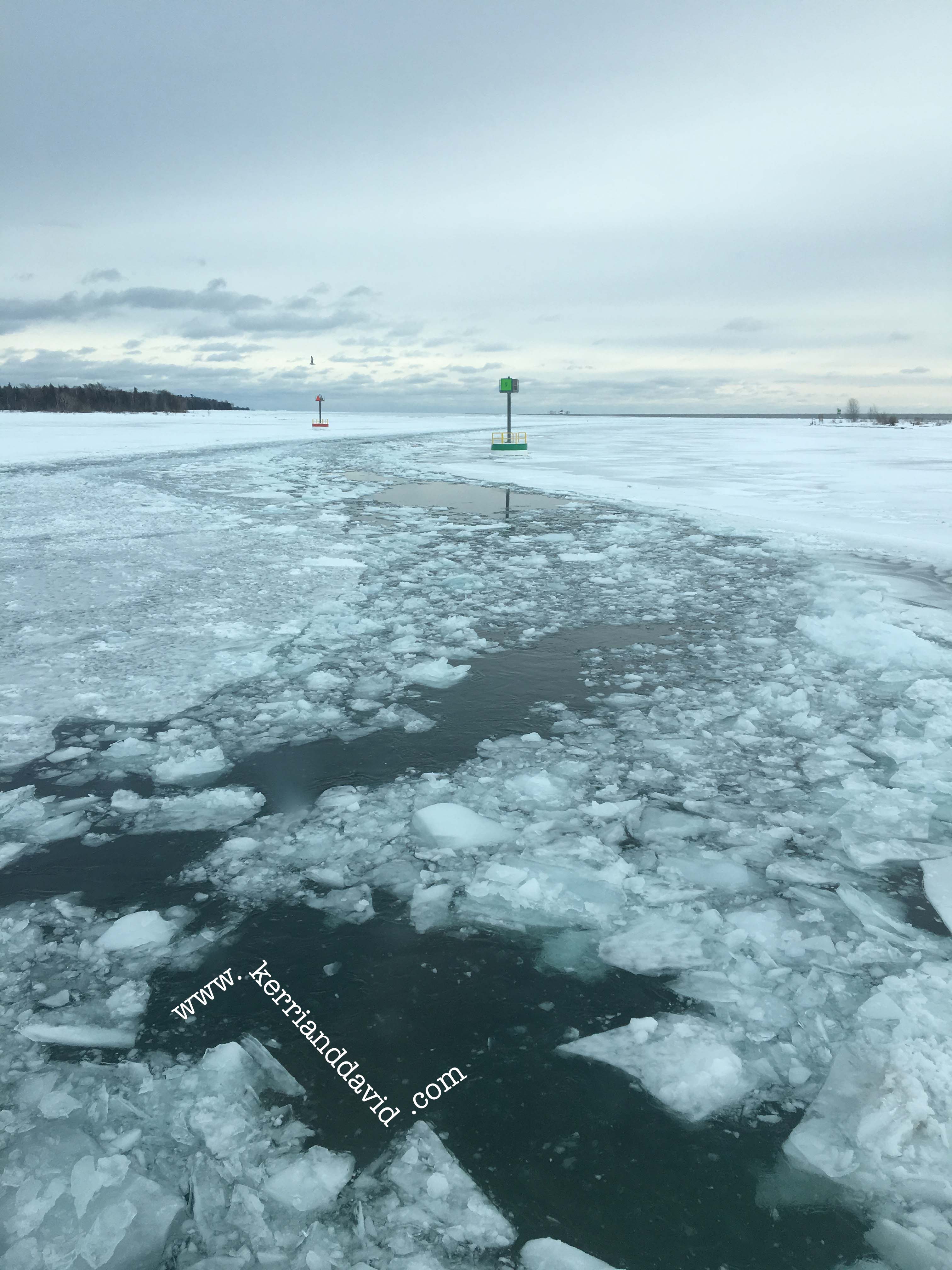
I love this photograph. It could be of the salt flats. It could be desert landscape. It could be the arctic snows. Absent of context, how can we know?

The headstone of the 21st century will read ‘Taken out of context.’ I was a teacher when the internet first washed over the land and the question on every educator’s desk was this: how do we teach students to discern what information is valid and what is not? Education is, at least partially, the pursuit and discernment of what is true and what is not.

Discernment (noun): the ability to judge well.

In a world in which any one can post anything about any topic in service to any agenda, void of context and with an astounding expectation of 280 characters or less, how do we judge well? No attention span available. No context necessary. Discernment is out of reach. As W.B. Yeats wrote, “The center cannot hold.” 

“The best lack all conviction, while the worst are full of passionate intensity.”  (Yeats, The Second Coming)

Context avoidance and manipulation is not unique to the 21st century. It’s been around since the invention of preachers and politicians. We simply have the tools to amplify it and glut ourselves on the fat that remains.

‘Taken out of context’ comes with a cold surgical sister phrase: after the fact. They knew after the fact. He was an accessory after the fact. It was only after the fact that they saw what was there all along.

fact (noun): a thing that is known or proved to be true.

How do you know or prove something to be true? It is the same question educators faced so long ago: how do we discern what information is valid and what is not? Well, begin by slowing down enough, care enough to place the thought, idea, opinion, data, in its full context. Conviction, ideals, truths…all of these lofty words, have meaning and value, become grounded, solid, and meaning-full – in the presence of context.

(The photograph was taken from a ferry cutting through the surface ice at Death’s Door).

lake ice copy

pull the camera down and this is what you see


read Kerri’s blog post on ICE LANDSCAPE


zigzag through ice website box copy