

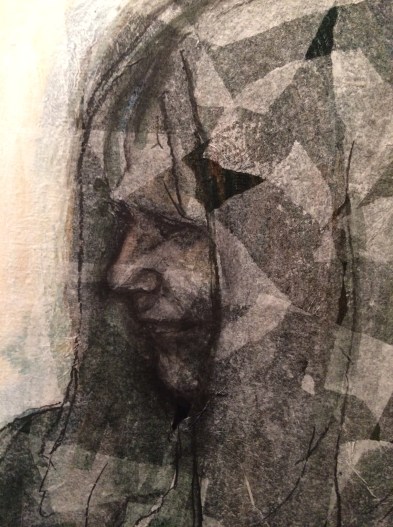
a close up of One Chord Ahead (a work in progress)
I started my artist life by drawing people. I was never really interested in landscapes or still life drawing. I was interested in the eyes. As a boy I copied photographs from National Geographic magazine and repeatedly sketched The Colonel from the side of the bucket of chicken.
I understood early on that the surface image was not what I was after, I was on the hunt for what was “beneath.” My dedication to the invisible made me a not-very-good portrait painter though I managed to do more than my share. They were technical exercises and for a while served a purpose.
It’s been over a century since the development of the photograph relieved artists from the necessity of capturing the visible. Optics to Impressionism to Expressionism to all the Neo-phases to pulling it into Cubes and Surrealism and Abstract Expressionism to just plain abstraction and conceptual-what-the-heck-does-it-mean-ism?
It’s an odd admission for a visual artist to declare a dedication to the invisible. Ellsworth Kelly caught the invisible in his Austin. John Singer Sargent captured it in his Lady Agnew. You know when an artist reaches the invisible when the painting/architecture stops you in your tracks. They make you catch your breath. More than once in my life I’ve stood in front of paintings and cried. The artist reached through the veil and touched the “beneath.” Picasso regularly kills me. I’ve spent hours staring at Richard Diebenkorn’s Ocean Park series.
At this late date I know that I will not shake the halls of history with my paintings, I am innovating nothing and now working for no other reason than I have to. I need to. There is no other reason. There is no better reason.
A few weeks ago Kerri was leading a rehearsal through Zoom. I caught my breath watching her and thought it might be time to attempt another portrait. Fun. Nothing formal.
Sometimes the circle comes around to shake a complacency or reconnect to the root. I feel as if I’m waking up some long-still muscle memory. I had to do a few drafts to remember how not-to-control. I’m learning in this latest iteration of One Chord Ahead that I’m more and more interested in reducing all things to a simplicity, to use the fewest lines to say the most. It’s the imperative of the pursuit of what’s beneath. A lesson, I recognize, that I learn again and again and again…
read Kerri’s blog post about ONE CHORD AHEAD
Kerri remains in Facebook lock up. When you click over to read her post please consider subscribing to her blog.
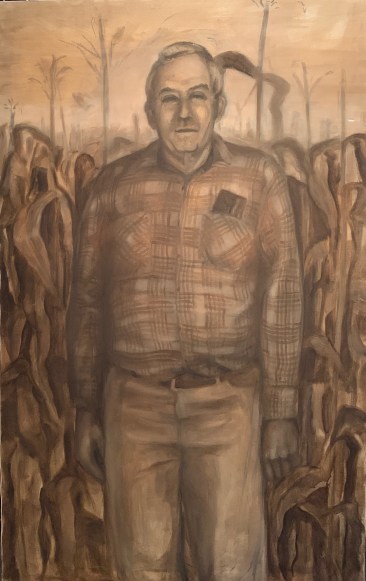
columbus (my dad), circa 1995 or 1996
one chord ahead (work in progress) ©️ 2020 david robinson
Filed under: Art, Creativity, DR Thursday, Navel Gazing, Uncategorized | Tagged: art, art making, artistry, Austin, david robinson, davidrobinsoncreative.com, Diebenkorn, ellsworth kelly, john singer sargent, Kerri Sherwood, kerri sherwood itunes, kerrianddavid.com, kerrisherwood.com, Ocean Park, painting, Picasso, portraits | Leave a comment »





 The Direction of Intention