Bang On Stuff

from Lucy & The Waterfox by David Robinson

from Lucy & The Waterfox by David Robinson

John said, “The real challenge is how to help people across the ‘I can’t’ line.” What a great phrase! I imagined myself drawing a line in the sand while my imaginary inner-voice shouted, “Don’t step over this line!”

“Everyone has an “I can’t” line.” John added, “The challenge is never the external stuff. It’s the stuff in our heads that stop us.” Too true!

John is a terrific drummer and extraordinary teacher. He told me that many people come to the drums from the place of, “I can’t” and his job is to hold their hand as they cross the threshold. “Of course they can,” he said, “they just need to know it.”

“How do you do it?” I asked. “How do you help them know it?”

“I have them bang on stuff and I bang on stuff with them.” He smiled.

In other words, gets them to experiment and play. When experimenting, there is no line between can or can’t. It’s a unified space called, “Let’s see!” In play, there is no need for achievement or expertise; there is only play. Bang on stuff and see what happens: it is a great definition for artistry. It is beginner’s mind.

In Austin Kleon’s latest book, Show Your Work, he suggests that we be intentional amateurs. He writes, “Amateurs are not afraid to make mistakes or look ridiculous in public. They’re in love, so they don’t hesitate to do work that others think of as silly or just plain stupid.”

If you desire to step across the “I can’t” line, embrace your inner amateur. Work for the love of your work and not the need to impress or “do it right.” Bang on stuff. Make messes. As Skip says, “Put a stake in the ground and then test it.” Pull on the chain. Walk through the door. Ask questions. Try a new technique. Invent a new technique.

In a bizarre and beautiful chapter in my life I was given a full ride scholarship for a masters degree in costuming. I’d never touched a sewing machine and was a danger to myself and others when trying to cut things with adult scissors. “Why not!” I said to myself and I went for a year. After turning in my first assignment in costume construction, the professor hugged my muslin mess to her breast and laughed, saying, “In the history of garments there have only been 7 possibilities (shirt, pants, skirt, etc.) and you have just created the 8th!” I didn’t know what I could or could not do so I did anything. It was fun. I had no “I can’t line.

John reminded me that the world’s first drum was (and is) a heart. “Everyone’s a drummer,” he said. “The day you can’t drum is the day you are dead.”

Go here to get my latest book, The Seer: The Mind of the Entrepreneur, Artist, Visionary, title_pageSeeker, Learner, Leader, Creator…You.

Go here for hard copies.


Embrace The Paradox

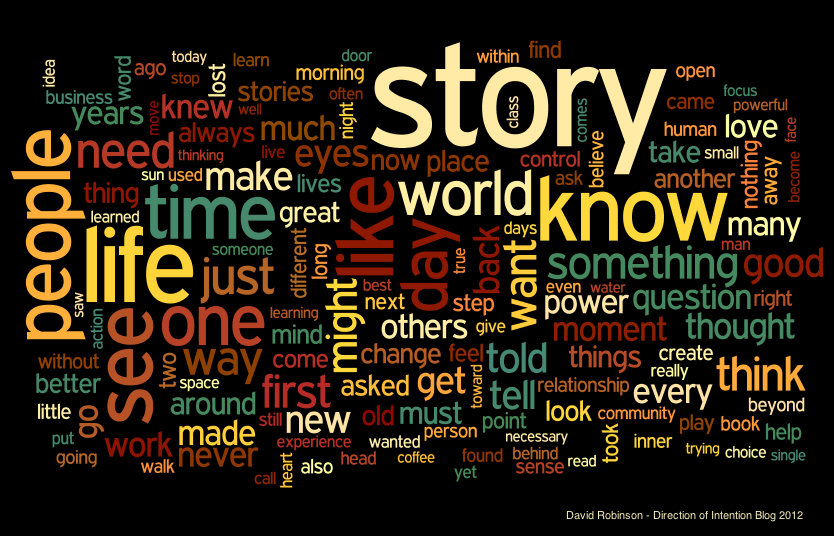
Mark Seely's gift to me: A Wordle of my blog

Mark Seely’s gift to me: A Wordle of my blog!

This is a landmark post: number 1000. When I started blogging I told Horatio that I feared I only had enough thought for 10 posts. He said, “If you can write 10, you can write 1000.” I wrinkled my brow in disbelief but it turns out that Horatio was right. With every step comes a new perspective. Kerri has a phrase I love: take down one tree at a time. In other words, if you can’t see where you are going, take the step that you can see; many single steps translate into miles of walking just as one post at a time can become 3 years of small thought-shares all in a row. What is a lifetime but a long series of days?

I’m writing this from a dining room table. All around me, covering the walls, are long strips of newsprint with a gathering storm of many colored post-it notes. The notes contain phrases, actions, like “Burn Your Trash,” or “Both Feet In, “ or “ Leave the Yuck Behind,” or, as you’ve already guessed, “Take Down One Tree At A Time.” They are story prompts. They are insight and idea prompts. Each prompt is associated with one of Kerri’s music compositions (she has 15 albums to date, with material enough for 3 more). They are building blocks for concert/storytelling evenings or keynote speech/performances. From the more than 60 post-it note prompts (and growing) we can combine any 9 to configure an audience-specific performance. The possibilities are endless. The viable themes are both unique and universal. Our umbrella title is Back To Center. We have a series of workshops to compliment the performances. The workshops illuminate the extraordinary moments and liberate the boundless capabilities of we mortals, we ordinary human beings. The big box is appropriately a prompt: Be A Ray!

Kerri and I are bringing our work together in a new form: Be A Ray!

Kerri and I are bringing our work together in a new form: Be A Ray!

As it turns out, I am a man of my time after all. The notion of a series of discreet component thoughts assembled to create a universal conception is taking over all of my processes – writing, painting, coaching, facilitating. It is the “many small steps making one large journey” philosophy of creation. It has taken over our world. It is contemporary: note the thought behind an App store or an Army of One. It is natural; cells do it. In the blog world it goes by the name of a “plug-in.” Build your own burger: design your car from the available components. It is the illusion of individuality in the midst of a constraint of choices. There is no arrival, just continuing process of expansive and interchanging capability. It is the Kahn Academy. Work at the pace that is appropriate to you. It is yoga: begin where you are, not where others are. It is what the old world of government process (ridiculously obscure tax codes), health care, education…the usual bureaucratic suspects and old school businesses do not understand. The world of rolling process has ascended; products and outcomes are obsolete before they hit the shelves. Story is more accurate than data (data is, after all, a type of story).

Nimble thinking requires nimble processes. Expansive living requires expansive thinking. Cathedrals are built one block at a time but the secret story of a cathedral is that it is never finished. It is always under construction, always changing, updating, repairing and modernizing. That’s the point of a sacred path. Stability, your sacred home, in this modern age is now found in motion, in a pure engagement with a moment. This is what we mean when we say, Be A Ray! Get into motion and focus your intention. Safety is never found in stasis.

Yesterday I wrote that a good life is marked by the capacity to stand solidly in the constancy of discovery. It is a paradox. Another prompt on the wall, one of my favorites, reads, “Embrace The Paradox.” Yes.

Go here to get my latest book, The Seer: The Mind of the Entrepreneur, Artist, Visionary, title_pageSeeker, Learner, Leader, Creator…You.

Or, go here for hard copies.


Update Your Model

InfinityI laughed when I read this phrase on Skip’s Power Point presentation:

“All models are false. However, some are useful.” Alan Kay

I spent years of my life reading books built upon the thought models of thinkers, consultants, physicists, mathematicians, artists, business people and spiritual thinkers. None of the models was true. Many contradicted other models. Models are only useful if they help us make sense of our days on this planet.

Culture is a thought model. Travel to another culture and you’ll spend some time being disoriented because you will have entered a different model for sense making. For instance, some cultures/models place the accent on the individual and others place it on the group. I come from a culture that celebrates the individual and my world was rocked in a culture that celebrates the group; the model was so different that I could not sense make anything and fell head long into “not knowing.” While stumbling about unable to make sense of the world, I saw my own cultural model for what it is: a useful model – not truth.

Art, in most of Western culture, is considered important if it breaks or disturbs the model. In most Eastern cultures art is considered important if it supports the model.  Neither is truth. Neither is right. Both are useful for sense making if you understand the model.

Language is a model. It is very useful model, wouldn’t you agree? Wade Davis is sounding an important alarm that is going mostly unnoticed: we are losing languages faster than species are going extinct. Each language lost is more than a lost collection of words; a language lost is an entire world lost. It is a mythology lost. A language lost is a way of seeing and engaging with the mystery that is lost. What is useful and unknowable (un-see-able) to other languages/models is lost forever.

Religion is a model. Science creates and constantly revises its models. Religion could learn a thing or two from science (and vice versa). Maps are models. For a terrific book on mind models, get Charles Hampden-Turner’s, Maps Of The Mind.

A study of history is a study of models that served as sense makers for a time but collapsed under the weight of updates. For instance, no explorer ever sailed off the edge of the world despite the unassailable model of the day. It turns out that the sun does not rotate around the earth though many people were hushed and crushed for going against the model of their day. Newton showed us that space and time were fixed and Einstein showed us that space and time are not only fluid but connected.

We get into trouble when we confuse our models with truth. No model is true. No model is right. This applies especially to the models that we carry within us: the mind models that lead us to believe that, “I can’t do it…” are false. My favorite model that is mistaken for truth shows up like this: “I’m not creative.” That is a model that is both false and not very useful. What might you need to do to reconsider your model and accept an update?

Go here to get my latest book, The Seer: The Mind of the Entrepreneur, Artist, Visionary, title_pageSeeker, Learner, Leader, Creator…You.

Go here for hard copies

Invite Creativity

785. Join me in inspiring truly powerful people. Each day I will add a new thought, story or idea to support your quest and mine.

To invite creativity it is necessary to first coax curiosity to open the door. I know that is an odd statement. Why would curiosity close and lock the door?

It is impossible for a human being to not be creative. We are in our nature creative. Every moment of our lives we are creating.

However, it is possible a human being to experience him or her self as not creative. Many people above the age of 5 years old define themselves as not creative.

If you have defined yourself as “not creative” it is a good bet that at some point in your life you got slammed for being curious. Your endless stream of questions was not welcome, your scribbling outside of the lines was not appreciated, and opening doors to see what might happen was not convenient. You might have stuck your finger in a light socket and it hurt. Your great capacity to ask “what if…” was curbed. You got into trouble. You put a lock on it.

It is possible to shackle your curiosity. It is possible to bottle your imagination. It is possible to restrict your voice. It is possible to define yourself too small. We are free to reduce ourselves to the lowest common denominator and we do that from the fear of what might happen. “What if…” can cut both ways (note: either way is a process of imagination).

The story goes something like this: curiosity called us out to play and we answered the call! Answering the call exposed us, made us vulnerable, and when we were completely immersed in play and unprotected, singing loud or dancing without bounds, someone laughed at us or criticized us or shook us or told us in front of the whole class that we were no good. BAM! The curiosity door slammed closed. We installed locks and began looking at the world through a peephole.

We develop an overzealous control mechanism to reign in our curiosity and strangle our creative range. We begin this process by dulling our curiosity. We sit still. We color between the lines. We learn to raise our hands if we want to speak. We play a game called “search for the correct answer” and do not ask too many questions. We develop and profound commitment to finding a right way. We make profound control commitments called trying to be perfect. We show up but not too much. We decide we need to know BEFORE we step.

To have the full human experience of wild creativity, curiosity needs an open door. Curiosity needs to run free. Creativity follows. Creativity ensues.

Learning is creativity and creativity is learning. Mastery in any discipline requires unbridled experimentation and play. This is curiosity.

Open The Door

748. Join me in inspiring truly powerful people. Each day I will add a new thought, story or idea to support your quest and mine.

“The artist vocation is to send light into the human heart.” George Sand

The first of the Four Noble Truths of Buddhism is that all of life is suffering. In this context the predicament of the artist is no different than that of a plumber or a president though I’ve yet to find a plumber who considers suffering necessary to his or her vocation. With artists (in the USA) suffering is central to the narrative. It is an expectation and seems to be a prerequisite. Why do artists think they need to suffer or believe that suffering unlocks the door to their artistry? It doesn’t.

Here are some conditions central to unlocking the door to artistry: curiosity, experimentation, exploration, discovery, passion, investigation, play, “What if…?”

We do not easily walk into our shadows. One of the roles of artist is to go where others choose not to go. A walk into the shadow may be uncomfortable but it is equally as liberating. An artist is supposed to see what others cannot and sometimes that is painful. An artist often acts as a bridge between worlds of perception, living on the edge of the village, translating the signs. As the god of transitions and boundaries, Hermes was of this ilk. He was also the protector of poets. Sometimes it is the role of the artist to travel into the netherworlds to retrieve a truth or a lost soul. Orpheus descended into the underworld to reclaim Eurydice. He did not trust so he lost what he most desired. His artistry was a gift of the gods. His suffering was from distrust of the gods’ gift.

At times artistry may be solitary or scary but it is always transforming. Always. An artist rarely “fits” the social norms but continually serves the health and growth of the community. Artists are transformational.

The coaching work I do with artists (myself included) often requires a stroll into this misguided ideal or expectation of suffering. What are the underlying assumptions that make suffering or madness an erroneous precondition for artistry? This is what I know: suffering is what happens when we ignore our innate artistry or smother our essential creative spark. Suffering is not a prerequisite to anything. Suffering is a sign that the artistic door is closed.

Open The Door

648. Join me in inspiring truly powerful people. Each day I will add a new thought, story or idea to support your quest and mine.

When I was a kid I was standing on a barrel so I could reach the pencil sharpener. I sharpened my pencil with such fury that I tipped the barrel over and landed on the pencil: it stabbed my right palm and the lead snapped off. I was in a hurry because I was drawing a picture and I wanted to capture the image before the magic dissipated. That’s how I experienced artistry as a boy: a magic door opened. I saw an image on a blank piece of paper and it was my task to bring it into the visible world before the door closed. Sometimes I knew I had lots of time; sometimes I knew the door was only going to be open for a moment and it was a race to get enough of the image so that I might complete it after the door closed. I had a muse and she lived on the other side of the door. I spent many hours staring at blank sheets of paper willing her to open the channel and send me an image.

My fall off the barrel was over 40 years ago and I still carry the lead mark in my palm. It has become a reminder of the magic. It took me 30 years after the fall to realize that I had control over the door; the magic was not separate from me. I merely had to turn the knob, I simply needed to open and receive the image. Like two people in love but afraid to reveal their feelings I came to realize that the muse was waiting for me and I was waiting for the muse. She wanted me to turn the knob and say, “I’m here.” I was waiting for her to turn the knob and say, “I’m here.”

I look at the pencil mark on my palm when I need to remind myself that there is no door; my muse and I are now one. There is no hurry. In fact, what I came to understand was “the door” opened when I became present. As a boy, staring at a blank piece of paper, counting my breaths, I unwittingly developed a nice meditation practice and when I dropped into the moment the door opened. I work with many people and what I’ve learned is that magic is not unique to me – it is available to everyone. We are magic – all of us. If the nozzle is closed it is because we stand in the past arguing for the wound or seeking a future place, somewhere out there where there is magic to be claimed. My work is to say, “Slow down. There is nothing broken so there is nothing to be fixed. Look at what is right in front of you. Stand here and nowhere else: let the world see that you are magic.”