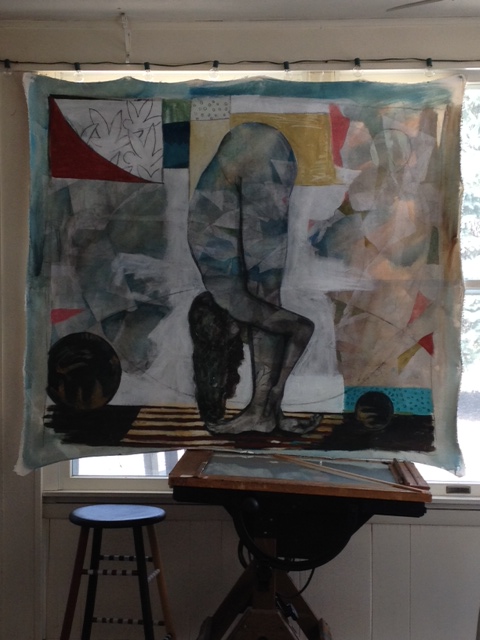
Embrace The Mess

circa 2011

circa 2011

I did not intend for this post to be a continuation of yesterday’s but when Amy climbed the stairs into the choir loft and said, “I don’t do change very well,” I laughed. It was word-for-word the same phrase that Kerri had just spoken.

For some reason, we’ve come to expect change to be comfortable and breezy. We expect ourselves to be paragons of reason in the face of imbalance. I find this ridiculous expectation of centered-off-centeredness to be suspiciously corporate. Apparently all change needs management and if it is not managed smoothly and without feeling or emotion then it is not well done.

Emotion is messy. Change is hard. The seed cracks before the tender shoot finds its way to the sun. The seed needs to crack in order for the new form to emerge. Hearts are broken, like seeds, to allow new forms to emerge. Even the “right” relationship is dynamic, messy, surprising, joyful, disappointing, filled with fear, the heights of elation, tenderness, quiet, and at the core is this volatile thing called love. Love burns hot during transformation; love is snuffed when excessively managed. Love is transformative when not unduly controlled.

Everyone does change well because change is the nature of our existence. Energy is always in motion. If humans are expert at anything it is change. We do change well because we can’t avoid it. What we do not do well is afford ourselves the grace of feeling the grief, the insecurity, the frustration, the anger, the joy, the exhilaration, and the dizziness that comes with change. We limit our emotional color palate when we confuse change with control. We do not allow ourselves the mess, the unpredictability, and the loss of balance that necessarily comes with this rolling vibrant transformation called life.

Amy would have been more accurate had she said, “I don’t do control very well.” I didn’t tell her the secret: no one who experiences the fullness of life does control well. In the face of her messy, volatile, change process, she wouldn’t have appreciated my counterpoint. When someone is standing in the middle of the muck it is cold comfort to tell them that they are in the right spot. So, I simply laughed, nodded my head, and said, ‘I know….”

Go here to get my latest book, The Seer: The Mind of the Entrepreneur, Artist, Visionary, title_pageSeeker, Learner, Leader, Creator…You.

 

Go here for fine art prints of my paintings.


Give Yourself Some Advice (2)

Finishing a painting is really about having a conversation with yourself. This one is talking!

Finishing a painting is really about having a conversation with yourself. This one is talking!

[continued from Give Yourself Some Advice]

Here’s the next bit of an email Horatio sent to me with his Advice To Myself. He wrote it following a question from a reporter about advice he’d give to emerging filmmakers. I am particularly fond of this section as many of my teachers, mentors, and guides are now passing away and I am revisiting what is mine to add to this “ancient conversation.” Here is the next section of Horatio’s advice to himself (for the full text, visit his blog at www.fidalgofilms.com):

Respect the boundaries of others; do not seek to control anyone else. You can only control your own choices.

Learn and honor with absolute integrity your own boundaries so that others may not try to control you or your work. Unfortunately, this is usually only learned through a certain amount of trial and error. 

Learning to trust is an art, and absolutely necessary. Learn to trust yourself first. Learn to trust others.

Always respect the tradition of your work, its ancient human conversation.

Connect to tradition, to all your teachers and your teachers’ teachers. Give yourself to it so that it can give to you and to your work. Honor it with rigor and doubt, with hours and hours of study and practice.

Then let your teachers go, follow the path that you understand as truth. You will know it when you see it. It will be your part of the ancient conversation. Likely, you will find that parts of one or two of your teachers have become part of you.

If you do not let your teachers go, your part of the ancient conversation will not be yours, but rather what you think other people want you to add to the conversation. That is not from you and only clogs up the conversation.

[to be continued]

Horatio asks great questions: What is the tradition that you carry forward? I follow the line of Tom and Marcia McKenzie, who learned from DeMarcus Brown, who learned from Eva Le Gallienne, who learned from…. What teachers/teaching do you need to let go?

Go here to get my latest book, The Seer: The Mind of the Entrepreneur, Artist, Visionary, title_pageSeeker, Learner, Leader, Creator…You.

Or, go here for hard copies (Amazon)


Give Yourself Some Advice

Horatio as a young man

Horatio as a young man

A few days ago I received an email from Horatio. He is an amazing filmmaker and gifted visual artist. We’ve wiled hours and days away talking about art and acting. He’s a treasure. His email was advice that he wrote to himself, the artist (what a great idea!) and with his permission, over the next three days, I will share it in segments. If you are impatient and want to read ahead, visit his blog or take a gander at his work at www.fidalgofilms.com. Here’s his email with the first portion of his Advice To Myself:

The evening after screening The Bath at Taos Shortz Film Festival in March, 2014, a very adept interviewer with the wonderful name Tamara Stackpoole (straight from Downton Abbey or Jane Austen?) asked if I had any advice to emerging filmmakers. My answer, as I recall:

“Let your teachers go. Just tell your own truth. Learn the craft – setup and payoff, three-act structure, and so on – and learn it well. But then let it go and tell your own truth, your vision. You’ll know it when you see it.”

When I woke the next morning, I realized that I had a lot more to say, and that it amounted to advice to myself. It follows:

You only can control yourself, which means your choices. You cannot control anything else.

Choose ethically, you will regret anything else.

The foundation of ethics is to respect others. Treat others as you wish to be treated. Be humble. Pride is the foundation of all the deadly sins, according to Dante and his mentor Virgil.

Your work is the essential ingredient of your life, an expression of your choices, your ethics. 

Connection to others is the essential mechanism of ethics.

A reciprocal connection of human to human (parent/child, student/teacher, artist/audience, friend/friend, or lover/lover) is the basic means to give yourself to others and to receive from them, to further yourself and others.

You will always be learning and practicing that kind of connection. You will never be finished. 

[to be continued]

Prompted by Horatio’s inspiration, I’ve started writing my version of Advice To Myself. It’s a great exercise and amounts to yanking the blankets on what matters to you. It begs the question: what will be your legacy? What might you write to yourself?

Go here to get my latest book, The Seer: The Mind of the Entrepreneur, Artist, Visionary, title_pageSeeker, Learner, Leader, Creator…You.

Or, go here for hard copies.

Choose Your Practice

598. Join me in inspiring truly powerful people. Each day I will add a new thought, story or idea to support your quest and mine.

In preparation for our class I was reading Alan’s book, Create A World That Works, and read a passage that I’ve read at least five times but never before registered. This time, it was the passage that stood out, the passage that stood up and said, “Hey!” The chapter is about stillness and the passage that hollered is a kind of equation that goes something like this: the more inner chatter you experience, the more you will try to control your outside world. Or, flip it over: quiet your mind and you will quiet your need to control things that you can’t control.

The inner world and the outer world are not separate affairs. One of the Hermetic Laws is, “As within, so without” and I understood the concept in story terms: quiet the racket inside and you will not live a life of racket on the outside. Yet, I hadn’t understood it in terms of the impulse to control. It makes sense to me: a life full of racket is a life full of the frustrated attempt to control things that you can’t control – which feeds the internal racket. It is a feedback loop.

I worked with a group this week and we played with the concept of “controlling what you can control and letting the rest go” – as it applies to personal and organizational health. A healthy person, a healthy organization is not invested in things beyond their control. They focus their energy and action where it is most effective. They are not invested in what other people think or see or feel; those things are beyond their control. They are invested in and responsible for what they think or see or feel. Their worth is in their own hands and not in the hands of others. Inner chatter, what you think, is a controllable. Every meditation and self-help book on the planet has clues about how to quiet the inner chatter. Add this to the pile: let go of what you can’t control, care more for what you think than you care about what others think. Chatter is a pattern and so it quiet; it is simply a matter of the practice you choose.

Take Off Your Blindfold

533. Join me in inspiring truly powerful people. Each day I will add a new thought, story or idea to support your quest and mine.

We were talking about illegal immigration. He is very conservative and was adamant that “illegals are breaking the law!” He exclaimed, “The law is the law! They’re breaking the law and should feel the consequences of their actions.” He made his proclamation about the black and white nature of the law and its consequences as he was lighting a joint – and the hypocrisy of his actions did not occur to him, not even for a moment. And although I found the moment absurd I did not think it was remarkable. As a successful white male he has always had a different relationship with the law and power than, for instance, the person trying to sneak across the border to find a better life. Things look differently at the top of the pyramid than it does at the bottom. When you are at the top, claiming a moral authority is part of the gig even though it requires holding others to an absolute code that you have never held yourself. I suppose it is the nature and necessity of power-over-others to excuse your self from participation; the need to control is a specifically exclusive act.

Of course he is not unusual. Tom taught for many years, long enough to see his students become adults – some with families, some even became teachers themselves. He used to laugh at the maniacal adults who wanted to impose strict rules on their children and students, rules that they would never have adhered to themselves. I’m fairly certain the proponents and makers of our current culture of testing never experienced nor would tolerate the madness they are now imposing on the nation’s children. Tom used to say, “Are their memories so short or is there another agenda entirely?” It was a rhetorical question.

One of my favorite Mad Magazine cartoons was of two hippies beating each other with signs, one read “Peace” and the other, “No More War.” What is it that allows us the peculiar blindness to afford ourselves consideration that we refuse to extend to others? When I am driving and inadvertently cut someone off I think, “Whoa! I didn’t see them.” When someone cuts me off, I am certain they are, “Trying to kill me!” Or making a statement or pulling status or…. I will never grant them the same specificity that I grant myself until I deem that they, too, have a story. Until then I do not see “them;” I see the story I project on their action.

The line becomes less black-and-white; the world becomes less absolute when I consider the human; when I factor in the circumstance, the necessity, the emotion, and the need; with personal story comes nuance and consideration. Lady Justice (both the inner version and the one standing before every courthouse) has never been as blind as she pretends.