Find The Purpose

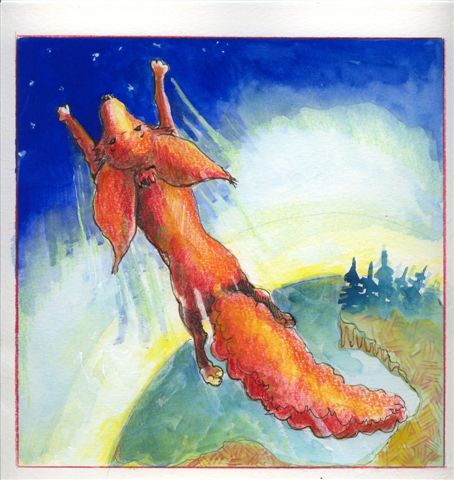
Despite warnings, Icarus reached for the sun.

Despite warnings, Icarus reached for the sun. Why do I paint? Why does anyone do anything?

The question of the day is, “What is the purpose?”

Mike is 85 years old and she said, “Never in my entire life did I think I would live in a world where beheading was a reality. We’ve gone backwards, it seems to me. My god! It’s like we’re living in the Middle Ages.”

Is history a sandwich with madness in the middle or perhaps a Mobius strip? What is the purpose?

Arnie just returned from Israel. He was profoundly moved by his experiences there. He was also angered by the discrepancy between what American media reports about Israel and what he found there. “I’ll never again believe another thing I hear on the news.”

Belief meets disbelief. The fields of the profound exist beyond anything called purpose. What changes in our hearts and minds when our experiences touch the profound? Our sight changes; our eyes open.

Horatio recently wrote and told me that he’d dumped his Facebook and Linked In accounts. He wrote, “I dislike them and the fallacies we suffer because of it. Mostly, I wonder what took me so long. I mainly feel like a man with a simpler life.”

Simplicity arises when complexity falls away. The extraordinary is always found in the ordinary, something as common as holding hands.

Kerri and I sat in the autumn sun to eat our lunch. She gazed at our house. She asked, “Do you think our house will be here in 100 years?” Before I could respond she answered her own question, “If it is, we’ll never know.” And then she asked the question beneath the question, “What is everyone racing to achieve?”

Moments of fulfillment. Presence. Both require a move beyond achievement to something more connected.

It is passing. Life. Purpose. Who assigns purpose to a life? Who assigns purpose to all of life? Is it achievable? What happens when we get there? Mirages.

“Purpose” is a word like “Outcome”; it exudes permanence but don’t be fooled. An outcome is a snapshot. Just as bottom lines are temporal, data is interpretation, and endings are beginnings.

Purpose wants to feel important. Profound simply wants to feel.

title_pageGo here to buy hard copies (and Kindle) of my latest book: The Seer: The Mind of the Entrepreneur, Artist, Visionary, Innovator, Seeker, Learner, Leader, Creator,…You.

Go here to support my play The Lost Boy.DSC_1196 copy


Learn To Swim

from my children's book on how to play, PLAY 2 PLAY

from my children’s book on how to play, PLAY 2 PLAY

Hoodie tells me that he is sarcastic by nature but I don’t believe it. I’ve spent a lot of time in nature and I find no sarcasm there. I also understand much about human nature and know that sarcasm is not a native plant; it is invasive. It is introduced into fertile, unknowing soil.

Sarcasm is the tool of the drowning man. It is an act of desperation to push others under the water in order to elevate the self. I’ve walked many paths and worked with many powerful and not-so-powerful people. There is a rule on the stage that applies: the king never needs to act powerful because the king is powerful. Those who need to demonstrate power have none. As Quinn used to tell me, if someone has to tell you that they’re important, they really aren’t. Sarcasm is a form of importance-telling. Powerful people create power with others. Power is a creative act. It is a communal act. They have no need to diminish or reduce others because they recognize that reduction also reduces. People who must reduce others are not powerful; they’ve confused control with power. They want to be king. They want to be seen as king. But, they do not believe they are king. Sarcasm is a form of perception control.

No one is by nature sarcastic. Sarcasm is learned in batting cages, at dinner tables, and on the field of play. Sarcasm is a mask. It is a place to hide smallness. It is passed down generationally. Masks both conceal and reveal and while it might feel good to pull others under the waves, it also reveals a non-swimmer. It is habit. It is learned.

Hoodie is not by nature sarcastic. Hoodie is a swimmer. He has the stuff of kings. He also tells me that his nature is to give comfort, to help others. He will one day realize, after he transcends his habit of drowning, that his nature to lift others is the center of his power place. Sarcasm separates him, reduces him, as do all forms of self-diminishment/control. Sarcasm is a lonely planet. Power is always a movement toward others. It is generative, as is all of nature.

title_pageGo here to buy hard copies (and Kindle) of my latest book: The Seer: The Mind of the Entrepreneur, Artist, Visionary, Innovator, Seeker, Learner, Leader, Creator,…You.

Go here to support my kickstarter campaign for The Lost BoyDSC_1196 copy


Covet The Right Stuff

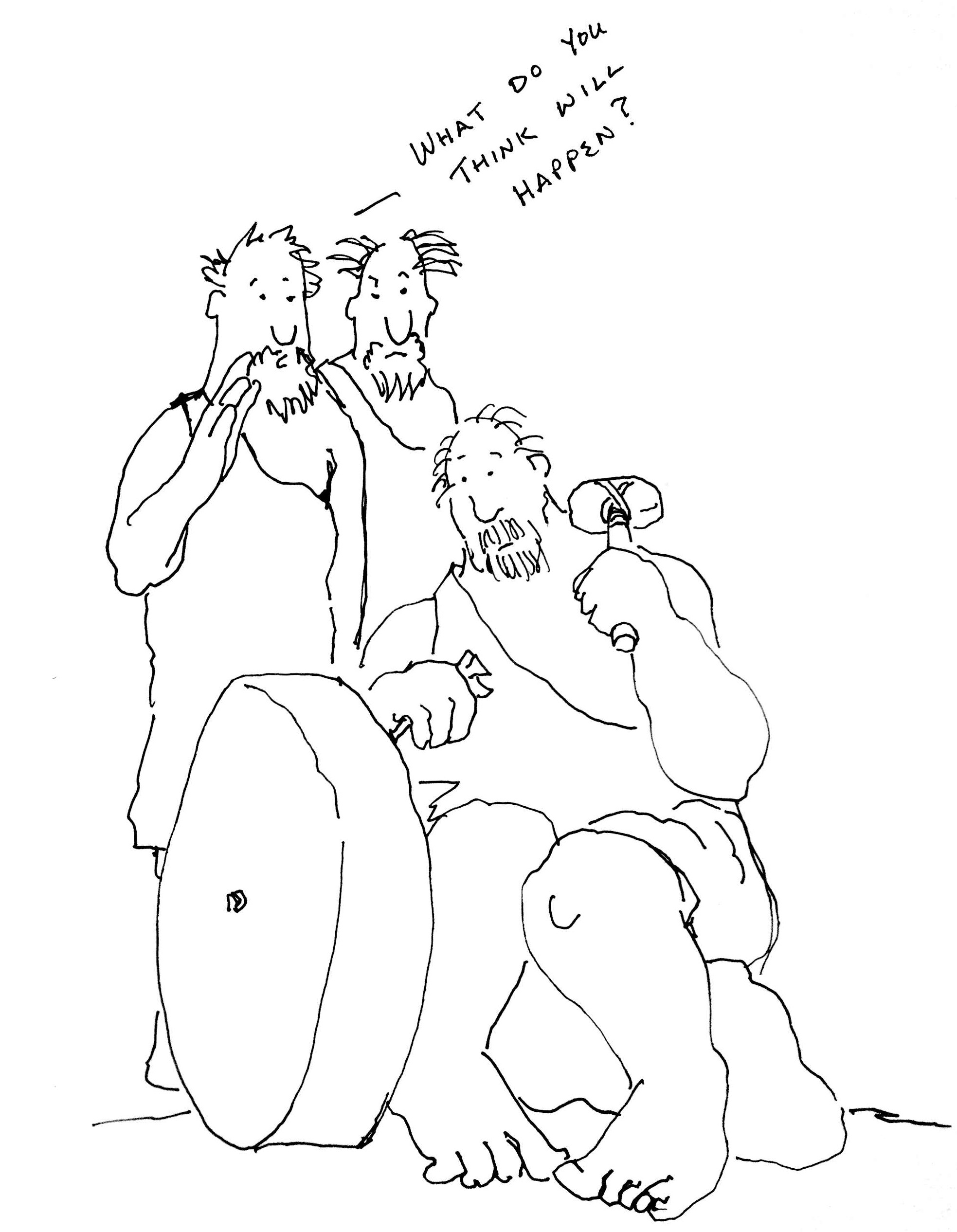
I did this drawing for my book, The Seer

I did this drawing for my book, The Seer

This morning Kerri shared a nice definition of the word “covet:” insufficient gratitude for what you already possess. It made me laugh because the definition exposes the ethical double bind of being human.

I imagine that in some distant past, a hairy guy stepped out of his cave and was startled to find that his neighbor had a new thing called fire. Being cold and also tired of eating sushi for every meal, he coveted his neighbor’s fire. He wanted some of that. A healthy lack of gratitude for what you already possess is often how good ideas spread (a random anthropological note: I read this morning that the average life span of a cave man was 18 years. I suspect coveting warmth-by-fire increased the average by a couple of years).

So, to covet is sometimes useful, especially where essentials like food, fire, and stories are concerned. It is only human to want enough food, a roof over your head, and a life-story that has meaning and purpose.

To desire is human. To want a better life is universal. What is the line between desire and coveting? To want what others have, to a certain extent, is pack behavior and we are, like it or not, creatures of the pack. Product marketers around the world count on our capacity to want what other people have and so our covet-muscle is exercised daily. The creation of imaginary need is a super trick for selling stuff and coveting what others have is key to lack creation. It’s hard to sell things if people are fulfilled.

So, to covet may be a warning signal that you are building your tower of meaning on sandy soil.

And that loops back to gratitude. All day, Kerri and I have been talking about being conscious in the moments of your life. None of us have unlimited time on this earth. The only thing we actually possess is our moments and our choices within our moments. The other stuff is really on loan and generally passing. Spiritual teachers and artists throughout history are unanimous on this point: the path to a rich life is built upon presence. Paying attention, exercising deep gratitude for the moments of your life, will always illuminate the extraordinary in the ordinary. Cultivating the capacity to see your extraordinary life will help you will covet the right stuff. Feeling grateful for your moment is always easier when you are warm and your brontosaurus burger is cooked just right.

title_pageGo here to buy hard copies (and Kindle) of my latest book: The Seer: The Mind of the Entrepreneur, Artist, Visionary, Innovator, Seeker, Learner, Leader, Creator,…You.

Check out the kickstarter campaign for my play The Lost Boy. DSC_1196 copy

Open The Box

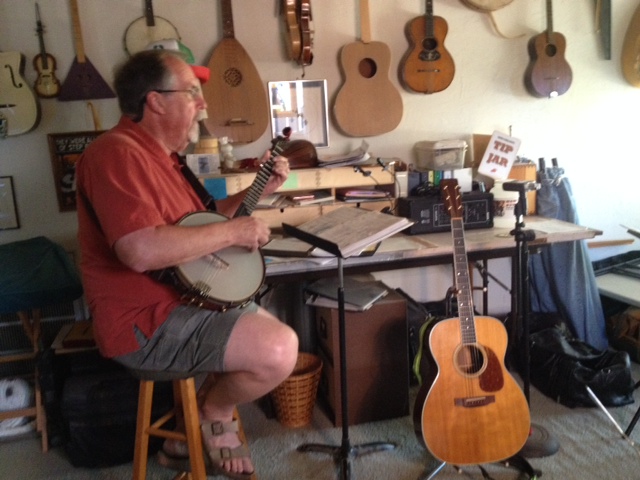
JIm Marsh of the band, Mom's Chili Boys, tuning up for rehearsal.

JIm Marsh of the band, Mom’s Chili Boys, tuning up for rehearsal.

It is often the simplest of actions that rock the world. I had one of those moments yesterday. It was a threshold moment. Its power took me by surprise. It changed me and all I did was open a box.

We flew to California to work on a play. I’ve worked on dozens of plays and performance pieces in my life but this one is special because it’s not an abstraction. It’s not a made-up story. I’ve lived it and lived with it for nearly a decade. The event, the catalyst of the play was the discovery of a box, a time capsule plastered into the walls of a ranch house over 130 years ago. Tom found the box. It held the possessions of an ancestor, a small boy who died in 1885. The boy’s mother, Isabelle, put his clothes and toys in a small trunk, wrote notes, some brief anecdotes about the boy, and then hid the box in the walls of the house.

Nearly ten years ago, we began creating the play when, late one night during a visit to the ranch, Tom asked me to help him. He asked, “What am I supposed to do with this box?” At first, much of the body of the play amounted to organized transcription. During each visit I recorded hours of conversation with Tom, hours of late night storytelling, and then flew home and transcribed the recordings. I wanted to catch the cadence of Tom’s vocal patterns. I wanted to catch the rhythms of his extraordinary voice and gift of storytelling. The play was his to perform; my work was simply to craft it, to draw a clear story-path for him to follow. The play, a one-man show, was ready for production when Tom’s health failed. He died a year ago.

During Tom’s decline I rewrote the play so that I might narrate the story and added another character to the piece. The Chili Boys had a battery of new music for the play so we gathered in Stockton to integrate the new music with the new text.

When we arrived in California, we visited Tom’s widow, Marcia. She gave us the trunk so we might photograph the clothes, toys, and notes. I’d seen the artifacts many, many times. Tom and I wiled away many nights unpacking the box and reading the notes, talking about his family stories. When our rehearsals were finished, sitting with Kerri and Jim moments before driving back to the airport for our return flight, we decided to open the trunk. Kerri had never seen the artifacts. As I lifted the lid, as I opened the trunk, I realized it was the first time; Tom had always opened the box. Tom had always reached inside, removed the shoes, the tattered coat, the hobby horse, the diary that contained the tracking notes of a fever that killed the boy. This boy was not fiction. Tom would say, “Look at this. Look at what she wrote on this.”

I opened the lid, for the first time, reaching inside, pulling out the shoes, the jumping jack, saying, “Do you see this? Someone must have made it for Johnny. And here, this is the notebook that Isabelle kept of Johnny’s fever. Look at what she wrote.”

DSC_1196 copyInvest in THE LOST BOY. See our kickstarter campaign


title_pageGo here to buy hard copies (and Kindle) of my latest book: The Seer: The Mind of the Entrepreneur, Artist, Visionary, Innovator, Seeker, Learner, Leader, Creator,…You.


Sit Down

google "Chicken Little" and this one will come up. www.homesforsaleinlascruces.com

Google “Chicken Little” and this one will come up. http://www.homesforsaleinlascruces.com

Many years ago I was feeling disoriented in my life. I told my friend Rob that I was lost in the woods and looking for my way out. He replied, “Sometimes when you are lost in the woods the best thing to do is nothing. Just sit down.” His message was clear: no one gets oriented or reoriented by spinning. Running in circles, although it might feel useful, will only make you dizzy. Sit down. Get quiet. Listen. It was great advice and at the time nearly impossible.

Orientation to life comes from getting quiet. In one of his books, Deepak Chopra wrote that an important practice on the path to success is a half hour of meditation in the morning and another half hour at the end of the day. Make a practice of getting quiet. Exercise the muscle of stillness. Listen. Clarity will ensue. That way, when the inner compass goes awry, the right tool for the job will be more readily available.

Sitting down can be hard. Stillness and disorientation are not natural bedfellows. The impulse is to action, any action. I was once in a car on a remote mountain dirt road. The road collapsed and the car slowly rolled into a gully. My friend and I spent two days trying unsuccessfully to build a road out. It was only after we gave up and sat down that we were capable of thinking things through. Disorientation generally inspires panic. Panic-driven actions, like running in circles or hauling stones to build a road, are generally comical and make for great stories after orientation is restored. We’ve all turned the wrong way down a one-way street when lost and panicked. Pulling over would have been better but much harder to do when dedicated to forcing an outcome.

Beneath Rob’s message to me was a more important lesson: let go. Let go of the need to do. Let go of the need to solve, fix, or find. The path to orientation always leads through a necessary disorientation and the disorientation comes from hanging on to old ideas, old roles, old baggage, old heroics. The cycle is perfect as hanging on necessitates letting go and letting go often means to sit down, surrender, and breathe. To sit down always affords the opportunity to see where you are as distinct from where you think you should be. To surrender is to open. To breathe is to invite in the new. No one is lost when they stop trying to be some other place.

title_pageGo here to buy hard copies (and Kindle) of my latest book: The Seer: The Mind of the Entrepreneur, Artist, Visionary, Innovator, Seeker, Learner, Leader, Creator,…You.

Go here to support my kickstarter campaign for The DSC_1196 copyLost Boy project

Determine The Value

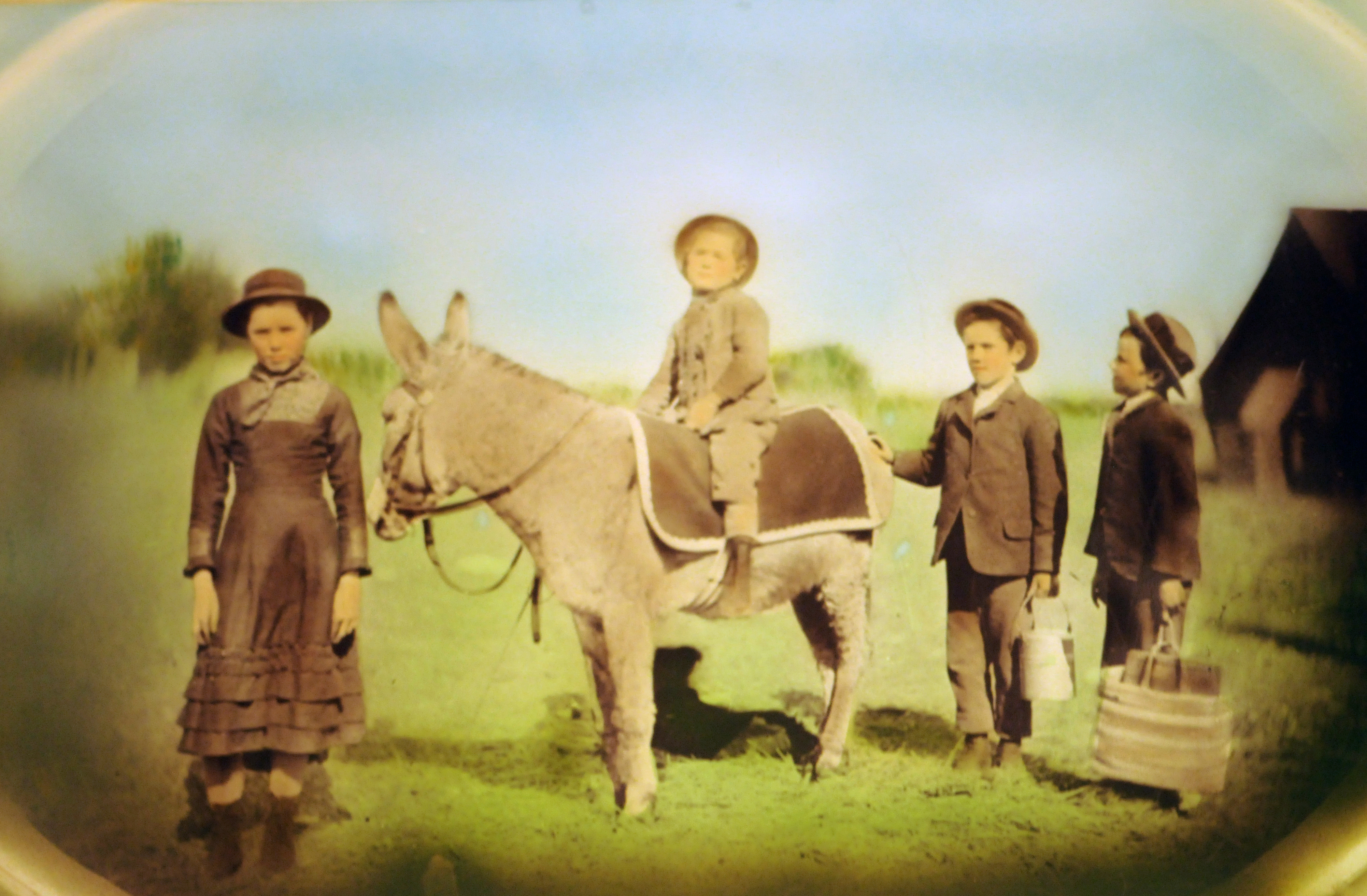
The Lost Boy (one of many) sitting on a mule.

The Lost Boy (one of many) sitting on a mule.

Last year Skip taught me that crowd sourcing sites like Kickstarter or Indiegogo were great ways to test the viability of a project or product. If an idea is valuable, people will invest in it. If not, not. If an idea is viable it will attract support.

As an artist I’ve had a wonky relationship with the valuation equation. Generally, the economics of art live outside the norms of the marketplace. For instance, I’ve run or consulted with many theatre companies; it is virtually impossible for the product of a theatre company – the live performance of a play – to pay for itself through ticket sales. Unlike other products, things like cars or bananas, arts organizations and the products they produce are made possible through grants, donations, patrons and this weird mechanism called “non-profit” status. The costs of producing the play (the art) usually outstrip the capacity of the “product” to generate a profit.

When I first met Skip he asked me a question for which I had no capacity to answer: “How can you scale up?” His question brought me to the concept confusion that lives at the very heart of the economics of art: bananas, cars, and iphones can be mass-produced. They are meant to be consumed on a grand scale. They are built to break down, to be replaced by the newest, latest, and greatest. The arts, to be living, to be vital, are rarely capable of mass consumption.

The arts serve personal (and, therefore, communal) transformation. They are not meant to break down, to be replaced by the new; they are meant to sustain, to renew from a deep irreplaceable wellspring. If the iphone, banana, or car is the fruit of the vine, the arts are the root system, that which brings nutrient to the fruit, that which holds the identity of the culture. Pluck the fruit and the vine will replace it. There will always be more. Pluck the root and you kill the plant. There is only one root. The fruit is meant for consuming. The root serves a different purpose.

Places of worship and education face the same value confusion. The sacred stuff, like art, is not consumable so how does a consumer culture determine its value? Learning is an ongoing personal process, an irreplaceable relationship with the world. Both education and worship, like a living art, are experiences rather than products. They are meant to be valued differently than a new countertop or a pair of shoes.

Some forms of art are capable, through the miracle of technology, of mass consumption: movies, music recordings, art posters and prints. Technology can do many things but it cannot replace presence. It allows us to see. It cannot replace touch. It allows us on a mass scale to see a reproduction of a painting by, let’s say, Van Gogh. We can appreciate the painting through the print. However, we cannot experience it. Nothing can replace direct experience, the personal moment of standing with the painting. A live performance is…live. It is alive, inclusive, and meant to transform through presence and participation in a shared moment. The economics of valuation confuse the greater valuation.

I am testing Skip’s notion with the viability of a project. I’ve launched a Kickstarter – my first – to fund a play. It is a heart project, personal to me and I think relevant to my community. Take a look. If it looks like it has value, you’ll know what to do.

Go here to check out my kickstarter for THE LOST BOYDSC_1196 copy


title_pageGo here to buy hard copies (and Kindle) of my latest book: The Seer: The Mind of the Entrepreneur, Artist, Visionary, Innovator, Seeker, Learner, Leader, Creator,…You.


Be Kind Now

Kerri with her mom, Beaky

Kerri with her mom, Beaky

On Beaky’s refrigerator there is a colorful poster with this quote by Gerald Jampolsky:

“How simple it is to see that we can only be happy now and there will never be a time when it is not now.”

Bruce told me of his children. He related a few simple anecdotes: a moment of confidence on the stage, a gentle moment caring for an old dog. His voice quaked as he said, “David, my children are considerate and kind.” I wanted to tell him that they get that from their father. Bruce has always been kind though he does not know it.

Judy and I were talking about community. She lives in a supportive intentional community. She said, “I think we do our selves a disservice by placing so much emphasis on the individual. No one does this alone.”

We entered Beaky’s room at the rehab facility. Lying on her side, flat on the mattress with no pillow beneath her head so she can see the notes she is scribbling, she writes in her journal the chronicle of her life. “You’ll never be able to read this!” she exclaims, and then without taking a breath, “Did I ever tell you of the time when….” We sit with her, deep in story, for the next several hours. “This is the stuff that matters.” Beaky says. Not the stories themselves; she means the sharing of stories.

In our phone call Judy also said, “When you are in trouble it is not your money that will save you. It’s your relationships that matter.”

The nurse wheeled Beaky to the car. We gathered from all around the country to be with her. At 93 years old she is going into a radical surgery that is the best of bad choices. As we progress down the hall, an entourage of family following a woman in a wheelchair, nurses kneel and kiss her. They hug her. They tell her that they loved her. “She is special to us,” they say. “She does more for us than we could ever do for her.”

Kerri said, “Momma, see how many people love you?” Beaky replied, “Everyone is so kind.”

There will never be a time when it is not now.

title_pageGo here to buy hard copies (and Kindle) of my latest book: The Seer: The Mind of the Entrepreneur, Artist, Visionary, Innovator, Seeker, Learner, Leader, Creator,…You.

Check out my kickstarter campaign for my play The Lost DSC_1196 copyBoy


Look At The Pictures

photoH’s wife passed after a long illness. This afternoon we went to the vigil and Kerri sang Amazing Grace for the service. We looked at the photographs of her life.

This summer, at my grandfather’s funeral, there was a similar board of photographs showing the span of his lifetime. They are a record of moments. He posed for some of the shots. In some, he had no idea that a camera was pointed at him. We are different when we know a camera is aiming our way. We put something on, a kind of mask, an attitude or assumption.

The photographs on the board served as a history of technology, black and white to color film, and then a jump to the proliferation of digital images. What was difficult became easy. What used to need chemicals and processing became instantaneous. This capacity to snap photographs and see them in a moment has changed us. Selfies abound! Once, at the Museum of Modern Art in New York City, I watched with fascination as people posed to have their picture taken with Van Gogh’s painting, Starry Night. They rarely looked at the painting. They just knew it was famous and wanted their picture taken with it. They primped. They smiled. They mugged for the camera or looked serious. Proof of life? Just like a handprint on the wall of a cave, those photographs shouted, “I was here!”

We are among the first people in the history of humanity to have this extraordinary window into our lives. I looked at the photo board of H’s wife and saw H at age 30, at age 40, and 50 and 60 and 70, 80, and I know him now at age 90. In the photographs I can see the cocky young man, the father, the achiever, the dreamer, the man who stopped resisting, the surrender,…each phase of his (and his wife’s) life. More to the point, he can see it. He can see the progression.

Two hundred years ago a photographic record of a life span was impossible. No one posed because there was no need. An old man remembered his life but did not have the window to see his path. No one had the opportunity to see the growth and process of age through the phases of their life. It changes us. And, it is a sword that cuts both ways. We can see. We can record. We can story ourselves like no other time in history. We can be known to future generations. We can talk to the future and the future can hear us. We were here. We had something to say. We had so much to share, so many rich experiences of living! And, we can miss our moment in the recording of it.

Kerri asked H what was his favorite photograph on the wall and he laughed and said, “I don’t know. We had happy times. Look at how much I weighed back then!”

“You need to eat more, H!” Kerri admonished and gave him a hug. He began to cry.

“I’m trying,” he said, laughing through tears. “I think I just need to drink more Frosties!”

title_pageGo here to buy hard copies (and Kindle) of my latest book: The Seer: The Mind of the Entrepreneur, Artist, Visionary, Innovator, Seeker, Learner, Leader, Creator,…You.

Go here for all digital forms of The Seer.

Go here for Fine Art prints of my paintings.Yoga.Meditation

Peel Off The Laminate

An illustration from my children's book, LUCY AND THE WATERFOX

An illustration from my children’s book, LUCY AND THE WATERFOX

Last week in a fit of frustration I climbed a ladder and scraped the damaged paint off the kitchen ceiling. The paint was compromised a few years ago and needed repair. The peeling paint was on my summer list of things to fix but we were traveling most of the summer. Autumn arrived and the to-do list remained. Scraping and sanding always leads to the necessity of new paint and Kerri said, “If you paint the ceiling it will make the walls look dingy. We better paint the walls, too.”

So, standing in the kitchen, fists filled with paint chips, discussing color possibilities, we realized that all of our color choices were defined by the fading yellow of the ancient kitchen countertop. The counter was at least 50 years old, laminate, and held in place by some well-placed packing tape. We’ve talked often of the day in some distant future when we could afford to replace it and that day seemed very far away.

In that moment, hands filled with paint chip possibilities, we realized that the countertop had became a metaphor. We were defining our choices based on a limitation. Or, said another way, we were limiting our possibilities based on our belief in an obstacle; what we could or could not do.

How often is that the case? What self-imposed limit defines the choices we see? How often do we unwittingly shrink our field of possibility? How often do we allow the things we don’t want to define our actions?

It took less than 30 minutes to pull off the old laminate, break it into pieces, bag it, and get it out of the house. As I wrote in an earlier post, the spontaneous kitchen remodel began when we realized we had the power to remove the limit. We had the capacity to make choices based upon a different set of criteria. Before the spontaneous remodel we believed we couldn’t afford to change the kitchen countertops. The moment of paint-chip revelation made us understand that we couldn’t afford not to change them.

Life is great at applying belief-laminate to us: what we think we can and cannot do. Something profound happens when, in a moment, we understand that we are capable of challenging the limit, of pulling off the laminate, of being forced to step into a greater field of possibility (known from henceforth as the “Now What?”)

It is worth noting that our new countertop, the old plywood support and made exceptionally beautiful with chalk paint and wax, has transformed our kitchen and our actions. We hang out in the kitchen. The colors we are considering using for paint are now based on what we want to create and not on what needs to go with the old yellow laminate.

title_pageGo here to buy hard copies (and Kindle) of my latest book: The Seer: The Mind of the Entrepreneur, Artist, Visionary, Innovator, Seeker, Learner, Leader, Creator,…You.

Go here (Leanpub) for all digital forms of The Seer.

Yoga.ForwardFoldOr, for kicks, go here for Fine Art Prints (and other stuff) of my paintings.


Step Into Your Sanctuary

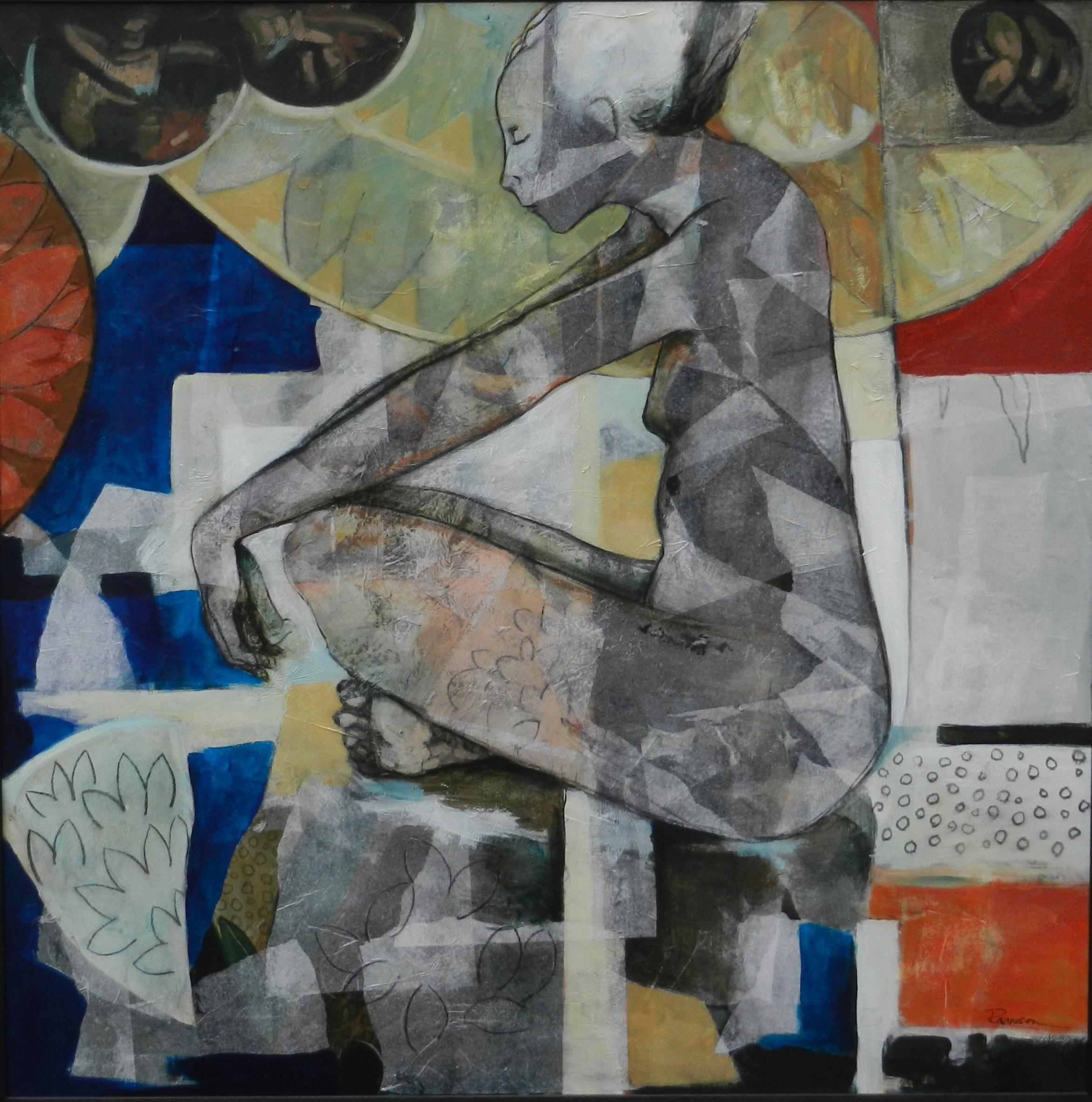
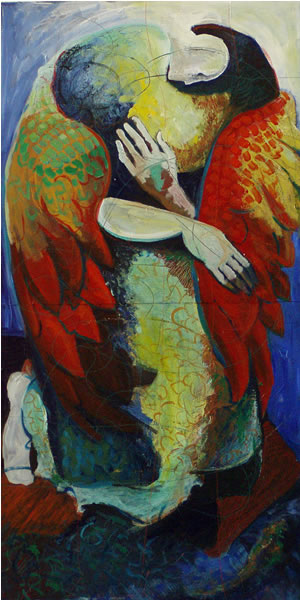
An oldie simply called ANGEL

An oldie simply called ANGEL

It is night and I am hanging out in the sanctuary while Kerri attends a meeting. I never in my life thought I’d hang out in a sanctuary but I quite like it. It is quiet and I am by myself. It is a good place to meditate or just get still. I am sitting with my stain glass window wondering if there is a conversation in the offing. I’ve spent many nights in my life sitting alone in dark empty theatres and always felt the same sense of peace that I feel at this moment.

I like the word “sanctuary.” It implies a safe place, a resting place. If all the world is my studio then it is also my aspiration to live as if all the world is my sanctuary. I’ve always understood my studio to be a holy place, a place of creation and presence. Going to my studio has always been a step into a safe space. It is where I rejuvenate. Tonight, sitting here, it occurs to me that “studio” and “sanctuary” are very similar words. They are very similar places just as “theatre” and “church” have, for me, been mostly interchangeable: where we go to affirm the stories that identify and transform us; where we go to find our community. My sister finds her community in a church. I have, until lately, found mine in the theatre.

This rambling path begs the question, “What is sacred and what is not?” Yesterday Diane told me that she is a spiritual teacher and I believe that is true. This morning while walking I remembered her words and wondered if we are all spiritual teachers to each other. Some of my greatest teachers had no idea that they were teaching me.They had no intention of teaching me. One great teacher was sweeping a floor and had no idea that I was watching him. He was one of the happiest people I have ever seen. He was shining. He was doing a job that most people would deplore. Everyone who saw him smiled, myself included. He was not his job. He was not his body. He was…connected and alive in his moment. He was living in his sanctuary and helped me know that all the world can be a holy place. He helped crack my understanding of what is possible.

These lines we draw between the sacred and profane are mostly imagined. They are convenient and sometimes useful but they are illusions that I am beginning to understand as destructive. Us and them. A divided house begins in a belief of divisions – a need for division. I’ve often told the story of the executive, red in the face, pounding the table with his fist, shouting, “I know how to compartmentalize my reason from my emotions!” I remember thinking, why would any one want to cut off their emotions from their reason? A better question might have been, who, in their right mind, willingly cleaves themselves into pieces? What delusion is necessary to entertain the notion that reason and emotions are distinct and separate? Separations are generally an indication of not-right-mindedness and a dedication to controlling the uncontrollable.

The angry executive was also a great spiritual teacher for me, too. He taught me to check my assumptions and step over the lines of false distinction that I draw. I can connect the dots directly from his table pounding exclamation to my desire to define my studio as all the world; to live consciously in my sanctuary all of my days.

title_pageGo here to buy hard copies (and Kindle) of my latest book: The Seer: The Mind of the Entrepreneur, Artist, Visionary, Innovator, Seeker, Learner, Leader, Creator,…You.

Or, go here for all digital forms of The Seer.

Go here for fine art prints of my paintingsEmbrace