Face The Sun

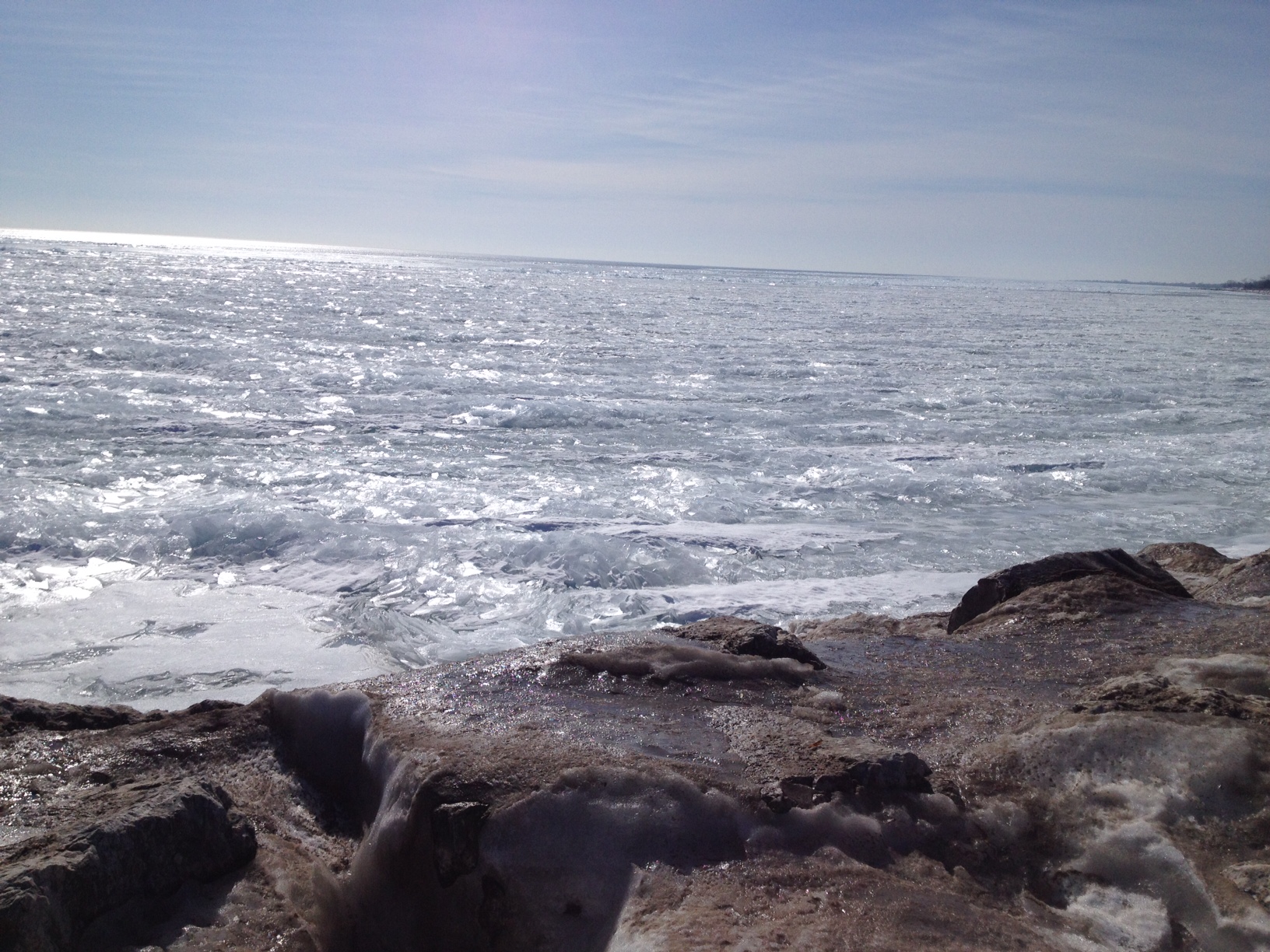
Lake Michigan frozen

Lake Michigan frozen

Standing on the sea wall, the sun on our faces, the frozen Lake Michigan looked like a vast field of broken glass, shards akimbo, glistening in the morning light. The shards popped and crackled, moaned and snapped; it was the first warm day in months. The birds frolicked. It was a small taste of spring, a gift before winter’s return tomorrow. I closed my eyes, faced the sun, and drank it in.

Kerri and I had just walked across the harbor. We watched the ice fishermen drill holes in the ice. The bit dropped more than two feet before breaking through. The fishermen assured us that the ice was very thick. “I’ve lived my whole life here and never seen the ice this deep,” the man said, sipping his coffee and looking at the lines he’d dropped in the water. We stepped out onto the ice, making a pact to rescue the other – and walked across the harbor.

The sea wall is on the far side of the harbor and usually requires a boat to reach. It is constructed of enormous boulders, some still encased in ice and looking like something the artist Christo might have created. On our water walk to the sea wall we snapped photographs, splashed in newly formed puddles, and left footprints in the snowy spots.  We laughed. We waltzed around an old fishing hole. We looked at each other and said over and over, “I can’t believe it!”

On the wall, listening to the ice chorus, my eyes closed and soaking up the sun, I photo-1remembered a conversation that I had years ago with Father Lauren when I was a student at The College of Santa Fe. We had great conversations because he knew I was not a believer in his faith. In many ways we saw the world from diametrically opposed points of view but rather than wrestle with winning the other to our perspective, we asked questions to try and understand. Father Lauren saw the earth as corrupt. I saw (and see) it as magnificent. We were talking about reincarnation and he’d just asked, “What kind of god would punish people by bringing them back to this place?” I responded with a phrase I’d recently heard in a lecture Joseph Campbell delivered about the gnostic gospels, “The kingdom of heaven is on earth and men just do not see it.”

Father Lauren closed his eyes and tried to spin his paradigm around. He asked, “So, we are already in heaven and simply need to open our eyes to the beauty of it all?”

“Yes,” I said. “That’s what I believe.”

He smiled, “I just can’t believe it.”

Standing on the sea wall, Kerri took my hand. The ice sang. She whispered, “I just can’t believe it.”  I wanted to reach back in time and tell Father Lauren, “Yes. That’s the thing! When you open your eyes and see heaven on earth, what you see is impossible to believe.” Heaven has nothing to do with belief and everything to do with what you choose to see.

“Me, too,” I whispered, the sun on my face. “It is unbelievable.”
Go here to get my latest book, The Seer: The Mind of the Entrepreneur, Artist, Visionary, title_pageSeeker, Learner, Leader, Creator…You.

Go here for hard copies (Amazon)

Listen To The Window

'Dancing In The Front Yard' by David Robinson

‘Dancing In The Front Yard’ by David Robinson

I am having an ongoing conversation with a stained glass window. Perhaps it sounds odd but I sit in the choir loft, across the sanctuary from it, and I listen. Without fail a thought always jumps into my head. Sometimes it’s a feeling and if I continue to listen, if I ask questions, breathe and get quiet, great insight follows. My conversations may be the fodder for my next book.

Here’s what I heard today: Stories can be the heaviest thing on earth to carry.

“Tell me more,” I prompted, staring at the red robe that serves as the visual focal point of the window.

After a few moments I heard: So many stories are fear-based. Fear stories are the centerpiece of angst and depression. They are monumental. If you pay attention you can see the weight of the story that people carry. Closed hearts and furrowed brows, burdened shoulders and bad backs: these are bodies struggling under the weight of the story they carry. Stories of shame are heaviest of all.

There was silence but I know enough to sit still, breathe, and listen. After a few moments, the stained glass window continued: No one need carry the burden. Every story can be set down. A story can be left behind.

“Why do we choose to carry the weight?” I asked.

I heard almost immediately: Everyone has experiences that inform the arc of their lifetime. Sometimes it is a wound. Sometimes it is a loss. The story is often the account of “something happening to me.” It forms the great helplessness. It is the victim story. People confuse their life with the story they tell of their life. They think they need the story to know who they are. Without the story they would have to own their choices. Both feet in! They would have to start living. People are life, not the story they tell of life.

“People tell stories. It’s what they do!” I responded.

The light poured in through the window. The clouds must have shifted across the sky. I imagined the window was chuckling at me as I heard: Stories can be the lightest thing on earth to carry….

Go here to get my latest book, The Seer: The Mind of the Entrepreneur, Artist, Visionary, title_pageSeeker, Learner, Leader, Creator…You.

Go here for hard copies (it’s Amazon;-)

Step On The Stage

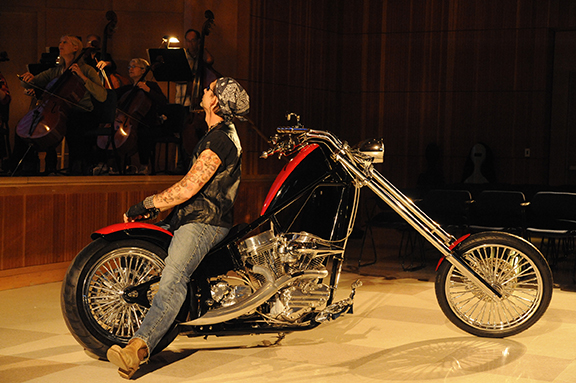
My performance with the Portland Chamber Orchestra of "The Creatures of Prometheus. I wrote and performed the piece for PCO.

My performance with the Portland Chamber Orchestra of “The Creatures of Prometheus.” I wrote and performed the piece for PCO.

Craig is laughing at me and with good reason. Through a post he asked a simple question about people building boxes around themselves. He issued a singular challenge: to apply what I found in his post to my writing. I’ve had more ideas and random ruminations than I know what to do with; he opened a big can. Before I let it go, I want to wade into the last part of his question: when did I know to create my stage?

Craig positioned a stage (showing up) as the polar opposite of a box (hiding) so I read his question as asking when I decided to show up. I’ve learned that a stage can be a strategy for hiding, too, so “showing up” means much more than just being visible.

Many actors get on the literal stage because they are seeking appreciation or approval from the audience. When anyone mounts a stage, either literal or metaphoric, to seek approval, they split themselves. By definition, they must hide their intention (to seek approval) and in so doing, give away their power and potential. Young teachers often pass through a growth phase in which they seek the approval of their students; they want to be liked and their need for appreciation neutralizes their capacity to teach. Ironically, in both cases (actors and teachers), the moment they cease splitting their intention they become great at what they do and their respective audiences can’t help but appreciate them. That’s the way power works.

Several years ago I was working with a corporate client who was upset because he felt uncomfortable with what he’d learned from my workshop. I told him that I could either serve him or please him but I could not do both. I understood that my job was to help him grow and that necessarily required discomfort. If he wanted to be pleased he needed to hire someone else.

I hid for years. I split myself for decades. My dear friend Roger once said that one day in his middle 30’s he realized that he was no longer becoming someone. He was someone. Everyone navigates the “becoming.” It is a necessary and vital growth phase and is often filled with fears of inauthenticity and split intentions; everyone wants to be appreciated and everyone sacrifices their primary intention in a mad dash for approval until one day, if they are lucky, they realize the only approval they need is their own. My revelation came when I was preparing to go on stage to perform. I realized that I was steeling myself against the audience (preparing to hide). I was assuming that they were going to judge me, which is a form of approval seeking. It was like a cold slap. I’d never had a bad experience with an audience. I’d only ever experienced appreciation and support and wondered why I was steeling myself against the very people I was there to serve. My need for approval dropped like a stone. I went on stage, perhaps for the first time in my life, present and powerful. I didn’t need anything from them. I was bringing life and my gifts to them and that was all that was required. My whole world flipped. No armor. No mask. No need other than to offer my gift on that day to that specific group. Whether or not they accepted my offer could no longer be my concern.

I’ve since learned that discomfort is a very valuable thing. It is present anytime learning and growing is happening. In fact, if there is no discomfort, there’s no learning. And that is the plaque nailed to my stage.

Go here to get my latest book, The Seer: The Mind of the Entrepreneur, Artist, Visionary, title_pageSeeker, Learner, Leader, Creator…You.

Go here for hard copies (Amazon;-)

Hear Your Words

[continued from EAT WELL]

Craig originally wrote a post about the boxes people construct around themselves and the alternative choice of creating a stage.  After his post he challenge me to enter the fray and muck about with boxes and stage and I’ve been pleasantly surprised at how much I have to say – I’ve followed the thread for a few days and will probably keep following it for a few more. It’s a rich exploration!

Yesterday I mentioned that I had the opportunity to work with Skip’s Human Centered Design class at the Illinois Institute of Technology in Chicago. I tossed the group into several exercises and experiences designed to help them understand how people story themselves. Specifically, we took a look at language as the building block of perception. We captured on video portions of my time with the students so rather than write about it, here’s clip from the day. [Note: the real riches start about 2:30 minutes in but I thought the students questions might be of use to set the stage so I left it in the cut. They’d just completed an exercise of misnaming things]. Let me know if you find some juicy bits about the boxes we build around ourselves and our attempts to “step outside of the box.”

[to be continued]

Go here to get my latest book, The Seer: The Mind of the Entrepreneur, Artist, Visionary, title_pageSeeker, Learner, Leader, Creator…You.

Go here for hard copies (it’s Amazon…)

Eat Well

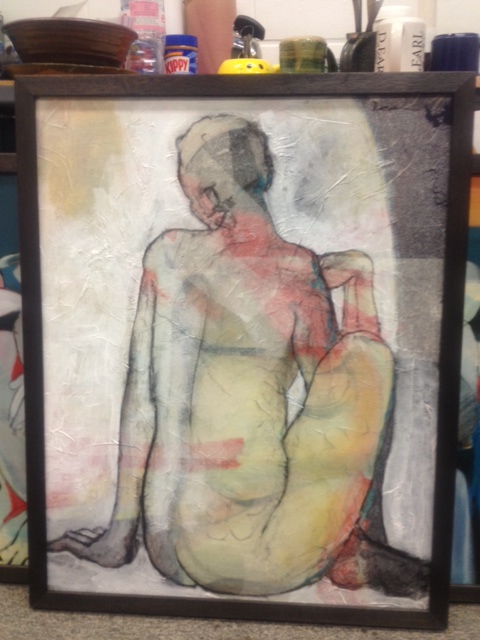
"Lovers," a work in progress by David Robinson

“Lovers,” a work in progress by David Robinson

[continued from LOOK BEYOND THE BOX]

I’m looping back to Craig’s questions concerning boxes and stages. I think the next question to wade into is about what I see from my stage and when did I know to create my stage.

This is the view from my stage. It may sound bleak at first but stay with me:

Yesterday I had the opportunity to travel into Chicago and work for a couple of hours with Skip’s class at the Illinois Institute of Technology. They are budding entrepreneurs. There’s lots of energy in the world today bubbling around this word, “entrepreneur.” Accelerators and incubators are popping up everywhere. We are now a society gorging on new technology; since we are modeled on the Rome of the Caesars we have little patience for digestion (it takes time) so we prefer to vomit what we just consumed to make room for the next course. We are living at the time of an idea feeding frenzy and mind blowing technological advances. Folks with resources but few ideas are hungry to link up with folks with ideas and no resources. Everyone is insatiably hungry. No amount of gorging will satisfy the hunger.

In our world of rabid consumption, nutrition isn’t necessarily a high priority. I mean that literally and metaphorically. For evidence, look at what the networks call “news.” Long ago we realized that entertainment is more profitable than reporting so reporting is now entertainment. It matters little if there is substance to the story so long as people consume it. More evidence: one of my favorite rants of the past decade came from Dane, a neighbor, who was sitting on his stoop eating a bag of potato chips. He called me over to look at the ingredients listed on the package. High on the list, in fact the second ingredient listed, was sugar. Dane screamed, “There’s more sugar than salt in my chips!” He fumed, “I’ve been reading the ingredient lists on everything and there’s sugar in everything. It’s more important to get us hooked than to feed us anything of substance!” Of course, the punch line to the story is that he ranted with his mouth full of chips. Another bit of evidence: I stopped counting the times I’ve heard a politician say, “We have to weigh our interests against our values.” You can find a variation of this statement in the news of the day everyday. You can find an example of it in your life each day, too. How do you weigh your interests against your values?

This consumption/nutrition question is the epicenter of confusion for lots of people. It is the reason many boxes and stages are constructed.

Most people that I work with are seeking greater meaning. They want a richer experience of life. They want to fulfill their potential. In the midst of their consumption of time, they feel consumed. They have little time to breathe. They have little capacity to develop deep, meaningful relationships. They are finding that their stuff doesn’t fill the void. They are finding that their achievements are hollow unless they serve the real needs of others. They always find that what they seek is something that they’ve had all along: relationships.

There is no magic to sustenance. Slow down and enjoy your meal: literally and metaphorically. Slow down and make the meal: literally and metaphorically. Slow down and make the meal from food that hasn’t been processed: literally and metaphorically. Care for the soil and you will grow healthy food: literally and metaphorically. This requires slowing down. All of these are about the relationship you have with your world. All rich relationships require lingering and the riches are always in the relationship. Always.

Substance is always about a relationship. Relationship can’t be consumed; it must be entered and/or engaged. Tend the relationships, especially the relationship you have with yourself. In this way, the box or stage you construct will be built from self love and self love is the wellspring of love for others.

I see riches in the relationships all around me and a species (homo sapiens) trying to remember what it means to eat from the tree of life.

[to be continued]

Go here to get my latest book, The Seer: The Mind of the Entrepreneur, Artist, Visionary, title_pageSeeker, Learner, Leader, Creator…You.

Go here to get a hard copy (it’s Amazon)

Look Beyond The Box

one of my paintings (untitled) from the Yoga series

one of my paintings (untitled) from the Yoga series

[continued from SEE THE BOX]

Craig’s question is bigger than a single post can accommodate. He’s both reflecting and asking several questions about the boxes people construct around themselves, about building personal “stages” and what becomes visible to us when we open ourselves to life without editor or inhibition. He’s asking deep river questions about the assumptions we make when we look at others through the lens of our own experience. He asked about what I see from my stage and when did I know to create my stage. And, here’s the kicker question, “When was the last time you stepped up and saw something you didn’t know was there?”

I want to start with the last question first because I believe it colors all of the other questions. At this point in my life, there isn’t a day that passes that I don’t see something surprising or new. I know that sounds like a superficial dodge until you consider that it wasn’t always the case. Like everyone else, I was schooled in a long series of mistaken notions: 1) that people need to know where they are going before they go there, 2) people need to know what they are doing before they do it, 3) knowing is something that happens in the head, and 4) that truth is singular and knowable; believers in right/wrong paradigms are especially fond of this point.

It took a few years (okay, decades) to realize that “knowing” is a process and not an arrival platform and, therefore, no body knows. People build boxes around themselves because they think they must know what is unknowable. People build boxes around themselves because they think they must look a certain way or think what others want them to think. People build boxes around themselves in an attempt to control what they can never control. No one really knows where they are going (well, everyone knows where they are going but dying is an existential question – a topic for another post). No one knows what tomorrow will bring. As Marshall McLuhan wrote, people step into the future with their eyes in the rearview mirror. We make sense of today through yesterday’s eyes so we can only “know” what happened, not what will happen. The day before September 11, 2001 people walked into airports to greet their friends and relatives at the gate. And then, the very next day, like millions of people, I sat in front of a television and watched a plane fly into the World Trade Center. That day I understood that what I thought I knew was basically useless.

Each of us has, at one time or another, had a personal September 11th. People learn. They grow. They have experiences and then make meaning of their experiences. People change. Life is a moving target. At one point in my life I started my own school within a school. It was experiential and filled with filmmaking and theatre and performance art. At the beginning of that era of my life I thought I would run that school until I the day I died. Three years later, I was done with my exploration in education and I surrendered my cushy tenured position and ran for the air of uncertainty. People story themselves according to inner imperatives through lenses of past experiences. The idea that we are primarily rational and reasonable is…not rational or reasonable.

At some point, when you cease thinking you know stuff, your eyes open. You see beyond what you think. Everything is surprising beyond the dull-wit of thinking. Thinking (a language-based activity) will always be an abstraction. Put a word on something and you delude yourself into thinking that you “know” what it is. This is especially heinous when applied to other people. People build boxes around themselves because of the words placed on them or the words they place on themselves.

Mostly, people build stages for the exact same reason. Saying, “I’m not going to be influenced by others; I’m going to act independent of others” is also a delusion constructed from notions of “knowing” or trying to determine how others will see you. Most stages are constructed from the desire to control. Sometimes the biggest box looks like a stage.

When you no longer need to know anything, you see surprising things everywhere you look.

[to be continued]

Go here to get my latest book, The Seer: The Mind of the Entrepreneur, Artist, Visionary, title_pageSeeker, Learner, Leader, Creator…You.

Go here for hard copies (it’s Amazon, don’t be afraid;-)


See The Box

‘The Box’ by Kerri Sherwood from her album Blueprint for My Soul Craig sent me a link and a challenge. The link was to his recent blog post, Break Down The Box. It’s about how people build boxes around themselves. “Instead of building a box that may later require extra work to remove,” he writes, “I suggest building a stage.” What a great image! His challenge to me was to apply it to my writing. He texted, “It’s relevant to your general topics.”

My question back to Craig was about the word “apply.” Is he challenging me to write about boxes and stages? Is he challenging me to build a stage and stand on it? Both? His challenge came on a day that I said aloud to myself and the universe, “I’m feeling boxed!” His timing was impeccable.

Self Cut outWe’ve not finished our correspondence so I don’t yet know what he means by applying it to my writing. To stall I will write what I know about boxes:

1) Everyone has one. Don Miguel Ruiz writes that we come into this earth as free, uninhibited spirits and then the adults around us begin impressing rules and random philosophy upon us. They teach us constraint and we comply. We are a pack animal, after all, and must operate within the greater needs of the community. That’s why there are traffic lights and a proper fork to use when eating a salad. Our greatest need is to belong; The GAP, Old Navy, or Abercrombie & Fitch could not exist otherwise. The need to belong is the driver behind box building. It’s a paradox. Somewhere amidst all of the compliance we begin to assume that we are no good or start making comparisons to others or create standards of perfection that are impossible to inhabit. So, we build a box called, “should be”. The paradox is that, in order to belong, our action is to hide.

2) Growth comes from constraints. No box is built without the need to deconstruct it. That is the opportunity of the box. Joseph Campbell would call box deconstruction The Heroes Journey. In the great mythologies of the world there is a tension between The Right Hand path (what society expects you to do) and The Left Hand path (following your bliss). Both are necessary and, in the end, we all must find the middle way between the two paths. The middle way is known in mythological terms as The Holy Grail. Bliss always needs the participation of others. We are pack animals and need the pack to know where we fit.

3) Constraint is necessary for creative fulfillment. School boards around the nation have the misguided notion that art is the absence of rule and/or discipline. It must be a requirement of school board participation to attend the symphony without recognizing that the musicians on stage have given their lives to discipline and constraint. It might come as a surprise to most people but artists outstrip the military in rule adherence and rigid discipline. The disconcerting aspect for the school board is that the rules and discipline of the artist are self-imposed. They are inner imperatives. Artists do not need a drill sergeant. They need constraints to push against, boundaries to overcome, rules to challenge, and patterns to disrupt. Watch a kid on a skateboard try to learn a new skill (oh, yes – they are artists, too). They might break their arm in the process but the break will just fuel the need to improve.

4) No one sees clearly their box. To return to a Don Miguel Ruiz-ism, we are the stars of our own movie and can never know the movie of another person (and they can never know our movie). The paradox is, of course, as the star of your movie you never get to see your life from any meaningful perspective until lots of time affords you some distance. Even then, you’ll interpret your movie through the lens of having lived it. If you have an inner monologue, you are center stage of your movie and your movie is your box.  Here’s the beautiful thing about movies/boxes: they all come with flaws and the flaws are almost always the location of the opportunities. As I recently learned, the Amish intentionally place a small flaw in every quilt because they believe that the flaw is what lets the spirit in. The same might be said of boxes.

I’ve been privileged in my life to work with and direct a bevy of actors and most had to learn to stand on a stage. In fact, the stage frightens most of the really good ones. They understand the power of being seen, the responsibility that comes with visibility. It is simply this: be present without the need to control the thoughts or emotions of another. Be present with them. Offer them a story without the self-protection of trying to control what they see. All stories are maps out of boxes. Or, more to the point, stories are maps out of one layer of box to a lesser layer of box. So:

5) Boxes are like onions. A stage is merely a layer.

Go here to get my latest book, The Seer: The Mind of the Entrepreneur, Artist, Visionary, title_pageSeeker, Learner, Leader, Creator…You

Go here for hard copies or Kindle

Do You Hear That?

'The Wind' by David Robinson

‘The Wind’ by David Robinson

This morning we drove the side roads on the way back from Lake Geneva. We passed through some small burgs that sported gas stations, antique stores, small diners and maybe a bar or two. These are the sweet forgotten places, once on the main road to Lake Geneva, but left behind when the highway was built. They sit amidst the fields waiting for spring thaw and the plow. Barns populate the horizon. People drive slowly, turn slowly, stop slowly. They have a different rhythm than we urban dwellers.

During the drive I thought a lot about the last day I spent with Tom. He passed away in August. I didn’t see him in the last few years of his life so the reality of his passing has yet to hit me. He slipped into dementia and Marcia, his wife, asked me not to come. “Better to remember him as he was,” she said.

It was autumn when I last saw him. Tom was already deep into his dementia and he wanted to show me the small rural graveyard where his ancestor, Frankie, another lost boy, was buried. He’d shown me the site a few times but he didn’t remember and it was important to him that I saw it. I buckled him into my rental car and drove him down the road that cut between the fields, passed the tiny schoolhouse where he went to school as a boy, and stopped at the clump of valley oaks that marked the location of the little graveyard.

We wandered through the graves looking for Frankie’s stone; Tom couldn’t remember where it was.  I led him to it and said, “This one has Frankie written on it; is this it?” He looked hard at the stone before responding, “No. No. I don’t think so.” He stared at the ground, confused. The wind rustled the autumn oak leaves, though the trees were not quite ready to let them drop.

Tom and me a long time ago.

Tom and me a long time ago.

We stood still for several minutes. A man drove up, parked, and came into the graveyard. He carried a small bunch of flowers picked from a home garden and walked directly to a new grave. As we passed him I said, “Hello,” but he didn’t respond. Tom and I moved toward the arch that marked the exit. The man began to sob, deep guttural wails of loss. Tom stopped as if listening to the wind and asked me, “Do you hear that?”

“Yes,” I said.

“Poor Frankie,” he said, “I wish I remembered where he is? We always meant to move him so he’d be closer to the rest of the family.” He sighed and looked up at the leaves chattering in the breeze. “I love that sound!” he said, “Don’t you just love it?”

Go here to get my latest book, The Seer: The Mind of the Entrepreneur, Artist, Visionary, title_pageSeeker, Learner, Leader, Creator…You.

Go here for hard copies

Stalk The Story

title_pageLast year I wrote a book and only recently got around to publishing it. One of the many benefits of waiting several months to publish is that I forgot what I wrote so, in preparing to publish, I got to read my book as if someone else wrote it. I got to discover my own book!

Now that the book is out in the world I’m receiving lots of requests to talk about it or coach to it. The requests are driving me to read it again and again – only through a different set of eyes each time. The question I’m asking myself is this: What is teachable beyond the obvious? I end each chapter with exercises and ideas but the real teachable moments happen within the story (just like life!). Here’s a “for instance” tidbit from the book:

When a story stalks you through your lifetime you inevitably learn some things about stories; you unwittingly stalk them, too. One of the first things I learned was that the word “beginning” is arbitrary. An end is always a beginning. A beginning is always an end. What we call a beginning or the middle or an end is really a simple matter of our point of view. It depends on what we see.

We rarely recognize the teachable moments in our lives. They seem so distant or have become so wrapped in justification that we don’t recognize them as opportunities for learning. A teachable moment is often embedded in the story that stalks you. In the book I weave the story of Parcival through the main narrative because Parcival gives his voice away. The main character of my book gives his voice away. He invests in the idea of what he should be and, so, loses sight of who he really is. He betrays himself. I’ve yet to meet a person who hasn’t given their voice away or lived from an image (a “should-do”) instead of honoring their “I-want-to-do.”  A moment of self-betrayal is a story that will stalk you all of your life. It will follow you until you reclaim your voice. And, the capacity to reclaim voice comes from a lifetime spent stalking the moment of self-betrayal. It’s a life story loop.

What are the stories that stalk you? The answer to this might not seem immediately apparent but if you take a moment and reflect you’ll likely come up with a moment (or several) that has shaped or continues to shape your life.

A moment of betrayal and a moment of reclamation might make a tight little beginning-middle-end story or might represent two beginnings or two ends, depending on how you decide to see it. Wounds are often opportunities for growth. Triumphs are often the beginning of a new chapter. We grow. We learn. We story and re-story ourselves. We give pieces away and reclaim them later. What’s important is that we learn to see our dance, capture the moment, and grow.

Go here to get my latest book, The Seer: The Mind of the Entrepreneur, Artist, Visionary, title_pageSeeker, Learner, Leader, Creator…You.

Go here to get hard copies


Update Your Model

InfinityI laughed when I read this phrase on Skip’s Power Point presentation:

“All models are false. However, some are useful.” Alan Kay

I spent years of my life reading books built upon the thought models of thinkers, consultants, physicists, mathematicians, artists, business people and spiritual thinkers. None of the models was true. Many contradicted other models. Models are only useful if they help us make sense of our days on this planet.

Culture is a thought model. Travel to another culture and you’ll spend some time being disoriented because you will have entered a different model for sense making. For instance, some cultures/models place the accent on the individual and others place it on the group. I come from a culture that celebrates the individual and my world was rocked in a culture that celebrates the group; the model was so different that I could not sense make anything and fell head long into “not knowing.” While stumbling about unable to make sense of the world, I saw my own cultural model for what it is: a useful model – not truth.

Art, in most of Western culture, is considered important if it breaks or disturbs the model. In most Eastern cultures art is considered important if it supports the model.  Neither is truth. Neither is right. Both are useful for sense making if you understand the model.

Language is a model. It is very useful model, wouldn’t you agree? Wade Davis is sounding an important alarm that is going mostly unnoticed: we are losing languages faster than species are going extinct. Each language lost is more than a lost collection of words; a language lost is an entire world lost. It is a mythology lost. A language lost is a way of seeing and engaging with the mystery that is lost. What is useful and unknowable (un-see-able) to other languages/models is lost forever.

Religion is a model. Science creates and constantly revises its models. Religion could learn a thing or two from science (and vice versa). Maps are models. For a terrific book on mind models, get Charles Hampden-Turner’s, Maps Of The Mind.

A study of history is a study of models that served as sense makers for a time but collapsed under the weight of updates. For instance, no explorer ever sailed off the edge of the world despite the unassailable model of the day. It turns out that the sun does not rotate around the earth though many people were hushed and crushed for going against the model of their day. Newton showed us that space and time were fixed and Einstein showed us that space and time are not only fluid but connected.

We get into trouble when we confuse our models with truth. No model is true. No model is right. This applies especially to the models that we carry within us: the mind models that lead us to believe that, “I can’t do it…” are false. My favorite model that is mistaken for truth shows up like this: “I’m not creative.” That is a model that is both false and not very useful. What might you need to do to reconsider your model and accept an update?

Go here to get my latest book, The Seer: The Mind of the Entrepreneur, Artist, Visionary, title_pageSeeker, Learner, Leader, Creator…You.

Go here for hard copies