Open To Belief

another from the Yoga series by David Robinson

another from the Yoga series by David Robinson

I’m having one of those days ripe with revelations and have been scrambling to capture the insight ripples before they rush down my thought river, around the bend, and out of mind.

One of the ripples has to do with the “As if….” The “As if…” is a tool for actors, self-growth seekers, and human beings in general. For an actor, to act “As if…” opens the door to belief in a character. For the seeker of self-growth, to act “As if…” opens the door to belief in his or her capacities, as if they were a character in the play of their own lives. The “As if” serves as a bridge into a possible future when belief is hard to come by.

When I was younger, a favorite “As if” mantra imparted to me by adults was, “To dress for the job I wanted, not the job I was applying for.” In other words, dress as if I already had the job I wanted. In my case it was lousy advice because donning pants and shirts spattered with paint was not the ladder climbing attire they wanted me to embrace. For me, the elders needed a different premise beneath their “As if” advice. There was no ladder in my paradigm. Dressing for any job felt like self-betrayal on my way to soul death. Of course, years later, having lost my mind, I actually put on a suit and lace-up shoes to coach my first executive client.  He laughed heartily as I writhed in my new suit. He advised me to show up as I am, not as what I thought he wanted me to be. Great advice! His quote, “You are an unmade bed and need to own it. It’s why I hired you – because you are different.” As if!

I’ve understood for years that people perform themselves. “As if” can be a kick-starter for a belief-filled performance. It is an illusion-seed that, when watered and tended, grows into the identity you wish to inhabit. In other words, perform the person you want to become and not the one you currently believe yourself to be. Invoke “As if…” and sooner or later you may start to believe in your performance. Sooner or later you may become who you imagine yourself to be.  The roles we play are not fixed identities and much more fluid than we pretend! Becoming who you imagine yourself to be is called growth and requires a wee bit of acting.

One of my favorite lessons from the theatre is that character (the role you play, like Hamlet or Juliet) is not something you pretend, it is found in how you do what you do. Characters in plays want something; how they go about getting what they want reveals who they are. So, when building a character, swim upstream.  The character will reveal itself through you (the actor) if you identify and take action: craft how he or she does what they do. Young actors have to transcend the notion that acting is pretending. It is not. Action and pretense are two different things. A musician does not pretend to play music and an actor does not pretend to play a character. An actor pursues intentions. An actor acts (thus, the moniker). Actions are the notes an actor plays. Hamlet is the consummate student. He seeks truth. He tests hypotheses. How he goes about seeking and testing determines what we see as a character.

The same might be said of you and me. A human being pursues intentions. We take actions everyday and so, perform ourselves. How we go about our pursuit reveals what we believe. When we have little belief and big, big fear, we have the option of acting “As if…” It’s a loop. “As if…” leads to belief and belief leads to “As if…” Life off the stage is just like life on the stage: it is a cycle of belief and dis-belief. “As if…” is an ongoing growth process. Imagination knows no outcome.

In a recent workshop, after remembering a favorite childhood game, a man in the workshop said, “My imagination opened me to my belief.” Yes. That’s it exactly!

Go here to get my latest book, The Seer: The Mind of the Entrepreneur, Artist, Visionary, title_pageSeeker, Learner, Leader, Creator…You.

Go here for hard copies (Amazon)

Feed The Spark

Marcia, DeMarcus, and me many moons ago.

Marcia, DeMarcus, and me many moons ago.

If I’d shared a context-less photo of Lake Michigan yesterday you’d swear I was standing on a beach in the Bahamas. The water was vibrant turquoise. It was intense and stopped me in my tracks more than once. It was a 180° turnabout from earlier this week when the lake was frozen over and looked like a sea of broken glass. Things change so fast. These extraordinary moments pass so quickly.

I talked with Marcia this morning. Today is her 85th birthday and she told me that she’s working on becoming present. “I’m not very good at it,” she said, “though I think my life would be so much better if I didn’t project myself into a made-up future and worry about the well going dry.” We laughed heartily.

Marcia was a great actress in her day. And when she stepped off the stage she became an exquisite costume designer. Her father, DeMarcus, was a pioneer in the theatre and a great painter and I am the lucky to carry forward their tradition of artistry. I know my lineage! It seems like yesterday that Marcia was designing a play that I was directing; she pulled me aside and said, “DeMarcus wants you to have these.” She handed me a painter’s box with his brushes and paint. That was over 25 years ago. If my house was on fire and I could only save one possession I’d take that box. It contains some of her renderings and some of his notebooks. It is sacred to me.

I dedicated my book to Marcia and her husband, Tom. Tom was my mentor and he passed away in August. Marcia said, “I’m reinventing myself now that Tom is gone.” I asked what she was discovering in her reinvention. “The creative spark never goes away!” she chirped. “I need a good project!” She told me that the final years with Tom were like cocooning because all of her energy went to caring for Tom in his dementia and failing health. “It was hellish!” she whispered, “I wasn’t doing any of the things that keep me fed. I’m ready to create again!”

Before hanging up I asked what she was going to do on her birthday. She chortled and said, “I have an excellent day planned for myself. I’m going to put new carpet in the studio and then I’m going to put my hands in the soil and feel the earth! I’ve no time to lose so you can be certain that I’m going to feed the spark.”

Go here to get my latest book, The Seer: The Mind of the Entrepreneur, Artist, Visionary, title_pageSeeker, Learner, Leader, Creator…You.

Get hard copies here.

Let’s Dance

from my cartoon series, FLUB

from my cartoon series, FLUB

[This is a response to my dear friend who believes he will someday be worthy to call himself “artist.”]:

There is a trap that every artist must negotiate: the mistaken notion that “artist” is something you achieve. “Artist” is something that you are (and every child is an artist, wouldn’t you agree?). Art is an exploration of life. Some of the greatest artists in history had no training and no experience. They, like you, enjoy playing with various colors and never followed a textbook or a guideline because art doesn’t happen in textbooks and the only guideline that ultimately matters is in the heart of each individual artist. Art is an exploration. It is a relationship with the mystery.  It is not a prescription. There isn’t A WAY to do it. There is your way. And my way.

Art is an engagement with something intangible and if it is life giving to you, that is all that matters. It gives you life and you bring it to life and that dance of giving and bringing life is the work of the artist. The viewer will never see what you see because they do not have your eyes or your life experience or your heart. They will see what they see and interpret it according to their life-filters. Some people will love your work, some will hate it, most will be indifferent – and that has nothing to do with you. You can’t (nor should you) determine what they see. A painting or photograph is like a doorway: the viewer can step through or not. They can choose to engage or not to engage and you have no power over what they  do or see or feel or think. And, it is vital that you understand that because the notion that you can control what they think is the very thing that leads you to believe that you must pass some credibility test to be deemed and artist. When a viewer engages with a work of art they cease to be a viewer and themselves become an artist. Engagement with art is never passive; it is creative. They enter their own dance of creation. They become creators. Yours is to offer the doorway, not to push people through it.

In truth, the shadow side for the artist in trying to control what other people think is that they give away the essential thing: what they think. Why assign to other people the responsibility for your identity as “artist.” If they like your work then you are an artist? If they hate your work then you are not? You can either serve your heart (art) or please other people but you cannot do both.

I’ve coached a legion of people who set up great studio space for themselves and then never go into it. People are great at creating separation from what they want. They can get close to it (set up the studio) but fear stepping into it (picking up the paint brush) because the act of making art is the act of releasing control. It is to offer without condition. It can be a scary thing to give voice to what you see. It is vulnerable to show your heart to the world. It is only scary until you own it and get out of the trap of valuing other people’s point of view over your own.

Another form of separation is to say, “I will be an artist when I sell my work.” Selling your work does not make you an artist. Making art is what makes you an artist. Acceptance does not make you an artist. Making art is what makes you an artist. 10,000 hours in the studio will make you better and better (meaning freer and freer to express) but it will not make you an artist. You are an artist in the first hour and an artist in the 10,000th hour because you are exploring your relationship with life. You might have better mastery of the tools in the 10,000th hour but “master of tool” and “artist” are two distinctly different things. The  artist uses the tool, the tool does not define the artist.

You have the courage to go to your studio and get lost in an exploration of life through image and color. You lose all sense of time because your relationship with the mystery is pure. And, in the end of the day, who cares if anyone sees you as an “artist;” who cares if you see yourself as an “artist.” All that matters is that you enter that sacred studio place and open yourself to the mystery and say, “Let’s dance.”

Go here to get my latest book, The Seer: The Mind of the Entrepreneur, Artist, Visionary, title_pageSeeker, Learner, Leader, Creator…You.

Or, go here for hard copies and Kindle (Amazon)

Update Your Model

InfinityI laughed when I read this phrase on Skip’s Power Point presentation:

“All models are false. However, some are useful.” Alan Kay

I spent years of my life reading books built upon the thought models of thinkers, consultants, physicists, mathematicians, artists, business people and spiritual thinkers. None of the models was true. Many contradicted other models. Models are only useful if they help us make sense of our days on this planet.

Culture is a thought model. Travel to another culture and you’ll spend some time being disoriented because you will have entered a different model for sense making. For instance, some cultures/models place the accent on the individual and others place it on the group. I come from a culture that celebrates the individual and my world was rocked in a culture that celebrates the group; the model was so different that I could not sense make anything and fell head long into “not knowing.” While stumbling about unable to make sense of the world, I saw my own cultural model for what it is: a useful model – not truth.

Art, in most of Western culture, is considered important if it breaks or disturbs the model. In most Eastern cultures art is considered important if it supports the model.  Neither is truth. Neither is right. Both are useful for sense making if you understand the model.

Language is a model. It is very useful model, wouldn’t you agree? Wade Davis is sounding an important alarm that is going mostly unnoticed: we are losing languages faster than species are going extinct. Each language lost is more than a lost collection of words; a language lost is an entire world lost. It is a mythology lost. A language lost is a way of seeing and engaging with the mystery that is lost. What is useful and unknowable (un-see-able) to other languages/models is lost forever.

Religion is a model. Science creates and constantly revises its models. Religion could learn a thing or two from science (and vice versa). Maps are models. For a terrific book on mind models, get Charles Hampden-Turner’s, Maps Of The Mind.

A study of history is a study of models that served as sense makers for a time but collapsed under the weight of updates. For instance, no explorer ever sailed off the edge of the world despite the unassailable model of the day. It turns out that the sun does not rotate around the earth though many people were hushed and crushed for going against the model of their day. Newton showed us that space and time were fixed and Einstein showed us that space and time are not only fluid but connected.

We get into trouble when we confuse our models with truth. No model is true. No model is right. This applies especially to the models that we carry within us: the mind models that lead us to believe that, “I can’t do it…” are false. My favorite model that is mistaken for truth shows up like this: “I’m not creative.” That is a model that is both false and not very useful. What might you need to do to reconsider your model and accept an update?

Go here to get my latest book, The Seer: The Mind of the Entrepreneur, Artist, Visionary, title_pageSeeker, Learner, Leader, Creator…You.

Go here for hard copies

Take The One Action

a work in progress. I'll call it "Salutation"

a work in progress. I’ll call it “Salutation”

It is true that, at the end of the day, we are our own best obstacle. Nothing is better at blocking meaningful action toward a dream than our personal story of doubt and fear. It comes in many forms, like, “Who am I to think that…,” or “If I only had some time I’d…,” or “If I only knew how to start, I’d….”

Lately, I’m fascinated with a specific form of the best-personal-obstacle canon: why do we take any action EXCEPT the one action that matters. For instance, I hear often statements like this: “I want to be a writer, but….” Anything following the statement of desire is a self-generated obstacle. There’s not enough time. No one will like what I write. Fill in the blank. The single action that matters is to write. Sit down and write. That is how one becomes a writer. And, if the writing happens everyday, one will become a better and better writer. Anything else is a well-placed, self-generated obstacle.

The question is, “Why do we need our obstacles?” What does placing a boulder in the road do for us? There is an obvious answer: it keeps us from the scary prospect of fulfilling our dreams. Fulfilling a dream requires showing up and expressing a personal truth. Personal truth is, well, personal, and will always meet resistance because there are billions of personal truths walking around out there.

The refusal to take the single-action-that-matters applies to the everyday. How many times have you swam in a pool of overwhelm rather than pick up the phone and make the call that you know you need to make? Once, when I ran a theatre company, I knew I needed to fire an employee but I didn’t want to do it. She was a nice person. She wasn’t doing her job. We had countless meetings discussing why she wasn’t taking the one single action that mattered (doing her job). And, so, I didn’t take the one single action that mattered (letting her go). When I finally mustered the courage to fire her, she thanked me. She wanted to do something else with her life but didn’t have the courage. When I fired her, I pushed her out of the nest. I became the circumstance that pushed her into the one action that mattered.

I think that’s the point of not taking the one action that will actually matter. We allow circumstance to decide for us. We delay until the bill collector comes or until the boss fires us or until we are sitting in a rocking chair telling the story of why we never had time to write. If only….

Go here to get my latest book, The Seer: The Mind of the Entrepreneur, Artist, Visionary, title_pageSeeker, Learner, Leader, Creator…You.

Go here for hard copies

Expect The Possible

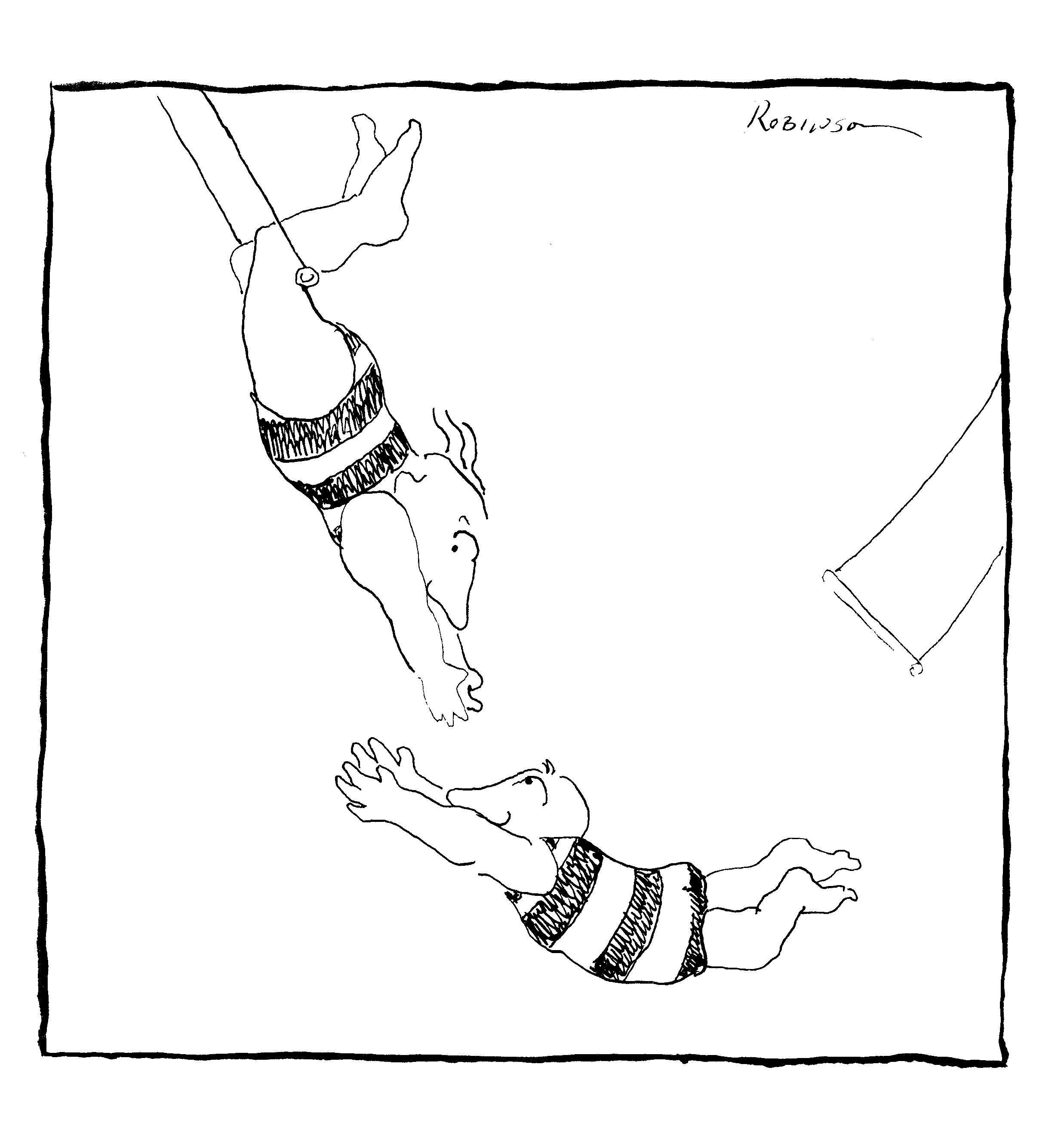
from the Flub series of cartoons by David Robinson

from the Flub series of cartoons by David Robinson

There is a Great Impossibility that looms when people or organizations step toward the creation of something new. See if you can catch it. It is a false expectation that is subtle but pure insanity once you see it. The conversation always goes something like this:

“We are trying to create something new but we’re having problems.”

“What’s stopping you?” I ask.

“We don’t know how to do it. We can’t move until we know how. Can you help us?”

I never answer this question. The only honest answer is, “It depends on what you’re willing to see and on your courage once you open your eyes.” That is not a very useful response. So, I usually ask, “What do you think you need help with?” That question is always a show-stopper!

Did you catch it? Did you see The Great Impossibility? It lives in the expectation that knowing “how” is a prerequisite to creating something new. The Great Impossibility is the belief that “how we do it” can be known ahead of time. “We have to know before we can step.” It is impossible. You can’t know. The skill is in learning to take a step anyway.

“How” is a trail that becomes visible after the path has been walked. “How” can only be known after the new thing is created. Think about it like this: if you know how to do it, you will inevitably recreate the old thing; it may have a new look but structurally it will be a repeat. If you follow a known path you will arrive at a known location. Creating, innovating, and learning, to be vital, are forays into unknown territory. They are explorations. They require leaving the known world behind for a while. They require exploding the expectation of “knowing how.”

The second Great Impossibility: expecting the walk into the new world to be comfortable. That’s a post for another day.

Go here to get my latest book, The Seer: The Mind of the Entrepreneur, Artist, Visionary, Seeker, Learner, Leader, Creator…You.title_page

Get hard copies here.

Circle The Nutshell

An illustration from A Dragon's Tale by David Robinson

An illustration from A Dragon’s Tale by David Robinson

A few days ago someone asked me, in a nutshell, to describe my book. I am a circular thinker and nutshells are generally too tight for me. Also, I tend to rant (my apologies to the many of you who’ve had to sit through my bluster) even when I have no intention of ranting. Fortunately, I made concept maps as support material found at the back of the book; being required to practice concept brevity has helped me find some sense of concision.

Here is my answer to the question: The book is about how to flip into a creative mindset (actually, it’s about how to regain the fantastically creative mindset that we are all born with but that requires some explaining. It’s easier to say, “flip perspective into…” like you can change your clothes and become an innovator. And, actually, that might be true if you assumed the role that the clothes inspired. For instance, Keith Johnstone writes about a “creativity” study done in the 1960’s in which people scoring low on a creativity test were asked to dress and act like hippies. They were then asked to retake the test in their hippie role and scored much, much higher). I warned you – I’m a circular thinker.

The rest of the nutshell goes like this: The book follows 3 cycles and each cycle facilitates a perspective flip:

The first cycle is Pattern: the flip is from needing “to know” to embracing not knowing (orient to patterns of curiosity).

The second cycle is Story: the flip is from “Things happen to me” to “I make things happen” (orient as the teller of the story). This one is the big one: people become capable of fulfilling their extraordinary capacity when they see how they make things happen.

The third cycle is Choice: the flip is from identifying as a witness to life to identifying as a creator of life (orient as a participant – a bringer of life).

And, the meta-flip that runs through it is all: Have the experience first and make meaning second. This is how your brain actually works. When you fool yourself into believing that you bring meaning to an experience before you actually have it, you are either lying to yourself, dulling your senses, or protecting yourself from learning something. Innovators, artists, creators, leaders, seekers, visionaries, and learners make their meaning after they have an experience: they know that the world is new every day.

Go here to get my latest book, The Seer: The Mind of the Entrepreneur, Artist, Visionary, title_pageSeeker, Learner, Leader, Creator…You.

Go here for hard copies

Learn To Play

Illustration from Play-to-Play by David Robinson

Illustration from Play-to-Play by David Robinson

This is from a yet-to-be-published children’s book I wrote and illustrated based on concepts from James Carse’s book, Finite And Infinite Games. The girl wants to play but the gorilla is reticent to start a game until he knows what she means by the word, “play.” Are they playing to win or playing to play? The gorilla helps the young girl make the distinction and set an intention to play to play.

At first glance this might seem like a ridiculous distinction until considering that one definition of play (playing to play) leads to mastery and the other definition (playing to win) leads to an outcome that might include a temporary sense of gratification (or despair if you lose). Do you remember the school lesson about angles? At the inception of the angle, a single point, vector variance seems minute but the further the vectors travel from their source the greater the paths diverge. Artists that play to win inevitably stop making art: losing is a painful business. Artists that play to play master their technique; mastery, in James Carse’s terminology, is an infinite game. There is no such thing as losing if mastery is the aim. If mastery is the aim, how an artist creates is as important as what they create. A life of mastery is a simple matter of where the focus is placed at the beginning of the journey.

This distinction is at the core of what ails many organizations. When the focus drops to the bottom line and stays there, organizations play to win and lose their reason for being. In fact, in today’s world, the rules of the game modify every few months amidst the rapid pace of change; playing to win is a great strategy for losing everything. Playing to play makes an organization nimble enough to survive and thrive amidst ever changing circumstances. Business, like learning, like art, is primarily centered on relationship and gets lost at sea when the focus becomes achievement. Relationship is an infinite game.

The power is in a choice made before the game begins. Are you going to play to win? Or, will you walk a mastery path and play to become a better and better player?

Go here to get my latest book, The Seer: The Mind of the Entrepreneur, Artist, Visionary, title_pageSeeker, Learner, Leader, Creator…You.


Ask Sam To Recite

The PoetI did this painting about my friend Sam. He is a brilliant poet who for years hid his poetry because he told himself the story that his poems weren’t good enough. He’s committed to memory the works of many other poets. At the drop of a hat, Sam can recite the perfect poem to fit any situation. Poetry is in his Irish blood.

He is remarkable in his love of language. In spirit he is a bard though he so feared his gift that for years he vehemently denied that he wrote poems. After cajoling him for months, he admitted to being a secret poet and in a parking lot behind an abandoned building he finally slipped me a sheaf of original poems. The experience was more drug deal than art share and I adored it. It took enormous courage for Sam to share his poems with me. I knew the moment he slipped the envelop of poems to me that I was holding in my hands the tender soul of an artist. It was big magic; like all artists, this man could change the world if he embraced his gift.

I never underestimate the courage and vulnerability necessary for an artist to open him or her self to the possibility of being seen. I am always honored when someone whispers to me, “I have something I want to share with you.” The artist-soul is a wild animal and does not easily come out of hiding.

I am convinced that all humans are artists because all humans have the capacity for presence. Artistry is not something mystic or out of the ordinary. Artistry is a way of being in the world. An artist sees beyond the abstraction of their thinking. An artist sees beyond the separation into the deep, fecund, shared space. Artistry is always about connectivity to that “something bigger” than the self. And then artists share what they see. There are as many ways to share the soul-space as there are people on the planet.

Sam’s poems are brilliant. He’s changed his story. The world outside changed when he changed his story and began sharing his poems. Eventually, when he was ready to let his wild animal run free, he published several poems under the title Fully Human. Find him. Ask him to recite a poem. And then ask him to recite one of his poems. You won’t be disappointed.

Go here to get my latest book, The Seer: The Mind of the Entrepreneur, Artist, title_pageVisionary, Seeker, Learner, Leader, Creator…You.

Intend The Glitch

Watching a video on “Glitch Art” the other day I heard this phrase: you have to understand a system before you can break it. A glitch in computer code is an anomaly or mistake that creates a hiccup or break in the system. It is a mistake that can make some very interesting imagery. Glitch artists seek the mistakes. They seek the beauty that comes from what others might view as a problem. And my favorite artistic moment as expressed by the glitch artists: at some point they start creating problems in the code. They intend the glitch (which makes it no longer a glitch).

Penicillin is the result of a process glitch. Science is often the art of surfing for glitches, finding the anomaly within the pattern. The word “experiment” implies an orchard of happy mistakes that reveal new insights. The word “unique” means distinctive, exceptional, singular – something out of the ordinary. In other words, a glitch.

Art and Innovation (in the USA) are equated with the new. Artists and innovators try to help us see the world in a new way – or even better, they help us see the world anew. Seeing anew always requires pattern disruption. It requires a challenge to the assumption set, a smack to the status quo. It requires a glitch.

Consider this: learning – true learning (not the answer driven drivel currently running rampant in our education system) and seeing anew are fundamentally the same thing. To learn is to see the new or to see anew. At the heart of art and science – the reason for math and English, economics, politics, ethics, social science,…, is an orientation to the question (as opposed to the numbing notion of a right answer).

Like the glitch artists, no one simply finds the new. It is not something that can be sought or predetermined. It is something we bumble into. It happens when you one day ask, “Hey, I wonder why that happened?” Or, “I wonder if it would work better if…?” It begins with wonder. Wonder leads to experimentation and questions within questions within questions that lead to more experimentation and more questions. This is also a good definition for being vitally alive. Wonder and step toward it. Orient to the question, do an experiment, and tomorrow ask a better question. Do this everyday and someday, just like the glitch artists, you will find yourself doing what all artists know as life-giving: you will intend the glitch, play with the mistake, and learn to see the world anew again and again and again.

For a humorous look at the wonderful world of innovation and new ventures, check out my new comic strip Fl!p and the gang at Fl!p Comics.