Expect The Possible

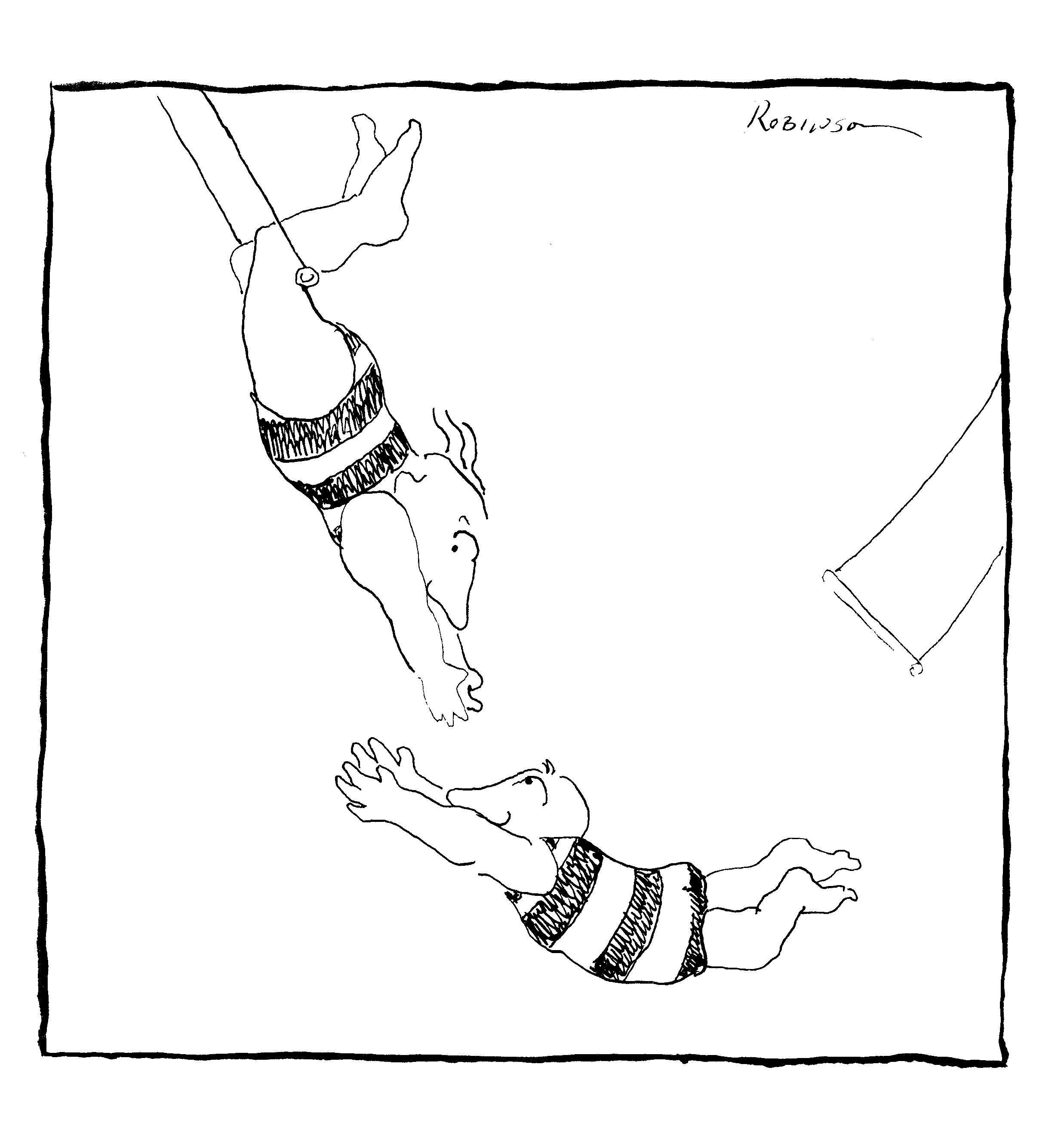
from the Flub series of cartoons by David Robinson

from the Flub series of cartoons by David Robinson

There is a Great Impossibility that looms when people or organizations step toward the creation of something new. See if you can catch it. It is a false expectation that is subtle but pure insanity once you see it. The conversation always goes something like this:

“We are trying to create something new but we’re having problems.”

“What’s stopping you?” I ask.

“We don’t know how to do it. We can’t move until we know how. Can you help us?”

I never answer this question. The only honest answer is, “It depends on what you’re willing to see and on your courage once you open your eyes.” That is not a very useful response. So, I usually ask, “What do you think you need help with?” That question is always a show-stopper!

Did you catch it? Did you see The Great Impossibility? It lives in the expectation that knowing “how” is a prerequisite to creating something new. The Great Impossibility is the belief that “how we do it” can be known ahead of time. “We have to know before we can step.” It is impossible. You can’t know. The skill is in learning to take a step anyway.

“How” is a trail that becomes visible after the path has been walked. “How” can only be known after the new thing is created. Think about it like this: if you know how to do it, you will inevitably recreate the old thing; it may have a new look but structurally it will be a repeat. If you follow a known path you will arrive at a known location. Creating, innovating, and learning, to be vital, are forays into unknown territory. They are explorations. They require leaving the known world behind for a while. They require exploding the expectation of “knowing how.”

The second Great Impossibility: expecting the walk into the new world to be comfortable. That’s a post for another day.

Go here to get my latest book, The Seer: The Mind of the Entrepreneur, Artist, Visionary, Seeker, Learner, Leader, Creator…You.title_page

Get hard copies here.

Circle The Nutshell

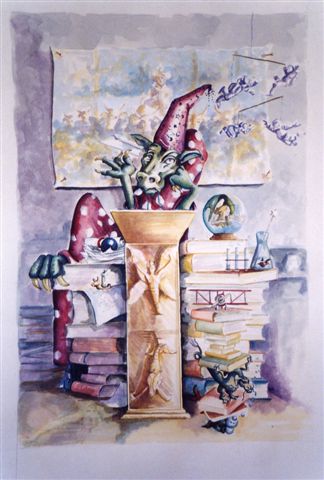
An illustration from A Dragon's Tale by David Robinson

An illustration from A Dragon’s Tale by David Robinson

A few days ago someone asked me, in a nutshell, to describe my book. I am a circular thinker and nutshells are generally too tight for me. Also, I tend to rant (my apologies to the many of you who’ve had to sit through my bluster) even when I have no intention of ranting. Fortunately, I made concept maps as support material found at the back of the book; being required to practice concept brevity has helped me find some sense of concision.

Here is my answer to the question: The book is about how to flip into a creative mindset (actually, it’s about how to regain the fantastically creative mindset that we are all born with but that requires some explaining. It’s easier to say, “flip perspective into…” like you can change your clothes and become an innovator. And, actually, that might be true if you assumed the role that the clothes inspired. For instance, Keith Johnstone writes about a “creativity” study done in the 1960’s in which people scoring low on a creativity test were asked to dress and act like hippies. They were then asked to retake the test in their hippie role and scored much, much higher). I warned you – I’m a circular thinker.

The rest of the nutshell goes like this: The book follows 3 cycles and each cycle facilitates a perspective flip:

The first cycle is Pattern: the flip is from needing “to know” to embracing not knowing (orient to patterns of curiosity).

The second cycle is Story: the flip is from “Things happen to me” to “I make things happen” (orient as the teller of the story). This one is the big one: people become capable of fulfilling their extraordinary capacity when they see how they make things happen.

The third cycle is Choice: the flip is from identifying as a witness to life to identifying as a creator of life (orient as a participant – a bringer of life).

And, the meta-flip that runs through it is all: Have the experience first and make meaning second. This is how your brain actually works. When you fool yourself into believing that you bring meaning to an experience before you actually have it, you are either lying to yourself, dulling your senses, or protecting yourself from learning something. Innovators, artists, creators, leaders, seekers, visionaries, and learners make their meaning after they have an experience: they know that the world is new every day.

Go here to get my latest book, The Seer: The Mind of the Entrepreneur, Artist, Visionary, title_pageSeeker, Learner, Leader, Creator…You.

Go here for hard copies

Learn To Play

Illustration from Play-to-Play by David Robinson

Illustration from Play-to-Play by David Robinson

This is from a yet-to-be-published children’s book I wrote and illustrated based on concepts from James Carse’s book, Finite And Infinite Games. The girl wants to play but the gorilla is reticent to start a game until he knows what she means by the word, “play.” Are they playing to win or playing to play? The gorilla helps the young girl make the distinction and set an intention to play to play.

At first glance this might seem like a ridiculous distinction until considering that one definition of play (playing to play) leads to mastery and the other definition (playing to win) leads to an outcome that might include a temporary sense of gratification (or despair if you lose). Do you remember the school lesson about angles? At the inception of the angle, a single point, vector variance seems minute but the further the vectors travel from their source the greater the paths diverge. Artists that play to win inevitably stop making art: losing is a painful business. Artists that play to play master their technique; mastery, in James Carse’s terminology, is an infinite game. There is no such thing as losing if mastery is the aim. If mastery is the aim, how an artist creates is as important as what they create. A life of mastery is a simple matter of where the focus is placed at the beginning of the journey.

This distinction is at the core of what ails many organizations. When the focus drops to the bottom line and stays there, organizations play to win and lose their reason for being. In fact, in today’s world, the rules of the game modify every few months amidst the rapid pace of change; playing to win is a great strategy for losing everything. Playing to play makes an organization nimble enough to survive and thrive amidst ever changing circumstances. Business, like learning, like art, is primarily centered on relationship and gets lost at sea when the focus becomes achievement. Relationship is an infinite game.

The power is in a choice made before the game begins. Are you going to play to win? Or, will you walk a mastery path and play to become a better and better player?

Go here to get my latest book, The Seer: The Mind of the Entrepreneur, Artist, Visionary, title_pageSeeker, Learner, Leader, Creator…You.


Ask Sam To Recite

The PoetI did this painting about my friend Sam. He is a brilliant poet who for years hid his poetry because he told himself the story that his poems weren’t good enough. He’s committed to memory the works of many other poets. At the drop of a hat, Sam can recite the perfect poem to fit any situation. Poetry is in his Irish blood.

He is remarkable in his love of language. In spirit he is a bard though he so feared his gift that for years he vehemently denied that he wrote poems. After cajoling him for months, he admitted to being a secret poet and in a parking lot behind an abandoned building he finally slipped me a sheaf of original poems. The experience was more drug deal than art share and I adored it. It took enormous courage for Sam to share his poems with me. I knew the moment he slipped the envelop of poems to me that I was holding in my hands the tender soul of an artist. It was big magic; like all artists, this man could change the world if he embraced his gift.

I never underestimate the courage and vulnerability necessary for an artist to open him or her self to the possibility of being seen. I am always honored when someone whispers to me, “I have something I want to share with you.” The artist-soul is a wild animal and does not easily come out of hiding.

I am convinced that all humans are artists because all humans have the capacity for presence. Artistry is not something mystic or out of the ordinary. Artistry is a way of being in the world. An artist sees beyond the abstraction of their thinking. An artist sees beyond the separation into the deep, fecund, shared space. Artistry is always about connectivity to that “something bigger” than the self. And then artists share what they see. There are as many ways to share the soul-space as there are people on the planet.

Sam’s poems are brilliant. He’s changed his story. The world outside changed when he changed his story and began sharing his poems. Eventually, when he was ready to let his wild animal run free, he published several poems under the title Fully Human. Find him. Ask him to recite a poem. And then ask him to recite one of his poems. You won’t be disappointed.

Go here to get my latest book, The Seer: The Mind of the Entrepreneur, Artist, title_pageVisionary, Seeker, Learner, Leader, Creator…You.

Intend The Glitch

Watching a video on “Glitch Art” the other day I heard this phrase: you have to understand a system before you can break it. A glitch in computer code is an anomaly or mistake that creates a hiccup or break in the system. It is a mistake that can make some very interesting imagery. Glitch artists seek the mistakes. They seek the beauty that comes from what others might view as a problem. And my favorite artistic moment as expressed by the glitch artists: at some point they start creating problems in the code. They intend the glitch (which makes it no longer a glitch).

Penicillin is the result of a process glitch. Science is often the art of surfing for glitches, finding the anomaly within the pattern. The word “experiment” implies an orchard of happy mistakes that reveal new insights. The word “unique” means distinctive, exceptional, singular – something out of the ordinary. In other words, a glitch.

Art and Innovation (in the USA) are equated with the new. Artists and innovators try to help us see the world in a new way – or even better, they help us see the world anew. Seeing anew always requires pattern disruption. It requires a challenge to the assumption set, a smack to the status quo. It requires a glitch.

Consider this: learning – true learning (not the answer driven drivel currently running rampant in our education system) and seeing anew are fundamentally the same thing. To learn is to see the new or to see anew. At the heart of art and science – the reason for math and English, economics, politics, ethics, social science,…, is an orientation to the question (as opposed to the numbing notion of a right answer).

Like the glitch artists, no one simply finds the new. It is not something that can be sought or predetermined. It is something we bumble into. It happens when you one day ask, “Hey, I wonder why that happened?” Or, “I wonder if it would work better if…?” It begins with wonder. Wonder leads to experimentation and questions within questions within questions that lead to more experimentation and more questions. This is also a good definition for being vitally alive. Wonder and step toward it. Orient to the question, do an experiment, and tomorrow ask a better question. Do this everyday and someday, just like the glitch artists, you will find yourself doing what all artists know as life-giving: you will intend the glitch, play with the mistake, and learn to see the world anew again and again and again.

For a humorous look at the wonderful world of innovation and new ventures, check out my new comic strip Fl!p and the gang at Fl!p Comics.

Step In Front Of The Canvas

I used to stand in front of a blank canvas, clear my mind, and look for the painting that was waiting for me to draw it out. Mostly, but not always, there was an image waiting for me. It was like a very shy animal staring back at me. I would coax it forward and it would slowly reveal itself to me. The act of painting was the act of following the signals. If I moved too fast the image would retreat. It drew me out as I drew the image forward. As it advanced, coming into the light, the image would shapeshift. It would try to frighten me. It would test my agility and capacity to pursue it. Finally, after it had tested my respect for it and gained respect for me, the image would rest, give up the chase and open. In that moment we merged. I was the art and the art was me. Many hours would pass in a single moment. Time was no longer fixed. None of the usual rules of life applied.

This sounds like a strange and reactive process until you consider that I spent days stretching and preparing the canvas. I prepared myself, too. I opened the portal and chose the moment to step in front of the canvas, brush in hand, and issue the call. Sometimes the animal that came forward was aggressive, sometimes magical, and sometimes swift. Always it was dedicated to opening a portal in me. Art is like that. Art opens portals in people.

Today I know without doubt that the world has at last become my studio. Each day is a blank canvas that holds a unique gift and demands one from me in return. It is a portal that I open that, in turn, opens me. It calls me to the center. I’ve spent a lifetime preparing this canvas. Each morning I step forward into the day and so begins a unique relationship with this vast field of possibilities shimmering in front of me – as it teases forward the vast field of possibilities within me. Life is like that. Life opens possibilities in people.

[903. Join me in inspiring truly powerful people. Each day I will add a new thought, story or idea to support your quest and mine.]

For a humorous look at the wonderful world of innovation and new ventures, check out my new comic strip Fl!p and the gang at Fl!p Comics.

Learn To Laugh

Comedy is about other people’s pain. Wiley Coyote going off the cliff one more time is funny. The guy slipping on the banana peel is hysterical as long as you are not that guy. Humor is mostly a status drop for someone.

I’ve been writing and drawing a cartoon called FL!P for almost half a year now so I’m inadvertently making a study of what’s funny and what is not. Recently some acquaintances that know me from my coaching life took me to task because my comic strip seemed out of character. “It’s mean,” they said. “Yes.” I said. That is precisely why it is funny.

The strip is aimed at entrepreneurs and there is a need for a bit of levity in a world so steeped in self-interest and confusing agendas. In many traditions around the world the trickster is an integral part of worship. We are not meant to take our gods so seriously. The reverence is always found in the relationship and the realization that the godhead is in all of us. It is our flaws that take us closer to the creative. Worship is a relationship and a full relationship includes laughter, joy, play, as well as inner quiet and awe. Tricksters break rules and pull the blanket off of societies inequities. Tricksters help us see what we pretend not to see. The Emperor would still be strutting around naked if the trickster boy hadn’t spoken a truth that the rest of the village denied. Truth comes easier with laughter. I can tell you that there is much public prancing in the world of accelerators and incubators but very little real apparel. Humor is necessary in a landscape so rife with pretending.

Artists are often of necessity the tricksters of their culture. It is the artists’ job to open eyes to what is there (versus what we think is there). It is the artists’ job to bring the communal attention into the present, to slap-stop the puffed up importance of things that do not matter so that the things of real importance can be seen. With a 24 hour news cycle and a congress ruled by corporate dollars it is hard for us to sort out what is valuable and what is not. The narrative in the commons rarely reaches the level of significance. It is no wonder that many people confess to getting their news from John Stewart and Stephen Colbert (both heroes of mine).

The greatest lessons of my life did not come gently and I am all the more grateful for the force behind the learning. My lessons came with status drops and like Wiley Coyote I have gone more than once over the cliff with an anvil close behind. Comedy is mean. Learning requires falling down. Stepping into the unknown is potent because of the myriad of things to trip over. If you can’t laugh at the bungle you’ll miss the lesson.

897. Join me in inspiring truly powerful people. Each day I will add a new thought, story or idea to support your quest and mine.

For a humorous look at the wonderful world of innovation and new ventures, check out my new comic strip Fl!p and the gang at Fl!p Comics.

See Your Reflection

870. Join me in inspiring truly powerful people. Each day I will add a new thought, story or idea to support your quest and mine.

My desk is littered with pencils and pens. They are escapees from the coffee mugs scattered across my desk where the pencils usually stand like toy soldiers jammed in a kiddie pool. I have multiple lists going. They are scrawled on standard notebook paper and they provide a crisscrossed tablecloth of sorts. My lists are not contained in the lines. They spill out in every direction. I tend to write at any angle and I bend the words, as the moment requires. I have 3 notebooks: a journal, a work journal and a cartoon idea book. All three are open and stacked in no particular order. They are well worn and loved and filled with scribbles and ideas. No one could make sense of them so I feel that my state secrets are safe. No code breaker would willingly take on my handwriting.

I have a sun of blown glass. Tamara made it for me because she knows that I suffer from the absence of light in the Seattle winter. Her gift of the sun has brought to me great light when I most needed it. Next to the sun is a clay vase that Tom made for me many years ago. I’ve cherished it these many years because it was his very first clay project and he wanted me to have it. The vase is wabi sabi, it is a leaning tower; in it I keep incense from Bali and from special people. Both the sun and vase are sacred to me.

Two empty Altoids tins, a sandwich bag with cords to charge my phone, a binder clip, a pocket flashlight, a pencil sharpener, little post it notes and a spattering of business cards for accent. Overseeing it all is a sculpture I made of wood, wire, clamps and paper: a crow cawing at the world. Next to the crow is a set of Unblockers. They are a gift from David and are “writer’s inspiration dice.” Each die has a word from Hamlet on each face. There are five dice and I throw them every once in a while for kicks. Right now they say, “Mercy sword, soldiers, weakness. Farewell.” David feeds my creative soul and sends me music treats and periodic whimsy to stoke the fire. Once, he and I did a collaborative painting on several panels spread across my kitchen floor. I have saved it all these years. Someday I will have a proper space to hang our painting (or I will surprise him with it!).

My desk is a snapshot of my life. Multiple projects in motion, chaos rolling on top of attempted order, talismans from friends and cherished loved ones. It is warm and whimsical and sometimes maddening so I restore order only to achieve swirling motion and chaos once again. The pencils and pens look like leisurely sunbathers scattered here and there and I will give them a reprieve for another day. Besides, like me, they are more productive when rested. Order looms on the horizon and I will invite it in soon but not too soon. Premature order will limit my choices.

Dream And Follow

869. Join me in inspiring truly powerful people. Each day I will add a new thought, story or idea to support your quest and mine.

Patti used to say that she refused to make business cards because a business card was a commitment. Say it and you will have to walk it. I’ve learned in the past several months that entrepreneurs resist talking to potential customers for fear of learning that their idea – their dream – may not have merit. Today Sean said it best: people are afraid of failing at their dream so they find a thousand reasons not to pursue it.

Dreams can be deferred but they will not be denied. A dream rejected becomes a knot in the belly. A dream ignored becomes low-grade anxiety, heart palpitation, road rage, a good reason to drink too much, an investment in notions like perfection or not-good-enough, a deathbed regret. Ignore a dream and it will twist and block all flow.

“What if…?” is a powerful question when in reference to the future. It is a call to action, a fount of possibility, an imagination tickler. “What if…? is equally powerful question when in reference to the past. No action is possible. It is an imagination tormentor. it is an abdication of responsibility to your self.

It is an old adage: the only certain road to failure is to not try. Failure is an abstraction. It is a construct that exists only as a story in your mind. It is an investment in what other people might think. Hint: other people have their own dreams and usually if they are negative about your dream it is because they are ignoring theirs; they need allies in their impotence.

As Tom used to say, “A painter paints.” A Painter does not succeed or fail. A painter paints and becomes a better painter. Failure is not an option when you are following your dream. Success is not an option when you are following your dream. Dreams do not dally with failure or success. Dreams call. All that is required is to follow, to grow, to learn, to live. To love.

Make The Offer

798. Join me in inspiring truly powerful people. Each day I will add a new thought, story or idea to support your quest and mine.

If you’ve not yet heard Neil Gaiman’s commencement address to the University for the Arts in Philadelphia, take a moment and treat yourself. His message in a nutshell: make good art regardless of what life throws your way. And, by good art, he means your art. Give full expression to your voice. Make your art regardless of what life throws your way.

This morning Kerri sent me a text. She’d just played the music for a funeral. Her message: this ride is short. There’s no time to be afraid. Make your art. Step into life. Love big. Love now. And, back to Neil Gaiman, enjoy your moment. Really enjoy it. That’s how you make good art. The tortured artist image is highly overrated and mostly a lie. Art comes through pain but is never sourced in it.

As Skip and I waited for the ferry last night he recounted a conversation from his day. It was with a young entrepreneur who thought the whole world was waiting impatiently for his idea. Idea thieves lurked around every corner. He was keeping his idea close to his vest. He was suffocating his idea and himself so steeped was he in his assumed importance. I told Skip to share with the young entrepreneur what Quinn once told me: there are several billion people on this planet and you are the only one who gives a damn about what you think.

Life is too short to suffocate your ideas and limit your artistry with assumed importance. The other several billion people are thinking about their voices, not yours. They might compare theirs to yours and perhaps, like you, even copy some of what you chunk out. That’s called inspiration. Make good art. Share it. Enjoy it, regardless of its reception. Its worth has nothing to do with how it is received. Your worth has nothing to do with how you are received.

Make the offer. Make good art.