Invite Them In

When Kerri read this poem I almost laughed. She was leading the Taize service and had chosen this poem specifically for me to hear. I had, all day, decided to have a very very hard day. In retrospect, nothing happened that was necessarily overwhelming. A tornado did not blow my house down. My paintings did not burn in a hill fire. All of the people I love survived the day, in fact, most thrived! My challenges were imaginary. They were walls of my own creation!

I chose frustration. I danced with disappointment. And then I got angry at myself for being frustrated. It was a feedback loop of self-incrimination. I told myself that I’d lost a perfectly beautiful day in my dedication to my mania. In the middle of my dark storm, Kerri introduced this poem. Enjoy it. Remember it the next time you choose to have a very very hard day.

The Guest House by Rumi

This being human is a guest house                                                                                               Every morning a new arrival.                                                                                                                 A joy, a depression, a meanness                                                                                                   Some momentary awareness comes                                                                                                 As an unexpected visitor.

Treat each guest honorably.                                                                                                                 He may be clearing you out                                                                                                                 For some new delight.

The dark thought, the shame, the malice,                                                                                       Meet them at the door laughing                                                                                                           And invite them in.

Be grateful for whoever comes                                                                                                     Because each has been sent                                                                                                                    As a guide from beyond.

title_pageGo here for my latest book

Count Your (Minor) Miracles

This is a silly watercolor I did a few years ago. I call it 'Dreams and Dogs.' It's not show worthy but makes me laugh so I keep it around.

This is a silly watercolor I did a few years ago. I call it ‘Dreams and Dogs.’ It’s not show worthy but makes me laugh so I keep it around.

Today I heard the phrase, “minor miracle.” It struck me as odd because I’m not sure that miracles come in major, minor, or standard forms. But, that being said, I decided to make a list of the minor miracles I experienced today:

I awoke. I was alive! And, being alive, I was excited to live another day of life.

I had the best cup of coffee I’ve ever had. Although this happens every morning, the first cup of coffee never fails to be the best ever. It was the first. It was the best.

Mid-morning we took a walk. The day was gorgeous. The breezes from the lake were cool but the sun was warm. The collision of temperature was sensual, startling and enlivening. It was so gorgeous that we took an extra long walk so we might linger in the day.

During our walk, we were surrounded by a cloud of dragonflies. They ringed us and stayed with us for several hundred yards.

I had an epiphany.

We made a customer service call and talked with someone dedicated to serving customers. The challenge remains but the company is no longer an obstacle but is now an ally.

Later, taking Tripper Dog-Dog-Dog for a walk, instead of the usual sled dog technique, he actually walked like a real dog that was trained to heel. The change was so impressive that Kerri said, “This makes me believe anything is possible.”

I have a new painting tapping my shoulder. It wants to be painted. It won’t leave me alone until I pay attention. I admire its persistence.

At sunset, we sat in the hammock with cold beer and Skinny Pop popcorn watching the clouds seep brilliant orange and migrate slowly across the sky.

We sang a song on the voicemail of a friend in deep distress. It made her laugh. It changed her day.

The night air is cool. The windows are open and the breeze is almost but not quite cold. It is quiet and begs for a walk. It will be the third walk of the day and will most likely be filled with a few more minor miracles.

The day also held major miracles, too. But, being major, they are subject to a report on another day.

title_pageGo here for my latest book

Let Yourself Go

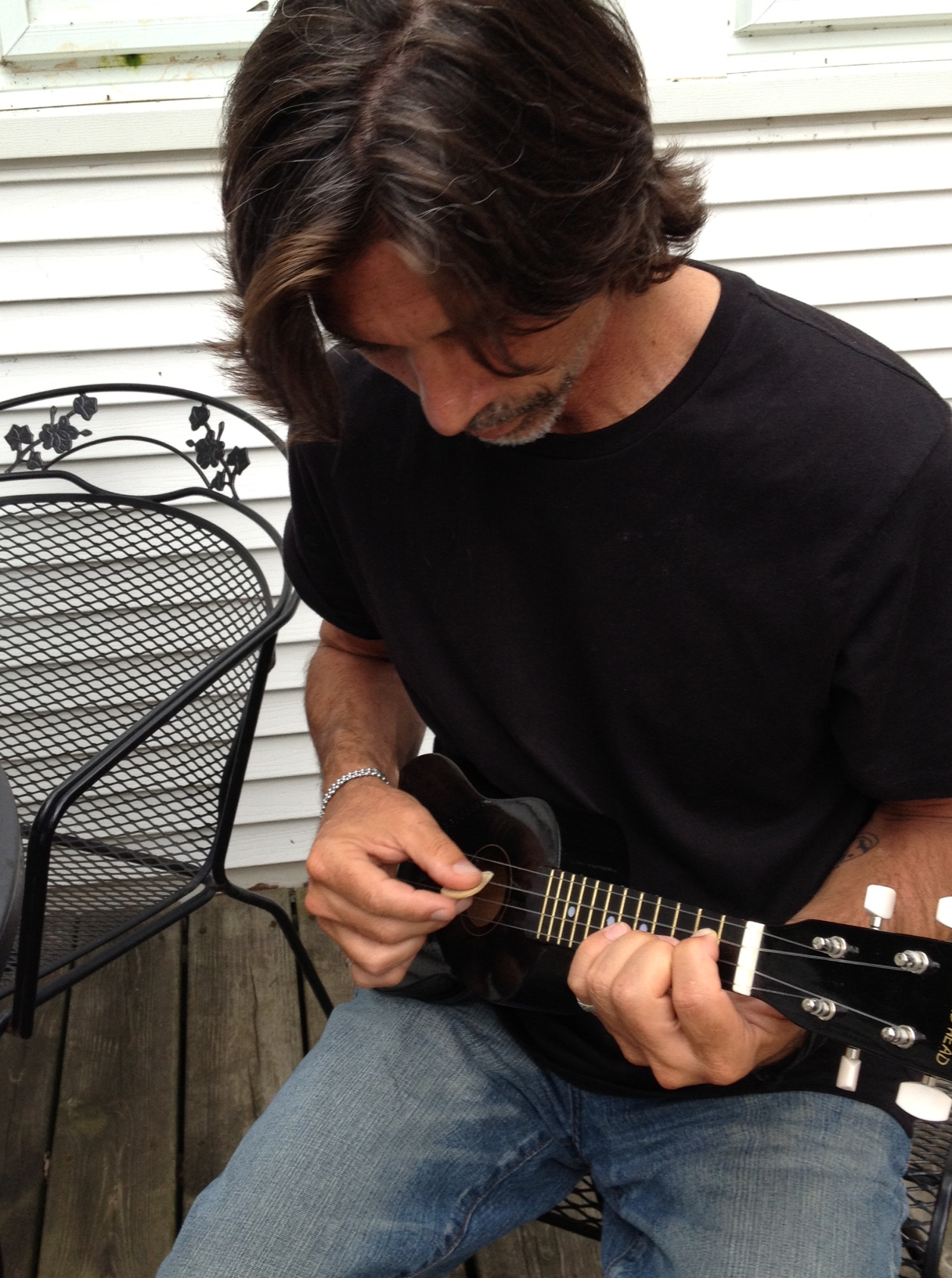
I have no idea how, but I'm making a mess of sound and will one day play the ukulele.

I have no idea how, but I’m making a mess of sound and will one day play the ukulele. Kerri says that I already am…

My meditation on the word “how” continues.

At our recent Summit in Holland, Alan and I asked the question, “What would you do if you didn’t have to know how?” It is a great question. The short answer is this: you’d figure it out. You’d try things. And if your first attempts led nowhere you’d try something else.

In this musing I have often written that “how” is something that is known at the end of the journey. We can’t answer “how” with any honesty until the story is played. Today I recognize that there are two distinctly different “hows:” 1) the explanation, “This is how I did it. This is how you do it. This is the “how” that presumes a path or a prescription. When dealing with this version of “how” I ask groups or clients to consider their life story and tell me how they got to this day in this place doing this job, etc.. The answer is mostly, “A clear path with a lot of happy accidents,” or something like, “I have no idea. I didn’t try.” Yes. Ask me how to paint a painting and I will tell you that I have no idea. I’ve painted a thousand of them and I can teach color theory or composition but I cannot tell you how to open to the muse, how to become a channel for something greater to come through. To paint a painting, to act in the play, to write the book, there is something akin to letting go. There is a divine surrender. So, how did you get to this place in your life? Divine surrender. Happy accident. Unstoppable forces.

If the first form of “how” is an explanation, the second is akin to giving permission. I have worked with a legion of blocked artists who set up studios, buy musical instruments, sign up for improv class,…, and then sit in their studio, stare at their musical instrument, and forget to go to class. When they call me, they tell me their story and always finish the telling with, “I don’t know how….” For my fee, I could say a single, simple word: start. Instead, what we usually do in our work together is find their internal permission. When they realize that their block has nothing to do with “how” and everything to do with the fear of being judged (“how” is an internal braking system meant to prevent starting), when they are ready to, as Saul would say, “Orient to their own concern,” they allow that their opinion of their work trumps all others, they give themselves permission. They start. They play.

Recently, a brilliant woman, an attendee of the Summit, a maker of incredible mandalas, sent me an email with a photo of the start of a painting. She asked for my advice. I wrote: make a mess. Paint on top of the mess. Then repeat. Today in my inbox I received her beautiful mess with a note that their would be more messes to follow. She started. She picked up a brush. She splashed some paint. She splashed some more paint in response to her first splashes. That is how art is made. That is how light bulbs were invented.

This morning I laughed when I realized the double definition of the phrase, “Let yourself go.” In common parlance, it is used as a negative, when people give up, when they stop trying to maintain their health or their appearance, “He really let himself go.” The second possible meaning is to start. To go. The next time someone is sitting in their studio and asks me the question “how,” I will respond like this: let yourself go.

Go here for my latest book. title_page

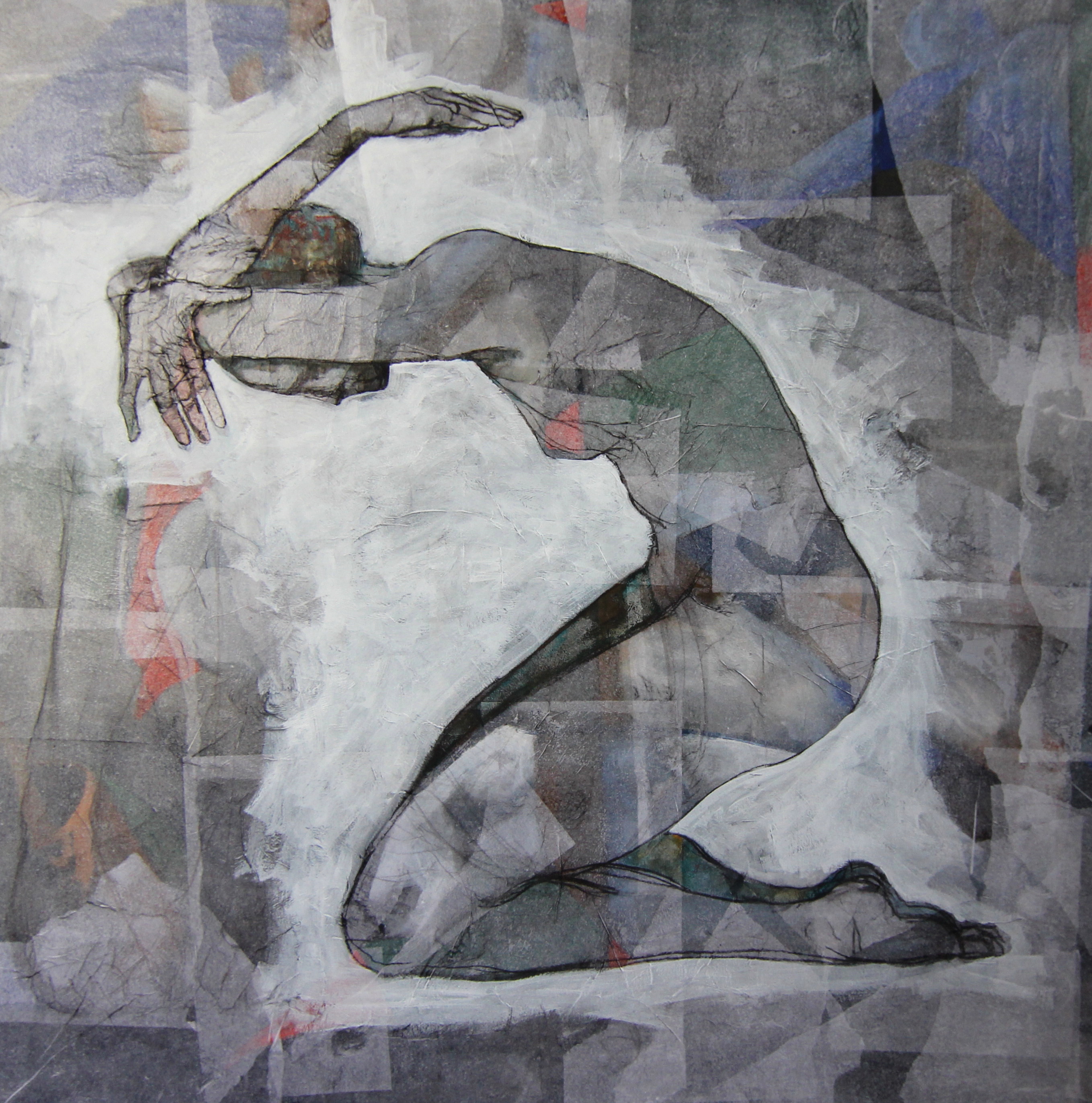
Yoga Series 7Go here for fine art prints of my yoga series (and more).

Know Your Pilgrimage

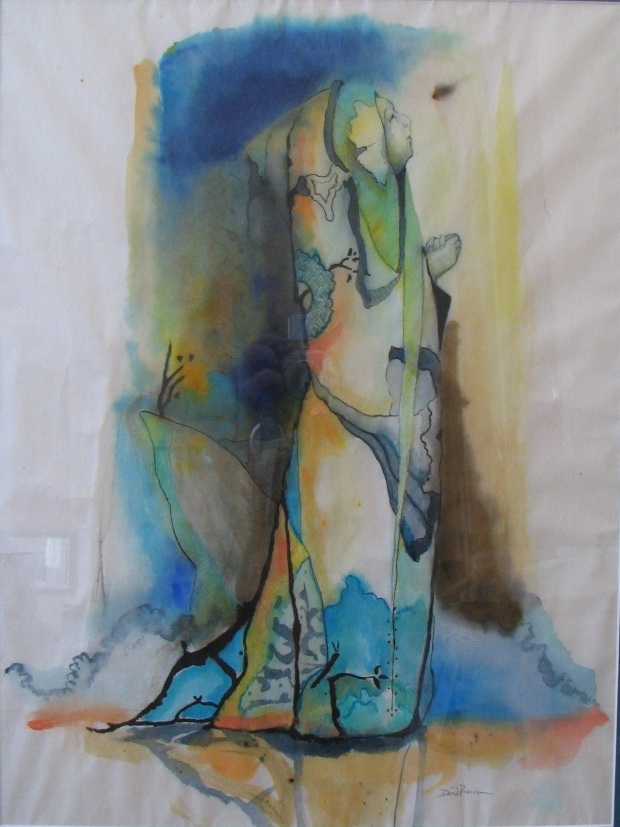
Arnie owns this one. A watercolor from days past.

Arnie owns this one. A watercolor from days past.

I keep notes and short phrases to spark thoughts for future posts. The notes are scattered everywhere: scribbled in margins of my notebooks, written on Post-it notes stuck to the wall or in a helter-skelter line running the length of the table, or cryptic messages typed at the bottom of other documents. This morning I caught sight of this prompt:

Pilgrimages are supposed to be arduous.

During facilitations I used to tell groups that people without challenges create challenges. These created challenges are called hobbies. Or, really bored people create drama: drama is a unique challenge otherwise known as gossip.

People thrive when challenged. People grow when challenged. When I was a teacher I used to love the skateboarders. They’d dedicate hours and hours of repetition, broken wrists and ankles to master a move. Every athlete and artist knows the journey to their personal Everest is fraught with challenge and impossibility. That is why they do what they do. One of the people I admire most on this planet is John Kirschenbaum. He is a master woodworker. His criteria for taking on a project: it has to include something that he does not know how to do.

The idea that a good life is safe and easy is a marketing idea meant to sell you a suburban house in a gated community that includes a hot tub. It is also a recipe for boredom and frustration. It is also a lie. A good life is not without obstacles just as a good story is driven by challenges. A good life is not safe or easy. A good life is passionate. A life well-lived has a bliss-center that is focused on fields of potential and not fears of failure. A life well-lived does not avoid challenges; it embraces them. It courts them. It celebrates them.

Pilgrimages are meant to challenge you. They make your feet ache while they open your eyes and heart. They are meant to help you recognize what matters and what does not.

Go here to get my latest book, The Seer: The Mind of the Entrepreneur, Artist, Visionary, title_pageSeeker, Learner, Leader, Creator…You.

Or, go to Amazon: The Seer, David Robinson

Give As Love

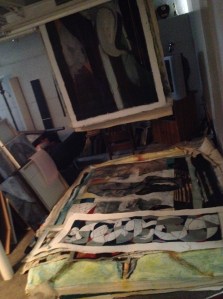
The stack of paintings sitting in my basement waiting for me to show them.

The stack of paintings sitting in my basement waiting for me to show them.

Sitting in the choir loft this morning I was at first disappointed that the stained glass window was silent. I was so full of questions – and have lately been so full of questions – and have come to look forward to hanging out in the loft, conversing with the window, while Kerri plays a service.

When I bring my questions the window always has something to say. The window offers a better set of questions or a startling reflection or a slap of insight. The window’s responses always come in the form of a message of return (return to heart, return to forgiveness, etc.). If I get quiet and ask my question, out of the peace, a conversation always ensues. Today, from my quiet, I asked my question about artistry, about my artistry, and I was met with an unusual silence. I wrinkled my brow. I wondered if my conversation with the window had come to an end or if perhaps my question was out of the scope of topics for a stained glass window.

There was a visiting pastor, an elder who’d been preaching for over 50 years. I sat up and paid attention when he began his sermon this way:

“Artists have a special gift. They help others see in a new way….”

His message was about love. Love, he told us, takes many forms and the form that love takes depends upon the unique gifts of the lover: a symphony is a gift of love, a painting is a gift of love. A plumber fixing a broken water main late into the evening is a gift of love. “What is your gift? he asked. Do you recognize it as love?

A few years ago, on New Year’s Eve, I visited a tarot woman at a bookstore in Denver. During our session she asked me a question that felt like a cold slap in the face. “You know god’s voice,” she said. “Why do you not use it?” I mumbled a lame excuse that dribbled into silence. “Why do you not use it?” she asked again.

Sitting across the table from the tarot woman, I knew without doubt that I have, my whole life, been a great servant to other people’s artistry but a lousy servant to my own. In my life I’ve been the midwife to many people’s gifts while mine have remained mostly unrealized.

The window whispered, “A painting is a gift of love. So is a play. So is a book. These are your forms of love. Your gift is a gift of love. Love is god’s voice and you know god’s voice.”

“I do know it,” I said, timid to admit it. “Don’t we all?” I asked the window.

“Access is open to all. Few actually listen,” the window replied. “Few know how to listen. Most fear their gift and plug their ears.”

To offer my gift without inhibition is how I best express love to the world? That was old and new for me at the same time. I asked the window, “How many artists need to hear that message? How many people need to hear that message?”

“You are deflecting. You deflect your gift by serving other people’s purposes before your own. These questions you ask are the wrong questions,” said the window. “Yes, of course, all people need to hear the message. But, is it your purpose to deliver the message or is it your purpose to fulfill your gift? Helping others hear their message is not yours to do. Yours is to fulfill your gift and, in that way, help others to see their gift in a new way. You need do nothing but give your gift. They will see or not without your intervention. Love by giving your gift. It is simple. Give your gift, give your love, without reservation or doubt.”

“Love can be how you listen to a friend in need,” the pastor said. Love is not about the rules or the restrictions. Even when you try to alienate love, it will always find its way back to you. It will find its way back through you.

“You know god’s voice,” the window continued. “And you know it. Return to the truth; return to your truth. The question, ‘Why do you not use it,’ no longer matters. It, too, is a deflection. Asking ‘why’ merely delays the giving. Use it. Give it. Give as love.”

Go here to get my latest book, The Seer: The Mind of the Entrepreneur, Artist, Visionary, title_pageSeeker, Learner, Leader, Creator…You.

Or, go here for hard copies.

What Do You Value?

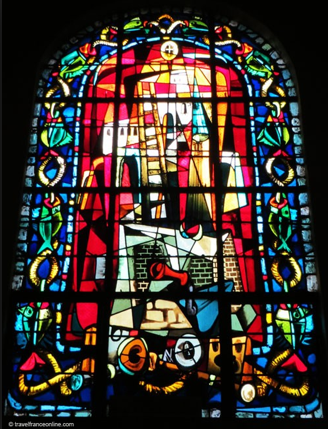
One of the windows by Max Ingrand at Saint Pierre de Montmarte

One of the windows by Max Ingrand at Saint Pierre de Montmarte

What has value? What has merit?

Or, here’s a better question: What is value? What is merit?

During our travels I looked at a lot of art and architecture from across the centuries and across many different cultures. There is a very old church, Saint Pierre of Montmarte, one of the oldest in Paris, seated adjacent to Sacre Coeur high on the hill overlooking the city. This ancient church has been outfitted with stained glass windows, designed by Max Ingrand, that I can only describe as cubist. The collision of ancient church and modern window is breathtaking and perfect. The windows were so beautiful (to me) that they brought tears to my eyes. It was hard for me to leave the church as I was so taken by the windows yet I was also aware of the number of people moving through that were not impacted at all. Later, I entered Sacre Coeur and felt nothing. To me, it was impressive, impersonal, and left me cold – yet I watched others catch their breath with its scope and grandeur. They were moved to tears.

Is value purely personal and subjective?

I remember listening to a recorded lecture by Joseph Campbell. He said that you could tell what a society valued by the buildings constructed in the city center. For centuries, churches occupied the village center. Financial institutions occupy our village/value center. Is value an agreement? Is it a focal point of worship? Take a gander at the titles in the local bookstore and you will find that money, morality, spirituality, and success are odd bedfellows. Is a good life richly lived demarcated by the size of a bank account? Tourists in the distant future will visit the holy sites occupying our village center and read placards about what we valued.

Near Sacre Coeur is the cemetery at Montmartre. We descended the hill to the cemetery and walked the paths through the monuments and graves. They fascinate me. They are essences, value statements distilled to a thick concentrate of marble and stone. There are angels and gargoyles, draped figures in repose and riders of the apocalypse. There are statements: loving father, devoted mother. There are roles: composer, writer, soldier, painter, baker, philosopher, politician. The famous are interred next to the ordinary. In a cemetery, all lives are even. Standing amidst the graves I see lives lived, dreams dreamed and realized or unrealized, and I wonder what each person valued during their allotment of days, and what they valued on the very last day.

Value is relative and passing? An extraordinary moment, when conscious, is valuable.

This is from Rumi: Spirit is so mixed with the visible world that giver, gift, and beneficiary are one thing. You are the grace raining down; the grace is you.

Value is grace? You? What surrounds you?

Go here to get my latest book, The Seer: The Mind of the Entrepreneur, Artist, Visionary, title_pageSeeker, Learner, Leader, Creator…You.

Story Your Life

title_pageI’ve received a few questions this week about life stories and rather than blather…here’s another snippet from my book, The Seer:

Stories often deal with the collision that arises when learned patterns blind us to our natural impulses. Living according to what we “should do” or “should think” inevitably collides with what we desire to do and this provides a hot crucible for growth. When Virgil asked me to practice “not knowing” he was poking a hole in my story of “should do” so that I might once again hear what I intuitively knew to be true. Stories show us how to get out of our own way. As Virgil recently wrote:

Virgil: You are at one time the source of your yearning and your greatest obstacle. What you think that you should do IS the obstacle to your desire.

In my latest chat with Virgil I told him of my revelations about ‘not knowing what I DO know,’ about my memory of my client, and how I convinced her that she didn’t need me and could do the work by herself. I wrote:

Me: At the time I really needed the money. I needed the business! And I spent that morning convincing a potential client that she didn’t need me. It’s the story of my life!

He responded:

Virgil: Oh, you are dangerously close to the third recognition.

I decided I needed to stop being careful with how I said things to Virgil. I’d just learned that my language mattered so I might as well write what I was thinking:

Me: Well, maybe you should tell me before I trip over something and hurt myself. You must have an answer or two in there somewhere…

Virgil: I’m woefully low on answers but I do have a question for you: What did you mean when you wrote: It’s the story of my life?

Me: I don’t know. It was just a phrase, an attempt at humor.

Virgil: What if it’s not just a phrase?

Me: You mean that convincing people that they don’t need my services is the story of my life? That is why my business crashed?

Virgil: No. I’m not inferring, interpreting or implying anything. You used this phrase: It is the story of my life. I’m asking you to consider that this is more than a flippant phrase. Are you aware of the story of your life?

I was getting angry again. And I was beginning to recognize that my anger was a pattern that flared when I felt lost. I get angry when I am driving and miss my turn or can’t find where I’m going. I wanted a map. I wanted Virgil to be my personal GPS and tell me where to go. Where were we going with this? Sometimes I can’t help my sarcasm:

Me: You mean I only get one story?

Virgil: Your story is not something you get. Remember, your language matters. Choose your words more carefully and you might see the third recognition before you trip over it. Connect the dots. Tripping over it will not hurt you. It’s the choice to be blind that causes your pain.

Go here to get my latest book, The Seer: The Mind of the Entrepreneur, Artist, Visionary, Seeker, Learner, Leader, Creator…You.

Go here for hard copies.


Locate Your Self

title_pageHere’s a short excerpt from my book, The Seer, dealing with the dance between investments, limitations, and the roles we play in life. This conversation is a kind of coaching session and is happening via online chat:

Me:…All week I’ve asked myself, “why?” Why the dramatic shift in experience from role to role? I’m a bit shocked to realize that I play many, many roles each day. In each role I want something and what I want is different depending upon the people I am with. I realized that my roles are not about me in isolation – and what do I mean by that? I mean that I define my role by how I define the relationship I am in at the moment. For instance, in my workshop, I assumed the role of “guide” and I wanted to lead the young people to some new insights that might help them create their businesses. In my conversation with my parents, in the role of “son,” I wanted them to be pleased with my work. I wanted to share and I wanted their approval. So, my role is defined by relationship and in each different relationship I tell a specific story based on what I want or need. I’ve “cast” myself in these little mini-stories. Or to use your term, “role” is the way I “locate” myself in the story.

Virgil: And how does this knowledge help you with your questions about business?

Me: The first thing that occurs to me is that I have the capacity to locate myself in a different way if I don’t like the role I’m playing. I can change how I locate myself. Also, there is a dance with the words “limitation” and “investment.” I took notes all week and realized that I was using the verb “to invest” over and over again to describe my experience of different roles. So, for instance, during my dinner with my friend Bruce I invested in helping him. I wanted Bruce to know that I cared about his challenges. Then, I watched Bruce invest in being the wine expert. It was his way of caring for me and demonstrating his expertise. I began to see my investments as keys to discerning my limitations. In some roles I’ve invested in the idea that I can’t do something or that I’m not good at something. In some roles I diminish myself; my limitations are investments in being small.

Virgil: Just a caution: as you explore further the dance between investment and limitation, remember to practice suspending your judgment. Remember: you are having experiences first so you can see how you make meaning and begin to choose how you make meaning.

Me: Thank you. It’s a good reminder. I was beating myself up every time I     realized I was investing in being small.

Virgil: We tell ourselves stories. We locate ourselves within the stories. In fact, that is the next recognition: you locate yourself within your story. We do it physically (like your description of choosing the table in the restaurant); we do it through the roles we assume – specifically our assumptions of how we need to play our roles, what is ours to do, etc. Locating is simply a way of establishing comfort. We sort to the known. If you judge how you locate yourself, you miss the opportunity to change how you locate yourself.

Me: Right. Judgment blinds me to the choices I am making.

Virgil: Judgment is always a version of the “things are happening to me” story. In fact, judgment is a way of locating: it is the warning signal when we step too close to discomfort. When I judge myself and say, “I’m an idiot,” I’m actually locating myself, pulling myself back into my comfort zone. When I judge others, “They are idiots,” I’m locating myself in a higher status position. The action of diminishing “them” elevates me back into a comfortable status position. Thus, suspending your judgments removes the easy step back to comfort and allows you to stand in “not knowing” and see what is there beyond what you think is there.

Go here to get my latest book, The Seer: The Mind of the Entrepreneur, Artist, Visionary, Seeker, Learner, Leader, Creator…You.

Or, go here for hard copies.

Clear The Channel

Something else from the archives.

Something else from the archives.

It is the day before we fly to the Netherlands. We started the day early with a long walk, coffee, and a chat about everything but our prodigious to-do list. We’ve learned that it makes a huge difference to our day if we start slow. It makes a difference if we make a conscious choice about where we place our focus in the day.

For years I rose early and read something that inspired me. I read sacred texts, philosophers, artists, seekers, children’s books,…, anything that pulled my mind from my to-do list and grounded me in things that seemed more important to give my thought space. It was a form of meditation. I learned early on that my readings influenced what I saw during the day and, so, influenced my experiences; I interpreted my life according to my meditation instead of my to-dos. I opened to experiences instead of predetermining how I should feel about the list.

Now, after so many years, I have developed an automatic response to the flotsam that might catch my attention. When some clutter catches my attention I say to myself, “I don’t want that to occupy my mind.” And, like a cloud, it evaporates. I want to keep my thought channels clear. I want my thoughts focused on attention to and appreciation of the moment, creative processes, or noodling with cool ideas – and not snagged on the news of the day. Thought channels are like arteries and too much gunk will jam the flow. Gunk is a great source of depression. Last year I went on a news moratorium when I started my walk-about and found that I had a lot more thought space without the news-cycle-chatter. I learned that without turning on the news or opening a paper I heard everything worth knowing. I learned that I  had no need for the endless cycle of breaking news to be well informed; 24 hour news is like bad cholesterol. It is an addiction. It is a false high. I learned the necessity of questioning what I was plugging in to (what I was plugging into my mind).

Knowing what you don’t want clogging your mind necessitates becoming clear about what you do want occupying your thought. Thought requires a focus and focus is a choice. Mostly, my answer is no thought. I want silence. I want presence and presence requires almost no interpretation.

Go here to get my latest book, The Seer: The Mind of the Entrepreneur, Artist, Visionary, title_pageSeeker, Learner, Leader, Creator…You.

Go here for hard copies.


Summit

A painting from the distant past. For some reason I wanted to reach deep into the archives for this post.

A painting from the distant past. For some reason I wanted to reach deep into the archives for this post.

The theme for the workshop in Holland is “team.” I’ve never been linear about how I think about anything and this time of planning has been exceptionally circular. I complimented Alan the other day; he has a genius for immediately reducing complex concepts into easily graspable models. I, on the other hand, have to circle and circle in an ever-tightening spiral in order to articulate what I see to others. I generally live in the stratosphere and have to grab ahold of a stone in order to touch the ground.

It’s been over a year since I gave much thought to the corporate world or any form of facilitation. I left it when I went on my pilgrimage. Walking away affords space and perspective. I wrote my book, The Seer, during the first months of my walk-about. It served as a shorthand story for all the things I’ve so far learned. It also served as a “letting go,” a release of all the things I thought I knew. All of my previously held sacred assumptions dissipated. What was known is now unknown. I am certain that I know nothing at all so it is the perfect time to begin a discovery process with a group of people. My worth to any group has been my perspective, my capacity to say, “I don’t know. Let’s find out together.” I need to be an outlier to be able to see. I need to stand on the margin to serve.

I’ve come to recognize that my pilgrimage is not over. It entered a different phase. It is not a path to a cathedral or holy land, it is the ascension of a summit. My lengthy walk took me to base camp merely. For many months I’ve been acclimating to the altitude and now it is time to travel toward the summit. For the first time in my life I am asking myself a better set of questions about my unique pursuit. I can see how my unique K2 is distinct from all of the other peaks. I’ve climbed other people’s mountains. I’ve helped carry lots of other people’s stuff. This peak, this summit is mine.

As I spiral in tighter and tighter, coming to understand what is so allusive about this simple word, “team,” I am amused to realize that what was once charted territory is now the outland. The wilderness into which I step is the very field I left behind. What was known is now unknown. I am certain of two things and recognizing both lets me know I am ready to move forward: 1) I know nothing at all. 2) No one summits alone.

Go here to get my latest book, The Seer: The Mind of the Entrepreneur, Artist, Visionary, title_pageSeeker, Learner, Leader, Creator…You.

Or, go here for hard copies.