What’s Now? [on Two Artists Tuesday]

After a fairly contentious conference I co-facilitated in The Netherlands, Kerri and I took the bullet train to Paris. It was early in our relationship and our first time abroad together. We couldn’t afford to get to Paris otherwise, so tagging a small vacation onto a work trip seemed foolish not to do. It was the perfect place at the perfect time. I released the conference friction the moment we stepped off the train. I didn’t know it at the time but on the streets of Paris I left behind a skin that I’d badly needed to shed.

We had limited funds so we bought baguettes and Camembert cheese, fruit, tarts from vendors and bottles of wine. We ate in parks. We wandered the streets. Climbed the hill to Sacre’- Coeur, visited Rodin, and tried to get lost. We fell exhausted into bed each night, full of art and sound and color and delicious wandering. One night we sauntered to the Arc de Triomphe and barely escaped a riot. Bus loads of police in riot gear appeared on the street and, wide-eyed, we slipped out of the crowd and hustled to find more peaceful rues. Paris now serves as a marker. There was before Paris. And after.

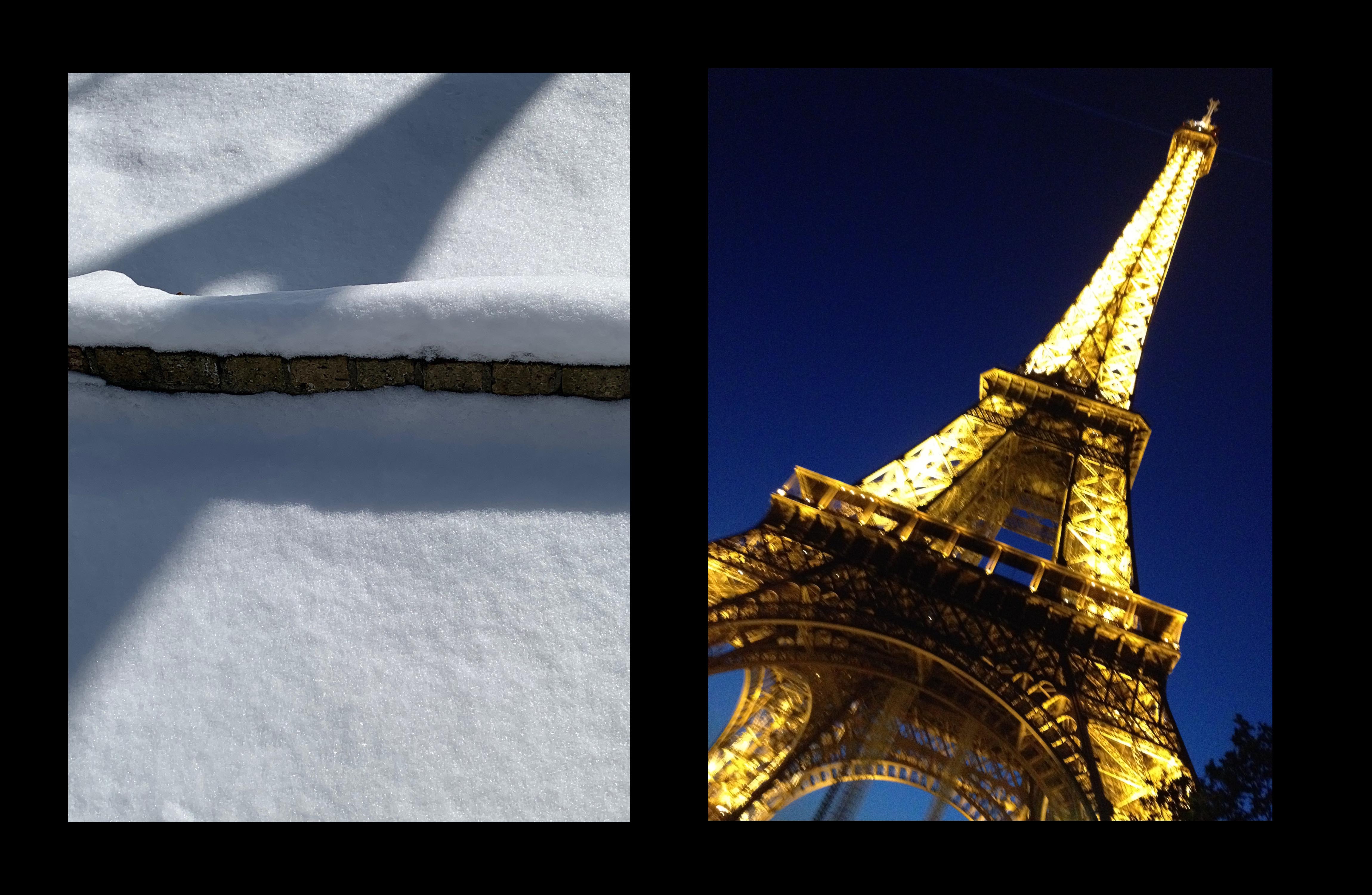
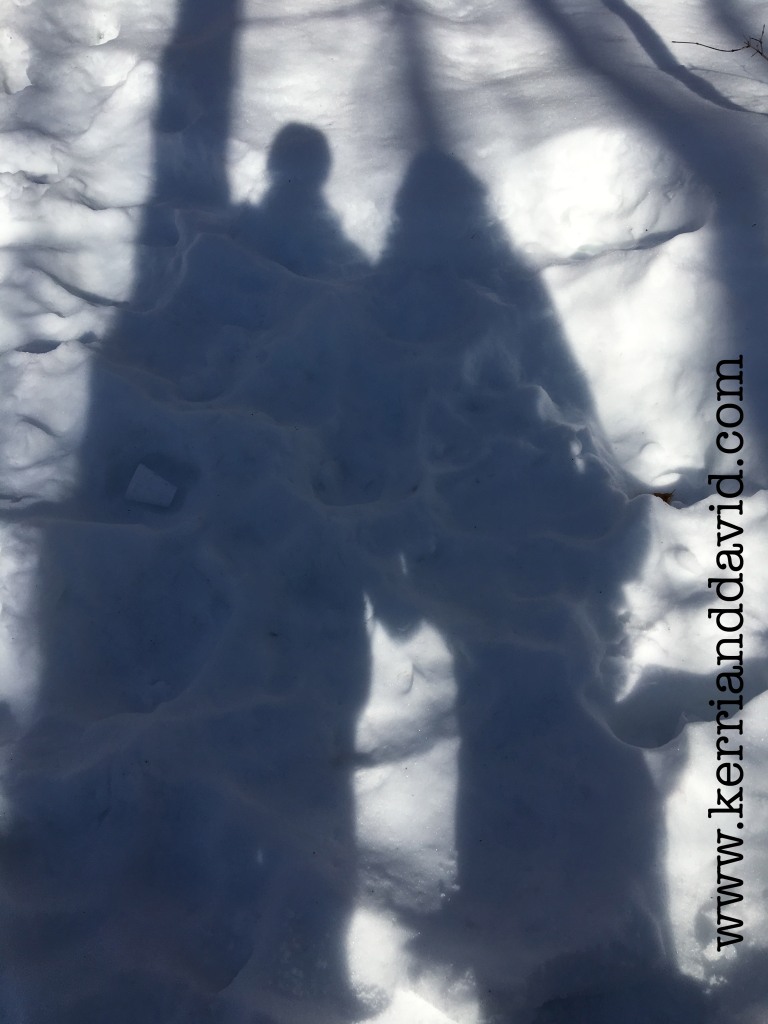
“This shadow looks like that picture I took of the Eiffel Tower,” she said, showing me the photo of the shadow. The angle is perfect. The shadow is appropriate. Shadows. What was. An outline of the people we were, reflected on the snow. And, the series of photos, shadows along the way, the surprising people we have lived-into since we wandered those streets, shedding old skin, and boarded a plane home with a a question, “What’s next?” What’s now?

read Kerri’s blog post about SHADOWS
Step Out Of Line [on Merely A Thought Monday]

“…the fountain of creative work is an intelligent questioning of the rules.” ~Alan Watts, Tao: The Watercourse Way

“If someone tells you they know, they most certainly do not.” It’s not a direct quote from Quinn but it’s close enough. Art school almost snuffed the art in me; there were so many rules and nary a hint of curiosity allowed in the studio. I fled into the theatre after a single year for fear of losing my heart to a book of rules. My theatre professors were explorers of nature. Their refreshing mantra was, “Well, let’s find out!”

What if…? What happens if…?

Nature is boundless expression. Boundless expression is human nature, too, until it is taught otherwise. Boys don’t cry. Be a good girl. Sit in your desk. Follow the rules. There’s a right way. My way or the highway…So much effort to force nature – your nature, your curiosity, to stand on a line.

Einstein revolutionized our world because he dared to posit that Newton had it upside-down. Thank goodness, as Alan Watts observed, “The scientist and the mystic both make experiments in which what has been written is subordinate to the observation of what is.” In other words, they look beyond established belief, expectation and entrenched norms into what is.

What is? Curiosity. A desire to know what’s over that hill. No child begins their life-walk by desiring to color within the lines. Lines are a learned thing. The word “wild” was invented by people whose ancestors emerged from the woods and who have forgotten that they, too, are part of nature – so have become afraid of stepping into the woods. What might they – we – find there?

“It’s not an idea problem,” David Burkus wrote in the HBR, “It’s a recognition problem.” Stepping beyond the known – a great definition of curiosity – is too often seen as an aberration or an assault upon authority. Nip it in the bud. Forcing flow into a fixed state invariably causes idea-blindness and the imperative to think-outside-of-the-box. Innovations are too often smothered in the crib by “What we know,” or “We don’t do it that way.” Coloring in the lines, once ingrained, is a life-long-book-to-follow.

I wish I had a nickel for every time I’ve been invited into an organization or hired by a client to help them “see what they cannot see,” and then subtly or not-so-subtly, been rebuked for opening their eyes to what is in plain sight…or the availability of alternative paths. “We want a vital arts program but we only want art that entertains,” said the school board after the student play asked a serious question of their audience. “…the scholastic theologians would not look through Galileo’s telescope because they considered that they already knew, from Scripture, the order of the heavens.” (Alan Watts)

Think outside the box – as long as you stay within the model or the expectation or the rules. So many models. So many lines. So in love with the struggle and afraid of the simple, natural joy of curiosity. Bend your will to the line. See what you are supposed to see and look no further. What, exactly, are we trying to control?

read Kerri’s blog post about CURIOSITY