Shake The Sickness [David’s blog on Flawed Wednesday]

We thought it was motion sickness or perhaps a brush with heat stroke. In retrospect, it was her first symptoms of COVID. Fever and nausea. Perception is a funny thing. We were on a pontoon boat on Lake Powell, a miracle of water in the middle of the desert. We ascribed her sickness to the circumstance of the moment, blinding ourselves to the presence of the virus.

20 days later, now at home, I called an ambulance. Searing pain in her back, intense nausea. She couldn’t move. She lost consciousness and when she came back into her body, she was utterly incoherent. She couldn’t keep her eyes open. I dialed 911. I thought she had a stroke or heart attack. It never occurred to me that it was COVID inflaming her spine. Sometimes we miss the obvious sickness in the pressure of the moment.

It is through these two experiences that we witness and interpret this moment in our nation’s history. The sickness is right in front of our faces. Is it the pressure of the moment, the circumstances, that make so many of our citizens willingly blind to the hate-filled virus? To what do we attribute the appeal of this maga-fascist movement within a multi-cultural democracy? I am writing ahead so am freshly disgusted by what we witnessed last night at the maga-rally at Madison Square Garden.

This morning I heard this question: Why do we hold Kamala Harris to a high standard for her position on issues, her capacity to articulate ideas, for the emotions she does or does not exhibit – and yet, there is no equal standard or expectation for her opponent? For him, there is no bar too low, no lie too repugnant, no assertion too vile…We’ve normalized his hate-speak; we’ve come to expect his racist, misogynistic rhetoric.

Why the disparity? His fascist rants drive ratings. In a decent society it should disqualify him.

Are we truly this sadly transactional? Is our moral center nothing more than quid-pro-quo?

Kamala holds herself to a high standard. She actually has ideas to articulate. She has and follows a moral compass. She holds fast to a firm belief in public service and champions the tenets of our constitution. She believes the occupant of the office of the presidency should lead by example, should elevate rather than diminish others, should support rather than threaten, should solve problems rather than make accusations, should embody and lead from a high standard, should take responsibility rather than blame. I’m almost embarrassed to write this as it should be a given for any candidate for our nation’s highest office: she also has a firm grasp of reality.

Her opponent and his party have no such expectation of themselves.

We’ve just witnessed a major newspaper withhold an endorsement for fear of retribution if maga-man wins the election. Jeff Bezos does not wish his future business deals to suffer in the event of a maga-win. We are witness to politicians – like Mitt Romney – who fear retribution and banishment from their party if they speak honestly about authoritarian big daddy. That our business leaders, that our politicians fear retribution – retribution from a candidate for president – this is the sickness. This is the fascist disease currently infecting the tongues and minds of those who have platforms to speak.

Think about it: In the United States of America, many of our senior republican politicians are so fearful of defending our democracy that they ask us not to hear what we hear. They gaslight without shame. In 2024, in the United States of America, some of our most successful business people, some who control much of our media, are choosing silence at the very moment we most need their voices. Or, worse, they are actively spreading the lies of the autocrat-wanna-be. Apparently, magnifying the bile could be good for business.

Quid pro quo. No virtue necessary. No moral fiber required. This is the virus attacking the courage- the spinal system – of our nation.

We hold Kamala Harris to a high standard because she holds us to a high standard. She believes that we will vote for a healthy future and not a diseased-fantasy-past. She believes that, after the maga-fever-dream passes, we will as a nation reunite, regain our health. We will hold ourselves and our elected officials to a higher standard. We will re-embody our famous optimism – and those who lost themselves in cowardice and hatred will reawaken, shake the sickness from their hearts and brains, and ask, as Kerri asked in the ER, “What just happened?”

read Kerri’s blogpost about THE VIRUS

like. share. comment. support. subscribe…vote.

Warm Hearts [on DR Thursday]

The past few days in Wisconsin have confirmed my suspicion: the ice age will not be fun. Long underwear is no match for mother nature when she’s giving you the cold shoulder.

It was an uncomfortable coincidence that we watched the movie The Day After Tomorrow a few short hours before the temperatures plummeted. It was almost as uncanny as the night we watched Contagion with Brad and Jen because we heard news stories of a virus in China that might become a pandemic. In both cases, when life mimicked the film, Kerri said, “I feel like I’m living the movie.”

I can only conclude that we need to watch different movies.

While hunkered down and very much appreciating the modern thermostat, heat at the touch of a button, I think Love Actually might be an excellent choice of film-invocation (Hugh Grant voice over: Love actually IS…all around us). The Family Stone is another good option. The complex nature of love. It makes me laugh and warms my heart every time.

Invoking warm hearts on frigid days is a worthy pursuit. Invoking warm hearts on any-old-day is a worthy pursuit but is certainly made more poignant when facing the ice age. Now, if only Dennis Quaid would show up with a helicopter cavalry and whisk us away to warmer climates! A boy can dream.

read Kerri’s blogpost about THE DEEP FREEZE

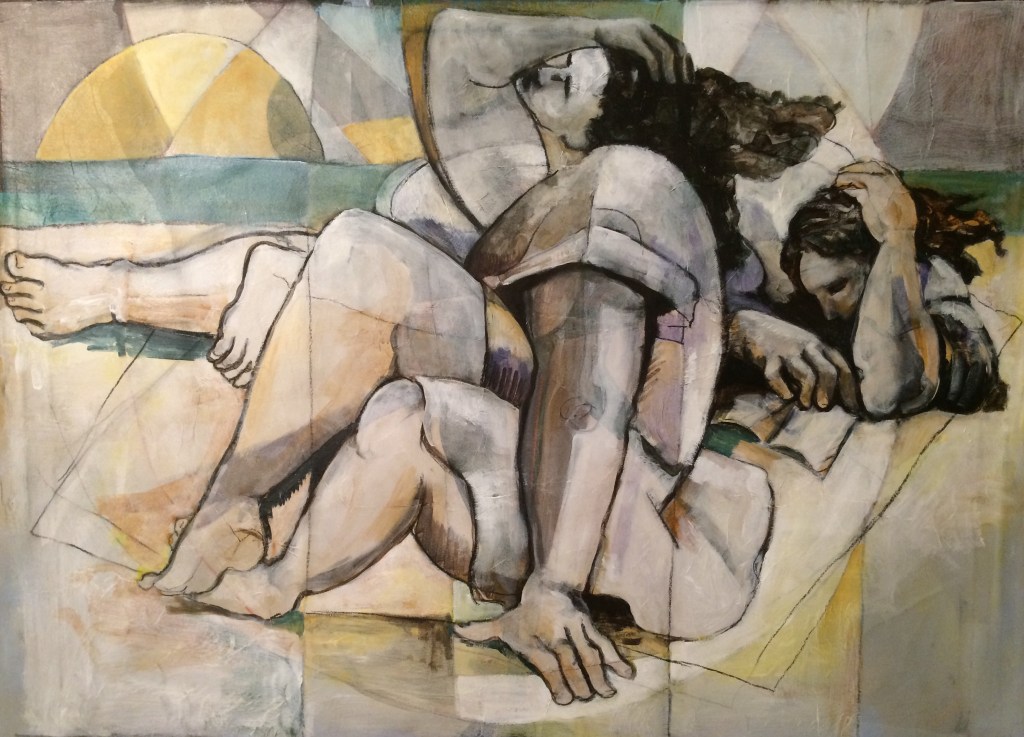
A Day At The Beach, 38x52IN

a day at the beach © 2017 david robinson

Be With [on Not So Flawed Wednesday]

“When you love someone, the best thing you can offer is your presence. How can you love if you are not there?” ~ Thich Nhat Hahn

We attended the funeral rites via Zoom. It was moving. Intimate. We felt grateful to be included.

Kerri attempted to keep the ukulele band going. There was a delay in the signal so the group played gloriously out of sync, our rehearsals a hysterical cacophony. In the end it didn’t matter because we met each week and shared stories. We asked the most important question: how are you doing?

We Zoomed with friends across the country. The screen between us punctuated the distance, exaggerated the separation.

The pandemic put a new twist on the word “presence.” How do we – how did we – remain present for each other, with each other, when distancing was one of the few routes available to slow the spread of the virus? We learned both the expanse and limits of technology, sometimes giving us communication but not always the capacity for presence.

It certainly made us more intentional. Presence required scheduling time. Presence required confronting the line of can-this-be-in-person-or-not. It made us slow down and question. In the early days of Covid, Kerri and I had a heated debate en route to Colorado to see my parents: do we wear masks or not? After a few moments the masks came off. We needed to be present. Fully.

“Presence” and “going slow” hold hands. One cannot walk without the other. A slow walk will invite presence. An intention to be more present invites slowing down.

When I returned from Bali I was different. Changed. I understood the necessity of going slow, of being in my life rather than racing through it.

The pandemic years have been equally as profound. Like everyone, we lost jobs, lost identities, lost connections, lost security. Every possible pattern of life was disrupted. Isolation brought a new level, a different understanding of going slow. A two-dimensional and three-dimensional understanding of presence.

We are emerging as different people. I feel it. I can see it. I cannot place words on how we are different. I simply know that we are not in such a hurry anymore. We are much more intentional. We draw deeper lines in the sand.

There are people we want to see. There are people we need to see, beyond a Zoom or a phone call. To sit in the same room, laugh. To hold hands. To go slow. To be “with.”

read Kerri’s blogpost about GOING SLOW

Open The Box [on KS Friday]

“Old beliefs die hard even when demonstrably false.” E.O. Wilson, Consilience, The Unity Of Knowledge

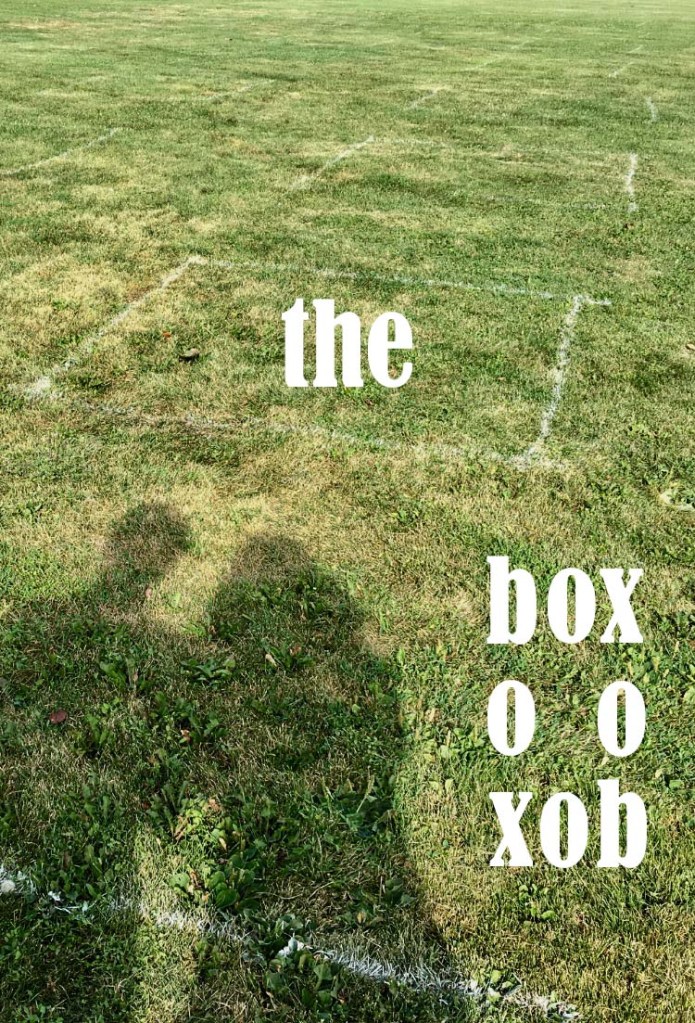
On the field where the city holds its Tuesday night summer jazz concert series, boxes are painted on the grass. A visual statement. A nod to the necessity of social distance in a time of pandemic. Stay within the box. The series started despite the CDC warning against large gatherings. The series stopped when the protests began.

Boxes within boxes within boxes. We are a nation that has gladly and enthusiastically confused itself. Mitigating the spread of the pandemic is easily achieved – as demonstrated by much of the world – through mask wearing and social distancing measures. We’ve somehow managed to force ourselves into a too-tight-box by defining the simple pandemic-mitigation-measures as assaults on freedom.

Our freedom must be very fragile indeed if a thin piece of fabric, a mask worn to benefit others in our community, is all that it takes to constitute a threat. Our freedom. 200,000 dead in six months. We wage war on each other, no external threat is necessary.

We’ve managed to make simple science the Cassandra of our time. Screaming in the streets, she delivers to us simple truth and we ignore her dire warnings. We tug the Trojan Horse through once-secure gates into our cities and homes. “We are free to do whatever we want!” we gloat unmasked in reply to Cassandra science. “We are free!”

Boxes within boxes within boxes. Yes, we are free to shoot each other. It is our right. We are free to spread the virus while we assemble unmasked to demonstrate our freedom. In a time of confronting our history of racial injustice, we are free to equate a temporary pandemic lock down to slavery. There is, after all, more than one way to shoot at each other.

We are free, we are free, we are free. Boxes within boxes.

THE BOX on the album BLUEPRINT FOR MY SOUL is available on iTunes

read Kerri’s blog post about THE BOX

the box/blueprint for my soul ©️ 1996 kerri sherwood

Know And Share [on Merely A Thought Monday]


If you were alive in the 1980’s you’ll remember Robert Fulgrum’s book, All I Really Need To Know I Learned In Kindergarten.  It is a festival of simple-yet-clear-advice for living well. Play fair. Share everything. Don’t hit people. Say you’re sorry when you hurt someone. Each bit of advice is a nod to our inter-connectivity. No one walks this path alone. Hold hands. Stick together.

Visit Robert Fulgrum’s homepage and you’ll read this: “Often, without realizing it, we fill important places in each other’s lives.” Mutual influence. We impact each other everyday in ways that we remain mostly unaware.

If this pandemic has done anything illuminating it has proven beyond doubt how utterly interconnected we actually are. My breath and your breath are intimate exchanges. My choices and your choices will either harm or help each other. It’s a choice. Your story and my story may be diametrically opposed and warring but they both must adhere to the force of gravity, the nature of time, the spread of virus. This virus actually thrives when we shout at each other. It rides our aerosols in a rodeo of mutual influence and cares not for the political color of the lungs it inhabits. After all. truth and misinformation share the same airspace, touch the same doorknobs, are broadcast over the same technology, are paid for and brought to us by the same commercial sponsors.

One of the things Robert Fulgrum learned in kindergarten and wrote about is this: goldfish and hamsters and white mice and even the little seed in the Styrofoam cup – they all die. So do we.

This virus cares not whether we love or hate each other in the precious bit of life that we share. About us, its host, it is utterly agnostic. On the other hand, we have the choice. It’s a choice and seems so simple. Play fair. Don’t take things that aren’t yours. Like it our not, recognize it our not, our lives are in each other’s hands.


read Kerri’s blog post about ELEMENTARY SCHOOL RULES


heart in island sand website box copy


in dreams I wrestle with angels ©️ 2017 david robinson


Why Ask Why [on Two Artists Tuesday]

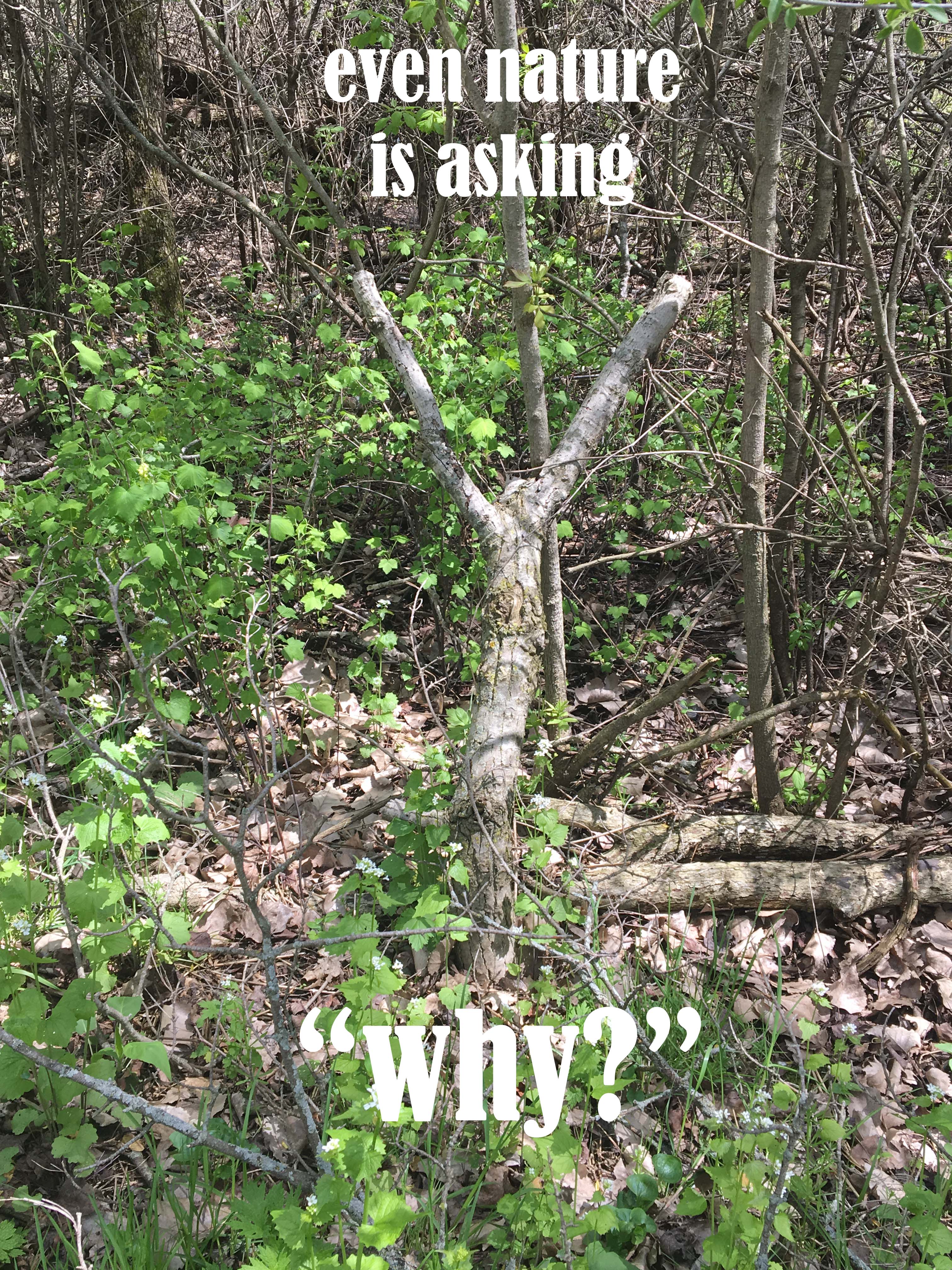
even nature is asking why copy

A rare warm day, walking the Des Plains River trail. I should have been startled when Kerri suddenly jumped off the trail but I’ve grown accustomed to her spring-loaded-photo-impulsive-gambols. I actually love the passion of her image capturing so I’ve learned not to be surprised when she leaps and snaps. There is no danger. There is a photo opp.

“SEE!” she exclaimed, showing me the photo. “Even nature is asking ‘Why?'”

My first thought: Which “why” is nature asking? Why a pandemic?  Why so much division?

Simon Sinek has made a career of teaching people to ask “Why?” before asking “How?” It makes sense: you should probably know why you want to scale the mountain before asking, “How will I do it?” People need an answer to “why.” And, because we are human, the answer to “why” need not be reasonable or rational. “Because it is there,” is an acceptable answer to “why?” I want to. I need to know. I want to feel. I need to see what is there.

“How?” is a question that can only be answered after the fact. “How” is known through reflection. There is the plan. There is the reality that comes when the plan meets the unknown forces. The plan changes. The only honest answer to “how” is: do what makes sense and we’ll talk about it later.

Amidst a pandemic, it is only human to throw up our arms to the sky and demand an answer to our “Why?”  To borrow a lyric from Nick Cave & The Bad Seeds: “I don’t believe in an interventionist god. But I know, darling,  that you do.” In other words, viruses are intention-free. Sometimes, even though we want an explanation, there is no “why.”

There is, however, always a plan, there is a path to “How?”  How do we protect ourselves? How do we deal with it? In fact, there are layers to the question “how?” The first layer of ‘how’ is simple: social distance, wear a mask, wash your hands. Looking back from this vantage point, we know it is the best we can do short of a vaccine. Simple science.

The second layer of the how-cake is more complex and, like all ‘how’ questions, we will only be able to talk about at some point down the broken road. Maybe a vaccine. Maybe herd immunity. Maybe, maybe, maybe. Maybe we will be foolish, like the Philadelphia parade during the Spanish flu and escalate the death toll to the point that we wake up and listen to the first ‘how?’

The virus is a force like a tornado is a force. Why did it take my neighbor’s house and not mine? Why did the forest fire rage through this neighborhood and not that neighborhood?

Here’s the only “why” question we really need to consider: in the face of this virus-forest-fire, why did we rush out to light matches (pack into bars and onto beaches), parade around screaming about our individual rights instead of metaphorically rushing into the fire to save our neighbors in the only way we knew how (social distance, masks) –  as we would have done in an inferno?

I don’t believe in an interventionist god. But I do believe in intentional human beings (conscious and otherwise).

Nature need not ask “why?” We do. It’s a sure bet that our answer will make little or no sense at all.


read Kerri’s blog post about WHY


? website box copy