

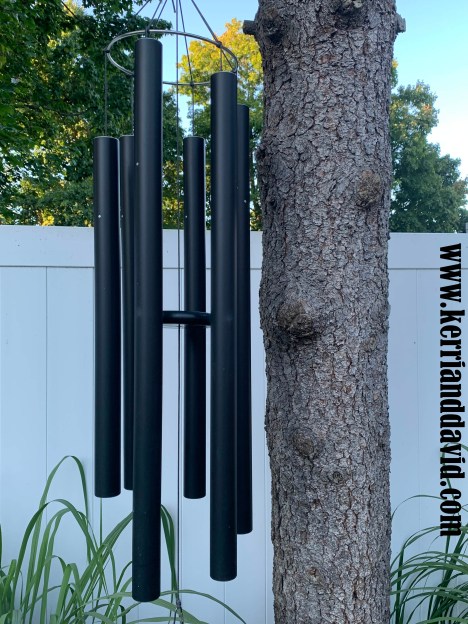
We took down the chimes because we knew the blizzard was coming. We watched the monster winds , sleet and snow, approach on radar. I am forever grateful to have immediate access to weather radar so I know what’s coming. It saved us once-upon-a-time when we were caught in a tornado. Just after the winds lifted our car from the ground, we huddled behind a restaurant and watched the radar for a small break in the storm so we could make a run for safety.
Last night as the blizzard buffeted the house, as we ate bananas at 3am, we talked about all the things in the world about which we know nothing. Does ice on the tracks impact how the trains run? How do they move Anselm Kiefer’s monumental paintings from his studio to a gallery? In the age of Goggle it is possible to find out how to lay bricks but would I really know how to do it until I’d studied with a master bricklayer? At what point is abstract knowledge actually useful? At what point do we know what we are talking about?
Yesterday I heard a phrase roll through the news cycle that I’m coming to detest: low information voter. It’s sanitized language and brings up a number of questions for me. The first is obvious: are we mislabeling an intentionally misinformed voter as a low information voter? I’ve watched dozens of interviews with “low information voters” who are quite capable of regurgitating pat-phrases seeded into their brains from their source of misinformation. Are they then a low information voter?
The ghost of Neil Postman whispered in my ear:
“The question is not, Does or doesn’t public schooling create a public? The question is, What kind of public does it create? A conglomerate of self-indulgent consumers? Angry, soulless, directionless masses? Indifferent, confused citizens? Or a public imbued with confidence, a sense of purpose, a respect for learning, and tolerance? The answer to this question has nothing whatever to do with computers, with testing, with teacher accountability, with class size, and with the other details of managing schools. The right answer depends on two things and two things alone: the existence of shared narratives and the capacity of such narratives to provide an inspired reason for schooling.” ~ Neil Postman, The End of Education
Shared narratives. An inspired reason to ask questions and to seek greater understanding. These two things actually form a feedback loop. They are fluid and not fixed: greater understanding informs and evolves shared narrative which opens new questions. You might think that shared narrative and pursuit of greater understanding would be essential concerns for our democracy but we are learning – I am learning, much to my surprise – that is not true. Our narrative is intentionally divided. The current republican party openly and intentionally demonizes learning. Low information voters are easily manipulated and a political party empty of ideas and ideals relies exclusively on a voting public that readily swallows their rubbish.
If our democracy took itself seriously, would we tolerate highly profitable sources of misinformation? Would we so easily polish “ignorance” into a shiny phrase: low information voter? If we took our democracy seriously and intended to protect it, wouldn’t “low information voting” be unacceptable since the responsibility of casting a ballot is predicated upon knowing what you are voting for?
I live in the age of Google. I can see storms coming and that informs my choices: I take down the chimes. I secure anything that the wind will destroy.
I live in the age of Google. I can -and do – in a moment fact check any assertion that comes my way. For instance, I know that the Save America Act is not what it appears to be. It is a storm coming. It does the opposite of what it purports to do. It has nothing to do with voter ID and everything to do with preventing voters from voting. It is a straw man; incidence of voter fraud in the United States is statistically zero. Do low information voters know that? This wind will destroy our democracy.
The woke folk on my side of the divide read Project 2025 and learned from the chaos and grift of the first four years of the authoritarian wannabe. We screamed, “There’s a storm coming!” The necessary information – like weather radar – was readily available. It was easy to see. Low information is, in actuality, the unwillingness to look.
What’s happening now in our nation is not a surprise. The campaign to create low information voters was -and is – successful. Eliminate education. Demonize truth as a hoax. Create “alternative” facts (legitimize lies) while labeling actual news “fake”. Split the people.
If we survive the attempted take down of our democracy, an item high on my list of things to address is the elimination of the possibility of the low information voter. One need not have a mass of information in their brain to be educated, they only need the desire to question, the dedication to discern what is true from what is dross. One need only understand the need to check the radar and act accordingly.
“Because we are imperfect souls, our knowledge is imperfect. The history of learning is an adventure in overcoming our errors. There is no sin in being wrong. The sin is in our unwillingness to examine our own beliefs, and in believing that our authorities cannot be wrong.” Neil Postman, The End of Education
read Kerri’s blogpost about THE CHIMES
likesharecommentsupportthankyou

Filed under: Perspective, Two Artists Tuesday | Tagged: artistry, david robinson, davidrobinsoncreative.com, democracy, education, information, Kerri Sherwood, kerri sherwood itunes, kerrianddavid.com, kerrisherwood.com, learning, misinformation, Neil Postman, questions, SAVE act, shared narrative, story, studio melange, The End of Education, the melange, truth, vote | 1 Comment »






 The Direction of Intention