Breathe Out. Breathe In

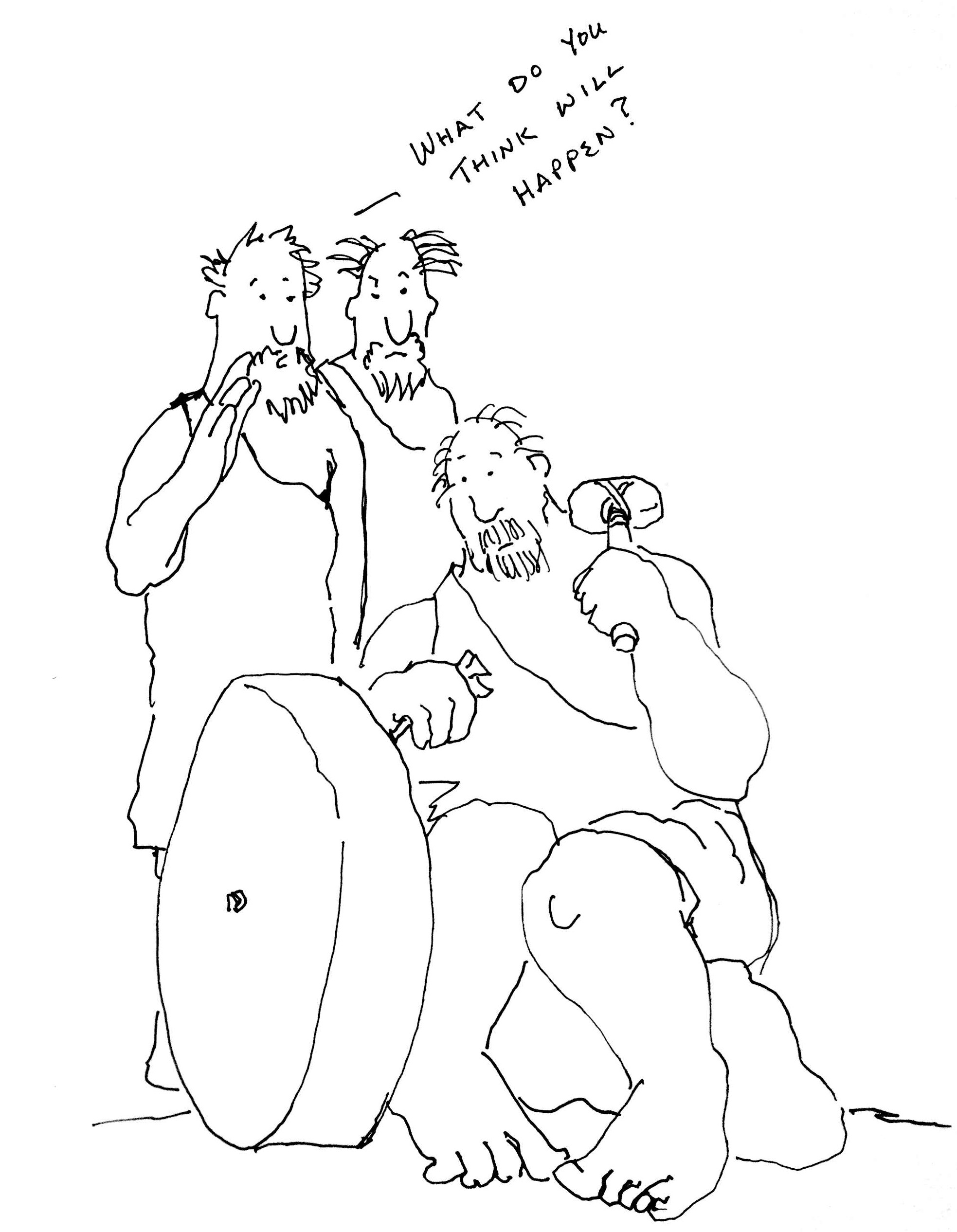
...if beakybeaky was a band, this would be the album cover...

…if beakybeaky was a band, this would be the album cover…

The most important thing in life is to learn how to give out love, and to let it come in. Mitch Albom, Tuesdays With Morrie.

Somewhere in the 22nd hour of our drive, the sun rose. Even through our exhaustion and bad fast food coffee, it took our breath away. It replaced, or, rather, swallowed, a brilliant sliver-crescent moon.

We’d stayed longer in Tampa than we expected. The day after Beaky’s book reading and signing, Sunday, we were exhausted so we delayed our return trip home for a day. The following day, Monday, was bad for Beaky – she was in tremendous pain and we were overwhelmed with the need to stay. So, we stayed, knowing the result would be a 24 hour dash home for rehearsals.

His voice dropped to a whisper. Let it come in. We think we dont deserve love, we think if we let it in well become too soft. But a wise man named Levine said it right. He said, Love is the only rational act.’” Mitch Albom, Tuesdays With Morrie

...and the truth of beakybeaky....

…and the truth of beakybeaky….

This year is unusual. I’ve done too many plays, paintings, and projects to count and each had its rewards and regrets. Twice since the turning of the New Year I’ve completed a project that was so fulfilling, so right, that I would not change a thing. Both have this in common: the intention was pure. I did them for the right reason: someone else. The first, The Lost Boy, was a message from Tom to his nephew, Seth, and I was the messenger. The second, Beaky’s first book, Shayne, was to make a dream happen. Every dream needs assistance to be born: the manuscripts existed. Beaky’s desire to share (publish) existed. They lacked an illustrator and designer. I did the illustration. Kerri did the layout and design; a dream fulfilled itself. For me, both are lessons in breathing out love so that I might also breathe it in.

Just prior to Beaky’s reading, we took a series of selfies with her. I told her that, if Beakybeaky was a rock band, the selfies would make excellent album covers. After our photo opp, we wheeled her to a standing-room-only crowd, many people that she knew and many more that she didn’t, people who’d gathered to hear an almost-94 year old author read and sign her very first book.

a dream fulfilled

a dream fulfilled

Breathe out. Breathe in. It turns out that an exhale is necessary for the inhale.


Possess It

An untitled  watercolor I did years ago

An untitled watercolor I did years ago

Last night P-Tom said, “This is the time of year that everyone is telling us what we need and where we can go to buy it.”

Yesterday I worked on website language. After a year-long hiatus I’m re-visioning what was once a coaching practice. All day I was aware that words like “potential” and “purpose” are abstractions; they are marketing terms. Many years ago, when I was first establishing a coaching practice, I read articles and listened to recordings full of advice about “how to start a coaching business;” the recommendation was unanimous: host free calls, help people see their problem, and end the call. Leave them standing in the mud so they will need you. Create lack (isn’t that a great definition for marketing?).

What does it really mean to fulfill your potential? What does it mean to “find your purpose?” Look to the layer beneath. To fulfill, to find…, these are terms from the canon of outcome and result. No one willingly seeks his or her endpoint. If there is a universal problem it is that we see our existence as something with a bottom line and hire coaches and therapists to help us do the accounting.

(Insert mantra: nothing is broken. You do not need to be fixed).

Good coaches, teachers, mentors, and therapists get you out of the spreadsheet and into the moment. Looking for the fullness of life is usually a process that requires the cessation of looking so we might see what is right in front of us. Stop the search and you will be found. As the old saying goes, life is the thing that is happening while you are running around looking for it.

I’m a world-class note taker and always take notes when I work with people. For me it’s like mapping verbal terrain, capturing inner geography. Lately I’ve been reviewing the maps before I destroy them and I find not seekers of potential and purpose, but people overwhelmed by the experience of 1) feeling lost, 2) feeling that something is missing or they are missing something, 3) feeling that they are pushing on a door that won’t open, or 4) a yearning for a different way of being. These are questions of feeling. These are questions of orientation to life (experiences of life). “Potential” and “purpose” are words of doing. These are questions of being.

What if meaning, value, purpose,… in life was not something found or bought but something that is already possessed?

Go here to buy hard copies (and Kindle) of my latest book: The Seer: The Mind of the Entrepreneur, Artist, Visionary, Innovator, Seeker, Learner, Leader, Creator,…You.


Find The Purpose

Despite warnings, Icarus reached for the sun.

Despite warnings, Icarus reached for the sun. Why do I paint? Why does anyone do anything?

The question of the day is, “What is the purpose?”

Mike is 85 years old and she said, “Never in my entire life did I think I would live in a world where beheading was a reality. We’ve gone backwards, it seems to me. My god! It’s like we’re living in the Middle Ages.”

Is history a sandwich with madness in the middle or perhaps a Mobius strip? What is the purpose?

Arnie just returned from Israel. He was profoundly moved by his experiences there. He was also angered by the discrepancy between what American media reports about Israel and what he found there. “I’ll never again believe another thing I hear on the news.”

Belief meets disbelief. The fields of the profound exist beyond anything called purpose. What changes in our hearts and minds when our experiences touch the profound? Our sight changes; our eyes open.

Horatio recently wrote and told me that he’d dumped his Facebook and Linked In accounts. He wrote, “I dislike them and the fallacies we suffer because of it. Mostly, I wonder what took me so long. I mainly feel like a man with a simpler life.”

Simplicity arises when complexity falls away. The extraordinary is always found in the ordinary, something as common as holding hands.

Kerri and I sat in the autumn sun to eat our lunch. She gazed at our house. She asked, “Do you think our house will be here in 100 years?” Before I could respond she answered her own question, “If it is, we’ll never know.” And then she asked the question beneath the question, “What is everyone racing to achieve?”

Moments of fulfillment. Presence. Both require a move beyond achievement to something more connected.

It is passing. Life. Purpose. Who assigns purpose to a life? Who assigns purpose to all of life? Is it achievable? What happens when we get there? Mirages.

“Purpose” is a word like “Outcome”; it exudes permanence but don’t be fooled. An outcome is a snapshot. Just as bottom lines are temporal, data is interpretation, and endings are beginnings.

Purpose wants to feel important. Profound simply wants to feel.

title_pageGo here to buy hard copies (and Kindle) of my latest book: The Seer: The Mind of the Entrepreneur, Artist, Visionary, Innovator, Seeker, Learner, Leader, Creator,…You.

Go here to support my play The Lost Boy.DSC_1196 copy


Covet The Right Stuff

I did this drawing for my book, The Seer

I did this drawing for my book, The Seer

This morning Kerri shared a nice definition of the word “covet:” insufficient gratitude for what you already possess. It made me laugh because the definition exposes the ethical double bind of being human.

I imagine that in some distant past, a hairy guy stepped out of his cave and was startled to find that his neighbor had a new thing called fire. Being cold and also tired of eating sushi for every meal, he coveted his neighbor’s fire. He wanted some of that. A healthy lack of gratitude for what you already possess is often how good ideas spread (a random anthropological note: I read this morning that the average life span of a cave man was 18 years. I suspect coveting warmth-by-fire increased the average by a couple of years).

So, to covet is sometimes useful, especially where essentials like food, fire, and stories are concerned. It is only human to want enough food, a roof over your head, and a life-story that has meaning and purpose.

To desire is human. To want a better life is universal. What is the line between desire and coveting? To want what others have, to a certain extent, is pack behavior and we are, like it or not, creatures of the pack. Product marketers around the world count on our capacity to want what other people have and so our covet-muscle is exercised daily. The creation of imaginary need is a super trick for selling stuff and coveting what others have is key to lack creation. It’s hard to sell things if people are fulfilled.

So, to covet may be a warning signal that you are building your tower of meaning on sandy soil.

And that loops back to gratitude. All day, Kerri and I have been talking about being conscious in the moments of your life. None of us have unlimited time on this earth. The only thing we actually possess is our moments and our choices within our moments. The other stuff is really on loan and generally passing. Spiritual teachers and artists throughout history are unanimous on this point: the path to a rich life is built upon presence. Paying attention, exercising deep gratitude for the moments of your life, will always illuminate the extraordinary in the ordinary. Cultivating the capacity to see your extraordinary life will help you will covet the right stuff. Feeling grateful for your moment is always easier when you are warm and your brontosaurus burger is cooked just right.

title_pageGo here to buy hard copies (and Kindle) of my latest book: The Seer: The Mind of the Entrepreneur, Artist, Visionary, Innovator, Seeker, Learner, Leader, Creator,…You.

Check out the kickstarter campaign for my play The Lost Boy. DSC_1196 copy

Own It And Offer

797. Join me in inspiring truly powerful people. Each day I will add a new thought, story or idea to support your quest and mine.

All winter in the many arenas of my work, I’ve been hearing a question: Who are you in service to? Sometimes the question comes in the form of “customer.” Sometimes it wears the mask of “client.” Entrepreneurs and actors try to identify their “audience.” Most often the question of service comes hidden in the guise of “purpose.”

This last variation, purpose, is deceptive because when a person asks, “What is my purpose?” they automatically focus inside themselves. The question implies unique volition, an inner imperative. It implies ownership. All of that is true. Purpose is uniquely felt. Purpose is an inner drive. It is personal. It is also empty if not offered. Arrows need targets. Businesses need buyers. Pastors need congregants. Artists need audiences. Purpose needs receivers. Purpose is all about relationship.

It comes as a great curiosity to me that the block entrepreneurs experience most is rooted in the fear of reaching out and talking to potential audiences. They fear that their idea might be stupid. It is better to not know than to put it out, ask and adjust. Their fear is akin to the data that tells us that most people fear public speaking more than death. Think about it. Rather than be seen, most of us would rather die. We want to speak but only if we know what we have to say has merit before we speak. Young actors have to learn not to shield themselves from their audience. They want on the stage only to hide. It cancels the purpose. The challenge is the same – it is playing out in many arenas.

In other words, purpose is all about relationship yet we are deeply invested in controlling or restricting our relationships. We blunt our purpose in the restraints we put on sharing. Ownership of purpose is related to freely sharing our offers. Share. Ask. Engage.

This work, my purpose, is at the center of Flipped Startup (my new collaboration). Yesterday I realized it is only incidentally aimed at entrepreneurs. This work is for everyone. In this world we are of necessity all entrepreneurs and wrestling with the same question: who am I in service to? Own it. And offer it.

Tap Into It

775. Join me in inspiring truly powerful people. Each day I will add a new thought, story or idea to support your quest and mine.

What is the original “why?” What is your reason for doing what you do? During a break in the Design for Demand class I eavesdropped on a conversation between Skip and one of his students. The student asked, “Isn’t making money the reason “why.” It can be a reason. It’s not the reason.

Before the break the students were doing business pitches followed by a discussion about their reasons for creating the business. Skip showed them Simon Sinek’s terrific TED talk explaining what distinguishes a great business from a mediocre business. In the talk Simon explains his golden target with the reason “why” occupying the center. A great business operates from why. How and what occupy the middle and outer rings of the target. Mediocre businesses confuse their what and how with why. This might seem obvious but it’s not.

In another class, I recognized that the MBA students think the single reason they are getting a degree is to get a better job. They’ve confused their why with the what. Getting a better job can be a reason. It’s not the reason. K-12 education believes that the purpose of education is to raise test scores. They’ve confused why with how – and it is debatable whether raising test scores is a viable how. In our lives we have an abundance of “how and “what” reinforcement. It is no wonder we sometimes misplace our why.

In the modern age, people without a clear understanding of their “why” will generally buy something to fill the void. It is a temporary hit but delays the recognition that there is nothing substantial driving their life. Or, they’ll numb themselves, distract themselves or sabotage themselves. Either way, the “why” gets lost in the “what.”

Everyone has a why. Sometimes you have to wipe off a layer of dust or muster enough courage to look beyond the purchases. It is there. It’s waiting to be sourced. If your current answer to the question, “What’s the point?” is to raise your test score or to get a better job, stop and ask yourself, “What else is true?” Look beneath the superficial and you will find a spring that will rejuvenate you and keep you nourished for the arc of your life. Tap into it.

Truly Powerful People (469)

469.
Join me in inspiring truly powerful people. Each day I will add a new thought, story or idea to support your quest and mine.

As I dust off and relearn the story of Parcival I have decided that it will be the spine of the work I do next week with teachers; we will follow the metaphors; we will open the story so the stories of our lives might open. As I work I am discovering that everything you need to know to be a great teacher is in this story! Parcival is a knight of the Round Table and, depending upon the version you read, he is the knight that finds the grail. Metaphor alert: the grail is not a thing to be possessed. It is what Maslow called self-actualization. It is a metaphor for finding your truth and fulfilling your purpose. What is the purpose of learning if not to seek and find your truth (do not be fooled, passing a test is far from the point of learning and will ultimately leave you empty and the test full)?

I love many aspects of this story and the section I reworked today made me smile. I giggled in the coffee house where I was rehearsing. The other patrons, afraid of the man in the corner talking and cackling to himself, gave me plenty of room to work (have I mentioned that I can’t talk without flailing my hands all over the place. If you ever want me to be quiet, simply bind my hands. I’ll make noises but words will be impossible). The story describes Parcival’s first entry into court. He grew up isolated, deep in the forest (not unlike Arthur, though Parcival did not have Merlin to school him) so he knew nothing of people or manners or custom. He thought dressing like a knight meant he was a knight. He approximated some armor, weaving a breastplate from reeds, a helmet from fronds, and he wielded a stick as a sword. He “borrowed” a mule and rode into Camelot. Arthur and his knights, thinking Parcival was a clown, laughed at him.

Growing up without instruction meant that he had the ideal upbringing for a trickster. He followed his nature without inhibition. Parcival had no inner-editor so the civilized world viewed him as a fool. He acted purely so he threatened custom. He spoke what others could not; he carried no conventions so he had no limits. He had no rules of conduct. Parcival would be the boy in the crowd to say, “This emperor has no clothes!” It would not occur to him to lie. When you are not doubting or protecting your purity you have no reason to deflect or manipulate or withhold. Lies are a byproduct of rules. He was powerful yet his power was raw, unrecognizable, so the world he wanted to enter could only laugh. And their laughter was his fuel. Their laughter propelled him into the world to learn. Arthur was capable of seeing his purity. And Arthur gave him hope. Arthur sent him into the world to prove himself, to learn the rules of society, and invited him to return to court once he’d learned the code and conduct of a knight.

The story is a story of desire; it is a story of following an inner imperative. It is a quest for fulfillment. It has laughter and despair, triumph and shame, obstacles that seem insurmountable; it is a story of perseverance and letting go. It is a story of 2 teachers: one provides the rules for conduct; the other helps Parcival shed the rules of conduct. Both are necessary if you want a shot at entering the grail castle.

If it were a poem it would read like this: Revel in your nature. Betray your nature. Rediscover you nature: grail.

Truly Powerful People (460)

460.
Join me in inspiring truly powerful people. Each day I will add a new thought, story or idea to support your quest and mine.

A week ago, Judy came to my studio and we talked for hours. When we talk, time has a funny way of condensing: 3 hours becomes three minutes. It is not uncommon for us, 3 minutes into our conversations, to notice the sun setting, the day slipping into night. We jump up, look at a clock, eyes popping at the time; with Judy I always feel the need to make sure my clock is not broken or that it didn’t somehow slip into east coast time. It is one of my favorite aspects of our relationship: so engrossed in our banter, we never have slow goodbyes – the ferry is about to sail or the meeting has already started; we rush to the door like teenage lovers whose parents came home early.

In our last “good god look what time it is” revelation, Judy pulled from memory this poem by Naomi Shihab Nye:

Red Brocade Pillow

The Arabs used to say,
When a stranger appears at your door,
feed him for three days
before asking who he is,
where he’s come from,
where he’s headed.
That way, he’ll have strength
enough to answer.
Or, by then you’ll be
such good friends
you don’t care.

Let’s go back to that.
Rice? Pine nuts?
Here, take the red brocade pillow.
My child will serve water
to your horse.

No, I was not busy when you came!
I was not preparing to be busy.
That’s the armor everyone put on
to pretend they had a purpose
in the world.

I refuse to be claimed.
Your plate is waiting.
We will snip fresh mint
into your tea.
.

Isn’t it lovely? Being busy is the armor everyone wears to pretend that they have a purpose in the world. How nice to stop pretending – even for a moment – and go back to the real purpose of living. Your plate is waiting.