

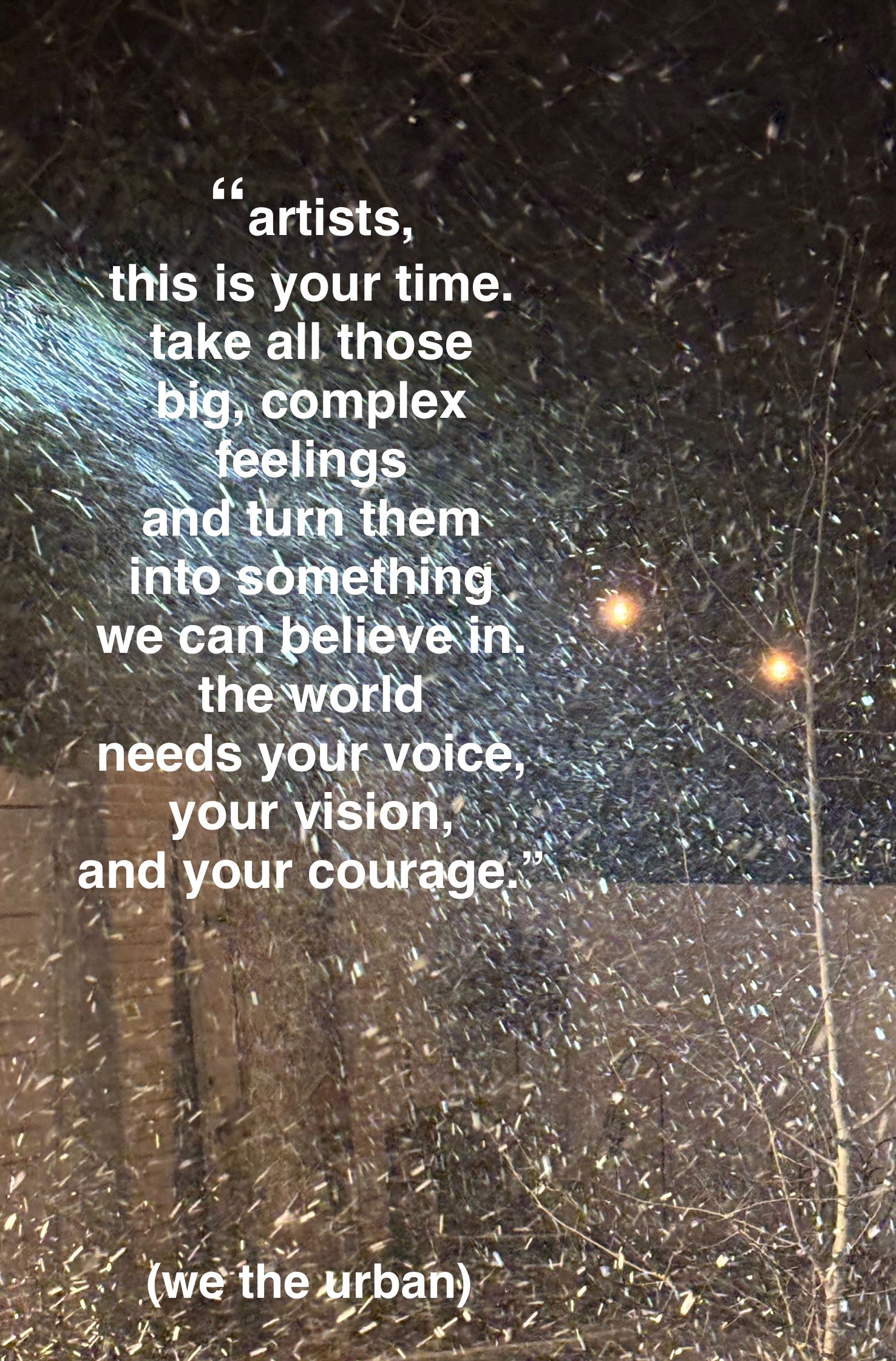
“Politics is downstream of culture.” ~ Brian Tyler Cohen
Societies disappear but their art remains. The art serves to carry forward through time the essence, the beliefs, the customs, the inner space and outer limits of a culture. Culture is a force greater than politics. Artists carry in their work the flame of culture; they serve a greater truth. The same cannot be said of politicians or captains of industry.
Like it or not, the artists at the Grammy awards spoke directly to the current horrors of our politics. They know the reach and power of their words and their artistry to inspire action. Bruce Springsteen’s song, The Streets of Minneapolis has become an anthem celebrating the courageous people who refuse to hide from the bully. It is a call to the essence of the American spirit while also calling out the lies of division and brutality of ICE and those who’ve created this mindless monster.
On the National Mall a sculpture appeared of the authoritarian-wannabe holding hands with Epstein. It’s entitled “Best Friends Forever”. A second installation, a ten foot replica of The Wannabe’s Birthday Card to Epstein, has shown up. The work of Banksy and those who emulate him are showing up on walls all across the world. A picture is worth a thousand words.
Anselm Kiefer, among the greatest visual artists of our times, has spent his life working “…themes of German history and the horrors of the Holocaust”. His work speaks directly to the fascist moment we now face in the USA.
Art inspires action because it reaches beyond words to touch souls. It simplifies the complex. It clarifies the chaos.
To say we live in complex times is an understatement. An old world order is collapsing. The gap between the haves and the have-nots is ever-widening, our politicians sell our future to the corporate dollar and create oligarchs, who, in turn, would have us believe that the people are incapable of governing themselves.
In our lifetime there has never been a greater need for the artist’s voice. We are daily served an avalanche of lies meant to keep us confused and off-center. Consider this: every person on the streets blowing a whistle or recording the brutality of ICE is an artist. They are calling our attention to the truth. They actively pierce the ugly rhetoric to expose the stark reality. They challenge the lies. They support us in knowing with absolute clarity who we are so that we might come together as a community and say to this administration, “You do not represent us. We are better than this.”
To all the republican politicians out there: be certain that culture is coming for you.
Kerri’s albums are available on iTunes and streaming on Pandora
read Kerri’s blogpsot about ARTISTS
likesharecommentsupportthankyou

Filed under: Art, Creativity, KS Friday, Power | Tagged: Anselm Kiefer, artistry, artists, Banksy, Bruce Springsteen, community, cutlture, david robinson, davidrobinsoncreative.com, fascism, history, ice, Kerri Sherwood, kerri sherwood itunes, kerrianddavid.com, kerrisherwood.com, Minneapolis, politics, story, studio melange, the melange, truth | 1 Comment »







 The Direction of Intention