Speak Out Of Turn

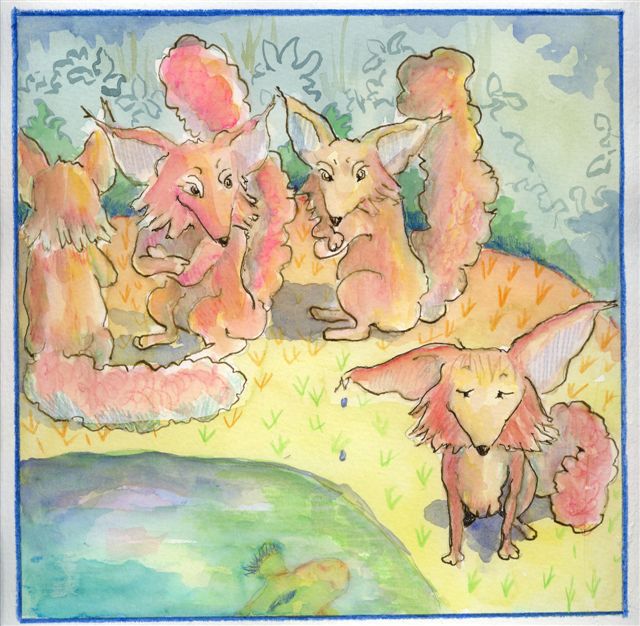
From my book, Lucy & The Waterfox. The waterfox is shunned for deviating from the norm.

From my book, Lucy & The Waterfox. The waterfox is shunned for deviating from the norm.

I’m not supposed to be writing about the system of education in America. It is a topic that I made off limits for myself because I was ranting too much. I finally allowed myself to admit what I’ve known for years but refused to accept. Our system of education is not broken and never has been; it was designed to create maximum docility and is succeeding magnificently. I decided to open the off-limits file because I just posted a question concerning education inspired by my friend and retired superintendent, Arnie Glassberg, and then this morning the same news story featuring the resignation letter of a teacher came across my screen three times. It is tragic to read and resonated with me: after a career playing in the fields of innovation and change in education, I now have a hard time driving by a public school without shuddering.

For grins I googled “origins of education in America (it was the subject of Arnie’s comment to me),” and came up with more than a few options but was struck by how many of the links topping the list concerned the reprehensible origins and intentions behind this thing we continue to call school. Several were articles, speeches, and youtube clips of John Taylor Gatto, a former New York state Teacher of the Year and most well known for his book, Dumbing Us Down. Here’s a bit from a speech he gave several years ago to a home schooling conference in Vermont:

The secret of American schooling is that it doesn’t teach the way children learn — nor is it supposed to. Schools were conceived to serve the economy and the social order rather than kids and families — that is why it is compulsory. As a consequence, the school cannot help anybody grow up, because its prime directive is to retard maturity. It does that by teaching that everything is difficult, that other people run our lives, that our neighbors are untrustworthy even dangerous. School is the first impression children get of society. Because first impressions are often the decisive ones, school imprints kids with fear, suspicion of one another, and certain addictions for life. It ambushes natural intuition, faith, and love of adventure, wiping these out in favor of a gospel of rational procedure and rational management.

Compare this quote (or read the text of his speech) with the teacher’s resignation letter making the news today. I’ve read a similar letter each spring for the past several years; a teacher – probably a great teacher – can no longer participate in the creation of docility in children and in themselves. They admit what they’ve known for years: the intention of they system they serve is the opposite of what it purports: they can no longer wipe out their natural intuition with the gospel of rational procedure (standardized tests).

John Taylor Gatto’s quote reminded me of the first few pages of one of my favorite books, Teaching As A Subversive Activity, by Neil Postman. It was published in 1969. Here’s a snippet from page 2:

In our society, as in others, we find that there are influential men at the head of important institutions who cannot afford to be found wrong, who find change inconvenient, perhaps intolerable, and who have financial or political interests they must conserve at any cost. Such men are, therefore, threatened in many respects by the theory of the democratic process and the concept of an ever-renewing society…Such men as these would prefer that the schools do little or nothing to encourage youth to question, doubt, or challenge and part of the society in which they live, especially those parts that are most vulnerable.

Retarding maturity has long term consequences: a population that is 1) incapable of the necessary self-awareness that comes with maturity cannot recognize how far it has drifted from it’s center and, 2) even if it did see the tower tipping, it is incapable of meaningful action as the conjoined twins of passivity (born of fear of speaking up) and divisiveness (do you really think the red state/blue state nonsense has no origin or implication?) have been so thoroughly thrummed into the national anthem.

To loop back a few posts to Master Marsh’s quote that keeps on giving: I’ve come to believe this is less about can and can’t than about the challenge of doing. And not doing is always easier.

Complaining is no substitute for doing. Neither is ranting, which is why education is off limits for me. I do not know what to do and have no belief that a butterfly will come from a system directed by a few small minds so hell-bent on remaining a caterpillar.

The only thing I can think to do is echo a sentiment offered by John Taylor Gatto in this short clip: the system is great at hammering the individual deviant but is incapable of handling a mass of deviants. To the teacher who resigned in frustration and all those who have, will, want to, or do not yet know they can, join hands. Become a mass and deviate. Do the thing that you’ve been so trained not to do: speak out of turn. Stop raising your hand and join hands. The kids can’t resign and they need you to, as Neil Postman writes, become a “shockproof crap detector.”

Go here to get my latest book, The Seer: The Mind of the Entrepreneur, Artist, Visionary, title_pageSeeker, Learner, Leader, Creator…You.

Go here for hard copies.

Ask Why?

Courageous teachers

Courageous teachers

This is the week of comments sparking questions. From yesterday’s post, SAY, “I CAN,” my dear friend Arnie, and life-long educator, offered the following thought:

Remember dear friend, that public schools in the US were built not by educators but by the business/industrial community. They were structured as they are for two purposes: one was to train children to work in factories (this model came about during the Industrial Revolution). The other was to keep children out of the workforce until they were 16 so they wouldn’t take jobs from the adults (thus compulsory education). It makes lots of sense that the model has lasted so long. It feeds into the natural human need to control. Teachers generally come into the system out of the safety and security of their homes and then college. They are steeped in the “control” model and it certainly makes them feel more secure – so the system keeps on chugging.

It is only in those places where there are a few (both in the management and teaching ranks) people who believe in the substance of your “Say ‘I Can.’” posting that a different model can emerge – one that is student-driven (as opposed to the phony student-centered model).

Arnie is now retired. He was a visionary superintendent, one of the few I’ve met in my walk through education who challenged the chugging system and attempted to midwife a new model. Early in my career Arnie and I were crushed together under the wheels of the chugging system. We both emerged from the tire tracks with greater wisdom. He dusted himself off and gave it another go, and another, and another.

His comment created a feedback loop through yesterday’s post and gave rise to a question that has been with me my entire career. Here’s the loop: throughout my entire pass through the world of education I’ve heard, read, and experienced a variation of this thought: if we practiced medicine like we practice education we’d still be using leeches. In other words, we no longer use children to man our factories yet we still use and support the system created for that purpose. Beginning with the great Neil Postman’s book, Teaching As A Subversive Activity, written in the 1960’s, there has been a mountain of data, investigation, brain science, intuition and common sense…we know how to create great education. Here’s the question: Given what we know, why do we not do it?

I’ve worked with countless educators, primarily around systems change. Mostly, I’ve led them into slaughter – the same slaughter that Arnie and I experienced when we tried to create a system of learning that might replace the system of factory fodder. The slaughter is worth it because we emerge wiser, more experienced, sometimes disheartened, but mostly filled with the question that I just asked: why do we not do what we know to do? Why do we continue to support what we know to be destructive for our children?

In this light, Jim’s quote from yesterday is profound, “ I’ve come to believe this is less about can and can’t than about the challenge of doing. And not doing is always easier.”

The first recognition from my book, The Seer, is this: you don’t have a problem, you have a pattern. This example from the lost world of education is perfect. Problems confuse us with the notion that we can solve for it. We can’t. Patterns, on the other hand, can be broken. We have a pattern of seeing our children as fodder for factories in the age of the internet. This is not about whether we can or can’t do anything about our education system, it is about whether we will do it or not do it. And, as Jim wrote, “not doing is always easier.”

Go here to get my latest book, The Seer: The Mind of the Entrepreneur, Artist, Visionary, Seeker, Learner, Leader, Creator…You.title_page

Or, go here for hard copies.

Say “I Can.”

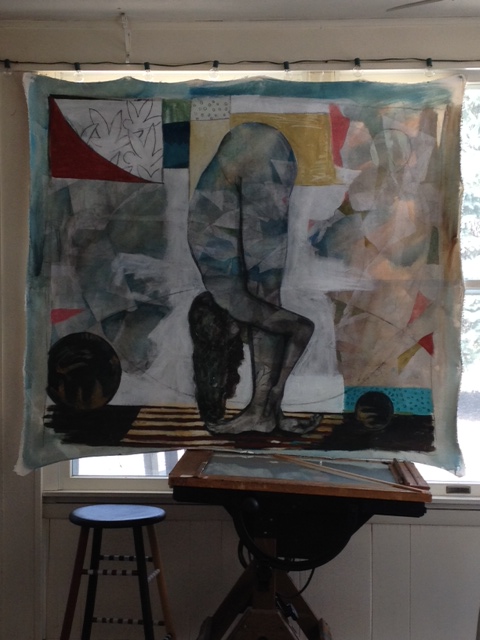
My latest addition to the Yoga series.

My latest addition to the Yoga series.

This is a bit of a confluence of thought-rivers. Two comments came across my virtual desk on the same day and collided.

1) Master Marsh sent me some wise words about a recent post concerning “can” and “can’t.” He wrote:

“There have always been plenty who will say: ‘It can’t be done.’ Ignore those. Surround yourself only with those who say: ‘It can.’ I’ve come to believe this is less about can and can’t than about the challenge of doing. And not doing is always easier.”

2) Another of my favorite readers sent this comment about a post on boundaries and choices:

I’m thinking making own-able choices is so freakin’ difficult for so many us because we were never taught/allowed to make them as children, nor are we often encouraged/allowed to do so as adults. Most of us learned at a very young age that to do as instructed – without complaint or question – meant that you were “good.” Being “good” was all tied up in stuff like being seen and not heard; accepting “Because I said so” as an explanation; being expected to abide by dictated boundaries and beliefs because of tradition or what “Other people will think.”  Operate by the rules and you are “good.” Buck that system by challenging the status quo and you are “bad.”

At first glance these might seem like two entirely different subjects. Though, as luck would have it I read them one-after-the other and I started pondering why, “not doing is always easier” and if that might not have something to do with identifying “good” with compliance and “bad” with non-compliance.

It’s a fascination of mine that in a nation that prides itself on a spirit of independence we place so much emphasis on obedience, control, and compliance. Nike sells us shoes by plucking the chord, “Just Do It!” Yet, we all know that the cowboy spirit is not welcome in grades K – 12. It’s a mixed message at best.

In the world of work, in environments heavy on control and compliance, workers can be counted on to do the minimum. Why would they show up ready to give their best when their best requires a mind-of-their-own. They, in essence, become resistant to take initiative and necessarily refuse any ownership of actions. To take ownership requires being seen and compliance is a game of invisibility. I remember a very frustrated artistic director asking me why her creative people never initiated action. She was dumbfounded when I helped her see that she was the problem. She made it a habit of negating every idea that she didn’t originate. Her staff did what all people do when punished for making offers; they stop making offers. Her “creative” team became adherents of “It can’t be done.”

No child comes to the planet with an internal line dividing “can do” and “can’t do.” Imagination makes all things possible. “Can do” and “can’t do” is learned; it marks the boundary between safe and not safe (or unseen and shamed). There is a price for domestication. “It can’t be done” is often a statement of fear and refusal to cross the line into disobedience (independence by another name). I would add a thought to Master Marsh’s comment, “not doing is always easier;” it is also true that not being seen is always easier, too. Showing up is hard. Doing is always a challenge because doing is often unpopular.

Tom used to say: “You know the value of your work by the size of the tide that rises against you.” In other words, it takes a special kind of courage to say, “this is mine to do and it matters not a whit what others think or feel about it.” It takes a special courage to say to yourself, “I’ll never know if it is possible or not until I try.”

Go here to get my latest book, The Seer: The Mind of the Entrepreneur, Artist, Visionary, title_pageSeeker, Learner, Leader, Creator…You.

Or, go here for hard copies.

Give Yourself Some Advice (3)

A younger version of myself rehearsing for The Creatures of Prometheus. The tats are fake!

A younger version of me rehearsing for The Creatures of Prometheus with The Portland Chamber Orchestra. The tattoos are fake!

[continued from GIVE YOURSELF SOME ADVICE (2)]

Here’s the third and final section of Horatio’s Advice To Myself. He sent it to me in an email last week. Horatio is one of my dear companions in art and artistry and I was so moved by his words that I asked him if I might post his thoughts. Were I still teaching young artists, this would be required reading:

Do not make work that attempts to control others. That is only advertising or propaganda and sustains no one. Make work that connects to others. That is sustaining. 

Do not make work that exalts yourself alone. That separates you from others.

Walking is good for you. Eating and sleeping are good for you. Loving is good for you. All those things sustain and heal you. Make your work like those other things. That kind of work is good for you, and for everyone.

Bragging is not good for you, or for anyone.

Never work in order to be famous or get rich. Never confuse your work with either one of those false goals, even though either or both may come your way.

Fame and riches are burdens and require a whole set of tools and abilities not at all related to the work that may have brought you fame and riches. No one but a very small minority of the rich and famous and a few visionary souls who are not rich or famous understand this. It may be the greatest false idol of human self-fulfillment of all time.

Time is the only asset that really matters. Value and prioritize it. You also need enough food and shelter, which usually means money. But enough is enough. That’s all that matters.

Having enough money for food and shelter is a necessity of doing good work. You have no choice but to figure something out. There are many paths. 

You will make bad choices. Learn from them. Forgive yourself so you can make other choices. Keep pursuing the real work.

You will waste effort and time. You will do work you don’t like. Everyone does. Try again.

All good work contains a discovery, something necessary for human life, even if it’s only that you need to drink water. 

All good work shows how we are all human, both you and your audience, that you connect, that you are the same.

All good work shows that it matters that we are all the same.

[to learn more about Horatio’s films or to read the complete Advice, visit www.Fidalgofilms.com]

Go here to get my latest book, The Seer: The Mind of the Entrepreneur, Artist, Visionary, title_pageSeeker, Learner, Leader, Creator…You.

Go here for hard copies.


Give Yourself Some Advice (2)

Finishing a painting is really about having a conversation with yourself. This one is talking!

Finishing a painting is really about having a conversation with yourself. This one is talking!

[continued from Give Yourself Some Advice]

Here’s the next bit of an email Horatio sent to me with his Advice To Myself. He wrote it following a question from a reporter about advice he’d give to emerging filmmakers. I am particularly fond of this section as many of my teachers, mentors, and guides are now passing away and I am revisiting what is mine to add to this “ancient conversation.” Here is the next section of Horatio’s advice to himself (for the full text, visit his blog at www.fidalgofilms.com):

Respect the boundaries of others; do not seek to control anyone else. You can only control your own choices.

Learn and honor with absolute integrity your own boundaries so that others may not try to control you or your work. Unfortunately, this is usually only learned through a certain amount of trial and error. 

Learning to trust is an art, and absolutely necessary. Learn to trust yourself first. Learn to trust others.

Always respect the tradition of your work, its ancient human conversation.

Connect to tradition, to all your teachers and your teachers’ teachers. Give yourself to it so that it can give to you and to your work. Honor it with rigor and doubt, with hours and hours of study and practice.

Then let your teachers go, follow the path that you understand as truth. You will know it when you see it. It will be your part of the ancient conversation. Likely, you will find that parts of one or two of your teachers have become part of you.

If you do not let your teachers go, your part of the ancient conversation will not be yours, but rather what you think other people want you to add to the conversation. That is not from you and only clogs up the conversation.

[to be continued]

Horatio asks great questions: What is the tradition that you carry forward? I follow the line of Tom and Marcia McKenzie, who learned from DeMarcus Brown, who learned from Eva Le Gallienne, who learned from…. What teachers/teaching do you need to let go?

Go here to get my latest book, The Seer: The Mind of the Entrepreneur, Artist, Visionary, title_pageSeeker, Learner, Leader, Creator…You.

Or, go here for hard copies (Amazon)


Bang On Stuff

from Lucy & The Waterfox by David Robinson

from Lucy & The Waterfox by David Robinson

John said, “The real challenge is how to help people across the ‘I can’t’ line.” What a great phrase! I imagined myself drawing a line in the sand while my imaginary inner-voice shouted, “Don’t step over this line!”

“Everyone has an “I can’t” line.” John added, “The challenge is never the external stuff. It’s the stuff in our heads that stop us.” Too true!

John is a terrific drummer and extraordinary teacher. He told me that many people come to the drums from the place of, “I can’t” and his job is to hold their hand as they cross the threshold. “Of course they can,” he said, “they just need to know it.”

“How do you do it?” I asked. “How do you help them know it?”

“I have them bang on stuff and I bang on stuff with them.” He smiled.

In other words, gets them to experiment and play. When experimenting, there is no line between can or can’t. It’s a unified space called, “Let’s see!” In play, there is no need for achievement or expertise; there is only play. Bang on stuff and see what happens: it is a great definition for artistry. It is beginner’s mind.

In Austin Kleon’s latest book, Show Your Work, he suggests that we be intentional amateurs. He writes, “Amateurs are not afraid to make mistakes or look ridiculous in public. They’re in love, so they don’t hesitate to do work that others think of as silly or just plain stupid.”

If you desire to step across the “I can’t” line, embrace your inner amateur. Work for the love of your work and not the need to impress or “do it right.” Bang on stuff. Make messes. As Skip says, “Put a stake in the ground and then test it.” Pull on the chain. Walk through the door. Ask questions. Try a new technique. Invent a new technique.

In a bizarre and beautiful chapter in my life I was given a full ride scholarship for a masters degree in costuming. I’d never touched a sewing machine and was a danger to myself and others when trying to cut things with adult scissors. “Why not!” I said to myself and I went for a year. After turning in my first assignment in costume construction, the professor hugged my muslin mess to her breast and laughed, saying, “In the history of garments there have only been 7 possibilities (shirt, pants, skirt, etc.) and you have just created the 8th!” I didn’t know what I could or could not do so I did anything. It was fun. I had no “I can’t line.

John reminded me that the world’s first drum was (and is) a heart. “Everyone’s a drummer,” he said. “The day you can’t drum is the day you are dead.”

Go here to get my latest book, The Seer: The Mind of the Entrepreneur, Artist, Visionary, title_pageSeeker, Learner, Leader, Creator…You.

Go here for hard copies.


Sizzle!

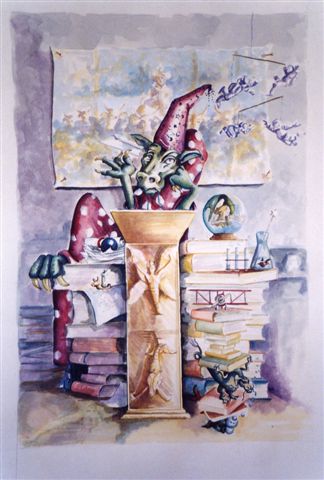
an illustration from a book I never published: A Dragon's Tale

an illustration from a book I never published: A Dragon’s Tale

I’m breaking my book down into component actions almost as if I was dissecting a play script. It’s an interesting exercise because I’m experiencing a measure of creator’s blowback: I’m having the distinct impression that someone else wrote this book knowing that I’d read it someday. The author formerly known as “me” knew that I’d need to know what it contains. It is often true that we teach what we most need to know.

I started my component part breakdown because I’ll soon be throwing people into an exploration of the book’s 9 Recognitions. I wanted to chart the actions of the story and the learning embedded within the narrative. I say, “throw people into an exploration,” because I eschew the word “teaching.” My life has taught me that good teaching is about creating a container for exploration. Good teaching involves no teaching. Good teaching is watching and waiting for the right moment to ask a single simple question: what did you discover? The response will always be personal and relevant to the learner. No amount of control or planning can match the power of relevant personal discovery.

A side note: good teaching and a good life share a common center: the capacity to stand solidly in the constancy of discovery.

The primary thought-river that carries the raft of my book is “to have the experience first and make meaning second.” Making meaning second is what we do even when we think we know where we are going. Life is mundane only when “mundane” is the meaning we assign to it. Life goes bland and gray when we make meaning prior to having experiences.

The word “presence” is shorthand for having experiences before assigning meaning to the experience. If you strive to be more present simply cease thinking that you know what’s coming. You don’t.

And so, this is what my component part breakdown/book blowback looks like:

“Throw them into an exploration.” This is a remarkably different action than, “teach them.” (Another Recognition from my book: the language we use to assign meaning matters more than we know).

“Ask a single simple question” This is also a remarkably different action than, “teach them.” Live in the question and not the need for an answer.

When I was an aspiring actor deep in my acting school studies I learned that the verbs that I choose matter. The actions that I assign to my pursuit can ignite me up or block my path. The same is true on my discovery path: when I am making meaning, use really good verbs. There’s no need to minimize the sizzle of this extraordinary life.

Go here to get my latest book, The Seer: The Mind of the Entrepreneur, Artist, Visionary, title_pageSeeker, Learner, Leader, Creator…You.

Or, go here for hard copies (Amazon)

Roll Up Your Sleeves

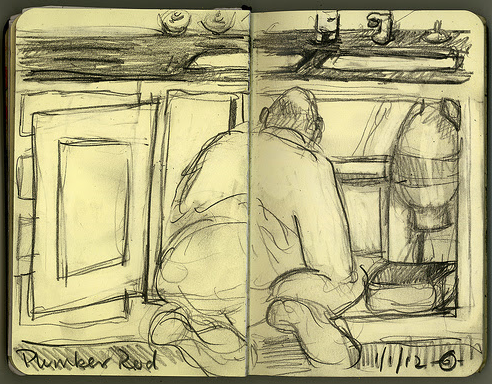
"Plumber" by Marcia Milner-Brage

“Plumber” by Marcia Milner-Brage

I’ve never owned a house so I’m not much of a repairman. I don’t come with tools or know-how. So, when the bathroom sink plumbing failed yesterday, I was contemplative, which is to say, not much use. I watched Kerri roll up her sleeves and get to work. She crawled under the sink, swore like a sailor, and pulled apart the offending pipes. I ran to fetch tools, paper towels, buckets, and anything else that she needed. I became the plumbing equivalent of a sous-chef.

All the little rubber rings (a technical term, I’m sure) in the pipe joints failed. I like to think that after many years of fine service they simply decided to retire and since they started their careers together they retired together. It was a group retirement without prior notice.

Since we’d entirely deconstructed the fittings, we decided to replace everything so we went to the hardware store, stood in an aisle and consulted with a man who knew less about plumbing than I did. Kerri rolled up her sleeves, swore like a sailor (the unhelpful man fled), and she began pulling parts off the rack until she’d discovered what she needed for reconstruction.

Like true plumbers we had coffee and delayed the inevitable descent beneath the sink. After a healthy interval, since all the heavy lifting and brainwork was already done, I did the deed. Following the example modeled for me, I rolled up my sleeves, swore like a sailor (though my repertoire of words was less imaginative than Kerri’s), and crawled under the sink. Like a control tower helping a passenger land the plane after the pilot passes out, Kerri talked me through the assembly. I was triumphant when the pipes did what pipes are supposed to do, when no water dribbled to the bathroom floor, when the sink was once again open for business.

In my work and my life I rarely experience a sense of real completion. It’s the reason I like to do dishes: there’s a clear beginning, middle, and end. Right now I’m trying to find ways of getting my book into the world and I’ve run through what I know to do. I’ve exhausted my first level of ideas. I realized that the challenge is a lot like plumbing. At the beginning, contemplation is not very useful. Asking the question, “How will I do it?” is necessary but needs to come somewhere in the middle of the process. And, “how” is never a definitive answer, it is a good guess at a next step. “How” never reveals itself until after the job is done.

I work with lots of people and the number one block to meaningful action is the question, “How?” Yesterday in the role of plumber’s apprentice, I learned what I teach: the answer to “how” is this: pull things apart, put your hands in the muck, swear like a sailor, see what’s there, ask for help, know when help is or is not useful, look at the pieces, run and get buckets because there will most likely be a mess. Then, take another step based on what you find.

Go here to get my latest book, The Seer: The Mind of the Entrepreneur, Artist, Visionary, title_pageSeeker, Learner, Leader, Creator…You.

For hard copies, go here.

Stand With Hope

Untitled Narrative by David Robinson

Untitled Narrative by David Robinson

Here’s my gorgeous quote of the day. It came from Barney during a conference call with Skip. We were talking about yesterday’s striking quote, “lost is the new normal.” Barney reflected that being lost (not knowing) is a beginning. He said, “It necessitates that we stand in the presence of hope.”

Isn’t that elegant! Do you remember the last time you stood in uncertainty and whispered quietly to yourself, “I do not know what to do?”  Did you recognize the moment as a beginning? Why is “not knowing” what to do so frightful? What assumption set requires us at all times to know? Knowing what to do is, at best, an illusion.

“Not knowing” is the beginning of learning. Learning has nothing to do with knowing. Learning has to do with exploration. Life has nothing to do with knowing. Life has everything to do with experience and engagement. Every educator, mentor, guide, and leader should listen to Barney’s thought.

What if we understood that being lost was nothing more than a beginning and the gift of “not knowing” was that, for a moment, we might stand silently in the warm presence of hope? What if we understood the role of student to be a long walk in the presence of hope? Can you imagine who we might be as a society (and as individuals) if we understood the need to test for the presence of hope before we ran tests for knowing stuff?

Go here to get my latest book, The Seer: The Mind of the Entrepreneur, Artist, Visionary, title_pageSeeker, Learner, Leader, Creator…You.

Go here for hard copies of The Seer


Intend The Glitch

Watching a video on “Glitch Art” the other day I heard this phrase: you have to understand a system before you can break it. A glitch in computer code is an anomaly or mistake that creates a hiccup or break in the system. It is a mistake that can make some very interesting imagery. Glitch artists seek the mistakes. They seek the beauty that comes from what others might view as a problem. And my favorite artistic moment as expressed by the glitch artists: at some point they start creating problems in the code. They intend the glitch (which makes it no longer a glitch).

Penicillin is the result of a process glitch. Science is often the art of surfing for glitches, finding the anomaly within the pattern. The word “experiment” implies an orchard of happy mistakes that reveal new insights. The word “unique” means distinctive, exceptional, singular – something out of the ordinary. In other words, a glitch.

Art and Innovation (in the USA) are equated with the new. Artists and innovators try to help us see the world in a new way – or even better, they help us see the world anew. Seeing anew always requires pattern disruption. It requires a challenge to the assumption set, a smack to the status quo. It requires a glitch.

Consider this: learning – true learning (not the answer driven drivel currently running rampant in our education system) and seeing anew are fundamentally the same thing. To learn is to see the new or to see anew. At the heart of art and science – the reason for math and English, economics, politics, ethics, social science,…, is an orientation to the question (as opposed to the numbing notion of a right answer).

Like the glitch artists, no one simply finds the new. It is not something that can be sought or predetermined. It is something we bumble into. It happens when you one day ask, “Hey, I wonder why that happened?” Or, “I wonder if it would work better if…?” It begins with wonder. Wonder leads to experimentation and questions within questions within questions that lead to more experimentation and more questions. This is also a good definition for being vitally alive. Wonder and step toward it. Orient to the question, do an experiment, and tomorrow ask a better question. Do this everyday and someday, just like the glitch artists, you will find yourself doing what all artists know as life-giving: you will intend the glitch, play with the mistake, and learn to see the world anew again and again and again.

For a humorous look at the wonderful world of innovation and new ventures, check out my new comic strip Fl!p and the gang at Fl!p Comics.