Roll Up Your Sleeves

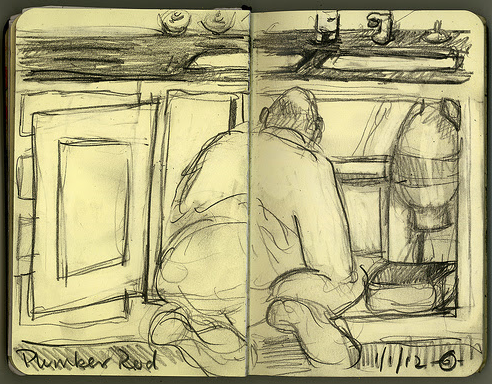
"Plumber" by Marcia Milner-Brage

“Plumber” by Marcia Milner-Brage

I’ve never owned a house so I’m not much of a repairman. I don’t come with tools or know-how. So, when the bathroom sink plumbing failed yesterday, I was contemplative, which is to say, not much use. I watched Kerri roll up her sleeves and get to work. She crawled under the sink, swore like a sailor, and pulled apart the offending pipes. I ran to fetch tools, paper towels, buckets, and anything else that she needed. I became the plumbing equivalent of a sous-chef.

All the little rubber rings (a technical term, I’m sure) in the pipe joints failed. I like to think that after many years of fine service they simply decided to retire and since they started their careers together they retired together. It was a group retirement without prior notice.

Since we’d entirely deconstructed the fittings, we decided to replace everything so we went to the hardware store, stood in an aisle and consulted with a man who knew less about plumbing than I did. Kerri rolled up her sleeves, swore like a sailor (the unhelpful man fled), and she began pulling parts off the rack until she’d discovered what she needed for reconstruction.

Like true plumbers we had coffee and delayed the inevitable descent beneath the sink. After a healthy interval, since all the heavy lifting and brainwork was already done, I did the deed. Following the example modeled for me, I rolled up my sleeves, swore like a sailor (though my repertoire of words was less imaginative than Kerri’s), and crawled under the sink. Like a control tower helping a passenger land the plane after the pilot passes out, Kerri talked me through the assembly. I was triumphant when the pipes did what pipes are supposed to do, when no water dribbled to the bathroom floor, when the sink was once again open for business.

In my work and my life I rarely experience a sense of real completion. It’s the reason I like to do dishes: there’s a clear beginning, middle, and end. Right now I’m trying to find ways of getting my book into the world and I’ve run through what I know to do. I’ve exhausted my first level of ideas. I realized that the challenge is a lot like plumbing. At the beginning, contemplation is not very useful. Asking the question, “How will I do it?” is necessary but needs to come somewhere in the middle of the process. And, “how” is never a definitive answer, it is a good guess at a next step. “How” never reveals itself until after the job is done.

I work with lots of people and the number one block to meaningful action is the question, “How?” Yesterday in the role of plumber’s apprentice, I learned what I teach: the answer to “how” is this: pull things apart, put your hands in the muck, swear like a sailor, see what’s there, ask for help, know when help is or is not useful, look at the pieces, run and get buckets because there will most likely be a mess. Then, take another step based on what you find.

Go here to get my latest book, The Seer: The Mind of the Entrepreneur, Artist, Visionary, title_pageSeeker, Learner, Leader, Creator…You.
For hard copies, go here.

Stand With Hope

Untitled Narrative by David Robinson

Untitled Narrative by David Robinson

Here’s my gorgeous quote of the day. It came from Barney during a conference call with Skip. We were talking about yesterday’s striking quote, “lost is the new normal.” Barney reflected that being lost (not knowing) is a beginning. He said, “It necessitates that we stand in the presence of hope.”

Isn’t that elegant! Do you remember the last time you stood in uncertainty and whispered quietly to yourself, “I do not know what to do?”  Did you recognize the moment as a beginning? Why is “not knowing” what to do so frightful? What assumption set requires us at all times to know? Knowing what to do is, at best, an illusion.

“Not knowing” is the beginning of learning. Learning has nothing to do with knowing. Learning has to do with exploration. Life has nothing to do with knowing. Life has everything to do with experience and engagement. Every educator, mentor, guide, and leader should listen to Barney’s thought.

What if we understood that being lost was nothing more than a beginning and the gift of “not knowing” was that, for a moment, we might stand silently in the warm presence of hope? What if we understood the role of student to be a long walk in the presence of hope? Can you imagine who we might be as a society (and as individuals) if we understood the need to test for the presence of hope before we ran tests for knowing stuff?

Go here to get my latest book, The Seer: The Mind of the Entrepreneur, Artist, Visionary, title_pageSeeker, Learner, Leader, Creator…You.

Go here for hard copies of The Seer


Intend The Glitch

Watching a video on “Glitch Art” the other day I heard this phrase: you have to understand a system before you can break it. A glitch in computer code is an anomaly or mistake that creates a hiccup or break in the system. It is a mistake that can make some very interesting imagery. Glitch artists seek the mistakes. They seek the beauty that comes from what others might view as a problem. And my favorite artistic moment as expressed by the glitch artists: at some point they start creating problems in the code. They intend the glitch (which makes it no longer a glitch).

Penicillin is the result of a process glitch. Science is often the art of surfing for glitches, finding the anomaly within the pattern. The word “experiment” implies an orchard of happy mistakes that reveal new insights. The word “unique” means distinctive, exceptional, singular – something out of the ordinary. In other words, a glitch.

Art and Innovation (in the USA) are equated with the new. Artists and innovators try to help us see the world in a new way – or even better, they help us see the world anew. Seeing anew always requires pattern disruption. It requires a challenge to the assumption set, a smack to the status quo. It requires a glitch.

Consider this: learning – true learning (not the answer driven drivel currently running rampant in our education system) and seeing anew are fundamentally the same thing. To learn is to see the new or to see anew. At the heart of art and science – the reason for math and English, economics, politics, ethics, social science,…, is an orientation to the question (as opposed to the numbing notion of a right answer).

Like the glitch artists, no one simply finds the new. It is not something that can be sought or predetermined. It is something we bumble into. It happens when you one day ask, “Hey, I wonder why that happened?” Or, “I wonder if it would work better if…?” It begins with wonder. Wonder leads to experimentation and questions within questions within questions that lead to more experimentation and more questions. This is also a good definition for being vitally alive. Wonder and step toward it. Orient to the question, do an experiment, and tomorrow ask a better question. Do this everyday and someday, just like the glitch artists, you will find yourself doing what all artists know as life-giving: you will intend the glitch, play with the mistake, and learn to see the world anew again and again and again.

For a humorous look at the wonderful world of innovation and new ventures, check out my new comic strip Fl!p and the gang at Fl!p Comics.

Serve Your Gift

Each night for the past 6 nights, k.dot has read to me a chapter from Deepak Chopra’s Seven Spiritual Laws of Success. I was moved last night when she read in the final chapter, the law of Dharma, guidance and advice that he’d given to his children. He taught them to meditate at four years old. He asked them not to concern themselves with making money but instead to identify what was their unique gift and how could they might best give it in service to the world.

I keep telling myself to give up educational rants. I’ve banged the drum of hope and change for years. I watched the hopeful, the dreamers, and the revolutionaries get creamed by a machine that cared more for dollars than for children. I watched Lisa slowly get pulled into the machinery and get crushed; she was brilliant. She cared for children over politics so, of course, she had to go. I might as well have led her to slaughter. We talked about it years ago, this possibility of systemic rejection. Never-the-less, I am culpable and no longer capable of looking at an educator and saying, “believe.”

Last night I found myself wanting this man, Deepak, to lead the education reform movement in these United States of America. What is the use of testing the pants off our children if the adults meant to guide them are clueless to the things that matter? Don’t you just want to scream, “Your soul is worth infinitely more than the job your will trade it for.” A score on a test means nothing if you can’t put your feet in the river and know that you are unique and divine. Owning a BMW is just as empty if you don’t know your unique gift and understand how to give it with gusto. Don’t just get through life. Live it!

If you can’t answer this question, “What is mine to do?” then the education system has failed you. If you are oriented to taking instead of giving your community is crumbling. Period.

Technology has wrought a whole new ball game and the only people who don’t know it are the policy makers pulling the levers of education. The kids know. They tolerate the system and then go pursue something meaningful.

Isn’t it a great educational north star to ask these two questions: 1) What is your unique gift? 2) How can you use it to serve the world? If these simple questions were the drivers of your education you’d spend almost no time in your life asking yourself if you mattered or if your work had meaning. You’d know. The people guiding you would value your self-direction and support you in the giving of your gift. They’d be invested in guiding you to personal power instead of controlling you.

Giving completely your gift is the path to fulfilling yourself and what is the point of education if not that? And, wouldn’t it be helpful to learn how to cultivate inner quiet while you are young? Navigating this noise world, operating from a solid center, is easy if you’ve developed the skill of deep listening. Self-direction and self-regulation are qualities of powerful people and come from listening. They are qualities that we are born with. They are ordinary. Power is ordinary. Divinity is ordinary. Losing it to the little stuff is…tragic.

[899. Join me in inspiring truly powerful people. Each day I will add a new thought, story or idea to support your quest and mine].

For a humorous look at the wonderful world of innovation and new ventures, check out my new comic strip Fl!p and the gang at Fl!p Comics.

Learn To Laugh

Comedy is about other people’s pain. Wiley Coyote going off the cliff one more time is funny. The guy slipping on the banana peel is hysterical as long as you are not that guy. Humor is mostly a status drop for someone.

I’ve been writing and drawing a cartoon called FL!P for almost half a year now so I’m inadvertently making a study of what’s funny and what is not. Recently some acquaintances that know me from my coaching life took me to task because my comic strip seemed out of character. “It’s mean,” they said. “Yes.” I said. That is precisely why it is funny.

The strip is aimed at entrepreneurs and there is a need for a bit of levity in a world so steeped in self-interest and confusing agendas. In many traditions around the world the trickster is an integral part of worship. We are not meant to take our gods so seriously. The reverence is always found in the relationship and the realization that the godhead is in all of us. It is our flaws that take us closer to the creative. Worship is a relationship and a full relationship includes laughter, joy, play, as well as inner quiet and awe. Tricksters break rules and pull the blanket off of societies inequities. Tricksters help us see what we pretend not to see. The Emperor would still be strutting around naked if the trickster boy hadn’t spoken a truth that the rest of the village denied. Truth comes easier with laughter. I can tell you that there is much public prancing in the world of accelerators and incubators but very little real apparel. Humor is necessary in a landscape so rife with pretending.

Artists are often of necessity the tricksters of their culture. It is the artists’ job to open eyes to what is there (versus what we think is there). It is the artists’ job to bring the communal attention into the present, to slap-stop the puffed up importance of things that do not matter so that the things of real importance can be seen. With a 24 hour news cycle and a congress ruled by corporate dollars it is hard for us to sort out what is valuable and what is not. The narrative in the commons rarely reaches the level of significance. It is no wonder that many people confess to getting their news from John Stewart and Stephen Colbert (both heroes of mine).

The greatest lessons of my life did not come gently and I am all the more grateful for the force behind the learning. My lessons came with status drops and like Wiley Coyote I have gone more than once over the cliff with an anvil close behind. Comedy is mean. Learning requires falling down. Stepping into the unknown is potent because of the myriad of things to trip over. If you can’t laugh at the bungle you’ll miss the lesson.

897. Join me in inspiring truly powerful people. Each day I will add a new thought, story or idea to support your quest and mine.

For a humorous look at the wonderful world of innovation and new ventures, check out my new comic strip Fl!p and the gang at Fl!p Comics.

Let Go Of Zero

874. Join me in inspiring truly powerful people. Each day I will add a new thought, story or idea to support your quest and mine.

Last week while I was in Colorado at my father’s 80th birthday celebration, knowing I would not have enough time to write, I reposted pieces from over a year ago. I selected them at random so it was an accident that many of the posts were about zero. Since rereading those reposts I’ve decided that I no longer believe in zero. Don’t get me wrong. I see the value of zero as a mathematical construct. I remember hearing in my middle school math class that the invention of zero revolutionized reckoning.

It was an invention, a representation of nothing. It was a starting point with no point. I don’t believe in zero because I’m hard pressed to imagine anything in this vast universe that is empty. This vast universe is alive. It’s energy. It’s vibration. There is nothing that is truly nothing. There is no such thing as less than one. It’s all one.

I saw a tweet from Kevin Honeycutt (I am a huge fan of Kevin. He is my brother from another mother) a day or so ago imploring teachers to see their students on day one of the new school year as the writers and artists and astronauts that they really are. Every single child is magic. Every single teacher is magic. It is our investment in zero that lets us see the amazing children and dedicated teachers as less than one (to think that they are in school to pass tests is to see them as less than one). They are the one. Each and every one of them is the one. There is no zero. There is no less than one…. So, join Kevin in seeing the one, the gifts as they walk through the door and return this fall to this thing we call school.

Meet The Opponent

860. Join me in inspiring truly powerful people. Each day I will add a new thought, story or idea to support your quest and mine.

On the white board Skip wrote, “The enemies.” We were planning our business and as we moved deeper into specific details, the forces of opposition became apparent. Skip listed them as “enemies” rather than “obstacles” because forces that rise against clear intention are not passive. A boulder in the road is an obstacle. A tide of opposition is an opponent and the strategy for meeting an opponent is different than that of meeting an obstacle. Both strategies begin with respect and then the paths diverge.

Innovation will always bring a tide of opposition. Several times in my life I have seen “the system” crush the very innovation that it purports to seek. It smashes the innovators that work to improve the lives of all involved. Their innovation would necessitate change and the fear that change inspires in a system is lethal to change makers and the advances that they bring. Tom used to say, “You will know the worth of your work by the size of the tide that rises against you.”

On the list of enemies Skip wrote “The Four Overcomings.” This is a reference to one of Carlos Casteneda’s books. The Four Overcomings are 1) The Fear of Learning, 2) The Fear of Clarity, 3) The Fear of Power, and 4) The Fear of Old Age. In the book, Don Juan tells us that very few people move beyond the first fear. A true learner must open to change. A true learner must embrace the unknown and become practiced at stepping into it. One in ten will face this fear and overcome their need to know. The majority will seek safety and grasp firmly to what they know.

Learning brings clarity. Of the people that move beyond the first overcoming, only a very small percentage will face their fear of clarity. As Skip explained, those who become clear are dangerous to the status quo and are ostracized or worse. It takes courage to speak truth in a society dedicated to maintaining the safety at all cost. Most will hide their clarity. They will pretend ignorance. A very few will embrace their clarity and give voice to what they’ve learned.

If one is able to face the fear of learning, move beyond the fear of clarity, they become potent. They become powerful. And the powerful must embrace their power. They must not deny their power and in fact must willingly use their power. Fear of being power defeats almost all people. As Marianne Williamson famously wrote, “Our deepest fear is not that we are inadequate. Our deepest fear is that we are powerful beyond measure.” All people are powerful beyond measure but would rather measure than be powerful.

The fourth and final overcoming is old age. Skip smiled and said, “By the time you get beyond Overcomings 1 – 3 you will be old. And no one overcomes number four.

Learning, clarity, power, and old age are forces. They are not obstacles. They are not passive. They are opponents and to overcome them one must begin with respect – not for the opponent but for one’s self. And then you must ride out to meet them on the field of your life.

Embrace Your Discipline

858. Join me in inspiring truly powerful people. Each day I will add a new thought, story or idea to support your quest and mine.

It occurs to me that during this phase of my life I am learning discipline. Not that I’ve ever been undisciplined but a short gander at my current daily activity looks like a masters class in self-direction. I laughed out loud when a few minutes ago I looked up “discipline” in the thesaurus and the word “punishment” topped the list. The other choices are regulation, self-control, and subject (as in field or specialty). I generally resist rules, am not in to punishment, and am a generalist to such a degree that I have no field or specialty. So, discipline must be necessary to help me come to some semblance of balance before I’m too old to balance. All will be lost the day I wear pants with elastic waistbands and Velcro shoes but until then some balance may be possible.

Two years ago I decided to write posts every day. I decided to take on a daily writing commitment because the need for fodder opened my eyes. I had to pay attention to all the colors of life swirling around me if I was going to have something to write about. Little gestures of kindness became visible. The world is much more vibrant than I understood before I began paying attention. I’ve always been a painter so I’ve practiced “seeing” all of my life but a new kind of sight opened when I decided to write. Also, I’ve never considered myself a writer so my sub-intention for writing each day was to learn to write. Double discipline: open my eyes to see and become a better writer.

Two months ago I committed to publishing a daily cartoon strip for an audience entrepreneurs. Although the strip is crude (by design), each panel takes a few hours to complete and in just a few months I’ve drawn over 120 panels. Today, like most days, I spent the afternoon drawing and inking cartoons. I’m trying to get two months ahead because the strip publishes everyday, seven days a week. It is not lost on me that since beginning the cartoon I find that I am listening with a new set of ears. I’m becoming a world-class eavesdropper. Everything is fair game for cartoon material and everything – especially the most serious conversations – sound like a cartoon. People have no idea that they are riotously funny. In cartooning I’ve already learned that few things in this life warrant the weight that we give to it. Our addiction to drama and blaming is a comedy gold mine. I am my own best source for a good yuck. The discipline is to listen and laugh.

Walking home from tai chi this morning made me realize that I also have a daily tai chi practice. I began my study almost 2 years ago and I love it. I start each day with my practice and I am changing in some fundamental ways because of it. The discipline is to root over what Saul calls “the bubbling spring.” Connect to the chi and empty of all forms of pushing. The discipline is to empty and listen.

Listen. Empty. Laugh. See. Balance. Punishment is nowhere in sight. Alan says that the root word of discipline is disciple –and today I take great delight in my chosen path of discipleship.

Look For The Crossroads

855. Join me in inspiring truly powerful people. Each day I will add a new thought, story or idea to support your quest and mine.

I’m having an ongoing email conversation with Rafael. We are discussing educational change but more specifically asking how to change a culture of exclusion. I won’t go on a rant so let it suffice to say that the idea that we have equal access is just that: a nice idea but is nowhere apparent in the national fabric or the lived narrative of our nation. Our tax codes are created to keep the poorest poor and the wealthiest wealthy. Revolutionizing education is to revolutionize the economy and that is why it has become such a wicked problem. The forces in play do not favor the many. The voices in power represent the few.

I’ve spent a great deal of my life pushing against the public school system. And despite my capacity to fling around phrases like, “You can’t solve a problem at the level of the problem,” I’m only now seeing beyond the level of the problem. Inequity is institutionalized and deeply embedded in the national narrative so it is a fool’s errand to push on the institutions. As Buckminster Fuller advises, move toward what you want to create. This requires a new narrative. It requires to look at something other than what currently exists.

We go where we look. Where are we looking? We can hit division every time if we insist on seeing division. What’s good for business is not always what’s good for community and I often think that business wins the contest every time because we have a fleeting sense of community. We define our national health by the stock exchange. We are up or we are down. When I listen to the news or read the papers I am filled with the narrative of division. It is Us and Them on every page. This is not a new narrative. It is as old as our nation. Life, Liberty, and The Pursuit of Happiness refers to land ownership and at the time those words were penned those privileges were extended to a few white males with resources and no others. A system does what a system was designed to do.

A new narrative would be one of unity. A new narrative is one of inclusion. A new narrative would consider the health of the system – in fact it would demand a healthy system and that is impossible to realize if any segment of the system is impoverished. A healthy plant cannot grow in exhausted soil. This is not an abstraction. Grow a garden in polluted soil and tell me what you discover.

It feels as if we are standing at the crossroads of “Every man for himself,” and “I am my brother’s keeper.” Both of these phrases are philosophies of an economy. The great thing about a crossroads is that the roads cross. They come together and are neither this nor that. They are a meeting ground and places of commerce accessible to all. Meeting grounds are also the place where new narratives are created. They are places of possibility. We know that our political climate is averse to seeing crossroads. We do not have to go where they are looking. We are capable of telling a different story if we are courageous enough to look where the roads cross and decide to stand in the place of an economy that includes instead of an economy that excludes.

It Matters

808. Join me in inspiring truly powerful people. Each day I will add a new thought, story or idea to support your quest and mine.

From the department of subtlety in language comes a submission from Skip. During lunch today (His email said, “Meet me for a black and tan. We’ll call it late lunch or early dinner.”) During “lunch” he told me about a speaker who made the distinction between a student and a learner – to make the point that our systems of education (higher and lower) are not about learning. To be a student and to be a learner are not the same thing at all.

The distinction is in the assumptions beneath the words. The word “student” implies the need for teachers, curricula, etc. The deeper implication is in the necessary action: it is ‘other-directed.” The word learner, on the other hand, requires no teacher, no agenda, nor a curriculum. The necessary action is self-directed. The action can be facilitated, it can be mentored, it can be shared, but the imperative is within.

Why, you ask, does this matter? Isn’t this just splitting hairs?

Last year Skip and I met at a conference for educators on reinventing learning but in Skip’s words, it was not about learning at all. It was about reinventing teaching. The organizers were educators so their assumption set necessitated students and teachers in an expert driven relationship. The teachers know. The students receive the knowing. No learning required. There were incredible conversations that day and few had to do with learning.

Learning is a pursuit. It is a discovery path. There is nothing passively receptive about learning (note: the moment you separate content from method you end all learning and enter the realm of student/teacher).

It matters. The way we ask the question determines the possibilities we see or don’t see. None of our current questions in the field of education have much to do with learning. I walk in many worlds and in the business realm I regularly hear these phrases: “Why don’t my employees take any initiative?” “They expect to be rewarded for everything?” “It’s impossible to critique anything because they take it so personally.” “Everything needs to be an ‘atta-boy!” “They might do just what you ask but never go beyond the prescription.” Frustration abounds.

Well. We get what we create. Students look for permission, color inside the lines, need approval and fixate on their grade. Learners embrace challenges, step across lines, and know intrinsically whether or not their work is good. It matters.

