Step On The Stage

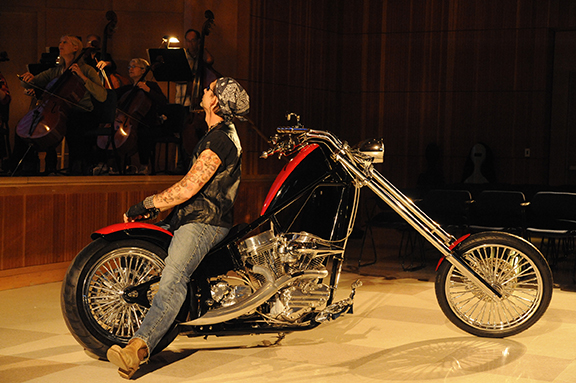
My performance with the Portland Chamber Orchestra of "The Creatures of Prometheus. I wrote and performed the piece for PCO.

My performance with the Portland Chamber Orchestra of “The Creatures of Prometheus.” I wrote and performed the piece for PCO.

Craig is laughing at me and with good reason. Through a post he asked a simple question about people building boxes around themselves. He issued a singular challenge: to apply what I found in his post to my writing. I’ve had more ideas and random ruminations than I know what to do with; he opened a big can. Before I let it go, I want to wade into the last part of his question: when did I know to create my stage?

Craig positioned a stage (showing up) as the polar opposite of a box (hiding) so I read his question as asking when I decided to show up. I’ve learned that a stage can be a strategy for hiding, too, so “showing up” means much more than just being visible.

Many actors get on the literal stage because they are seeking appreciation or approval from the audience. When anyone mounts a stage, either literal or metaphoric, to seek approval, they split themselves. By definition, they must hide their intention (to seek approval) and in so doing, give away their power and potential. Young teachers often pass through a growth phase in which they seek the approval of their students; they want to be liked and their need for appreciation neutralizes their capacity to teach. Ironically, in both cases (actors and teachers), the moment they cease splitting their intention they become great at what they do and their respective audiences can’t help but appreciate them. That’s the way power works.

Several years ago I was working with a corporate client who was upset because he felt uncomfortable with what he’d learned from my workshop. I told him that I could either serve him or please him but I could not do both. I understood that my job was to help him grow and that necessarily required discomfort. If he wanted to be pleased he needed to hire someone else.

I hid for years. I split myself for decades. My dear friend Roger once said that one day in his middle 30’s he realized that he was no longer becoming someone. He was someone. Everyone navigates the “becoming.” It is a necessary and vital growth phase and is often filled with fears of inauthenticity and split intentions; everyone wants to be appreciated and everyone sacrifices their primary intention in a mad dash for approval until one day, if they are lucky, they realize the only approval they need is their own. My revelation came when I was preparing to go on stage to perform. I realized that I was steeling myself against the audience (preparing to hide). I was assuming that they were going to judge me, which is a form of approval seeking. It was like a cold slap. I’d never had a bad experience with an audience. I’d only ever experienced appreciation and support and wondered why I was steeling myself against the very people I was there to serve. My need for approval dropped like a stone. I went on stage, perhaps for the first time in my life, present and powerful. I didn’t need anything from them. I was bringing life and my gifts to them and that was all that was required. My whole world flipped. No armor. No mask. No need other than to offer my gift on that day to that specific group. Whether or not they accepted my offer could no longer be my concern.

I’ve since learned that discomfort is a very valuable thing. It is present anytime learning and growing is happening. In fact, if there is no discomfort, there’s no learning. And that is the plaque nailed to my stage.

Go here to get my latest book, The Seer: The Mind of the Entrepreneur, Artist, Visionary, title_pageSeeker, Learner, Leader, Creator…You.

Go here for hard copies (Amazon;-)

Hear Your Words

[continued from EAT WELL]

Craig originally wrote a post about the boxes people construct around themselves and the alternative choice of creating a stage.  After his post he challenge me to enter the fray and muck about with boxes and stage and I’ve been pleasantly surprised at how much I have to say – I’ve followed the thread for a few days and will probably keep following it for a few more. It’s a rich exploration!

Yesterday I mentioned that I had the opportunity to work with Skip’s Human Centered Design class at the Illinois Institute of Technology in Chicago. I tossed the group into several exercises and experiences designed to help them understand how people story themselves. Specifically, we took a look at language as the building block of perception. We captured on video portions of my time with the students so rather than write about it, here’s clip from the day. [Note: the real riches start about 2:30 minutes in but I thought the students questions might be of use to set the stage so I left it in the cut. They’d just completed an exercise of misnaming things]. Let me know if you find some juicy bits about the boxes we build around ourselves and our attempts to “step outside of the box.”

[to be continued]

Go here to get my latest book, The Seer: The Mind of the Entrepreneur, Artist, Visionary, title_pageSeeker, Learner, Leader, Creator…You.

Go here for hard copies (it’s Amazon…)

Eat Well

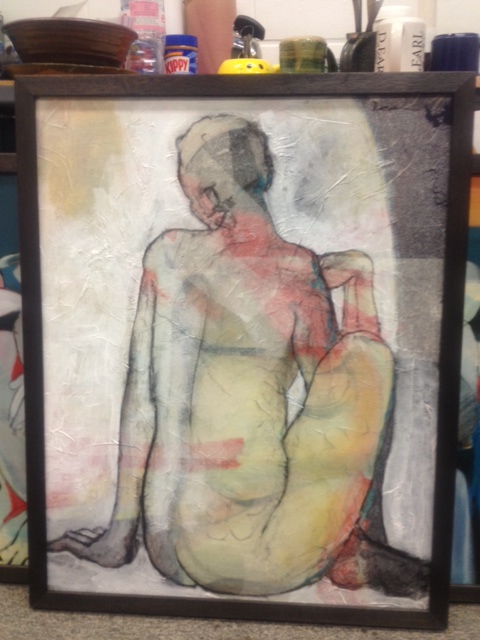
"Lovers," a work in progress by David Robinson

“Lovers,” a work in progress by David Robinson

[continued from LOOK BEYOND THE BOX]

I’m looping back to Craig’s questions concerning boxes and stages. I think the next question to wade into is about what I see from my stage and when did I know to create my stage.

This is the view from my stage. It may sound bleak at first but stay with me:

Yesterday I had the opportunity to travel into Chicago and work for a couple of hours with Skip’s class at the Illinois Institute of Technology. They are budding entrepreneurs. There’s lots of energy in the world today bubbling around this word, “entrepreneur.” Accelerators and incubators are popping up everywhere. We are now a society gorging on new technology; since we are modeled on the Rome of the Caesars we have little patience for digestion (it takes time) so we prefer to vomit what we just consumed to make room for the next course. We are living at the time of an idea feeding frenzy and mind blowing technological advances. Folks with resources but few ideas are hungry to link up with folks with ideas and no resources. Everyone is insatiably hungry. No amount of gorging will satisfy the hunger.

In our world of rabid consumption, nutrition isn’t necessarily a high priority. I mean that literally and metaphorically. For evidence, look at what the networks call “news.” Long ago we realized that entertainment is more profitable than reporting so reporting is now entertainment. It matters little if there is substance to the story so long as people consume it. More evidence: one of my favorite rants of the past decade came from Dane, a neighbor, who was sitting on his stoop eating a bag of potato chips. He called me over to look at the ingredients listed on the package. High on the list, in fact the second ingredient listed, was sugar. Dane screamed, “There’s more sugar than salt in my chips!” He fumed, “I’ve been reading the ingredient lists on everything and there’s sugar in everything. It’s more important to get us hooked than to feed us anything of substance!” Of course, the punch line to the story is that he ranted with his mouth full of chips. Another bit of evidence: I stopped counting the times I’ve heard a politician say, “We have to weigh our interests against our values.” You can find a variation of this statement in the news of the day everyday. You can find an example of it in your life each day, too. How do you weigh your interests against your values?

This consumption/nutrition question is the epicenter of confusion for lots of people. It is the reason many boxes and stages are constructed.

Most people that I work with are seeking greater meaning. They want a richer experience of life. They want to fulfill their potential. In the midst of their consumption of time, they feel consumed. They have little time to breathe. They have little capacity to develop deep, meaningful relationships. They are finding that their stuff doesn’t fill the void. They are finding that their achievements are hollow unless they serve the real needs of others. They always find that what they seek is something that they’ve had all along: relationships.

There is no magic to sustenance. Slow down and enjoy your meal: literally and metaphorically. Slow down and make the meal: literally and metaphorically. Slow down and make the meal from food that hasn’t been processed: literally and metaphorically. Care for the soil and you will grow healthy food: literally and metaphorically. This requires slowing down. All of these are about the relationship you have with your world. All rich relationships require lingering and the riches are always in the relationship. Always.

Substance is always about a relationship. Relationship can’t be consumed; it must be entered and/or engaged. Tend the relationships, especially the relationship you have with yourself. In this way, the box or stage you construct will be built from self love and self love is the wellspring of love for others.

I see riches in the relationships all around me and a species (homo sapiens) trying to remember what it means to eat from the tree of life.

[to be continued]

Go here to get my latest book, The Seer: The Mind of the Entrepreneur, Artist, Visionary, title_pageSeeker, Learner, Leader, Creator…You.

Go here to get a hard copy (it’s Amazon)

Look Beyond The Box

one of my paintings (untitled) from the Yoga series

one of my paintings (untitled) from the Yoga series

[continued from SEE THE BOX]

Craig’s question is bigger than a single post can accommodate. He’s both reflecting and asking several questions about the boxes people construct around themselves, about building personal “stages” and what becomes visible to us when we open ourselves to life without editor or inhibition. He’s asking deep river questions about the assumptions we make when we look at others through the lens of our own experience. He asked about what I see from my stage and when did I know to create my stage. And, here’s the kicker question, “When was the last time you stepped up and saw something you didn’t know was there?”

I want to start with the last question first because I believe it colors all of the other questions. At this point in my life, there isn’t a day that passes that I don’t see something surprising or new. I know that sounds like a superficial dodge until you consider that it wasn’t always the case. Like everyone else, I was schooled in a long series of mistaken notions: 1) that people need to know where they are going before they go there, 2) people need to know what they are doing before they do it, 3) knowing is something that happens in the head, and 4) that truth is singular and knowable; believers in right/wrong paradigms are especially fond of this point.

It took a few years (okay, decades) to realize that “knowing” is a process and not an arrival platform and, therefore, no body knows. People build boxes around themselves because they think they must know what is unknowable. People build boxes around themselves because they think they must look a certain way or think what others want them to think. People build boxes around themselves in an attempt to control what they can never control. No one really knows where they are going (well, everyone knows where they are going but dying is an existential question – a topic for another post). No one knows what tomorrow will bring. As Marshall McLuhan wrote, people step into the future with their eyes in the rearview mirror. We make sense of today through yesterday’s eyes so we can only “know” what happened, not what will happen. The day before September 11, 2001 people walked into airports to greet their friends and relatives at the gate. And then, the very next day, like millions of people, I sat in front of a television and watched a plane fly into the World Trade Center. That day I understood that what I thought I knew was basically useless.

Each of us has, at one time or another, had a personal September 11th. People learn. They grow. They have experiences and then make meaning of their experiences. People change. Life is a moving target. At one point in my life I started my own school within a school. It was experiential and filled with filmmaking and theatre and performance art. At the beginning of that era of my life I thought I would run that school until I the day I died. Three years later, I was done with my exploration in education and I surrendered my cushy tenured position and ran for the air of uncertainty. People story themselves according to inner imperatives through lenses of past experiences. The idea that we are primarily rational and reasonable is…not rational or reasonable.

At some point, when you cease thinking you know stuff, your eyes open. You see beyond what you think. Everything is surprising beyond the dull-wit of thinking. Thinking (a language-based activity) will always be an abstraction. Put a word on something and you delude yourself into thinking that you “know” what it is. This is especially heinous when applied to other people. People build boxes around themselves because of the words placed on them or the words they place on themselves.

Mostly, people build stages for the exact same reason. Saying, “I’m not going to be influenced by others; I’m going to act independent of others” is also a delusion constructed from notions of “knowing” or trying to determine how others will see you. Most stages are constructed from the desire to control. Sometimes the biggest box looks like a stage.

When you no longer need to know anything, you see surprising things everywhere you look.

[to be continued]

Go here to get my latest book, The Seer: The Mind of the Entrepreneur, Artist, Visionary, title_pageSeeker, Learner, Leader, Creator…You.

Go here for hard copies (it’s Amazon, don’t be afraid;-)


See The Box

‘The Box’ by Kerri Sherwood from her album Blueprint for My Soul Craig sent me a link and a challenge. The link was to his recent blog post, Break Down The Box. It’s about how people build boxes around themselves. “Instead of building a box that may later require extra work to remove,” he writes, “I suggest building a stage.” What a great image! His challenge to me was to apply it to my writing. He texted, “It’s relevant to your general topics.”

My question back to Craig was about the word “apply.” Is he challenging me to write about boxes and stages? Is he challenging me to build a stage and stand on it? Both? His challenge came on a day that I said aloud to myself and the universe, “I’m feeling boxed!” His timing was impeccable.

Self Cut outWe’ve not finished our correspondence so I don’t yet know what he means by applying it to my writing. To stall I will write what I know about boxes:

1) Everyone has one. Don Miguel Ruiz writes that we come into this earth as free, uninhibited spirits and then the adults around us begin impressing rules and random philosophy upon us. They teach us constraint and we comply. We are a pack animal, after all, and must operate within the greater needs of the community. That’s why there are traffic lights and a proper fork to use when eating a salad. Our greatest need is to belong; The GAP, Old Navy, or Abercrombie & Fitch could not exist otherwise. The need to belong is the driver behind box building. It’s a paradox. Somewhere amidst all of the compliance we begin to assume that we are no good or start making comparisons to others or create standards of perfection that are impossible to inhabit. So, we build a box called, “should be”. The paradox is that, in order to belong, our action is to hide.

2) Growth comes from constraints. No box is built without the need to deconstruct it. That is the opportunity of the box. Joseph Campbell would call box deconstruction The Heroes Journey. In the great mythologies of the world there is a tension between The Right Hand path (what society expects you to do) and The Left Hand path (following your bliss). Both are necessary and, in the end, we all must find the middle way between the two paths. The middle way is known in mythological terms as The Holy Grail. Bliss always needs the participation of others. We are pack animals and need the pack to know where we fit.

3) Constraint is necessary for creative fulfillment. School boards around the nation have the misguided notion that art is the absence of rule and/or discipline. It must be a requirement of school board participation to attend the symphony without recognizing that the musicians on stage have given their lives to discipline and constraint. It might come as a surprise to most people but artists outstrip the military in rule adherence and rigid discipline. The disconcerting aspect for the school board is that the rules and discipline of the artist are self-imposed. They are inner imperatives. Artists do not need a drill sergeant. They need constraints to push against, boundaries to overcome, rules to challenge, and patterns to disrupt. Watch a kid on a skateboard try to learn a new skill (oh, yes – they are artists, too). They might break their arm in the process but the break will just fuel the need to improve.

4) No one sees clearly their box. To return to a Don Miguel Ruiz-ism, we are the stars of our own movie and can never know the movie of another person (and they can never know our movie). The paradox is, of course, as the star of your movie you never get to see your life from any meaningful perspective until lots of time affords you some distance. Even then, you’ll interpret your movie through the lens of having lived it. If you have an inner monologue, you are center stage of your movie and your movie is your box.  Here’s the beautiful thing about movies/boxes: they all come with flaws and the flaws are almost always the location of the opportunities. As I recently learned, the Amish intentionally place a small flaw in every quilt because they believe that the flaw is what lets the spirit in. The same might be said of boxes.

I’ve been privileged in my life to work with and direct a bevy of actors and most had to learn to stand on a stage. In fact, the stage frightens most of the really good ones. They understand the power of being seen, the responsibility that comes with visibility. It is simply this: be present without the need to control the thoughts or emotions of another. Be present with them. Offer them a story without the self-protection of trying to control what they see. All stories are maps out of boxes. Or, more to the point, stories are maps out of one layer of box to a lesser layer of box. So:

5) Boxes are like onions. A stage is merely a layer.

Go here to get my latest book, The Seer: The Mind of the Entrepreneur, Artist, Visionary, title_pageSeeker, Learner, Leader, Creator…You

Go here for hard copies or Kindle

Remember Your Trick

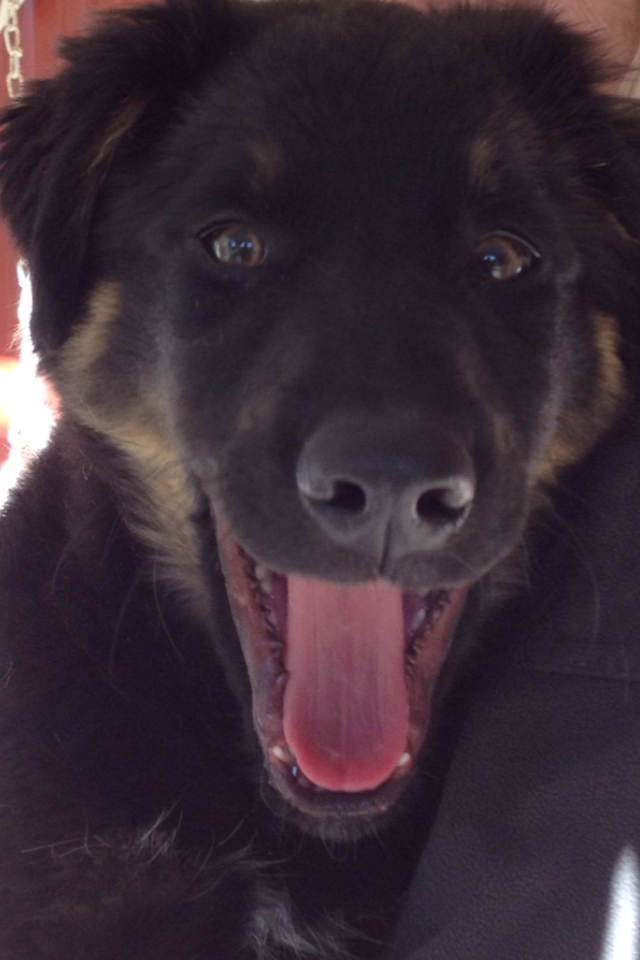
Tennessee TripperDog-Dog-Dog

Tennessee TripperDog-Dog-Dog

The newspaper is using words like “biting” or “frigid” to describe our current temperatures. My favorite was this morning’s weather paradox: sunny and bitter. Sunny and bitter sounds like an umbrella drink I might order at a Tiki bar or a perhaps a comedy team. If I had twins I’d name them Sunny and Bitter.

After standing on the deck for several minutes, making sure that the arctic winds blowing off the lake had subsided, Tripper-dog-dog-dog and I took a walk. Certain that we would not be cut in half by the wind, braving the sunny-bitter paradox, we high stepped through the snow drifts, stretching our faces to reach the sun. It was glorious. It was not as advertised: sunny, not bitter.

It had been more than a few days since we could venture out and Tennessee Tripper-dog-dog-dog was eating the baseboards, chewing on cabinets, and pacing from door to door. We’ve been teaching him tricks to keep him occupied but he’s a fast learner and mostly bored with “stay” and “shake” and “roll over.” When I realized that I was pacing door to door with dog-dog-dog I knew that advanced cabin fever was setting in and we needed to run (he runs and I watch but it sounds better if I use the royal we. I like making you imagine that I am fit and running through the arctic snow with the dog-dog).

As I stood in the field, face to the sun, watching him romp and run, I had one of those moments that I am certain will appear in the slide deck that will move through my mind’s eye at the moment of my death. All of my stories dropped away; all of my senses flung wide open. There was the cold air and the warm sun and the sound of Trip leaping and playing in the deep snow. There was the sound of ice clacking in the lake, squirrels cursing in the treetops.  I had no past and no place to be. I had no cares or desires to distract me. I was present. I was there, fully alive.

I think Tripper sees those moments. The Dog Whisperer tells us that dogs are energy sensors and I’m convinced Trip sees my aura. During my moment of presence, he stopped his romp and we stared at each other. If he could talk, he’d have said, “Finally! I was beginning to doubt that you’d ever get this trick. Want a cookie?” I smiled and as if to prove a point, Tripper-dog-dog-dog sat as if by command. His eyes glistened, saying to me, “I remember my trick, will you remember yours?”

Go here to get my latest book, The Seer: The Mind of the Entrepreneur, Artist, Visionary, title_pageSeeker, Learner, Leader, Creator…You.

Get hard copies here.

Step

'Hope and Prayer' by David Robinson

‘Hope and Prayer’ by David Robinson

I’m in a “life is funny” phase. It is as if the universe is hammering me with this theme: you do not need to see the big picture. You do not need to see the plan or even have a plan. You simply need to take the next step that you see. The next step need not make sense.

Do you remember the scene in one of the Indiana Jones films when Indiana has to take a step that looks as if he was going to step off a cliff and fall into the abyss? What he sees is in direct opposition to what he knows he needs to do. How often does life send us that conundrum! He saw an abyss but knew he needed to take a step anyway. He stepped and an invisible path became visible.

Take the step BECAUSE it does not make sense.

On Sunday, Pastor Tom asked his congregation, “Is your faith by default or by choice?” He told the story of the Roman nobleman whose son was dying. None of the doctors of the day could help the boy so in an act of desperation, the man walked two days to find the magician/healer named Jesus. As Pastor Tom said, this Roman nobleman had the best healthcare plan available and nothing was working; in the absence of science he turned to faith. Of course, we know the rest of the story: the magician/healer told the nobleman to go home. He told him that his son would live. Remember, it was a two-day walk so the question is this: during those two days walking home, did the man have faith or did he want to have faith? In other words, did he need proof to have faith? Did he rush home to see if the magic worked? When he arrived home and found his son alive and well, did he cancel his healthcare policy? What would you do in a similar situation?

Take the step BECAUSE sense-making has nothing to do with it.

Last week Diane wrote a great comment about “knowing” from my previous post, Stand With Hope. She wrote, “…it makes me think about the definition of knowing. I am seeing that, for me, it is not about knowing an answer (like I know that 4 x 4 = 16), but knowing my self and being present with what is happening, and trusting the inner impulse to respond and act. I think this is standing in hope, but for me hope is uncertain faith. But then, when I’m short on faith, I guess I can hope to have hope.”

Take the next step BECAUSE you trust your inner impulse to guide you.

In other words, step because if feels right. Sense-making is a function of the brain. Stepping while uncertain is a matter for the heart. Sense-making is something that always happens after the fact. The next step need never make sense. It does need to make heart.

Take the next step BECAUSE it is what you must do.

Go here to get my latest book, The Seer: The Mind of the Entrepreneur, Artist, Visionary, title_pageSeeker, Learner, Leader, Creator…You.

For hard copies, go here

Step Into The Storm

Canopy by David Robinson

Canopy by David Robinson

We took a walk at midnight last night. It was snowing hard. For a while we watched the storm from the comfort of our living room but the swirling snow was like a siren’s song; it was too beautiful not to sail into it. We put up a sham resistance for a few moments and then surrendered. Piling on layers of clothes, we strapped on boots and hats and gloves and stepped into the storm.

The snow was blowing so hard that it stung our faces so we laughed and pulled our scarves up to our eyes. We looked like winter bandits or strange band of arctic Bedouins.

Drifts formed and sparkled in the streetlights. More than once we stopped to admire the sweeping forms, nature’s sculpture. We high stepped through the drifts, stood still and listened to the wind through the trees, turned our backs to the blowing snow and let the wind push us toward home. An hour later we stepped back into the house, grateful for the warmth and chattering about our adventure.

I remember these words from another lifetime: I’d rather be alive than comfortable. A midnight walk in the snow seems like such a small thing, but as we stepped into the flurry I was aware that our choice to take a walk was the choice to engage rather than merely witness.  So much of my life has been lost in the decision to witness instead of getting cold and messy and uncomfortable. Isn’t it too easy to turn on the television and watch life happen or complain about how things are run while refusing to participate in the process of running things? I’ve learned that it is much more fun to play than to watch the game. Sometimes the game is grimy and you get hurt but that is the cost of playing.

I’m watching an organization wrangle with growth and change. As always happens in a change process, there comes a moment when the people involved have to decide whether they want to sit in the warmth of the house or step toward the siren’s song and get messy, cold and grow. They can’t have both. Life is like that.  There is a certain satisfaction to looking out the front window of your life but there’s nothing to compare with stepping into the night, holding hands and being part of the snowfall.

Go here to get my latest book, The Seer: The Mind of the Entrepreneur, Artist, Visionary, title_pageSeeker, Learner, Leader, Creator…You.

Go here for hard copies


See The Majesty

Pidgeon Pier (Alan and David on the Sound) by David Robinson

Pidgeon Pier (Alan and David on the Sound) by David Robinson

This is a portion of the text I wrote Alan’s newsletter. He’s always been my champion and is helping spread the word for my book (hard copies available later this week! Stay tuned). I reread the rough text this morning and thought this chunk would also make a good post. 

Many years ago, during the first minute of my first class on the very first day of art school, a musty old professor stepped to the center of the studio and taught the class to see. The lesson took less than 5 minutes. As he stepped away from the center of the room he quietly said, “Learning to see is the only thing of value I will ever be able to teach you. The rest is nothing more than technique.”

He was right. Artistry is about how you see. Innovation is about how you see. Leadership is about how you see.  Transformation begins with how you see. Everything else is execution.

His lesson that day was simple. It was powerful. It was transformational. And, like all things simple and transformational, I didn’t recognize it at the time. I discounted it because it was so basic. He planted a seed that day that took me many years to understand. It took me a few more years to embody. It was with great delight that many years later I recognized his lesson as a threshold to my soul mission. I am on this planet to help people see.

The core of his lesson was this: most people merely look; they do not see. Their thinking gets in the way. In other words, we see what we think – which means we do not see at all. We miss the majesty of what is right in front of us. More importantly, it means we do not see the majesty of what is within us. I am on this planet to help people see the majesty within themselves. The Seer is a guide to seeing the majesty within so we might fulfill our extraordinary capacity.

Go here to get my latest book, The Seer: The Mind of the Entrepreneur, Artist, Visionary, title_pageSeeker, Learner, Leader, Creator…You.

Wake Up

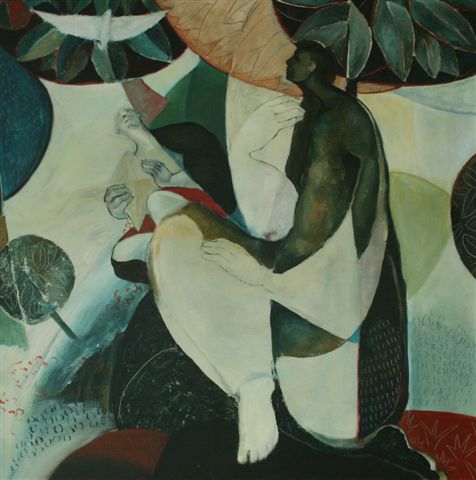
ELDERS

The Elders by David Robinson

Many years ago I took a class called Art and Transformation. Over several months we studied the art of different culturals, specifically cultures that understand art as central to their health and wellbeing. It is not correct to say we studied: we made art. We drummed our way into trance and drew what came to us in the trance. We participated in a sweatlodge to find the symbols necessary to make medicine shields. We meditated and made sandpaintings. We sat still in nature, drew with our nondominant hand, gathered dream symbols, made mandalas and explored what it means to be connected through art to “something bigger.”

In the weeks following a class session, we painted work inspired by the class experience and then gathered to share our new work. It was amazing to see the change in my own work when I was rooted in the deeper rivers of life. When I was working from the actual experience of connectivity – and not a mental abstraction or a concept – my paintings startled me.

We worked for months – consciously –  with transformation as the central impulse driving our visual forms. I learned through the class that “transformation” and “connection” were the same thing. Growing in consciousness is almost always a recognition of unity. As Joe said, “The universe tends toward wholeness.” Becoming more aware, opening the doors to greater consciousness, is how that tendency toward wholeness shows up. We see.

I also realized during the course that “story” was central to transformation. Art in its purest form is meant to be the keeper and transformer of the identity of a community. Identity is a story based on certain agreements a community makes about nature and time and god. Story needs context to make sense. I know this sounds like a loop and it is. Transformation is usually a movement toward wholeness (unity) and the movement is made visible through a change of story. I used to say, “Change your story, change your world,” but stopped because the phrase generally invoked wrinkled brows, protests and confusion. Most folks see their story as “reality” and will do anything to defend their reality. Initally a change of story can feel like an assault on reality.

I was once called on the carpet by a superintendent because a play I did with students challenged the reality of the teachers and parents. The superintendent shouted, “Art is supposed to entertain.” Well, yes. Art can entertain. Art is supposed to challenge, to shake the tree of assumptions, to help the community see itself. Art is supposed to help a community ask, “Is this who we are? Is this who we want to be? Is this what we believe?” I sighed and asked  the red-faced superintendent, “Why are you so upset?” Her response: “The play made me uncomfortable.” Yes. Powerful art will always make us uncomfortable. Growth is always in the direction of discomfort. When the universe within us tends toward wholeness we will inevitably walk into vast fields of discomfort. It is how we wake up and see.

Go here to get my latest book, The Seer: The Mind of the Entrepreneur, Artist, title_pageVisionary, Seeker, Learner, Leader, Creator…You.