Know The Difference [David’s blog on Flawed Wednesday]

“Public education does not serve a public. It creates a public. And in creating the right kind of public, the schools contribute toward strengthening the spiritual basis of the American Creed. That is how Jefferson understood it, how Horace Mann understood it, how John Dewey understood it, and in fact, there is no other way to understand it. The question is not ‘Does or doesn’t public schooling create a public?’ The question is ‘What kind of public does it create?'” ~ Neil Postman, The End of Education: Redefining the Value of School.

It’s important to know the difference.

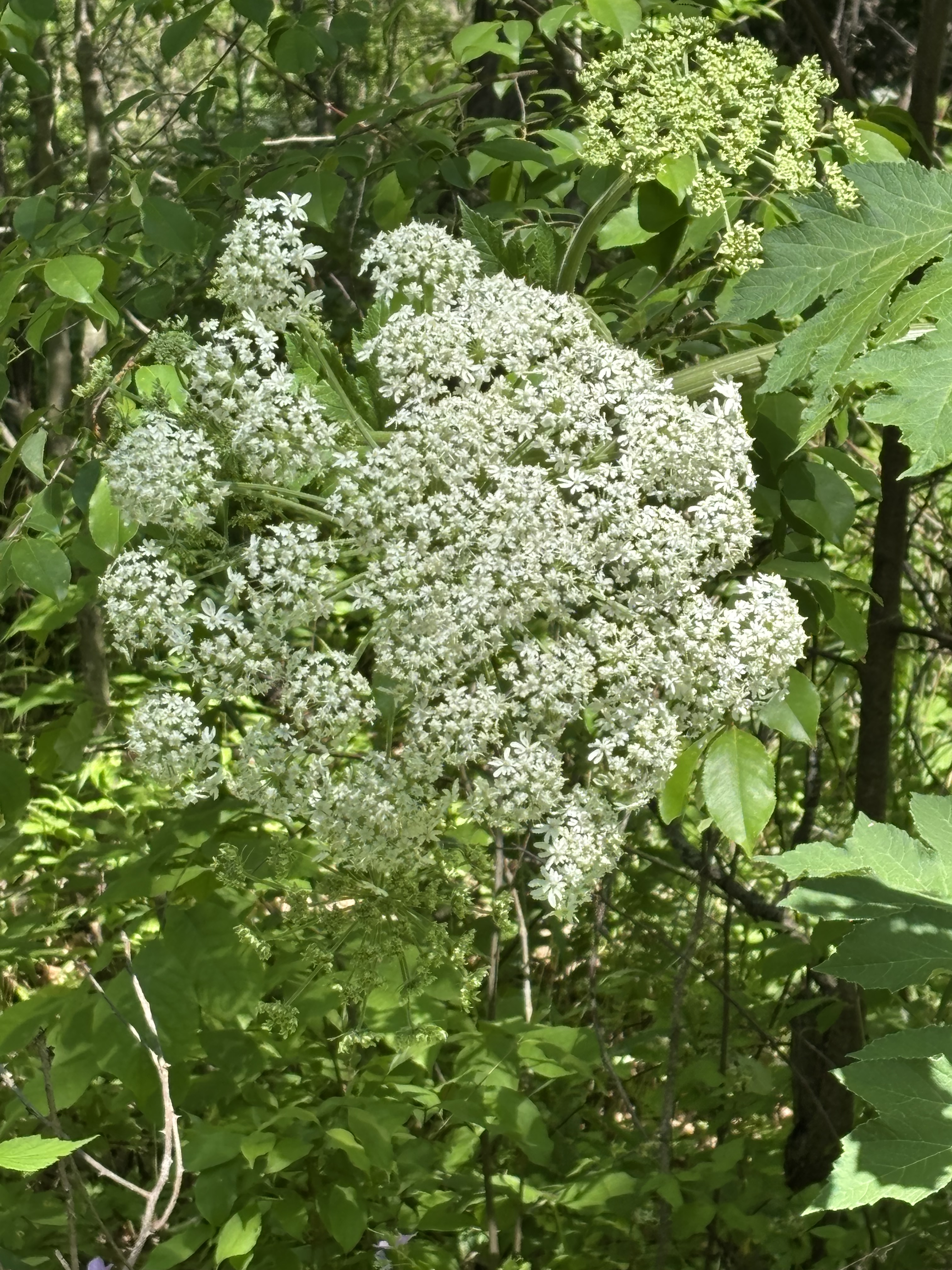
In the forests and fields through which our walking path winds, there is Cow Parsnip, Queen Anne’s Lace, and Hemlock. All sport umbrella-clusters of tiny white flowers. They are all members of the carrot family. To the untrained eye – like mine – they look similar. They are dangerously different.

Socrates was sentenced to death and was made to drink Hemlock. It’s very toxic. Queen Anne’s Lace is edible and used medicinally. Cow Parsnip can be eaten “if handled properly,” however a combination of sap and sunlight can cause a painful rash.

It is important to know the difference. It is why education is so important. It is why asking questions, stoking curiosity and looking deeper – beyond the superficial – is invaluable. The point of education, as Neil Postman reminds us, is not to get a better job, it is to be a well-rounded human being capable of making informed decisions.

“At its best, schooling can be about how to make a life, which is quite different from how to make a living.”

Republicans since Reagan have been actively undermining our public schools. Cutting budgets, hyper-emphasizing testing (answer-driven rather than question-inspiring), and waging a foxy campaign against “the woke,” a term referring to people who are curious enough to question what they are being told – a skill useful in learning. The demonizing of education and the educated has without doubt led us to this moment: a gullible, angry and easily distracted citizenry. I almost wept the day the young man, an expectant father, told me that he was going to home school his child because he didn’t want his son’s head to be filled with “any of those crazy ideas” that they teach in the public schools. He didn’t want his boy to be woke.

I wanted to tell that young man that democracy is an idea. So is fascism and communism and authoritarianism. It’s important to know the difference.

The fox and Republicans have been for years weaponizing the term “socialism”, an accusation they level when their wealth is threatened by those who question why taxation is unfair, who ask why Republicans cheer when government creates programs uplifting corporate America but snarl when government creates programs that uplift private citizens. Socialism is an idea, too. Asking questions, protecting civil rights, and believing in the promise of democracy is not socialism. It takes some study and questioning to know the difference.

There’s a reason that the cartoon symbol for insight is a light bulb illuminating brightly over a character’s noggin. Letting in the light.

Discernment. Distinction. Knowing the difference between indoctrination and education. Knowing the difference between character and corruption, value and vice, wisdom and hogwash. Knowing how to discern news from propaganda would seem to be essential – democracy-saving. Life saving.

And so, here we are, awash in a cult movement called MAGA, enabled by a feckless Republican Congress, that worships incompetence and promotes ignorance. It shields itself against even the most basic of questions and eschews responsibility for, well, anything (blame is their game). It howls in indignation at the very thought of learning. It is a celebration of the dim-bulb. Drinkers of toxic hemlock, totally incapable of discerning the difference between the deadly and the medicinal, the truth and a lie.

“Because we are imperfect souls, our knowledge is imperfect. The history of learning is an adventure in overcoming our errors. There is no sin in being wrong. The sin is in our unwillingness to examine our own beliefs, and in believing that our authorities cannot be wrong.” ~ Neil Postman, The End of Education: Redefining the Value of School.

read Kerri’s blogpost about DISCERNMENT

likesharecommentsubscribesupport…thankyou

Learn How To Use It [on KS Friday]

The young man came to our house to bid on a job. He is days away from becoming a new dad. We talked about becoming a parent, his hopes, dreams, and his fears. He and his wife have decided to homeschool their son; the very real possibility of his child being shot in a classroom was a major factor in their decision.

Having spent much of my life working in and with public schools, it broke my heart. Kerri and I acknowledged that, were we new parents, we’d probably make the same choice. “Every man/woman for him/her self” is winning the day over “I am my brother/sister’s keeper.”

Who hasn’t seen the video of a mother teaching her son what to do in the event of an active shooter at school? She purchased a bullet-proof backpack to help keep her child safe. Who hasn’t heard the description of what the bullet from an assault rifle does to the body of a child?

About the budding new democracy called The United States of America, Alexis de Tocqueville wrote, “There are many men of principle in both parties in America, but there is no party of principle.” He also wrote, “The American Republic will endure until the day Congress discovers that it can bribe the public with the public’s money.” And so it is.

As I’ve previously written, as a child in school, our safety drills were about atom bombs. Outside threats. This generation, this young artisan, about to become a new dad, knows his son will have to drill against an internal threat. A country that refuses to protect its children and opts, instead, to protect its gun lobby, its money.

“Nothing is more wonderful than the art of being free, but nothing is harder to learn how to use than freedom.” ~ Alexis de Tocqueville.

Freedom is an art form. A practice. It’s an ideal that a community practices and creates together. No one does it alone. And, therein, lies our problem. Every man/woman for him/herself is not freedom. It is chaos. Anarchy. It has our children ducking under desks and carrying bulletproof backpacks. Or, avoiding school altogether.

Kerri’s albums are available on iTunes or streaming on Pandora

read Kerri’s blogpost about LIGHT IN THE DARK

transience/right now © 2010 kerri sherwood

Start Walking

photoTell Me. How can I be a learner?

My mind went absolutely blank, and I heard myself saying, Its simple. To be a learner youve got to be willing to be a fool. ~George Leonard, Mastery

I used to do a lot of work in education. My career in the theatre took a sharp left-hand turn when I started consulting with schools. The puzzles that plagued educators seemed to me easy to address. To be human is to be curious. Tickle the curiosity, begin the story and get out of the way.

Tom once told me that teaching is about relationship (not control). He also told me that the best teaching/learning needed to be directly applicable; it had to be immediate. It had to be real. It had to matter – to both the teacher and the learner. The trick is to extend the mattering into greater and deeper levels of abstraction.

An emphasis on testing is an emphasis on knowing. Great learning places the emphasis on not-knowing. It reinforces the pursuit and dispels the notion that knowledge is something achievable. Worthy questions always open more worthy questions. To be human is to be curious. To be alive is to wonder what is on the other side of the hill and then take a step toward it.

The fool George Leonard references isn’t “ the unthinking person,” it is “the carefree fool in the tarot deck who bears the awesome number zero, signifying the fertile void from which all creation springs, the state of emptiness that allows new things to come into being.”

Emptiness. Not knowing. Relationship. Mattering.

Step Into Unknown with SigThe question, “How do we/I do it?” is a great step-stopper. It is the leading edge of every personal and organizational stagnation excuse. We don’t know how. I’ve come to believe that it isn’t a natural question but is learned behavior. It is an emergency brake installed by a system that values right answers over great questions.

My wife and I have a short-hand phrase, Beaky’s Wheelchair, to remind us when we stall, that “how?” is something that can only be known after the fact. No one knows “How?” at the beginning. Beaky needed an electric wheelchair to be mobile and the world of insurance/medicare was standing still. After months of waiting, with no clue which direction to begin, we started making calls. We met every “no” with a “why not?.” We asked a multitude of foolish questions. We learned. And learned some more. Within a matter of weeks, Beaky had her wheelchair.

How do you play the guitar? Paint a picture? Bridge a conflict? Transcend a limit? Know one knows. Tickle the curiosity, let go of any notion that you need to know how, and start walking.

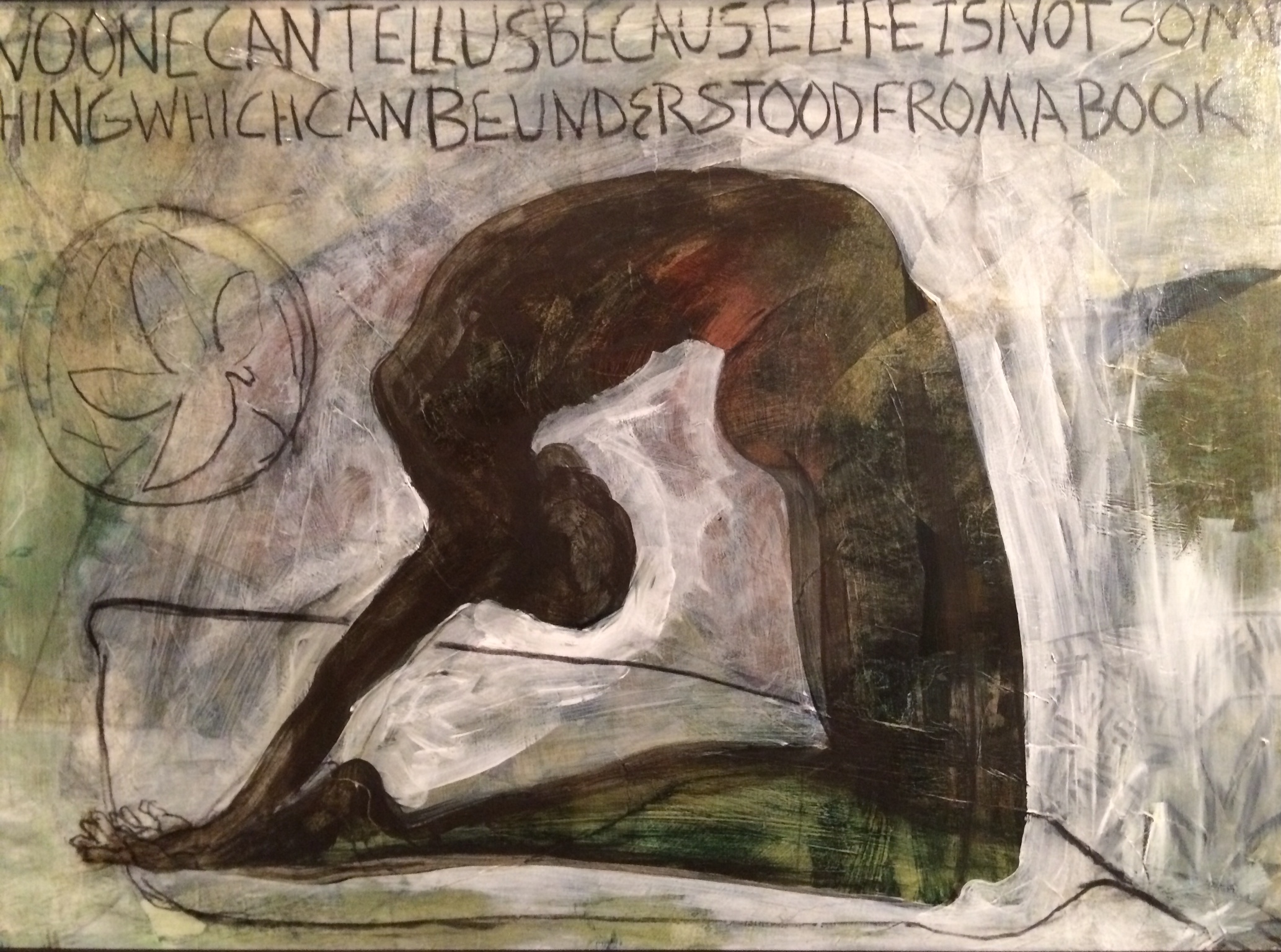
text from Krishnamurti as it appears in my painting

the text from Krishnamurti as it appears in my painting


Save

Save

Save

Save

Change Your Story

653. Join me in inspiring truly powerful people. Each day I will add a new thought, story or idea to support your quest and mine.

I just finished reading Thom Hartmann’s book, The Last Hours Of Ancient Sunlight. It’s now on the top of my, “If you want to understand the forces that are shaping our world and thought, you have to read this book” list. Turn off the television and get this book. It’s that relevant; it’s that important. I’ve been diddling around these past few years with my observations and beliefs about power-over and power-with cultures and his book has slapped me into immediacy.

On the front page of my website is the banner, “Change yourself, change the world.” I work with people to change their personal story and it follows that they will then inhabit and create a different world. In reading Thom Hartmann’s book, my words are coming back at me with a force that takes my breath away. It’s not just a good idea to change your story and change your world; it is a necessity. It’s the second time in as many weeks that I’ve been smacked with a call to urgency. Kevin Honeycutt said, “Our kids are dying in our schools. What are we waiting for?” His call to action was a few days before New Town. He meant it metaphorically and the literal horror happened yet again. It is not that we do not know what to do; it is that we do not believe that we have the power to do it. The wall between our political will and the corporate dollar, something our forefathers warned us to keep distinct and well maintained, has disappeared. Is anyone truly in doubt about what force drives our national debate?

I realized this morning that my previous two posts have been about bullying. In a power-over culture like ours there are predictable and horrible impacts on the community. These things, bullies, school shootings, gun violence, disenfranchisement, gang warfare, stupidly high teen suicide rates, etc., are expressions of a power-over culture not anomalies of that culture. Manifest Destiny is a story of violence visited upon others. The narrative of a chosen people is a story of violence perpetrated against others. Power-over cultures wreak havoc on others but ultimately the sword cuts both ways: it is a cancer that eats the communal body from the inside out. Haves must have have-nots. It will always create a resource gap and separation that collapses the center, luxuries are confused as values, money with morality, and resources are exhausted in the insane pursuit of perpetual growth (consumption). Historians will surely write of us that yet another power-over culture relegated itself to the trash heap. We are playing the story perfectly.

I used to teach that there was a radical difference between self-help and self-knowledge: the difference, of course, is where you seek your answers. In a self-help world we look for our answers in other people; we want to be saved (savior stories are big in dominator cultures). In the pursuit of self-knowledge the answer is sought and found within your self. You don’t need saving because you are not broken or separate from the nature that surrounds you. In a power-with culture, your nature is not corrupt so there is nothing to tame or suppress or deny or control. These stories are fundamentally different; they are fundamentally different orientations into life. Cultures of power-over breed stories of self-help as a power-over culture is comprised of people who seek power from others. A power-with culture necessitates seekers of self-knowledge and is comprised of people who know that power is something that is created with others; all are powerful or no one is.

Our challenge is not about guns or violent video games or Hollywood movies; these are expressions of the story we tell and nothing will change, no matter the laws we pass or fingers we point until we decide to tell a different story. It begins with you and me. No one is going to save us. Change your story, change our world.

Truly Powerful People (442)

442.
Join me in inspiring truly powerful people. Each day I will add a new thought, story or idea to support your quest and mine.

Over dinner one night Skip asked his friend, the concert pianist, what is the difference between a good and great pianist. Her answer was powerful. She told him the greatness was in the power of visualization. She travels to the composer’s country, she walks the paths they walked, she visits the gardens that inspired their compositions. In performance, she is not reproducing notes; she is walking in the garden. She is taking her audience on a walk through the garden.

A few months ago I had a powerful realization. I was working with teachers attempting to change their system and truly teach (as opposed to prepare for tests). They are working to transcend classrooms of control and compliance and instead create classrooms of self-regulation and self-direction. In short, they are supporting their students to be powerful. They are courageous and magnificent – yet, in the absence of an image for self-directed classrooms, they default to the old existing control image. We act out of our image. I finally saw their challenge. They need a new image. They have the yearning and they understand the process. They need to know what the garden looks like. They need to move toward a new image instead of away from an old habit.

Many years ago I worked for a theatre company. During an outreach program to the local schools I had an experience that jolted me to the core and opened my eyes to the power of the imagination. In a single day we visited two schools, one for the wealthy suburban kids and one for the poor migrant children. In each school we did a story exercise. The young children in the wealthy school imagined themselves to be princesses and princes, fighting dragons, and flying over mountains. The children in the poorer school imagined themselves as adults worried about the rent; instead of flying as birds they fled from landlords and immigration. That afternoon I sat on the curb and cried.

Note to the world: our greatness lives in our power to visualize. We go to the places we imagine. If you want to change the world, help a child fly over mountains. You’ll find that you have to remember how to fly, too. Even Einstein knew the math came second.