Follow The Dream [David’s blog on KS Friday]

As if the world was not topsy-turvy enough, last evening, just as the sun was setting, I opened the back door and was met with a wall of rising heat. The sun was going down and the temperature was going up!

We are in the land of Lewis Carroll. Logic spins like a wheel of fortune. Alice awoke from her Wonderland dream when she stood up to the Queen of Hearts. She awoke when she’d had enough of chaos and challenged the madness. It was a threshold moment, marking the passage into adulthood. Everything we need to know is in the story.

Do you remember Field of Dreams? “If you build it, he will come.” It’s a story of the power of following a dream no matter how irrational. Lately I’ve thought that our democracy is like the baseball field built in the middle of a cornfield. How irrational is it to imagine and then create a single nation, a field, that attracts and is home to people from all over the world! A nation where a wildly diverse populace governs itself. By the people, for the people, of the people. Build it and they will come.

Redemption is one of the themes of the movie. As is true in life, redemption for the characters comes after reconciling with their past. All of it: the good, the bad, the ugly. Redemption is a door that opens when a person or community – or nation – is brave enough to honestly look at and deal with the full scope of their history. There’s a good reason that Honesty is the first step in the twelve steps of addiction recovery. An honest reckoning opens the door to the pathway that leads to a second chance. It clears the vision, clarifies the dream.

Challenge the madness.

Say, “Enough!”

Get honest.

I took some small comfort when I read these words this morning: “…it’s never too late to reconcile with the past and find peace.” Follow the dream “…even when it seems impossible or irrational.”

“Go the distance.”

YOU MAKE A DIFFERENCE © 2003 Kerri Sherwood

Kerri’s albums are available on iTunes and streaming on Pandora

read Kerri’s blogpost about THE CORN

likesharesupportcomment…thankyou!

Teach The Moment [David’s blog on DR Thursday]

As I watched the curtain of grasses sway I thought they’d make an excellent set piece for a production of The Tempest. Their movement was hypnotic. I had the good fortune to design a minimal-budget-production of The Tempest several years ago and used huge pieces of driftwood and a bamboo curtain. I loved it.

The Tempest was on my mind because earlier in the day while doing some research I bumbled across the question, “Why is The Tempest a banned book?” The answer is a very sad statement about our times, the reason our nation cannot seem to mature: “The Tempest,” one of the playwright’s classics, is among the books removed, as teachers were urged to stay away from any works where “race, ethnicity and oppression are central themes,” the website Salon reported.

In our nation race, ethnicity and oppression are the central themes of our history: “246 years of brutal enslavement; the rape of black women for the pleasure of white men and to produce more enslaved workers; the selling off of black children; the attempted genocide of Indigenous people, Indian removal acts, and reservations; indentured servitude, lynching and mob violence; sharecropping; Chinese exclusion laws; Japanese American internment; Jim Crow laws and mandatory segregation…” (Robin Diangelo, White Fragility)

You’d think we might want to encourage teaching The Tempest and other great works so we might consider and discuss the full scope of our history. So that we might learn about ourselves. So that we might become capable of addressing and putting to rest the ugly fear – rooted in race, ethnicity and oppression – exploited for gain by the Republican party, that gave birth to the MAGA movement. It’s the Confederacy by another name.

In a nation of immigrants, you’d think it might be a first principle to teach our children about race, ethnicity, and oppression so we might learn how to reach across – and put to rest – division rather than perpetually recreate it.

The AI overview provided another related and currently more salient reason to teach The Tempest: “The main message of Shakespeare’s The Tempest is that forgiveness and reconciliation are preferable to revenge and punishment, especially when it comes to the restoration of social order and personal peace.

If social order and personal peace are the goals, our current path of revenge and punishment will not take us there. In the play, Prospero chooses release from his island prison through the power of forgiveness and redemption rather than perpetuating his imprisonment by seeking revenge.

In this teachable moment Prospero’s choice is an analogy worth teaching: a path provided to us by a play written in 1610 by one of the greatest poets of the English language; a way out of our national-soul-imprisonment.

I suspect that is why The Tempest and other great works of literature dealing with themes-that-matter are being banned. In the minds of this administration, continued imprisonment, revenge and punishment seem to be the goals.

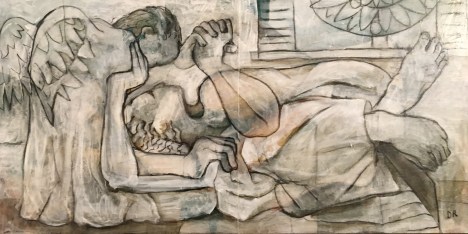
Angels At Our Side, 24″x48″, mixed media on board

read Kerri’s blogpost about THE GRASSES

likesharesupportsubscribecomment…thankyou.