

Word genius sends me a word everyday. Some I know. Most I do not. Yesterday, my word-of-the-day was sockdolager. Sockdolager is a word that, when typed, is unrecognizable to the vocabulary in my spellcheck and is adorned with a screaming-dotted-red-line meant to notify me that either I spelled the word incorrectly or it’s not a word at all. Language is a fickle companion.
In Seattle, when the rains clear, people are fond of saying, “The mountain is out.” Mount Rainier, hidden in the clouds, makes a grand – almost impossible – appearance when the weather clears. Where there was no mountain, suddenly a Titan appears. It is a sockdolager, an exceptional occurrence. A forceful blow. The first time I saw it I almost crashed my car.
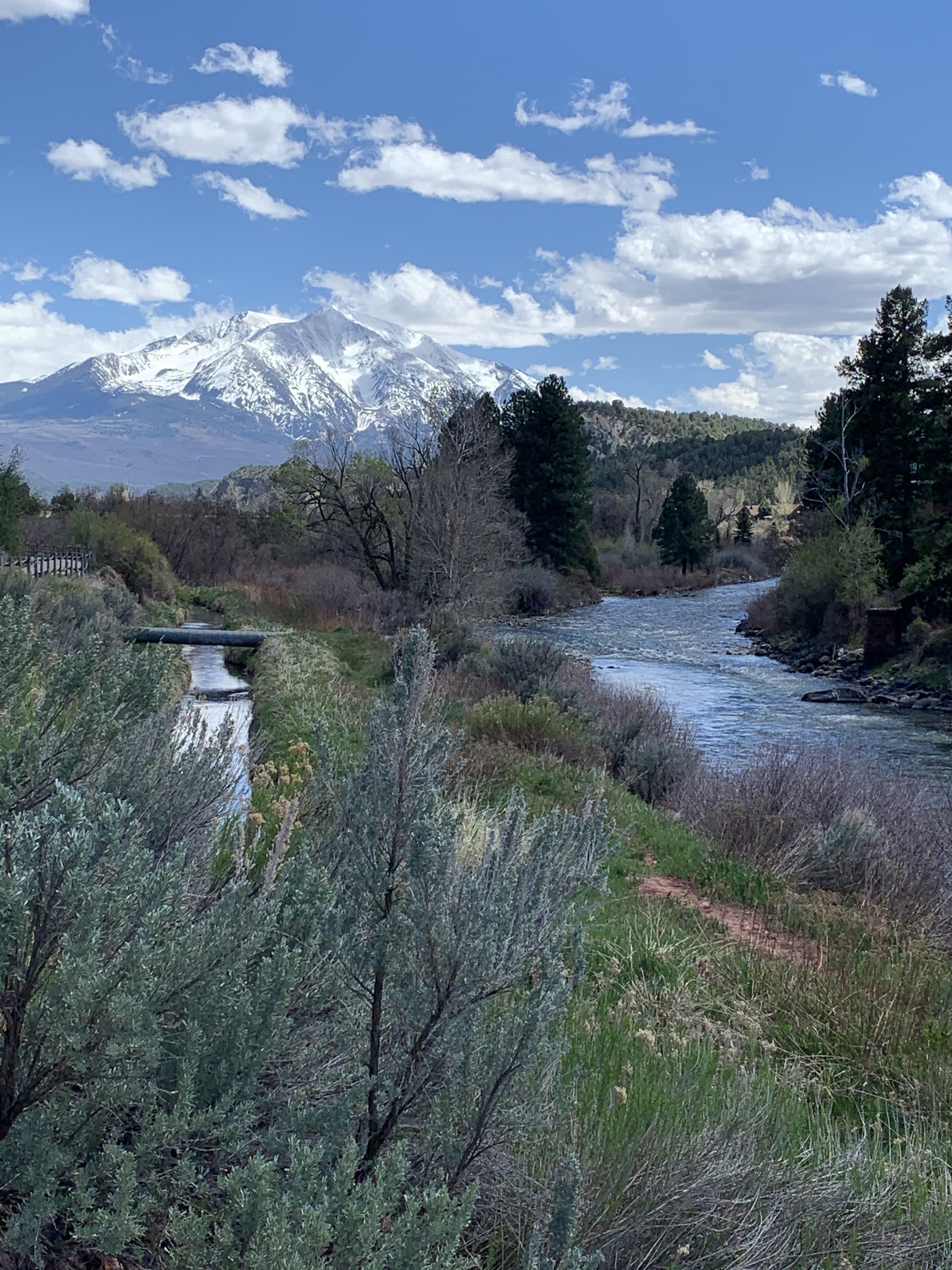
Mount Sopris hit us with a similar wallop. We arrived in Carbondale “in weather.” A day later, making a run to Main Street to meet Kirsten, we rounded a corner and nearly crashed the truck. There was a mountain towering over us where, previously, there was none. Clouds swirled around the summit. The late afternoon light made it glow. Sockdolager! Sockdolager!
I very much appreciate that my snotty spellcheck does not recognize or appreciate my use of sockdolager. No word can adequately capture the experience of being hit by a mountain. “Awe” is a word. So is “amazement.” They fall short, too. Language can reach toward but never quite touch that which it hopes to describe.
The day after the wallop we took a stroll on the Rio Grande Trail. We intentionally walked away from Mount Sopris, knowing that, at some point, to get back to our airbnb, we’d need to turn around and walk toward it. Like Orpheus leading Eurydice, we tried not to turn and peek but the majesty was too much. We’d giggle and turn and gasp. “My god!” we whispered.
We go to the mountains to remind us, to refresh our eyes and hearts and minds. This life. An exceptional event. A forceful blow. Grander than words can describe. Sometimes the mountain is hidden. Sometimes it shows its face. Either way, it never ceases to surprise you, to take your breath away. Sockdolager.
read Kerri’s blog post about THE MOUNTAIN
Filed under: Gratitude, Language, Seeing, Surprises, Two Artists Tuesday | Tagged: amazement, awe, carbondale, Colorado, david robinson, davidrobinsoncreative.com, Kerri Sherwood, kerri sherwood itunes, kerrianddavid.com, kerrisherwood.com, language, mount rainier, mount sopris, Orpheus, orpheus and Eurydice, rio grande river, rio grande trail, sockdolager, wallop, wonderment, words | Leave a comment »




 The Direction of Intention