The Imaginary Top [David’s blog on Two Artists Tuesday]

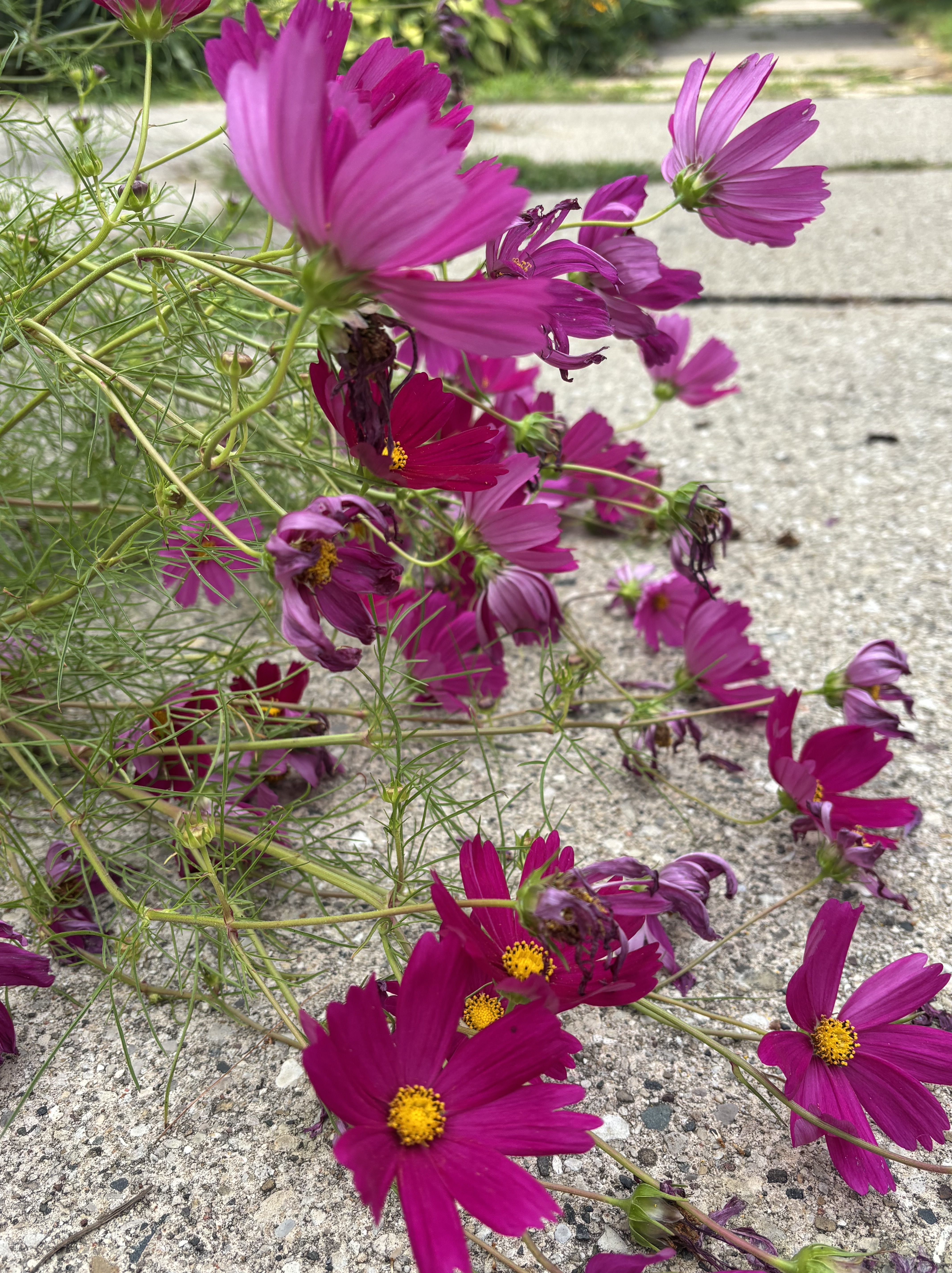
This gorgeous flower that derives its name from the Greek kosmos was lying on the sidewalk. The recent incessant heat and rain and humidity had wrestled it to the ground. It was down but not defeated.

Cosmos. Another name for the vast universe and its intrinsic order. Lately on our little planet the order of the universe seems to have lost its mooring. Actually, the flora and fauna seem to still be hitched to natural cycles and patterns, it’s we-the-human-beings that have slipped away from the dock of reason.

She knelt on the ground to take the picture. “They are beautiful,” she said. From a distance it must have looked like she was bowing to the cosmos. The image and word play tickled me. I thought, “We human-beings would do ourselves a favor if we were humble and occasionally bowed to the Cosmos.” We definitely occupy a place in the order, but rather than seeing ourselves as interconnected, we invent hierarchies and place ourselves at the pinnacle of importance. We give ourselves the blue ribbon. A few more years of thousand-year storms might wake us up but I doubt it. We like believing we are at the top. We like believing that there actually is a top to be occupied – and therein lies our dis-ease. Believing that we are at the top permits the delusion that we are somehow disconnected from the rest of the Cosmos. It gives us permission to believe that everything is a resource for our use and pleasure.

That, and, as they say, hierarchies beget hierarchies. We imagine an order to the vast Cosmos in which there are winners and losers. We turn our hierarchies on each other.

Of course, we are capable of imagining a different type of order. It’s why we have stories of messiahs and buddhas. They are meant to point the way out of our delusion and toward the actual order of the Cosmos. No hierarchy. Non-separation. Illumination and brother’s keeper. A return to the garden to discover the Tree of Everlasting Life otherwise known as unity. Those wacky sages are meant to help us see beyond our illusion, beyond our bloody scramble for the imaginary top.

After the flower photo op, we were careful to step over the cosmos-on-the-sidewalk. The cosmos were a good reminder in this time of madness run amok: reason, ethic, moral compass, compassion, service, kindness…may be down, but they are certainly not defeated. In the end, they are what give order to our cosmos

read Kerri’s blogpost about COSMOS

likesharesupportcommentthankyou

The Glue That Binds [David’s blog on Merely A Thought Monday]

It’s such a small line of distinction yet the implications are profound. Our mechanic, Steve, believes that he is rendering a service to members of his community. His goal – his ethic – is to do good work for the people who trust him with their cars. Consequently, he has a loyal following and a solid, healthy business. Visit Steve’s shop and you’ll find an old guy sitting in an easy chair reading the paper. No one is in a hurry. Ask a question and Steve will stop what he’s doing and come look under your car. Then, he’ll chat with you about the weather or politics or swap stories about what the kids are up to. Steve won’t try to sell you what you don’t need. Leave your car with him and more often than not, after the repair, your car magically shows up in your driveway.

I always feel good after a visit with Steve.

Across the town is a specialty shop. They do work that Steve can’t do – or won’t do – in his small garage. He used to refer clients when they needed specialty work done on their cars. Not anymore. The owner of that shop is hyper-focused on how to maximize his business so, now, if you take your car to the specialty shop, you’ll be presented with a long list of repairs that your car may or may not need. The owner of this shop is no longer driven by a service ethic; he’s driven by a profit motive. He’s definitely maximizing his business.

There is a line of distinction and it is as simple as this:

I believe what we’ve lost, what we are now missing, is what Steve embodies: a genuine service motive. It’s an old world mentality, a small town ethic: work as service to others. Social cohesion is the result of people dedicated to serving other people. You can feel it at Steve’s shop. It’s personal. People gather there. Trust is a given.

On the other side of the line is the specialty shop. It’s a mill. Business is business and business is about making money rather than caring for the needs of the customer. You can feel it. It’s become impersonal. The lobby is like an elevator: no one talks. Trust is not a given: the work is hyper-efficient, factory-esque, so customers leave doubting the quality of the workmanship because the customer is no longer the center of the equation. Cha-ching is now the boss.

Social cohesion is the casualty of business dedicated to the bottom line above the people they serve.

And isn’t social cohesion what we are lacking?

We can serve each other – the very thing that makes a community and nation great. Or, we can exploit each other – the very thing that divides a community and erodes its trust. I believe that all of those angry red-hat-wearing-fox-news-watching folks want the same thing that I want: more Steves. They – like me – don’t want to be continually exploited, demeaned, and reduced by gorilla corporate interests who use us as a resource to be consumed and not a customer to be served. We want a government that serves the people rather than lines corporate pockets. More trust.

In the afterward of her book, Michelle Obama thanks the many, many people who supported her with the double entendre, “I am glad for you.” It is the encapsulation of a service motive. The first meaning of the double: For you I am glad. Your work made me a better writer, a better person. I could not have done this without you. Your service on my behalf matters more than I can express.

Meaning number two: I celebrate you. I serve your betterment just as you serve mine. We give generously to each other because Generosity – service – is the glue that binds us: social cohesion.

It’s a simple line of distinction. It is profound.

read Kerri’s blogpost about GLAD FOR YOU

likesharesupportcommentsubscribethankyou.

Upside Down [David’s blog on Merely A Thought Monday]

We saw the sticker on the back of a traffic sign. “What’s the definition of hippy?” she asked.

Since she is a detail-girl, I Googled the definition. I am famous for making up definitions and she’s on to my game. I read aloud: “usually a young person who rejects the mores of established society (as by dressing unconventionally or favoring communal living) and advocated a non-violent ethic.” Or, “having very large hips.”

She frowned. “Do you have to be a young person to reject the mores of established society?”

“Are we young people?” I responded and she smiled. Always the rebel.

As we strolled away from the sticker I wondered about the mores of our society that so assumes violence as conventional that non-violence is considered – by definition – unconventional.

Sometimes this world seems upside-down.

The moment was made more ironic because, just moments before, every phone on the busy street rang with an alarm: there was an active shooter just six minutes drive away, a fifteen minute walk, and the police were locking down the area. Everyone stared at their phones and continued with their business.

What was the most unnerving? That there was an active shooter close-by or that no one was surprised?Everyone continued shopping. Violence as a convention.

“I think I want to be a hippy,” she said. Me, too.

read Kerri’s blog about HIPPIES

like. share. subscribe. support. comment. many thanks.

