DR Thursday

EmbraceNow

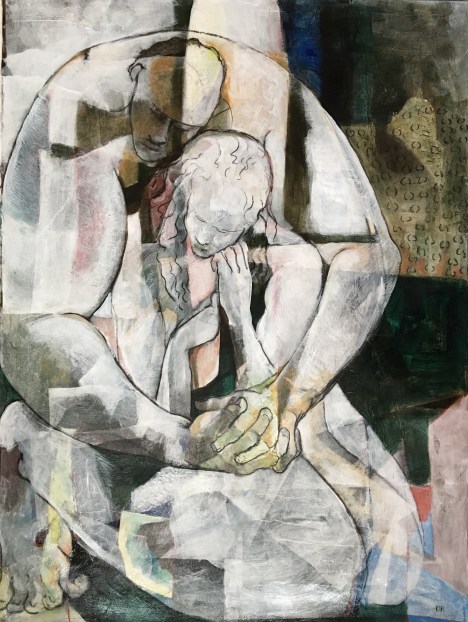
[Held In Grace: Embraced Now, mixed media on canvas, 48″ x 36″]

Beaky showed me a photograph taken of Kerri and me early in our relationship. She said, “I like this one because your strong arms are holding my daughter.” I took her comment as a kind of blessing. It was her way of telling me, ‘This is right and good. In this embrace you two have found all that you will ever need.’

In the studio melange, Thursdays are for my paintings. I chose this painting as the first in our melange offerings because it came from Beaky’s sentiment. During this Valentine’s week, let this painting, Embraced Now, from my Held In Grace series, remind you, as it does me, that all is right and good. In this embrace you will find all that you will ever need. It’s not a shabby thought to help navigate through a Thursday!

HELD IN GRACE: EMBRACED NOW [art prints]

HELD IN GRACE: EMBRACED NOW [purchase the original]

kerrianddavid.com


held in grace: embraced now ©️ 2017 david robinson


Clutch Your Stinky Blanket

Dog-Dog with stinky blanket

Dog-Dog with stinky blanket

Tripper Dog-Dog-Dog has a morning ritual that I do not understand. He returns to his crate, stands on his stinky blanket, and attempts to pull it from the crate. After a few moments it occurs to him that he’s unsuccessful because he’s standing on the blanket. It is a revelation. He exits the crate, walks halfway across the room, turns, returns to the crate, grabs the stinky blanket, finds his reverse gear and pulls the stinky blanket out of the crate and out of the room. His stinky blanket ritual happens every morning (that is why it is a ritual).

For the rest of the day, the blanket travels to new and exciting places around the house. Sometimes he takes great care of the stinky blanket. Sometimes he takes great delight in shredding it (often there are so many stinky-blanket-fragments littering the floor that it looks like a clown exploded in the house). Either way, great care or delight-in-shredding, his stinky blanket is a source of comfort not unlike a small child’s security blanket. For Dog-Dog, the world is a better place with a stinky blanket.

Last week, after Beaky was found on the floor of her apartment and rushed to the hospital, after we recognized that the incredibly resilient Beaky would not bounce back this time, Kerri needed to see Heidi. We drove an hour to where she was working and it was enough – more than enough – to grab a quick hug and spend a few passing moments with her as she worked. We sought out John, aka 20, and took great comfort in his good humor and kind heart. The family turned in and circled around Beaky. “This is hard…,” we cry as we reach for one another, giving and receiving comfort.

It occurs to me that we do this everyday. It is our ritual. Mike and Sabrina sent a text, “Think happy thoughts for us today…,” I emailed my mother, more for me than for her “Just thought you should know…,” Arnie tells me of his adventure and closes with, “Let me know how things are going.” David called and left a message, “Wanted to continue our cycle of communication…!” Each day, in many ways, in small ways, we reach out. We touch base. The world is a more secure place – a better place – in the reaching, in the touching base.

Meet At The Edge

665. Join me in inspiring truly powerful people. Each day I will add a new thought, story or idea to support your quest and mine.

On the plane today I read a short piece on edges and it reminded me of the power of this simple reality. The place where two elements come together, the place where two currents meet, the place where two cultures intersect, the place where the clearing meets the forest, the place where the world drops off: these places either teem with life or fire the imagination. It is at the edges where we become uncomfortable. It is at the edges where we say, “I don’t know” and thus, learning becomes possible.

There are internal edges as well as external edges. I work with people all the time who tell me they’ve hit a wall, come upon a block, or run into a limit that feels like an abyss. Internal edges are just the same as external edges: they either teem with new life in the form of ideas and pursuit or they evoke discomfort and resistance. Edges are present when we say, “I’m lost,” or “I don’t know what to do,” or “I’m frozen and can’t move.” Edges are present when we shout, “That was incredible!” Edges are supposed to generate instability: movement.

You know you are at an edge when you judge: judge some one or something else and it’s a good bet that you aren’t comfortable. Judge yourself and it’s a good bet that you’ve found an edge. If, in the moment of judgment, you realize that you are at an edge and suspend your judgment, you are instantly capable of learning. If, at the moment of judging, that you invest in the judgment, you’ve shut down the learning. Judgment is merely a way of establishing a location, a false “known” so you can get away from the unknown: it is an oddity human development that it easier to call yourself or others an idiot (thus, locating yourself or them) than it is to say, “I don’t know….”

Edges are everywhere. Kichom Hayashi sends his students out in the world to find as many edges as they can. Try it. You’ll find there are edges everywhere: grass meets concrete, brick meets brick, glass meets steel, earth meets water, sky meets horizon, hand meets hand, idea meets idea: the possibilities are endless. See them and then imagine the edges define connectivity instead of separation. If you reinforce the connectivity, you will walk toward your edges every time; the discomfort will call you and fire your imagination. If you see separations, the edges will frighten you and drive you back into the comfort of judgment. It all depends on what you choose to see.