Get Lost

Kerri in Avalon

Kerri in Avalon

I lost Kerri. She is deep in a world of imagination and creative glee and hasn’t heard a word I’ve said in hours.

A few years ago I went to a figure drawing class. It was the first I’d attended for several years. Not only was I unprepared for what I experienced that night but it was and still is my favorite example of generation gap (and I am on the far side of the gap!). That night, those of us that were 40 years old and older drew with charcoal, pencil, and crayon on paper. We had drawing boards and dusty tackle boxes with supplies. We came to the class expecting to get dirty. The younger set, those below 40, drew on a screen with a stylus. They walked in, flipped open their computers, pulled out their stylus and began adjusting their settings. Dirt was nowhere in their equation. I laughed at the brilliance of the moment.

I am mostly old school. Photoshop is still unexplored territory. I am not anti-technology; I often wish I was more tech-savvy and had the range of motion that comes with technology. Time in the studio is precious and when I have it, when I have the choice of learning a program or getting messy, I go straight to the paint. I like the drag of the paper. I like getting my fingers and clothes messy. There are smells and textures and a ritual walk to and from the canvas or paper to gain perspective that I adore. My paintings are often very large and the act of painting is kinesthetic, a dance, a full-body sweep of arm and brush. A mantra from a teacher of many years ago echoes in my bear-brain, “You paint with your whole body, not your wrist.”

Many months ago Div introduced me to Paper, the cool drawing app. We were waiting to film an evening of entrepreneur pitches and he asked why I was such a dinosaur (not his words, mine). He showed me Paper and I played with it on his ipad. I got lost in the possibilities and giggled at what I could do in a matter of seconds. I downloaded it on my ipad and then forgot about it. Until today. I just completed some watercolor illustrations for a children’s book and have run into a familiar wall: scanning watercolor images is remarkably difficult. A successful moonshot is more possible than a decent scan of a watercolor painting. As I sat with Kerri on the couch and pondered what to do, I remembered Div and Paper. What if I could avoid scans altogether? I pulled out the ipad, opened the app, and started to experiment. That’s when Kerri asked, “What’s that?” I handed her the ipad for a short test drive. I am like the  car salesman, standing at the edge of the lot, wondering why I didn’t get into the car with the customer.

image-1The sun has set. We missed a movie date. Every so often I walk back into the living room to check in and see if she has come back from Avalon. I ask to no avail if she is hungry. She sits on the couch, in the blue-green the glow of the ipad, whispering things like, “Cool,” or, “No way,” or, “Who knew?”

Mix Beautiful Color

photo-6This magnet-sentiment was on Jim’s refrigerator:

It’s never too late to become what you might have been.

It is particularly poignant because both Jim and I are surprised, dare I admit, disoriented, after finally producing The Lost Boy. It was over a decade in coming. I’d stopped believing that it would ever find a path to the stage and, instead, would remain a good story for dinner conversation. Now that it’s out of the box and rolling around in the world of possible-next-productions, I hear Tom’s voice ringing in my ears, “Readiness is all.” It couldn’t happen until it was ready, until I was ready.

For the past decade, coincident with the development of The Lost Boy, I have been telling stories at conferences, with symphonies, during organizational trainings, and other random stage performances. I have inadvertently learned to tell a good story (or better stated while slaughtering all grammar: to tell a story good). 5 years ago I couldn’t have performed the play as I did last week. I didn’t have the chops for it. I do now.

Years ago, after being wowed by Jim Edmondson’s performance of King Lear, I asked him what he’d learned from doing the role. He replied, “I don’t have enough colors in my paint box to do it justice. Not yet.” This giant of American theatre blew my socks off with his performance, but felt that he fell short. He couldn’t yet fulfill the demands of the role. He knew there was more to grasp and his artistic arms were not long enough. He knew he was not yet ready. No amount of accolade or sock-less fans would change what he knew: there was more to the role than he could reach. More age, more life, more skill was needed. He taught me in that moment what it meant to be an artist. The compass is internal. The capacity is ever expanding if you work at it.

I now believe that, to produce The Lost Boy, I also needed to find the right reason before readiness was available. For years I thought I had an obligation to Tom. I thought I had to finish it for him and tell his story. That was only partially true. The real obligation was to myself. I had to finish it for me – and it took a good deal of readiness for me to see that. It had to become my play. And, in becoming my play, I can now see that I have a world of color in my paint box – and a world of color that I still need to develop. That is the name of this game of mastery. There is never an end. There are just more and more beautiful colors to find and mix and share.


Step Into The Field

photo-5[continued from “Jump!]

I wrote this phrase: “The one facilitates the journey for the many.” And, today, I would add: the one facilitates the journey for the many so that the many can experience the one. This little phrase is the point and the purpose of the theatre.

I’ve come to believe, at this stage in my artist life, that all processes of art-making are actually exercises in presence. And, presence, for me, has come to mean transcending any experience of separation. For instance, when I am fully engaged with painting a painting, “I” am nowhere to be found. Time disappears. There is only rolling creation. To use a cliché: something comes through me. Language is incapable of grasping what really happens and all we are left with is “something comes through” – a statement of separation.

A week ago today we were preparing to perform the closing of The Lost Boy. This play is unique in my experience for many reasons (it would require a book or two to explain the many layers of this cake), one of which was that we only had two performances: an opening and a closing. We hit our stride on the closing – and by that I mean we let go of thinking, preparing, adjusting…, and entered presence. We stepped onto the stage with no thought of “what’s first” and “what’s next.” The play happened with no effort. The Chili Boys played like never before. We were, to use another cliché, in the flow. I have never felt more alive, more connected, more present. It was fun!

50 minutes before stepping onto the stage

50 minutes before stepping onto the stage

Years ago, I had the opportunity to assist Jim Edmondson in a series of plays and I riddled him with questions. He introduced me to the notion that the art of acting was the art of presence (though he used a different language). He taught me that words like “focus” and “intention” are merely tools for cultivating the capacity to be present. Presence is the portal and the actors’ (artists’) job is to step into presence so the audience can join them. Literally, join with them in the field of the present, the place of common story. To be. Together, in a single story. And, although he did not say it this way, he taught me that “to be” is infinitely more powerful than “to become.” “To be” is not an arrival platform; it is an experience of the many recognizing itself as the one [could you ask for a better definition of art!].

Mike, our stage manager extraordinaire, came down from the booth and told us that our performances were different than the first night. We were more potent; we found nuance and greater depth. He was right. We were finally able to surrender to the work, get out of our own way, and step into the field of shared story.

Jump!

photo

The set for The Lost Boy

Once, I stood on a ledge. I wanted to jump into a river several feet below but I was afraid. I’d watched kids do it all day. They told me in excited tones that it was only a 70-foot drop. I’m a bit afraid of heights – okay, I’m a lot afraid of heights – and from the ledge it looked to me more like 1000 feet. I jumped but have no memory of it. After investing in my fear for many minutes, I remember making a decision, standing and walking toward the edge. I remember bobbing to the surface and laughing aloud.

I learned a great lesson that day: if I put my focus on my fear I will be paralyzed. Before taking the big step off the ledge I sat on a rock, and told myself that I was afraid. I was stuck. I couldn’t move. My mind was atwitter with all the reasons I couldn’t do it. When, finally, I realized that, if I put the same amount of focus and energy into jumping as I was investing into being afraid, the jump would be easy. It would be inevitable. It would be a decision, a choice. And, it was easy. The jump was as intentional as the fear was irrational. It was enlivening.

The Chili Boys in rehearsal

The Chili Boys in rehearsal

Last week we performed my play, The Lost Boy and through the process I revisited my ledge of so many years ago. The opening night served as a touchstone of growth. A play is made complete with the addition of an audience. Boil a play down to its essence and there is an actor and an audience. One is exposed and vulnerable, the other is safe within a group. That’s what makes it work: the one facilitates the journey for the many.

The actor gives and the audience receives – and, if the actor is doing his or her job, the audience gives and the actor receives. It’s a loop. It is a relationship. For the actor, this dance of giving and receiving can be either a terrifying proposition or an exhilarating experience. It all depends upon where the actor places his or her focus. If the focus is on pleasing the audience, the play will be a miserable affair to perform. The audience will play the role of judge or worse, the enemy. It will be a ledge alive with irrational fear. If, instead, the focus is on the action of the play, the simplicity of doing, the experience will be alive and invigorating for everyone involved. The audience will be allies on a single journey with the actor. The actor will be present so that the audience can also experience presence.

When Kerri and I stepped onto the stage last Friday, there was no ledge; it was all jump…

[to be continued]

Delight In Delight

Dog-Dog throwing down the gauntlet!

Dog-Dog throwing down the gauntlet!

Tripper Dog-Dog-Dog has taught me a game. The rules are simple: I pick up a stick. He rushes me and snatches the stick from my hands. I exclaim, “Hey, that’s my stick!” (saying my line was the hardest part for him to teach me). And then I give chase. We have a small pond in our back yard and it makes a perfect track for running in circles. The game becomes more fun when I reverse directions and force Dog-Dog evasive maneuvers. Sometimes he drops the stick so that I will pick it up so that he will be able to snatch it from my hands so that I will exclaim, “Hey! That’s my stick,” and the game begins anew. The game ends when I can no longer breathe.

I’m not sure which of us loves it more. I find myself laughing uncontrollably at the look he gets in his eyes, the combination of intensity and glee. He delights in the pure pleasure of the chase. I delight in his delight.

During these bitter cold days, when I am dedicated to warmth and staying inside, he has a specific bounce and shirt nip technique that is the equivalent of throwing down a gauntlet. I know he wants to play THE GAME – not some namby-pamby indoor game, but the real thing. He is insistent and persistent – which has become another game: I pretend that I don’t understand to escalate his insistence. When he is near to outrage at the dull wit of his master, I feign a revelation. His relief is palpable. His excitement is unbridled, bouncing at the back door as I slowly (another game) pull on my coat and gloves.

Dog-Dog is helping me see life simply. Many things that used to seem so complicated now look to me like infinite games (see James Carse’s terrific book, Finite and Infinite Games). There is abundant joy everywhere if the game is recognized as a game, if playing the game well is more important than winning. If the game is not recognized, if winning is all that matters (a finite game), there will be serious faces, an existential tug-of-war, loads of stress, and dis-ease. “Hey, that’s my stick!” but with deep investments in stick ownership and control.

Each day that Dog-Dog tugs my sleeve, throws down the gauntlet, and bounds outside, I find myself bounding outside, too. I find that I am laughing before we start, before the stick is snatched from my hands. If the mark of a good life is the capacity to run for the love of running, the sheer joy of the pursuit, then I am blessed with a master teacher who believes that the best way, the only way to learn is in the doing: play to play.


title_pageGo here to buy hard copies (and Kindle) of my latest book: The Seer: The Mind of the Entrepreneur, Artist, Visionary, Innovator, Seeker, Learner, Leader, Creator,…You.

Or, go here for all digital forms of The Seer.

The PoetGo here for posters and prints of my paintings.

Begin Here

photo-6

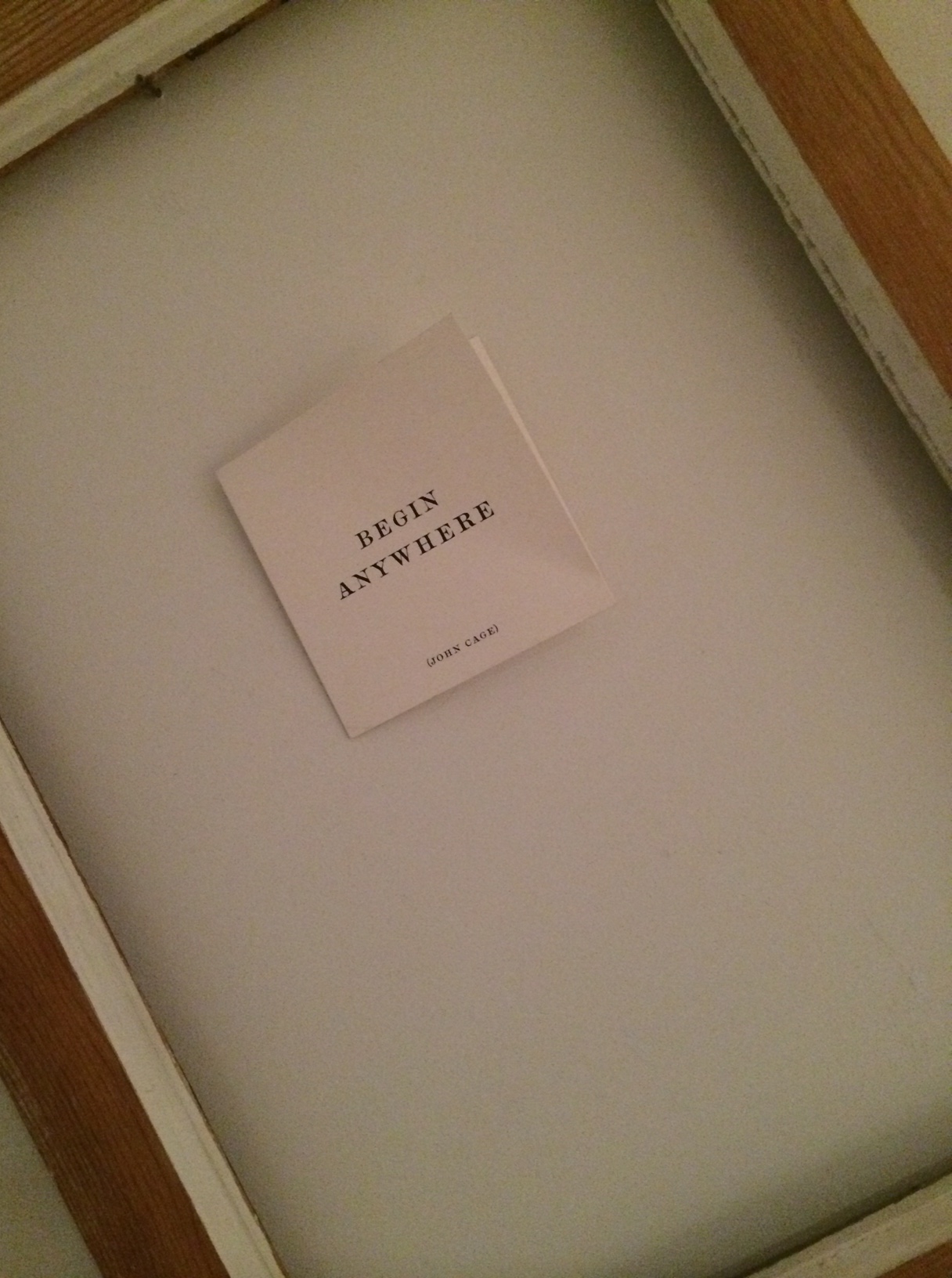
Begin Anywhere

In our house, hanging on the wall like a painting, is an old window frame. In the top pane is a card that reads, “Begin Anywhere.”

Earlier this week I had a great conversation with Diane. She laughed and said, “In my meditations I was whining to God because I wanted to see the plan of my life. I got the clear message that I was never going to see the plan but I could always see the next step. The next step is always right in front of me.” Dancing with what’s right in front of you is sometimes called faith. Sometimes it is called play. Sometimes it is called art.

Diane and I are good reflectors for each other; we are usually on parallel paths. For both of us, the past year or two has been a process of letting things go and stripping things back: paths, patterns, and presuppositions. It has been the mother of all house-cleanings (she had a literal flood!) and, like all good house cleaning it took some elbow grease and few hard decisions about what to keep and what to throw. After the job is done, nothing feels better than a clean house and along with the good feeling, new space, and wide-open possibilities, comes the question, “What’s next?”

Diane told me her story because my next step is so clear that I can focus on nothing else. With such a myopic focus I can see nothing else and that’s why I called her. I must do this play. I must. I cannot see beyond this dance. It is my first thought in the morning. It is my last thought falling into sleep. This step, my dance with The Lost Boy, makes no sense and Diane’s point was well taken: the next step rarely makes sense. Sense-making requires context. Sense-making is a skill of relativity – and since we can never know the plan (if, indeed, there is one), we can only make sense based on old information. That is good news for plumbers but is dubious at best for leaders, explorers, seekers, and artists.

After our call I realized that dancing with what’s right in front of me is how I paint. It’s also the key to a good conversation – and painting, for me, is a good conversation. After my good conversation with Diane, she sent me an email of affirmation and concluded her thoughts with this: “Stay focused on what is before you now and let the creations show you how and when they are ready to play.”

title_pageGo here to buy hard copies (and Kindle) of my latest book: The Seer: The Mind of the Entrepreneur, Artist, Visionary, Innovator, Seeker, Learner, Leader, Creator,…You.

For all digital forms of The Seer, go here

Yoga.ForwardFoldFor posters and prints of my paintings, go here


Make An Appeal

Tom and me a long time ago.

Tom and me a long time ago.

Horatio wrote and said he hoped my kickstarter campaign picked up steam soon. Me, too. It looks like a long hill to climb with less than 10 days to go and less than a third of the way to our goal.

In his email, Horatio asked a great question and also gave me some good advice:

The question: why should anyone care?

The advice: make a direct appeal.

The question (why should anyone care?): To be honest, I’m not sure why anyone cares or does not care about anything. I have lots of cerebral reasons why I think this play should matter but to expound the list feels somewhat like one of the many times I’ve stood in front of a school board telling them why the arts matter. What I know in my bones will bounce off because it is not yet personal to my audience. I know it has to be personally relevant for people to engage or invest in any thing, not just the arts. For instance, the people raising money for breast cancer research and awareness are the same people who’ve had breast cancer or know someone who has. It’s personal. It matters.

This is personal for me. I spent hundreds of hours over several years listening to Tom’s stories, taking notes, recording him. We walked through graveyards. We drove through the fields and stopped at places where his ancestors lived and played out their lives. It’s where he played out his life. He took me those places and told me those stories because he feared they would die with him. He wanted to keep alive the family story and, at the time, no one in his family was present to listen. I was present. I wanted to listen. I wanted to spend time with my friend and mentor and that time was a great gift to me. Tom is chief among the patriarchs of my artistic family. I am his artistic descendent.

Last week as I travelled back to the San Joaquin Valley to work with The Chili Boys to integrate the new music into the play, it occurred to me that I’ve poured more energy and time into this play than any other artistic project in my life. It’s been a decade of development and attempts to get it to production. We let it sit fallow for a spell after Tom’s health collapsed. Oddly, it was Tom’s passing that made it ready, necessary.

One mistake I made in setting up the campaign: I thought people would join the kickstarter because of Tom. It has been somewhat of a mystery to me but also a great delight that the majority of people supporting the play never knew Tom. I thought the legion of Tom’s students, peers, and friends would be the primary donors. Instead, the folks throwing in their support are my peers, students, and friends. They know me. They are supporting me. So, the only answer I can come up with that may make this relevant for you: because I care, because I need to bring this play across the finish line. Because I am now on the front line of an artistic legacy: I carry the stories, the teaching, the value-set, the vision as I inherited it. Making art (performing this play) is the way I serve as conduit to the next generation. It’s how I (like all artists) pass it on. Kerri continues to remind me that there is more to it than that. It’s not just the passing of the legacy to me. It is the reminder we all need in this busy world – the reminder that family story needs to be told and needs to be heard. And everyone has a family story to pass on. Period.

As for Horatio’s advice: make a direct appeal. Here it is: I have 10 days and need your help. Pass on the link. Give $10.00..or $1,000.00. Mostly, I appreciate your correcting my mistake. Thank you for supporting me.

DSC_1196 copyGo here for The Lost Boy Kickstarter campaign

Go here to buy hard copies (and Kindle) of my latest book: The Seer: The Mind of the Entrepreneur, Artist, Visionary, Innovator, Seeker, Learner, Leader, Creator,…You.title_page

Open The Box

JIm Marsh of the band, Mom's Chili Boys, tuning up for rehearsal.

JIm Marsh of the band, Mom’s Chili Boys, tuning up for rehearsal.

It is often the simplest of actions that rock the world. I had one of those moments yesterday. It was a threshold moment. Its power took me by surprise. It changed me and all I did was open a box.

We flew to California to work on a play. I’ve worked on dozens of plays and performance pieces in my life but this one is special because it’s not an abstraction. It’s not a made-up story. I’ve lived it and lived with it for nearly a decade. The event, the catalyst of the play was the discovery of a box, a time capsule plastered into the walls of a ranch house over 130 years ago. Tom found the box. It held the possessions of an ancestor, a small boy who died in 1885. The boy’s mother, Isabelle, put his clothes and toys in a small trunk, wrote notes, some brief anecdotes about the boy, and then hid the box in the walls of the house.

Nearly ten years ago, we began creating the play when, late one night during a visit to the ranch, Tom asked me to help him. He asked, “What am I supposed to do with this box?” At first, much of the body of the play amounted to organized transcription. During each visit I recorded hours of conversation with Tom, hours of late night storytelling, and then flew home and transcribed the recordings. I wanted to catch the cadence of Tom’s vocal patterns. I wanted to catch the rhythms of his extraordinary voice and gift of storytelling. The play was his to perform; my work was simply to craft it, to draw a clear story-path for him to follow. The play, a one-man show, was ready for production when Tom’s health failed. He died a year ago.

During Tom’s decline I rewrote the play so that I might narrate the story and added another character to the piece. The Chili Boys had a battery of new music for the play so we gathered in Stockton to integrate the new music with the new text.

When we arrived in California, we visited Tom’s widow, Marcia. She gave us the trunk so we might photograph the clothes, toys, and notes. I’d seen the artifacts many, many times. Tom and I wiled away many nights unpacking the box and reading the notes, talking about his family stories. When our rehearsals were finished, sitting with Kerri and Jim moments before driving back to the airport for our return flight, we decided to open the trunk. Kerri had never seen the artifacts. As I lifted the lid, as I opened the trunk, I realized it was the first time; Tom had always opened the box. Tom had always reached inside, removed the shoes, the tattered coat, the hobby horse, the diary that contained the tracking notes of a fever that killed the boy. This boy was not fiction. Tom would say, “Look at this. Look at what she wrote on this.”

I opened the lid, for the first time, reaching inside, pulling out the shoes, the jumping jack, saying, “Do you see this? Someone must have made it for Johnny. And here, this is the notebook that Isabelle kept of Johnny’s fever. Look at what she wrote.”

DSC_1196 copyInvest in THE LOST BOY. See our kickstarter campaign


title_pageGo here to buy hard copies (and Kindle) of my latest book: The Seer: The Mind of the Entrepreneur, Artist, Visionary, Innovator, Seeker, Learner, Leader, Creator,…You.


Determine The Value

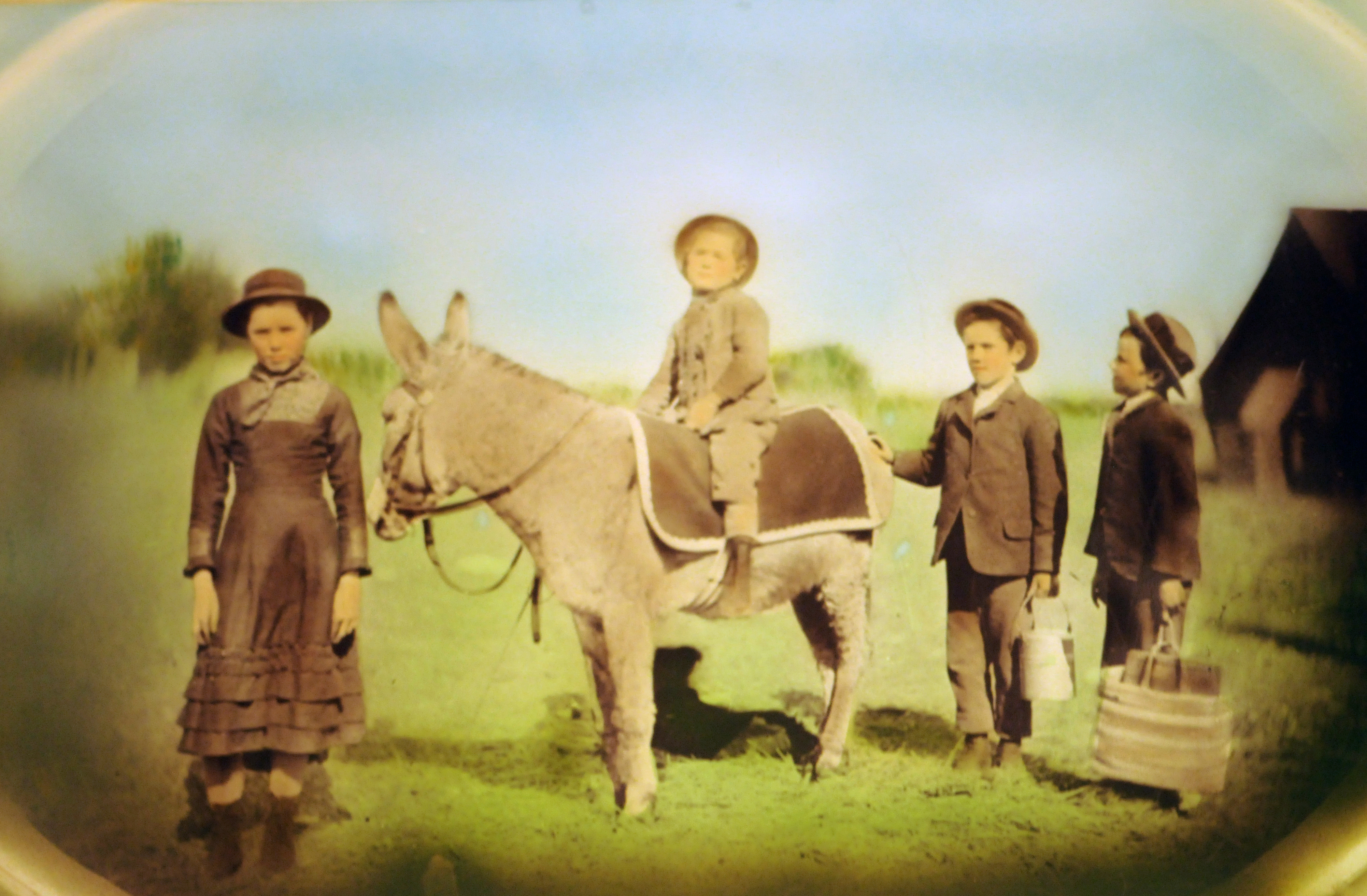
The Lost Boy (one of many) sitting on a mule.

The Lost Boy (one of many) sitting on a mule.

Last year Skip taught me that crowd sourcing sites like Kickstarter or Indiegogo were great ways to test the viability of a project or product. If an idea is valuable, people will invest in it. If not, not. If an idea is viable it will attract support.

As an artist I’ve had a wonky relationship with the valuation equation. Generally, the economics of art live outside the norms of the marketplace. For instance, I’ve run or consulted with many theatre companies; it is virtually impossible for the product of a theatre company – the live performance of a play – to pay for itself through ticket sales. Unlike other products, things like cars or bananas, arts organizations and the products they produce are made possible through grants, donations, patrons and this weird mechanism called “non-profit” status. The costs of producing the play (the art) usually outstrip the capacity of the “product” to generate a profit.

When I first met Skip he asked me a question for which I had no capacity to answer: “How can you scale up?” His question brought me to the concept confusion that lives at the very heart of the economics of art: bananas, cars, and iphones can be mass-produced. They are meant to be consumed on a grand scale. They are built to break down, to be replaced by the newest, latest, and greatest. The arts, to be living, to be vital, are rarely capable of mass consumption.

The arts serve personal (and, therefore, communal) transformation. They are not meant to break down, to be replaced by the new; they are meant to sustain, to renew from a deep irreplaceable wellspring. If the iphone, banana, or car is the fruit of the vine, the arts are the root system, that which brings nutrient to the fruit, that which holds the identity of the culture. Pluck the fruit and the vine will replace it. There will always be more. Pluck the root and you kill the plant. There is only one root. The fruit is meant for consuming. The root serves a different purpose.

Places of worship and education face the same value confusion. The sacred stuff, like art, is not consumable so how does a consumer culture determine its value? Learning is an ongoing personal process, an irreplaceable relationship with the world. Both education and worship, like a living art, are experiences rather than products. They are meant to be valued differently than a new countertop or a pair of shoes.

Some forms of art are capable, through the miracle of technology, of mass consumption: movies, music recordings, art posters and prints. Technology can do many things but it cannot replace presence. It allows us to see. It cannot replace touch. It allows us on a mass scale to see a reproduction of a painting by, let’s say, Van Gogh. We can appreciate the painting through the print. However, we cannot experience it. Nothing can replace direct experience, the personal moment of standing with the painting. A live performance is…live. It is alive, inclusive, and meant to transform through presence and participation in a shared moment. The economics of valuation confuse the greater valuation.

I am testing Skip’s notion with the viability of a project. I’ve launched a Kickstarter – my first – to fund a play. It is a heart project, personal to me and I think relevant to my community. Take a look. If it looks like it has value, you’ll know what to do.

Go here to check out my kickstarter for THE LOST BOYDSC_1196 copy


title_pageGo here to buy hard copies (and Kindle) of my latest book: The Seer: The Mind of the Entrepreneur, Artist, Visionary, Innovator, Seeker, Learner, Leader, Creator,…You.


Love The Game

Dog-Dog-Dog in the joy of the pursuit

Dog-Dog-Dog in the joy of the pursuit

Tripper Dog-Dog-Dog likes to chase bumblebees. He snaps at them in an attempt to catch them. He never catches them but that does not deter his endless attempts or the glee of his pursuit. He loves the chase. He loves it.

Tripper Dog-Dog-Dog also loves to be chased. He only requires something to carry, something to claim that makes the chase necessary. Any stick will do. I walk to the center of the yard, pick up the most available stick, he takes it from my hand and races away. My job is to give chase (as I pursue the Dog-Dog, I say again and again, “Give me my stick!” as if the stick was mine. Such is the power and grace of the human imagination!) Wild-eyed and joyful, he races around the yard at Mach speed, a bumblebee to my snapping dog. I never catch him but that does not deter the glee of my pursuit.

Dog-Dog is teaching me the secret to a joyful life. It is simple: love the chase. It is the glee of the pursuit. As James Carse wrote in Finite and Infinite Games, the point of the game is not to win but to continue the play. The point is to become a better and better player. In an infinite game, winning is not an outcome, it is a way of being. The point is to love playing.

I am grateful that Tripper Dog-Dog-Dog leaps for bees that are nearly impossible to catch. I am grateful that Tripper Dog-Dog-Dog runs from me even though he knows I will never catch him. When I am too tired to continue the chase, he drops the stick and circles back to where I stand huffing and puffing, ready to give him a few pets. His entire body wags with delight. His eyes shine with the thrill of the game and I laugh at his unbridled enthusiasm. He teaches me without using a single word. When I’ve caught my breath, I’ve learned to say, “Hey! Where’s my stick!” Picking any twig from the ground, he snatches it from my hand and we are off and running.

title_pageGo here to buy hard copies (and Kindle) of my latest book: The Seer: The Mind of the Entrepreneur, Artist, Visionary, Innovator, Seeker, Learner, Leader, Creator,…You.

Yoga.ForwardFoldGo here for Fine Art prints of my paintings