Look Up And See

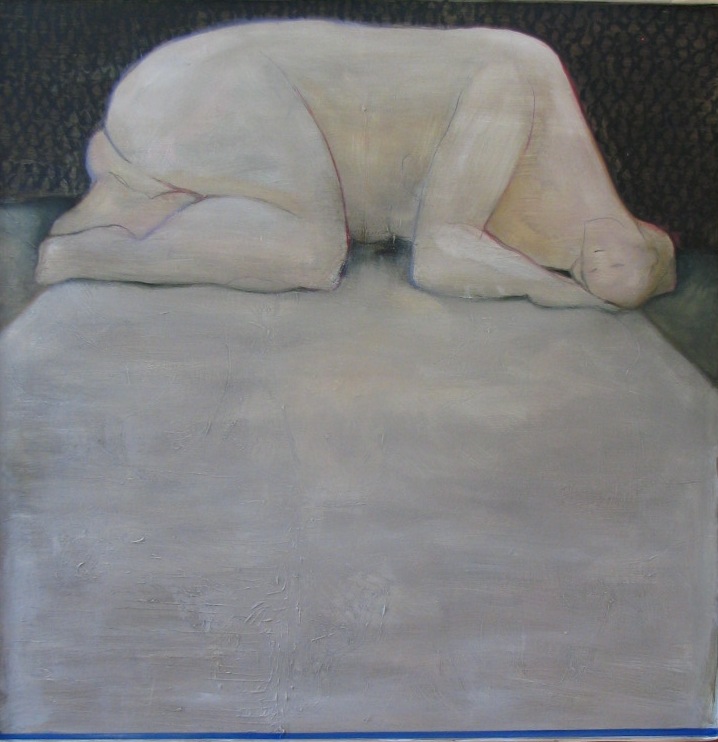
Another painting from my archive. Today I call this, "The Other Side Of Yearning."

Another painting from my archive. Today I call this, “The Other Side Of Yearning.”

The fire in the fire pit was waning. The party was over and everyone had gone. We sat staring into the small flames, quiet, exhausted from the day yet exhilarated from the amazing people and conversations that filled our evening. It was a cloudless night sky and I sat back into my chair and lost myself in the stars.

Once, many years ago, I went to Kitt Peak Observatory outside of Tucson and spent a long evening looking into deep space. I saw stars and star clusters, asteroids, black holes and ice fields. We ended the evening looking towards Andromeda, the nearest galaxy to ours; it was so distant that its stars appeared to me as a mist, a shadow that shimmered. I was overcome with emotion that night. I’ve never felt so small and yet so undeniably connected. I was a universe within a universe within a universe. I was nothing and everything.

As I sat last night in my chair looking at the little points of light in the sky, I thought about all the things that seem so insurmountable on this earth. There are economies of exclusion, wars and markets that depend upon wars to prosper, slavery and drought and poverty, there are broken lives, broken hearts, and broken dreams. There are closed hearts and closed minds. There are people killing people over conflicting definitions of god. There are so many tug-of-wars over possessions and power and resources and boundaries that, from ground level, appear vital, real and important. But the moment you gaze into the night sky, the moment you place yourself in the context of the enormity, the moment you recognize the paradox of existence, the smallness of separation and the infinity of connection, you see how mechanical and rote most of our dramas really are. They are mostly made up. They are patterns of our creation. They are, each and every one, built upon the ultimate cop-out answer: we do it this way because we’ve always done things this way.

Once, in high school, I was at science camp in the mountains on the night of a meteor shower. We lay on blankets in a meadow oohing and aahing at the dance of stars happening in the heavens. I remember being awed. I remember thinking that the only real purpose people serve is to make up stories about the things we can’t explain. We are witnesses to miracles everyday and because we must somehow contain it, we reduce it. That night I understood that all belief systems were just that: systems. They are mechanisms to help us contain what we cannot comprehend. We need them to function, to orient ourselves in infinite space but forget that we invent them. In the face of the sheer magnitude of our existence, we reduce ourselves, too, and forget that what blinks at us in the night sky, is a force, an energy that transforms, and we are an expression of that force. We are part of it. Our role may be to witness, to appreciate, to interpret, to sense make, but mostly, gazing into the sky, I think our role is to recognize ourselves in it. If we are capable of losing ourselves in the stars we are equally capable of finding ourselves in the enormity of it all.

Go here to get my latest book, The Seer: The Mind of the Entrepreneur, Artist, Visionary, title_pageSeeker, Learner, Leader, Creator…You.

Or, go here for hard copies and Kindle.


Serve

A painting from my archives. This one  sold in 2007.

A painting from my archives. This one was 4′ x 4′ and sold in 2007.

Jim asked a world-class question: When did customer service become a firewall against serving customers? If you’ve had to call about a mistake on a bill or to try to get some support from your insurance provider you’ll appreciate his question. How many buttons do you have to push to get to a person? How many levels of supervisor do you need to ascend to get to the person who has the authority to serve you?

What does it meant to serve?

Quinn once told me that the world was ruined with the advent of the salad bar. He was far sighted (and funny) and recognized that it might at first be attractive to build a salad your own way but the trade-off, the loss, would be much greater than the free-will-illusion that the salad bar provided. Service would become equated with efficiency; it would become a cost saving strategy. Quinn suggested that the “salad bar concept” would forever redefine the essential relationship of the business; it would reduce the word “customer” to something consumable for the business. In other words, it would no longer matter whether or not a customer was happy because there would always be someone else to sidle up to the salad bar. In a salad bar world, the word “service” would forever be subject to a strange ongoing cost/benefit analysis. The society would shift the emphasis from service to others to service to self. Do you remember, after the introduction of the ATM, having to pay a fee to your bank if you needed to talk to a teller? Serve yourself. Save time. Do you remember when the airlines started charging travelers for bringing luggage? Or recall the introduction of extra fees for extra legroom? It may seem as if we have product choice but Quinn would tell us that we are forever standing at a salad bar.

What does it mean to serve others?

Martin Prechtel writes that transcending self-interest to put your life in service to the greater communal interest is called maturity. In order for the community to thrive, to grow and renew, the members must be oriented toward serving something greater than their own individual need. Without this necessity of service the society descends to the bottom of Maslow’s hierarchy.

What does it mean to serve something greater than you own self-interest?

I’m preparing to go over seas and do a workshop on “team,” so I’m asking many questions of people who are trying to facilitate teams in organizations. “What’s the greatest challenge you face?” I ask. The response is universal: trying to get employees invested in something other than their own personal gain. In my mind I can hear Quinn laughing; he’d call this  salad-bar-blowback. When customers become consumable, employees also become consumable. The essential relationship in business, the one it has with its customers, is merely a reflection of the relationship it has within itself. Vested action is not something that can be manufactured. One must care in order to be invested. Vested action is the blossom of service to others.

Go here to get my latest book, The Seer: The Mind of the Entrepreneur, Artist, Visionary, title_pageSeeker, Learner, Leader, Creator…You.

Or, go here for hard copies.

Ask Why?

Courageous teachers

Courageous teachers

This is the week of comments sparking questions. From yesterday’s post, SAY, “I CAN,” my dear friend Arnie, and life-long educator, offered the following thought:

Remember dear friend, that public schools in the US were built not by educators but by the business/industrial community. They were structured as they are for two purposes: one was to train children to work in factories (this model came about during the Industrial Revolution). The other was to keep children out of the workforce until they were 16 so they wouldn’t take jobs from the adults (thus compulsory education). It makes lots of sense that the model has lasted so long. It feeds into the natural human need to control. Teachers generally come into the system out of the safety and security of their homes and then college. They are steeped in the “control” model and it certainly makes them feel more secure – so the system keeps on chugging.

It is only in those places where there are a few (both in the management and teaching ranks) people who believe in the substance of your “Say ‘I Can.’” posting that a different model can emerge – one that is student-driven (as opposed to the phony student-centered model).

Arnie is now retired. He was a visionary superintendent, one of the few I’ve met in my walk through education who challenged the chugging system and attempted to midwife a new model. Early in my career Arnie and I were crushed together under the wheels of the chugging system. We both emerged from the tire tracks with greater wisdom. He dusted himself off and gave it another go, and another, and another.

His comment created a feedback loop through yesterday’s post and gave rise to a question that has been with me my entire career. Here’s the loop: throughout my entire pass through the world of education I’ve heard, read, and experienced a variation of this thought: if we practiced medicine like we practice education we’d still be using leeches. In other words, we no longer use children to man our factories yet we still use and support the system created for that purpose. Beginning with the great Neil Postman’s book, Teaching As A Subversive Activity, written in the 1960’s, there has been a mountain of data, investigation, brain science, intuition and common sense…we know how to create great education. Here’s the question: Given what we know, why do we not do it?

I’ve worked with countless educators, primarily around systems change. Mostly, I’ve led them into slaughter – the same slaughter that Arnie and I experienced when we tried to create a system of learning that might replace the system of factory fodder. The slaughter is worth it because we emerge wiser, more experienced, sometimes disheartened, but mostly filled with the question that I just asked: why do we not do what we know to do? Why do we continue to support what we know to be destructive for our children?

In this light, Jim’s quote from yesterday is profound, “ I’ve come to believe this is less about can and can’t than about the challenge of doing. And not doing is always easier.”

The first recognition from my book, The Seer, is this: you don’t have a problem, you have a pattern. This example from the lost world of education is perfect. Problems confuse us with the notion that we can solve for it. We can’t. Patterns, on the other hand, can be broken. We have a pattern of seeing our children as fodder for factories in the age of the internet. This is not about whether we can or can’t do anything about our education system, it is about whether we will do it or not do it. And, as Jim wrote, “not doing is always easier.”

Go here to get my latest book, The Seer: The Mind of the Entrepreneur, Artist, Visionary, Seeker, Learner, Leader, Creator…You.title_page

Or, go here for hard copies.

Say “I Can.”

My latest addition to the Yoga series.

My latest addition to the Yoga series.

This is a bit of a confluence of thought-rivers. Two comments came across my virtual desk on the same day and collided.

1) Master Marsh sent me some wise words about a recent post concerning “can” and “can’t.” He wrote:

“There have always been plenty who will say: ‘It can’t be done.’ Ignore those. Surround yourself only with those who say: ‘It can.’ I’ve come to believe this is less about can and can’t than about the challenge of doing. And not doing is always easier.”

2) Another of my favorite readers sent this comment about a post on boundaries and choices:

I’m thinking making own-able choices is so freakin’ difficult for so many us because we were never taught/allowed to make them as children, nor are we often encouraged/allowed to do so as adults. Most of us learned at a very young age that to do as instructed – without complaint or question – meant that you were “good.” Being “good” was all tied up in stuff like being seen and not heard; accepting “Because I said so” as an explanation; being expected to abide by dictated boundaries and beliefs because of tradition or what “Other people will think.”  Operate by the rules and you are “good.” Buck that system by challenging the status quo and you are “bad.”

At first glance these might seem like two entirely different subjects. Though, as luck would have it I read them one-after-the other and I started pondering why, “not doing is always easier” and if that might not have something to do with identifying “good” with compliance and “bad” with non-compliance.

It’s a fascination of mine that in a nation that prides itself on a spirit of independence we place so much emphasis on obedience, control, and compliance. Nike sells us shoes by plucking the chord, “Just Do It!” Yet, we all know that the cowboy spirit is not welcome in grades K – 12. It’s a mixed message at best.

In the world of work, in environments heavy on control and compliance, workers can be counted on to do the minimum. Why would they show up ready to give their best when their best requires a mind-of-their-own. They, in essence, become resistant to take initiative and necessarily refuse any ownership of actions. To take ownership requires being seen and compliance is a game of invisibility. I remember a very frustrated artistic director asking me why her creative people never initiated action. She was dumbfounded when I helped her see that she was the problem. She made it a habit of negating every idea that she didn’t originate. Her staff did what all people do when punished for making offers; they stop making offers. Her “creative” team became adherents of “It can’t be done.”

No child comes to the planet with an internal line dividing “can do” and “can’t do.” Imagination makes all things possible. “Can do” and “can’t do” is learned; it marks the boundary between safe and not safe (or unseen and shamed). There is a price for domestication. “It can’t be done” is often a statement of fear and refusal to cross the line into disobedience (independence by another name). I would add a thought to Master Marsh’s comment, “not doing is always easier;” it is also true that not being seen is always easier, too. Showing up is hard. Doing is always a challenge because doing is often unpopular.

Tom used to say: “You know the value of your work by the size of the tide that rises against you.” In other words, it takes a special kind of courage to say, “this is mine to do and it matters not a whit what others think or feel about it.” It takes a special courage to say to yourself, “I’ll never know if it is possible or not until I try.”

Go here to get my latest book, The Seer: The Mind of the Entrepreneur, Artist, Visionary, title_pageSeeker, Learner, Leader, Creator…You.

Or, go here for hard copies.

Be A Team

can you see the team boosting the child? I have many of these and will soon begin intentionally pursuing this form

can you see the team boosting the child? I have many of these and will soon begin intentionally pursuing this form

Many years ago Judy gave me a book by African writer Malidoma Some. He wrote that, in the village where he grew up, there were no locks on the doors. In fact, there were no doors. The people of the community respected the possessions and privacy of others. Locks were not necessary. The community cared for the health of its members so its members cared for the health of the community. From his point of view, a society that needs locks on the doors is a sick society. Locks are sign of communal breakdown.

I’ve been thinking much about sickness and the need for locks as I prepare to do a workshop for organizations about effective teams. I’ve done too many of these workshops not to recognize that the need to build teams is a sure sign of an unhealthy community. In Malidoma Some’s community, people were aware of and acted from a consideration of the health of the whole. Loyalty begets loyalty. “Acting for the good of the whole” is a great working definition for a team. It’s all you need to know to nurture great teams: make sure everyone in the organization, from the top to the bottom, is caring for the health of all the members. Make sure the choices are made for the good of the whole.

An organization that needs to team build is like a society that needs locks: most organizational systems support a philosophy of “every man and woman for themselves” while the executive suite needs cooperation and compliance to get the job done. No amount of team building can transcend compensation for individual merit. Once, a CEO asked me, “How do I get them to do what I want them to do?”

The short answer: you don’t.

A healthy team, just like a healthy community, requires no leveraging to act. It requires no policing. A team is a not a “thing.” A team is a relationship and just like a sports team or a theatre troupe, everyone needs to feel safe to really bring their game. They have to know the team cares for them as much as they care for the team. Many years ago, while sitting in a jury pool, the judge asked us, “Why do people resent being called to serve?” A lovely older woman raised her hand and replied, “The government offices are inaccessible and unhelpful when I need information or support. Why should I be happy to serve a system that wants nothing to do with me until it needs my money or someone to sit on a jury.” The rest of the jury pool applauded. When loyalty is a two-way street, teams form naturally. When loyalty is a given, people quite naturally offer their service to something greater than themselves.

There are a few other elementary things necessary for the relationship known as, “team,” like a common story (a common center) and a clear intention, but they are not possible when the metaphoric doors need locks. “Team” is something we are, not something we build or do.

Go here to get my latest book, The Seer: The Mind of the Entrepreneur, Artist, Visionary, title_pageSeeker, Learner, Leader, Creator…You.

Or, go here for hard copies.


Sizzle!

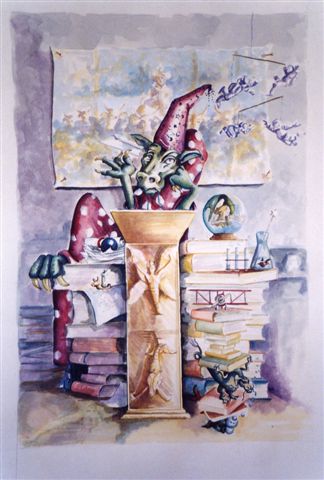
an illustration from a book I never published: A Dragon's Tale

an illustration from a book I never published: A Dragon’s Tale

I’m breaking my book down into component actions almost as if I was dissecting a play script. It’s an interesting exercise because I’m experiencing a measure of creator’s blowback: I’m having the distinct impression that someone else wrote this book knowing that I’d read it someday. The author formerly known as “me” knew that I’d need to know what it contains. It is often true that we teach what we most need to know.

I started my component part breakdown because I’ll soon be throwing people into an exploration of the book’s 9 Recognitions. I wanted to chart the actions of the story and the learning embedded within the narrative. I say, “throw people into an exploration,” because I eschew the word “teaching.” My life has taught me that good teaching is about creating a container for exploration. Good teaching involves no teaching. Good teaching is watching and waiting for the right moment to ask a single simple question: what did you discover? The response will always be personal and relevant to the learner. No amount of control or planning can match the power of relevant personal discovery.

A side note: good teaching and a good life share a common center: the capacity to stand solidly in the constancy of discovery.

The primary thought-river that carries the raft of my book is “to have the experience first and make meaning second.” Making meaning second is what we do even when we think we know where we are going. Life is mundane only when “mundane” is the meaning we assign to it. Life goes bland and gray when we make meaning prior to having experiences.

The word “presence” is shorthand for having experiences before assigning meaning to the experience. If you strive to be more present simply cease thinking that you know what’s coming. You don’t.

And so, this is what my component part breakdown/book blowback looks like:

“Throw them into an exploration.” This is a remarkably different action than, “teach them.” (Another Recognition from my book: the language we use to assign meaning matters more than we know).

“Ask a single simple question” This is also a remarkably different action than, “teach them.” Live in the question and not the need for an answer.

When I was an aspiring actor deep in my acting school studies I learned that the verbs that I choose matter. The actions that I assign to my pursuit can ignite me up or block my path. The same is true on my discovery path: when I am making meaning, use really good verbs. There’s no need to minimize the sizzle of this extraordinary life.

Go here to get my latest book, The Seer: The Mind of the Entrepreneur, Artist, Visionary, title_pageSeeker, Learner, Leader, Creator…You.

Or, go here for hard copies (Amazon)

Dream It!

a blast from the past. A self portrait of yearning from long ago.

a blast from the past. A self portrait of yearning from long ago.

[continued from Step Into The Dot]

Standing with both feet in your life means you get rid of Plan B – or at least to put Plan A and Plan B in the right sequence. It has been a source of wonder for me why people (including myself at times) pour their energy into the back-up plan before they jump head first into their dream. Dreams rarely seem practical. Plan B always seems practical. In fact, that is the role of Plan B: lower the bar so it is easily cleared.

I’ve mentioned before how often in coaching relationships I hear the story of people diligently building their art studio but never entering it. Or, if they allow themselves to enter the creative space, they sit, frozen, unable to pick up the brush or the camera. It is dangerous to entertain the freedom that comes with dreaming. It’s as if we allow ourselves to pull back the covers, peek at the dream, to get close enough to feel the heat of it, but not close enough to ignite it into possibility. It is a special kind of pain to delay a dream. It satisfies the desire to want it but not pursue it. It affords the soothing notion of, “ I tried,” or the devastating notion of, “It wasn’t realistic.”

Kerri and I are bringing our work together in a new form: Be A Ray!

Kerri and I are bringing our work together in a new form: Be A Ray!

This is why Kerri and I are combining our performance, teaching and storytelling gifts in a palate of offers we’re calling Be A Ray! Dreams deferred cause energetic eddies; they make people swirl, putting time and energy into actions that feel good (like building a studio) but do not move the intention forward. To stop the spin is to see the pattern of deferment. It is to see the story beneath a lifetime of actions that lead everywhere but in the direction of the dream. In our vernacular, to “Ray Up!” is to stop the spin, to look squarely at the dream, and to seize the second chances. It is to claim the dream and pursue it.

Dreams need not be realized. They only need to be pursued. In fact, a proper dream pursuit is never realized just as an artist is never finished. Like every good art process, the dream changes with the pursuit. It grows and morphs until the pursuer and the dream unite. There is never an outcome, only a joining, a blending of dream and dreamer. And, this blending is the reason most people go with Plan B. Dreams can’t be controlled and neither can dreamers once unleashed. In other words, the first step in Raying Up! is to relinquish control. Pick up the brush and throw paint; let go of outcome and live in vital process. Let go of what anyone else thinks of your dream and dream it.

Go here to get my latest book, The Seer: The Mind of the Entrepreneur, Artist, Visionary, title_pageSeeker, Learner, Leader, Creator…You.

Go here for hard copies.

Shift The Frame

another of my illustrations for Lucy & The Waterfox

another of my illustrations for Lucy & The Waterfox

I’ve been sitting in my fair share of waiting rooms, coffee houses, and gathering spaces lately and so I’ve been eavesdropping on conversations. Who knew there were so many problems in the world! Based on my public space sample you’d think that things were dire. The news of the day concurs with the casual coffee shop discourse. Problems abound. Wars rage, resources dwindle, political leaders squabble, corporations pillage, siblings rival, and people cut each other off in traffic! As my friend Albert used to say, “Good heavens! Just drop the bomb, already!” With so much devoted suffering, so much impending doom, ill intent and disaster anticipation, it’s a wonder we can sleep or step out of our houses in the morning.

Why is this the story we tell? We talk about life as if it was happening to us, as if we play no role in making things happen. I used to make it my practice to count the acts of kindness I saw each day and compare them with my count of acts of cruelty. There was never a day when the cruelty outpaced the kindness. For every example of road rage there were 20 instances of road generosity. In fact, in my count, the acts of kindness so far outstripped the cruelty that it became ridiculous to keep the count. We are far more kind than cruel, far more capable than inept, far more connected than detached, yet our narrative reverses the order. We tell a story of separation, of dog-eat-dog, of the inability to cooperate.

Many years ago the good folks at Disney conducted a study and found that when people had a bad experience at Disneyland they’d tell on average 18 other people. If they had a positive experience at the park they’d tell 3 people. That’s a significant imbalance. We seem reticent to share our joys and adept at sharing our fears.

It’s as if we are addicted to conflict and, well, we are. We delight in defining ourselves by our problems. It’s a pattern. More, it’s a story imperative. We are, after all, storytelling beings. We never cease storying ourselves through our inner monologues and outer dialogues. We justify. We defend. We interpret. In general, stories – lived and scripted – are driven by conflict; conflict moves the story forward. Stories are made meaningful by overcoming the forces of opposition. Our lives are made meaningful by the metaphoric mountains we climb. We mistakenly define a good life as the absence of conflict. Conflict is necessary; it is our relationship to conflict that keeps us hooked on the drama like so much sugar.

There is a significant threshold, a passage into health and power that happens in a life when the narrative changes from, “things happen to me,” to a story of, “I make things happen.” Conflict is present in both story frames. In the frame of, “things happen to me,” conflict is an oppositional wind. In the frame of, “I make things happen,” conflict is fuel, we no longer are at the mercy of the forces but in alignment with them. The metaphoric wind is at our back moving us forward.

When we make this story frame shift, we no longer need the drama; we no longer seek to fix things. We see a different set of options. Literally, we see a different set of possibilities. We create and live from a different pattern. We see choices instead of victimization. We see active participation, conflict as challenge, engagement, and opportunity.

The, “I make things happen story,” necessitates responsibility: wars can’t just happen, resources can’t just dwindle, political leaders just can’t squabble, corporations can’t just pillage. We would tell a story of “we,” and take the step into maturity that the story of, “things happen to me,” obscures.

Go here to get my latest book, The Seer: The Mind of the Entrepreneur, Artist, Visionary, title_pageSeeker, Learner, Leader, Creator…You

Or, go here for hard copies (Amazon)