Sit Down

google "Chicken Little" and this one will come up. www.homesforsaleinlascruces.com

Google “Chicken Little” and this one will come up. http://www.homesforsaleinlascruces.com

Many years ago I was feeling disoriented in my life. I told my friend Rob that I was lost in the woods and looking for my way out. He replied, “Sometimes when you are lost in the woods the best thing to do is nothing. Just sit down.” His message was clear: no one gets oriented or reoriented by spinning. Running in circles, although it might feel useful, will only make you dizzy. Sit down. Get quiet. Listen. It was great advice and at the time nearly impossible.

Orientation to life comes from getting quiet. In one of his books, Deepak Chopra wrote that an important practice on the path to success is a half hour of meditation in the morning and another half hour at the end of the day. Make a practice of getting quiet. Exercise the muscle of stillness. Listen. Clarity will ensue. That way, when the inner compass goes awry, the right tool for the job will be more readily available.

Sitting down can be hard. Stillness and disorientation are not natural bedfellows. The impulse is to action, any action. I was once in a car on a remote mountain dirt road. The road collapsed and the car slowly rolled into a gully. My friend and I spent two days trying unsuccessfully to build a road out. It was only after we gave up and sat down that we were capable of thinking things through. Disorientation generally inspires panic. Panic-driven actions, like running in circles or hauling stones to build a road, are generally comical and make for great stories after orientation is restored. We’ve all turned the wrong way down a one-way street when lost and panicked. Pulling over would have been better but much harder to do when dedicated to forcing an outcome.

Beneath Rob’s message to me was a more important lesson: let go. Let go of the need to do. Let go of the need to solve, fix, or find. The path to orientation always leads through a necessary disorientation and the disorientation comes from hanging on to old ideas, old roles, old baggage, old heroics. The cycle is perfect as hanging on necessitates letting go and letting go often means to sit down, surrender, and breathe. To sit down always affords the opportunity to see where you are as distinct from where you think you should be. To surrender is to open. To breathe is to invite in the new. No one is lost when they stop trying to be some other place.

title_pageGo here to buy hard copies (and Kindle) of my latest book: The Seer: The Mind of the Entrepreneur, Artist, Visionary, Innovator, Seeker, Learner, Leader, Creator,…You.

Go here to support my kickstarter campaign for The DSC_1196 copyLost Boy project
Simply Listen

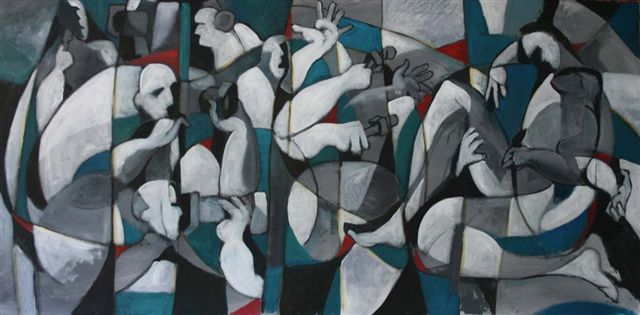
Pieta with Paparazzi

I call this one Pieta with Paparazzi

I am standing in a lobby listening to people compare their tragedies. It is more than comparison; it is a festival of one-ups-manship. “If you think that’s bad, my niece was just diagnosed with a terrible cancer….” The first speaker, now crestfallen, reaches into her story-bag of pain as another member of the group competes, “That happened to my brother just after his daughter was hit broadside by an enormous truck!” The group coos in sympathy, each in a hurry to make their personal story of hurt the center of the conversation. I wonder at their need to outdo each other in tragedy.

I suppose it is human, this feeding frenzy of drama. I want to reject my supposition outright. Suppose it is not human? I wonder if this dis-ease is cultural, an expression of the fragmentation that comes from the too-busy, the clan that avoids internal quiet at all costs, filling every moment with television, gaming, texting, emailing, gossip-news. As Anne Morrow Lindbergh wrote in Gifts From The Sea, it is impossible to know who you are without dedicated inner spaciousness and quiet. To listen to your self is the only way to really know your self. Filling the quiet space with incessant noise withers the root.

Maybe.

All stories require conflict to move forward but it is also true that the point of all storytelling is transformation. Through the conflict we are transformed. Perhaps that is what bothers me as I listen to this pain frenzy: the emphasis is on the suffering. The investment, the identity, is in the wound, not the transformation.

There is a simple Buddhist prayer that I like:

May I dwell in my heart. May I be free from suffering. May I be healed. May I be at peace.

The prayer is like a musical round that progresses from the “I” to the “You” to the “We.” The emphasis is on the transformation. It begins with dwelling in the heart.

Maybe.

What bothers me most is the absence of the capacity to listen. The first speaker needed to be heard, not outdone. I wonder what might have happened if the group had simply said, “Tell us.” I wonder what might have happened if they had been able to be present with another’s pain. To listen, simply to listen, must be a route to free each other from suffering, to heal, to create peace.

title_pageGo here to buy hard copies (and Kindle) of my latest book: The Seer: The Mind of the Entrepreneur, Artist, Visionary, Innovator, Seeker, Learner, Leader, Creator,…You.

Or, you can go here for all forms of digital options


And, you can go here for fine art prints of my paintingsYoga.Meditation


Intend And Forget

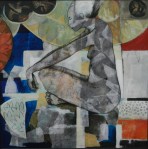
I have many titles for this painting and have used it a few times for posts. It is ultimately about intention and inner guidance.

I have many titles for this painting and have used it more than a few times for posts. It popped up for me again today. It is ultimately about intention and inner guidance.

I just finished writing this post and realized that, in many ways, this is the continuation of yesterday’s thought: clear the mental static and the channel to full expression opens. So, here is part two of my meditation on inner static:

John and I were having a conversation about the passage of time. He told me that he’d recently found some old lists that he’d written of life goals and intentions. The interesting thing about discovering the lists was 1) that he’d forgotten writing them and, 2) that he’d achieved most of what he’d written. He said, “The form of what I created was different than what I’d originally imagined but I was surprised to see that I’d actually created what I intended.” It was as if he had to write the intention in order to activate it. Forgetting the intention was necessary to give it space to manifest and grow. Write and forget.

When I was first training as an actor, late in every rehearsal process, my teachers consistently advised that we let go of everything we’d rehearsed and just show up. “You’ve done your work,” they’d say. “Now, let it go and trust.” Many years later when I was directing plays and teaching actors I gave the same advice. “Let go and trust. You’ve done your work. All that remains is to be present.” From the teacher/director seat, the moment of letting go is palpable; you can literally see and feel the phase in the process when an actor needs to let go of their work to come alive. They need to get out of their own way. They need to get out of their head and give all of their focus to the relationships on the stage. The work moves from the head to the body. It is this last step that transforms their study to a living pursuit. Forgetting the work creates spaciousness and allows the art to happen. Art is always about relationship and great art happens when the relationship is clear and expansive enough for all comers.

One of the most profound lessons I gained from my time in Bali concerned this dynamic connection between setting an intention and letting it go. While I was on the island my internal monologue disappeared; one day I realized that I was completely quiet. Thought was a choice and not a plague or chattering background noise. Silence was simple when no story was necessary, when no interpretation was needed. In the middle of that silence I could set an intention (“This is what I want to do/find today”) and then forget it. Before the day was over I would have found what I intended. The steps came to me; I did not have to seek the steps. Sometimes the intention was simple and sometimes seemed complex but that didn’t matter. If I clearly stated what I wanted and returned to silence the necessary coincidence always found me. I felt as if I could see the pieces on the game board moving on my behalf. There was no internal noise to compromise my intention so there was no external discord confusing my choices. I was conscious of my connection.

Alan calls this co-creating. Work with the energy and cease trying to force things to happen. John told me of his lists and I wondered how many people have had the same experience. We make lists, we try to make the list happen, life gets in the way and we forget. And, in the moment of forgetting, we relax our grip on how we think things need to happen. We forget the form and inadvertently open to possibility. In the forgetting we create the steps necessary for fulfillment: spaciousness, trust, and quiet participation.

Go here to get my latest book, The Seer: The Mind of the Entrepreneur, Artist, Visionary, title_pageSeeker, Learner, Leader, Creator…You.

Go here for hard copies.

Shovel Snow

716. Join me in inspiring truly powerful people. Each day I will add a new thought, story or idea to support your quest and mine.

Today I shoveled snow. It’s been over 25 years since I shoveled snow, maybe longer. I loved it. I had to borrow boots. The snow was deep and powder dry so it looked like a lot of heavy shoveling but was relatively light. Stan, the man next door, came out with his snow blower. We waved, introduced ourselves and talked snow talk. There was so much snow that I had to shovel again later in the day.

Besides shoveling I let go all of my work. I didn’t open my computer until well after sundown. There was a long nap. There were pancakes and lots of coffee. I sat on a heater and looked out the window. I played. I learned how to make Runzas’.

I thought about Horatio because a week ago we attended a party and met the executive director of a symphony. Horatio and I talked about how, as children, we both loved Prokofiev’s Peter and the Wolf. I hadn’t thought about that story in years. I associate Peter and the Wolf with snow because, when I was a kid and we had snow days, I’d sit in the basement for hours listening to an old record of the symphony with narration. I drew pictures of the wolf eating the duck, the bird circling the wolf to distract it as Peter captured the wolf by the tail. Snow and Peter and the Wolf go together in my mind.

There is a quiet that comes with the snow. That’s why I wanted to go out and shovel it. The worlds’ sounds soften; snow is a great muffler. Perhaps it is because the snow slows the pace of life – today it closed schools, businesses and roads city wide – that it inspires in me an inner quiet. There is a Hermetic Principle that applies: As within, so without. As without, so within. It was so quiet outside that I was silent inside. I mused as I shoveled that, one day, wouldn’t it be great if my inner quiet had the capacity to do for the world what snow is able to inspire in me.