

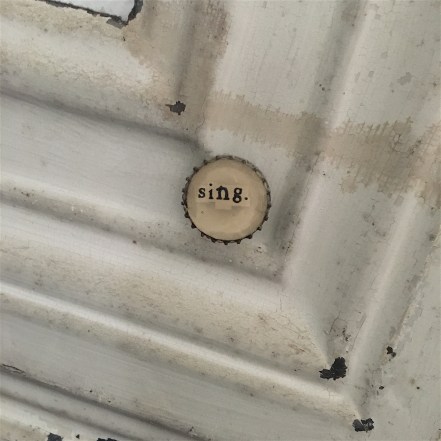
The story is famous in these parts. It goes like this: when I met Kerri I told her that she needed to know two things about me: 1) I don’t sing. 2) I don’t pray. She gave me a sideways knowing look and said, “Oh, that’s too bad.”
I had some very-traumatic-early-in-my-life-singing-experiences. Lots of shame and humiliation led me to an adamant preemptive proclamation with my musician-soon-to-be wife: I do not sing. No way. Don’t even ask. I’ll watch from the sidelines.
Of course, within a few months, she had me in a ukulele band, a choir, and a band. It turns out I like to sing. The problem, she taught me, was not in my capacity to sing, it was in how I hear sound. I hear an octave up. She taught me how to hear. I am now a confident parasitic singer (i.e. I sing just fine with others, just don’t ask me to sing alone).
I’ve spent my life teaching people to see. How beautifully ironic (or perfect) that I needed to learn to hear.
Early in the saga of Beowulf, he is caught in a swarm and blinded by bees. Because he was blinded, he had to develop other senses; his heightened senses were critical in combating and defeating the monster Grendel. Late in his life, he retired as a beekeeper. He not only made peace with bees, they become his allies. At the very end, his bees are his greatest strength. They defeat a dragon plaguing his kingdom.
The great stories are with us for a reason. They can help us navigate and craft our own life stories. For instance, the greatest wounds can be limits or they can lead to new and vital gifts. I’ve learned from Beowulf that the path you take – limit or liberation – depends on the story you argue for, the focus you choose. When I met Kerri I was arguing for my limitation. I do not sing. Period.
Another recurring theme in the great stories goes like this: when you are ready, the right teacher appears.
read Kerri’s blog post about SING

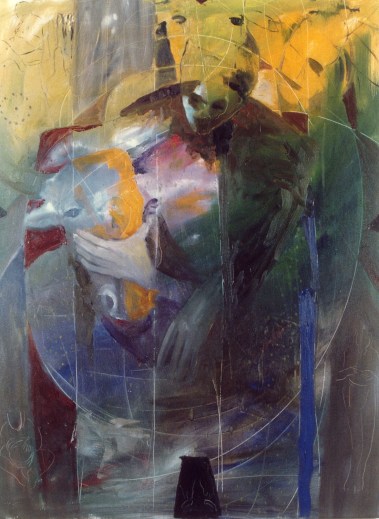
shaman ©️ 1993 david robinson
Filed under: Art, Creativity, Edges, KS Friday, Metaphor, Seeing, Story, Uncategorized | Tagged: bees, Beowulf, david robinson, davidrobinsoncreative.com, gifts, Kerri Sherwood, kerri sherwood itunes, kerrianddavid.com, kerrisherwood.com, singng, story, storying, strength, wound | 1 Comment »





 The Direction of Intention