


As I watched the curtain of grasses sway I thought they’d make an excellent set piece for a production of The Tempest. Their movement was hypnotic. I had the good fortune to design a minimal-budget-production of The Tempest several years ago and used huge pieces of driftwood and a bamboo curtain. I loved it.
The Tempest was on my mind because earlier in the day while doing some research I bumbled across the question, “Why is The Tempest a banned book?” The answer is a very sad statement about our times, the reason our nation cannot seem to mature: “The Tempest,” one of the playwright’s classics, is among the books removed, as teachers were urged to stay away from any works where “race, ethnicity and oppression are central themes,” the website Salon reported.
In our nation race, ethnicity and oppression are the central themes of our history: “246 years of brutal enslavement; the rape of black women for the pleasure of white men and to produce more enslaved workers; the selling off of black children; the attempted genocide of Indigenous people, Indian removal acts, and reservations; indentured servitude, lynching and mob violence; sharecropping; Chinese exclusion laws; Japanese American internment; Jim Crow laws and mandatory segregation…” (Robin Diangelo, White Fragility)
You’d think we might want to encourage teaching The Tempest and other great works so we might consider and discuss the full scope of our history. So that we might learn about ourselves. So that we might become capable of addressing and putting to rest the ugly fear – rooted in race, ethnicity and oppression – exploited for gain by the Republican party, that gave birth to the MAGA movement. It’s the Confederacy by another name.
In a nation of immigrants, you’d think it might be a first principle to teach our children about race, ethnicity, and oppression so we might learn how to reach across – and put to rest – division rather than perpetually recreate it.
The AI overview provided another related and currently more salient reason to teach The Tempest: “The main message of Shakespeare’s The Tempest is that forgiveness and reconciliation are preferable to revenge and punishment, especially when it comes to the restoration of social order and personal peace.“
If social order and personal peace are the goals, our current path of revenge and punishment will not take us there. In the play, Prospero chooses release from his island prison through the power of forgiveness and redemption rather than perpetuating his imprisonment by seeking revenge.
In this teachable moment Prospero’s choice is an analogy worth teaching: a path provided to us by a play written in 1610 by one of the greatest poets of the English language; a way out of our national-soul-imprisonment.
I suspect that is why The Tempest and other great works of literature dealing with themes-that-matter are being banned. In the minds of this administration, continued imprisonment, revenge and punishment seem to be the goals.
read Kerri’s blogpost about THE GRASSES

likesharesupportsubscribecomment…thankyou.

Filed under: DR Thursday, Identity, Transcendence | Tagged: artistry, banned books, david robinson, davidrobinsoncreative.com, ethnicity, forgiveness, history, Kerri Sherwood, kerri sherwood itunes, kerrianddavid.com, kerrisherwood.com, oppression, race, reconciliation, Robin DiAngelo, story, studio melange, teaching, the melange, The Tempest, white fragility, William Shakespeare |




 The Direction of Intention
[…] read DAVID’s thoughts this D.R. THURSDAY […]
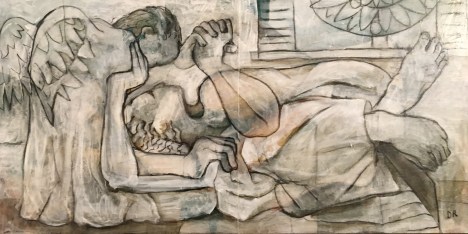
Your words, David, strike a chord. I am so relieved I never became a teacher in America. By the way, the last painting here is my favorite. Not even Picaso himself could have matched it for its vibrancy and color! -c
You are too kind (and I bet Picasso would disagree😂).
There was a time that teachers were allowed to teach and parents took responsibility for the behavior of their children – and the community ensured that schools were safe places…It’s truly sad how mangled its all become.