Exit The Circle

Mind Chatter

Mind Chatter

Jen came over today. She is taking a photography class and her assignment this week is to take pictures of people. She is working on mastering depth of field and introduced me to my favorite new term: circle of confusion (note: depth of field is also a great term but is less ominous!). I spent several minutes reading definitions for circle of confusion. This is the kind of stuff I encountered:

A lens cannot resolve a point exactly. Instead it creates a small circle of light called the ‘Circle of Confusion’ (from photoconnexion.com)

What does that mean? In my search for definitions of ‘circle of confusion’ I entered a circle of confusion! I kept digging and I learned that the term predates photography and originated in the study of optics. So, this is my stab at defining a circle of confusion for myself: my eye (or a camera lens) breaks an image into dots and the dots can never be completely focused. So, each dot is rimmed with a circle of light. In an image that appears to be completely focused, the light circle is very, very small so the dots are closer together and make a sharp image. In an image that appears unfocused, the light circle is large so the dots are farther apart, making a fuzzy image. This circle of light is called a circle of confusion, a blur circle, or a blur spot.

The greater the circle of light around the dot, the greater the potential for confusion. What a fantastic metaphor! The same concept applies to the imagination. I have friends who’ve always known what they wanted to become when they grew up. They had a sharp, clear picture of what they wanted to do with their lives. They imagined a clear, focused target-life. For instance, when I was in college, my best friend Roger knew that he wanted to direct plays and, more specifically, he wanted to direct plays at The Pacific Conservatory for the Performing Arts. Thirty years later, Roger has spent his career at PCPA directing plays. His actions were distinctly aimed at a very clear image-target. He did not spend much time wondering what he wanted to do with his life. Roger has lived with a smaller circle of confusion than most of us.

The metaphor could also be applied this way: If people were dots, the circle of light surrounding them would be their mind chatter. The greater the mind-chatter the greater the circle of light, the greater is the potential for confusion. Buck Busfield used to say of people with loud mind-chatter, “That guy has a big dog barking in his head.” The Buddhists call mind-chatter, “monkey mind.” A person with monkey mind is a person with a large circle of confusion; their dots can’t focus through the noise. Victim stories come with lots of mind chatter. So do blame stories or a fix-it mentality.

When we see and own our choices, we reduce the size of our circle of confusion. That’s how choice works. When we invest in stories like, “I have to…,” or “I should…,” stories that lead us to believe that we have no choice, we amplify our circle of confusion. Embracing our choices makes intentions clear. Embracing our choices clarifies our life-target. The noise in our minds quiets. It’s an equation: own your choices and your mind quiets. There’s less division in a mind that says, “I choose,” so there is less need for inner debate. If you want to exit your circle of confusion, start by seeing how vast is your capacity for choice.

Go here to get my latest book, The Seer: The Mind of the Entrepreneur, Artist, Visionary, title_pageSeeker, Learner, Leader, Creator…You.
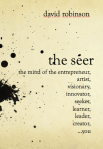
Or, go here for hard copies


Get Out Of Your Head

from my comic, FLUB. Don't ask why I think it belongs with this post...

from my comic, FLUB. Don’t ask why I think it belongs with this post…

When I was in school I was constantly amused and disconcerted by the disjoint between the arts and the academic interpretation of the arts. For instance, pick up any literary critique on the play HAMLET and you will read a lot of well-meaning but clueless intellectualizing on the inaction of the character Hamlet. And then, go to a rehearsal. Plays are about action. Hamlet is one of the most active characters in the canon. The play is essentially a detective story with the main character, Hamlet, trying to determine whether the ghost of his father is from heaven or from hell. He needs proof. Every action that he takes is to uncover the truth of his father’s death.

Yesterday I was witness to the arts/academic disjoint in person. A fantastic Christopher Wool retrospective is opening at the Chicago Art Institute. Kerri and I took the train in to the city to see the exhibit and attend a lecture by the curator of the exhibit. In a surprise appearance, Christopher Wool, the artist, took the stage with the curator. The curator was unprepared. She didn’t want him to talk. Over and over again she told him what his work was about and then asked him to confirm it. He was gentle with her and kind and contradicted her analysis. Five times she told us that his work was about self-annihilation (he makes gestural lines on canvas and then wipes them off) and he would counter by saying something like, “Well, actually, I didn’t like the line so I wiped the canvas but then I liked what was happening with the wipe so I left it.”[a long silence would follow]

She needed his work to have deeper, darker meaning. He is an artist in a relationship with his material and works intuitively. There was no intellectual meeting ground between her need and his work. Had she asked him about the greater meaning of his paintings (she didn’t) he might have said, “Well, what do you see?” As Joseph Campbell once said, “If an artist doesn’t like you, he’ll tell you what his work means. If he likes you, he’ll let you have your own experience.”

The curator needed the body of work to be sourced in the artists suffering. The artist did not suffer and, in fact, told us that his art was a form of play. In play, we assemble meaning (and the curator missed this fine point).

It finally came to this simple statement: Christopher Wool, the artist, stopped the curator in the middle of a lengthy pedagogical rant and said, “All this talk of process and technique! No one needs to know any of it.” He looked at the audience and continued, “I hope that when you see the work, that it engages you. I hope you have a relationship with the work.”

Artists know that the audience recreates the work. A work of art is never complete without the other, the viewer, who is not passive but becomes an artist in the moment of engaging. The viewer recreates the work anew, unique, and special to their eyes.

Go here to get my latest book, The Seer: The Mind of the Entrepreneur, Artist, Visionary, title_pageSeeker, Learner, Leader, Creator…You.

Go here for a hard copy

Where’s Your Safety?

from my Yoga series

from my Yoga series

Bill said, “People must make time to smell the roses.”

We were talking about the stories, specifically the stories we tell that become self-made prisons. “It’s never made any sense to me!” he laughed, “I’ve never been able to work for anyone because the whole mindset seems like madness. For instance, I just talked to a man who believes he must work at his job for three more years so he might have a better retirement. He hates his job!”  He added, “I have a dear friend that sat down after a game of tennis and died of a brain aneurism. We never know, do we?” His question was actually a statement and I nodded my head in agreement. It’s never made any sense to me to give away this day of life for an idea of life in the future.

“Why do you think people do that?” he asked. Social norms. Expectations. Fear. Stability. There are many reasons. There are many good reasons. We have to feel safe. I used to tell groups that a child can’t play unless he or she feels safe. To the man holding on for retirement, trading today for a possible tomorrow makes him feel safe and a safety story is a necessity in a culture that has forgotten community. Without a tribe, people must fen for themselves and the sacrifice they make is their autonomy. It’s a paradox. It’s a story.

Bill and I tell a different story. I’m a terrible employee. I have too many ideas. I like to change things. I do my best work late at night or very early in the morning. The middle of the day, the normal working hours, are down time. Fog time. I feel safe by breaking patterns and changing rhythms. I feel safe when I don’t know what is coming. I value presence and feeling alive much more than retirement. I do not know what retirement means because my job has never been a thing that I do. To retire means to die. I’ll certainly do that someday but I see no reason to save up for it.

My story, my path is no better or worse than the man who gives up his today for tomorrow. We both create our idea of security and live from a set of assumptions that define a good life. We both make sense – we make it. Sense is not found like happiness is not found. Both ensue.

Bill looked at me and said, “Maybe asking why people give away today for tomorrow is not the right question. Maybe the right question is, ‘Do they know that they are making a choice?”

Go here to get my latest book, The Seer: The Mind of the Entrepreneur, Artist, Visionary, title_pageSeeker, Learner, Leader, Creator…You.

Go here for hard copies

Make Sense

'John's Secret' by David Robinson

‘John’s Secret’ by David Robinson

Several years ago, decades in fact, G was driving his car. A young boy sprinted into the street in front of his car and was killed. To this day, G holds himself responsible. Even though it was an accident, he cannot forgive himself for the death of the young boy. He blames himself. Forgiveness is beyond his reach.

This terrible accident has become the defining moment of his life. Rather, his search for understanding why it happened and his refusal of forgiveness has shaped his existence.

He is a kind man. He is generous. He is devout. He is very old, walks with a cane, moves slowly, cares for his ailing wife, always smiles, He is generous with his time and his resources even though his resources are very, very limited. He sings. He prays. He listens. He asks, “Why?”

“What if I had left the house a minute later? What if I had left minute sooner? What if I’d decided to stay home? How could I have been the instrument of that young boy’s death? What could I have done…?” He suffers because, for him, there can be no absolution.

What do you do when there is no answer to the question, “Why?” What do you understand about your life and the forces of the universe when there is no sense to be made? What do we do when the experiences of our lives betray the sense that we’ve already made?

We do what we always do. We do what is most human: we make sense. We create order so we might not have to experience the chaos. We make statements in the form of questions: “What kind of God would let this happen?” or, “Why me?” There are so many things that we cannot control so somewhere there must be a bigger picture, a greater intention, a man behind the curtain, a reason why. We say to ourselves, “There must be a right path, a rule, a law, a design that we must follow.” It is something to ponder: why is our greatest horror to be out-of-control? What if we danced with the mystery rather than tried to contain it?

“To understand” is a form of the control illusion. Do you believe you need to know how to do something before you do it? You don’t but without the control-illusion of “how” you’d come face to face with the reality that process is chaos. Chaos is uncomfortable. Things happen. Order is something that is made after the fact. “There must be a way!” “There must be a reason!” There is always a way but you won’t know it until you walk the path and turn around to see it. There is always a reason, but you create it. It is not given. Order feels good.

And, it is necessary. Giving order to our chaos, telling a story, is what makes us human. If you could boil my work in the world down to a single phrase, it would be this: we have experiences first and then we make meaning, not the other way around.

We make meaning, we contain to infinite, through the stories we tell. The choreography of the human dance happens between the poles of “no sense to be made of the mystery,” and “the need to understand why.” G is making sense of his life. I am making sense of my life. As are you and everyone you meet today.

[to be continued]

Go here to get my latest book, The Seer: The Mind of the Entrepreneur, Artist, Visionary, title_pageSeeker, Learner, Leader, Creator…You.

 Go here for hard copies

Take The One Action

a work in progress. I'll call it "Salutation"

a work in progress. I’ll call it “Salutation”

It is true that, at the end of the day, we are our own best obstacle. Nothing is better at blocking meaningful action toward a dream than our personal story of doubt and fear. It comes in many forms, like, “Who am I to think that…,” or “If I only had some time I’d…,” or “If I only knew how to start, I’d….”

Lately, I’m fascinated with a specific form of the best-personal-obstacle canon: why do we take any action EXCEPT the one action that matters. For instance, I hear often statements like this: “I want to be a writer, but….” Anything following the statement of desire is a self-generated obstacle. There’s not enough time. No one will like what I write. Fill in the blank. The single action that matters is to write. Sit down and write. That is how one becomes a writer. And, if the writing happens everyday, one will become a better and better writer. Anything else is a well-placed, self-generated obstacle.

The question is, “Why do we need our obstacles?” What does placing a boulder in the road do for us? There is an obvious answer: it keeps us from the scary prospect of fulfilling our dreams. Fulfilling a dream requires showing up and expressing a personal truth. Personal truth is, well, personal, and will always meet resistance because there are billions of personal truths walking around out there.

The refusal to take the single-action-that-matters applies to the everyday. How many times have you swam in a pool of overwhelm rather than pick up the phone and make the call that you know you need to make? Once, when I ran a theatre company, I knew I needed to fire an employee but I didn’t want to do it. She was a nice person. She wasn’t doing her job. We had countless meetings discussing why she wasn’t taking the one single action that mattered (doing her job). And, so, I didn’t take the one single action that mattered (letting her go). When I finally mustered the courage to fire her, she thanked me. She wanted to do something else with her life but didn’t have the courage. When I fired her, I pushed her out of the nest. I became the circumstance that pushed her into the one action that mattered.

I think that’s the point of not taking the one action that will actually matter. We allow circumstance to decide for us. We delay until the bill collector comes or until the boss fires us or until we are sitting in a rocking chair telling the story of why we never had time to write. If only….

Go here to get my latest book, The Seer: The Mind of the Entrepreneur, Artist, Visionary, title_pageSeeker, Learner, Leader, Creator…You.

Go here for hard copies

What’s The Question

Sand SpiralThese were my questions from the day:

What is the difference between a very strong snowstorm and a blizzard?

What is the difference between a purpose driven life and a passion driven life?

What does it mean to the quality of a lifetime if you begin with the end in mind?

Isn’t the end we have in mind nothing more than something that plagues a mind – isn’t it a story? And can I really ever know the end?

Who cares?

Why is “not knowing” so scary for people?

Why is caring so scary for people?

Why is speaking truth so difficult to do?

Whose truth?

Have I always been on a pilgrimage? If so, why did I only now just realize it?

What does it mean to release the past? Why would I assume that today was going to be like any other day? Why would I assume that I know what is going to happen today just because I have things jotted on my calendar? How many miracles have I missed because of my assumptions?

Gary the waiter told me that during the Olympics, everyone becomes an expert at things that they really know nothing about. Isn’t this same principle always true?

Ann is in the final stages of cancer. I wonder what her questions were today?

Go here to get my latest book, The Seer: The Mind of the Entrepreneur, Artist, Visionary, title_pageSeeker, Learner, Leader, Creator…You.

Go here for hard copies

Know Your Why

Mark Seely's gift to me: A Wordle of my blog

Mark Seely’s gift to me: A Wordle of my blog

This morning I had another world-class call with Skip and Barney. I could populate a year’s worth of posts from our conversations. I treasure these two men. They feed me and keep me connected to a deep, rich river of curiosity and questioning. They challenge my thinking and shake my perceptions.

We meet weekly on a conference line to discuss Skip’s upcoming book, Emails To A Young Entrepreneur. It is a remarkable book and since Skip is the consummate student of life, our calls, although on the surface are about the book, in truth dive into matters of essence and heart and meaning-making.

Skip told a story of working with student-entrepreneurs. He provided them with an experiential process that helped them see, if only for a moment, that their business is different than their product. This might seem like an easy concept to grasp; a Big Mac is not the business of McDonalds, however entrepreneurs and small business owners consistently confuse their idea, their product, with the business. It’s a confusion that leads down the path to ruin (in the world of education, the parallel is to confuse test scores with learning).

In our business-product conversation, Barney offered this phrase that I love: the energy of “why” is different than the energy of “how.” How I make art is a remarkably different question than why I make art. How I do business is a remarkably different question than why I do business. How I walk this earth is a remarkably different question than why I walk this earth. Peter Block, in his book, The Answer To How Is Yes, reflects that in a lifetime spent helping businesses grow and fulfill their potential, that not once did the organization start with the question “Why?” They were invested in “how” and, therefore, blind to the actions that might help. They were frozen with the notion that “how” was something they needed to know before they took action. In fact, what they  needed to know prior to action was “why?”

The north star of action is always found in the question, “Why?” How is a matter of taking steps without knowing the end (just like life). Know your why. Take a step. Live in the life-giving energy of why, take a step and call it “how.”

Go here to get my latest book, The Seer: The Mind of the Entrepreneur, Artist, Visionary, title_pageSeeker, Learner, Leader, Creator…You.

Go Here for hard copies

Meet The Shadow

SHADOW[I bumbled into an old bit of writing and reworked it a bit; an old post becomes new]

“The artist’s vocation is to send light into the human heart.” George Sand

The first of the Four Noble Truths of Buddhism is that all of life is suffering. In this context the predicament of the artist is no different than that of a plumber or a president though I’ve yet to find a plumber who considers suffering necessary to his or her vocation. With artists, suffering seems to be a prerequisite. Why do artists think they need to suffer or believe that suffering unlocks the door to their artistry?

The healers in Bali are mostly artists and they believe their healing powers come after a wound. Suffering, they believe, the wound, opens them to a greater perception; it opens them to new powers. Suffering helps them walk into and get comfortable with their shadow. They learn to cease resisting their shadow and to make peace with it.

As a nation we do not easily walk into our shadow. One of the roles of “artist” is to go where others choose not to go. A walk into the shadow may be uncomfortable but it is equally as liberating. An artist is supposed to see what others cannot and sometimes that is painful. An artist may act as a bridge between worlds of perception, living on the edge of the village, traveling into the netherworlds to retrieve a truth or a lost soul. This at times may be solitary or scary but it is always transforming. An artist rarely “fits” the social norms – and sometimes that is disconcerting – but always serves the health and growth of the pack.

Artists walk into the shadow of their tribe and return with greater vision, insight, and guidance.

I love shadows – literally and metaphorically. Most stories are about people walking into their fears and fears always lurk in the shadows. Shadow work leads to an inevitable realization: you create the fear because you are the teller of the story. Recognizing that you are the teller of your own story, the interpreter of your experience, is great for releasing shadows. The walk through the shadow lands always leads to the heart and, at the end of it all, isn’t that what artistry (or life) is all about?

Go here to get my latest book, The Seer: The Mind of the Entrepreneur, Artist, Visionary, title_pageSeeker, Learner, Leader, Creator…You.

Remember Your Trick

Tennessee TripperDog-Dog-Dog

Tennessee TripperDog-Dog-Dog

The newspaper is using words like “biting” or “frigid” to describe our current temperatures. My favorite was this morning’s weather paradox: sunny and bitter. Sunny and bitter sounds like an umbrella drink I might order at a Tiki bar or a perhaps a comedy team. If I had twins I’d name them Sunny and Bitter.

After standing on the deck for several minutes, making sure that the arctic winds blowing off the lake had subsided, Tripper-dog-dog-dog and I took a walk. Certain that we would not be cut in half by the wind, braving the sunny-bitter paradox, we high stepped through the snow drifts, stretching our faces to reach the sun. It was glorious. It was not as advertised: sunny, not bitter.

It had been more than a few days since we could venture out and Tennessee Tripper-dog-dog-dog was eating the baseboards, chewing on cabinets, and pacing from door to door. We’ve been teaching him tricks to keep him occupied but he’s a fast learner and mostly bored with “stay” and “shake” and “roll over.” When I realized that I was pacing door to door with dog-dog-dog I knew that advanced cabin fever was setting in and we needed to run (he runs and I watch but it sounds better if I use the royal we. I like making you imagine that I am fit and running through the arctic snow with the dog-dog).

As I stood in the field, face to the sun, watching him romp and run, I had one of those moments that I am certain will appear in the slide deck that will move through my mind’s eye at the moment of my death. All of my stories dropped away; all of my senses flung wide open. There was the cold air and the warm sun and the sound of Trip leaping and playing in the deep snow. There was the sound of ice clacking in the lake, squirrels cursing in the treetops.  I had no past and no place to be. I had no cares or desires to distract me. I was present. I was there, fully alive.

I think Tripper sees those moments. The Dog Whisperer tells us that dogs are energy sensors and I’m convinced Trip sees my aura. During my moment of presence, he stopped his romp and we stared at each other. If he could talk, he’d have said, “Finally! I was beginning to doubt that you’d ever get this trick. Want a cookie?” I smiled and as if to prove a point, Tripper-dog-dog-dog sat as if by command. His eyes glistened, saying to me, “I remember my trick, will you remember yours?”

Go here to get my latest book, The Seer: The Mind of the Entrepreneur, Artist, Visionary, title_pageSeeker, Learner, Leader, Creator…You.

Get hard copies here.

Step

'Hope and Prayer' by David Robinson

‘Hope and Prayer’ by David Robinson

I’m in a “life is funny” phase. It is as if the universe is hammering me with this theme: you do not need to see the big picture. You do not need to see the plan or even have a plan. You simply need to take the next step that you see. The next step need not make sense.

Do you remember the scene in one of the Indiana Jones films when Indiana has to take a step that looks as if he was going to step off a cliff and fall into the abyss? What he sees is in direct opposition to what he knows he needs to do. How often does life send us that conundrum! He saw an abyss but knew he needed to take a step anyway. He stepped and an invisible path became visible.

Take the step BECAUSE it does not make sense.

On Sunday, Pastor Tom asked his congregation, “Is your faith by default or by choice?” He told the story of the Roman nobleman whose son was dying. None of the doctors of the day could help the boy so in an act of desperation, the man walked two days to find the magician/healer named Jesus. As Pastor Tom said, this Roman nobleman had the best healthcare plan available and nothing was working; in the absence of science he turned to faith. Of course, we know the rest of the story: the magician/healer told the nobleman to go home. He told him that his son would live. Remember, it was a two-day walk so the question is this: during those two days walking home, did the man have faith or did he want to have faith? In other words, did he need proof to have faith? Did he rush home to see if the magic worked? When he arrived home and found his son alive and well, did he cancel his healthcare policy? What would you do in a similar situation?

Take the step BECAUSE sense-making has nothing to do with it.

Last week Diane wrote a great comment about “knowing” from my previous post, Stand With Hope. She wrote, “…it makes me think about the definition of knowing. I am seeing that, for me, it is not about knowing an answer (like I know that 4 x 4 = 16), but knowing my self and being present with what is happening, and trusting the inner impulse to respond and act. I think this is standing in hope, but for me hope is uncertain faith. But then, when I’m short on faith, I guess I can hope to have hope.”

Take the next step BECAUSE you trust your inner impulse to guide you.

In other words, step because if feels right. Sense-making is a function of the brain. Stepping while uncertain is a matter for the heart. Sense-making is something that always happens after the fact. The next step need never make sense. It does need to make heart.

Take the next step BECAUSE it is what you must do.

Go here to get my latest book, The Seer: The Mind of the Entrepreneur, Artist, Visionary, title_pageSeeker, Learner, Leader, Creator…You.

For hard copies, go here