

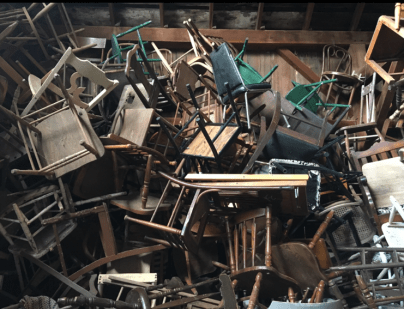
The first time we visited Hippie Tom’s Serendipity Farm, Kerri said, “It’s like being inside someone’s disease.” The farm is a hoarder’s dream. Stuff piled upon stuff. Stuff packed into corners, hung from rafters, tucked under shelves. Most of the stuff is exposed to the heat and cold, rain and snow. Having the stuff is more important than the caring for the stuff, a 3-D philosophical statement. Certainly there are treasures to be found, curiosities that are heartier than the mildew and rust or perhaps have not yet been on the farm for a cycle of seasons.
In the barn there is a room for chairs. Chairs stacked to the ceiling though I use the term ‘stacked” loosely. Piled, perhaps. It reminds me a scene post tsunami, what remains after the waters have retreated. The artifacts of lives-now-gone. It would be a brilliant set for a play, metaphors abound. The sickness of acquisition. Or, perhaps it is not sickness so much as the inevitable destination of stuff after the story connection is lost.
The power of story. The value is never in the stuff, it is in the shared narrative invested into it. A diamond has no value without people to appraise it.
Once, I visited Georgia O’Keeffe’s home and studio in Abiquiu, New Mexico. It was spartan. And I loved it. A few chairs. And, oh-my-god the paintings. The view and vibrant connection to the natural world. It was like being inside someone’s happiness. So many years after her passing it felt alive – a place of life. That’s my appraisal.
Hippie Tom loves his farm, I’m sure. As for me, I think I’d rather walk the path with Georgia. Less stuff. More life.
read Kerri’s blog post about STUFF

Filed under: Flawed Wednesday, Metaphor, Story, Uncategorized | Tagged: accumulation, appraisal, david robinson, davidrobinsoncreative.com, disease, Georgia O'Keeffe, happiness, Hippie Tom, Kerri Sherwood, kerrianddavid.com, kerrisherwood.com, metaphor, story, studio melange, stuff, the melange | Leave a comment »





 The Direction of Intention