Truly Powerful People (5)

Join me in inspiring truly powerful people. Each day I will add a new thought, story or idea to support your quest and mine.

5.

Truly powerful people inspire true power in others without really trying.

They arouse, encourage, enthuse, motivate, stir, stimulate, invoke,… because they are not protecting anything, they are not shielding themselves against what others might see or think. They have no fear of being discovered because they have no doubt of the authenticity of their intention or motivations. They are open and available without being vulnerable to danger, real or imagined.

They are not at war within themselves so they have no need of warring with others. Imagine who you might become when you at last step off the field of battle?

Be Human

photo by Wonderlane

Judy and I were approaching the crosswalk on the far side of the Town and Country Market. We had coffee in hand and were heading to the park across the small avenue en route to the harbor to sit and talk. Judy is one of my favorite people, full of laughter and learning, and my opportunities to see her are rare and precious; I want to hoard every minute with her. A blue station wagon with a forgotten six pack of beer riding on the roof of the car, turned right out of the lot and the six pack, lacking fingers or suction cups, could not make the turn, took flight and exploded in a foamy mess, littering the crosswalk with shards of glass.

Like the many pedestrians and park-goers present for the explosion, I was thinking only of myself (after all, I was in hoard-my-time-with-Judy mode) so I pretended not to see the mess or the distressed station wagon driver that had pulled over after realizing that her beer never made it into her car. Judy was also thinking of herself but unlike the rest of us, her definition of herself includes being an active, responsible member of a community. “Can I help you?” Judy asked, handing me her coffee as she walked toward the station wagon. I was already across the street heading toward the harbor completely unaware that I now had two cups of coffee in my hands. The woman’s response to Judy stopped me in my tracks. She said, “Thank you for being so human.”

I turned around, set the coffee on the curb, and helped Judy and the woman pick up glass. Judy flagged down a city truck (she wanted a broom and, of course, the next vehicle to come along was a city parks truck with every tool known to human kind). Within a few minutes, the glass was swept up, the crosswalk was safe for crossing, and the woman, the park workers and I went our separate ways each feeling better about our selves and the world. More importantly, a playground full of children watched and I assume they, too, on some level, felt better about the world. All that was required for this bit of feel-good magic was for one person, Judy, to be human.

Her very small gesture comes with an enormous impact. Her ability to “be human” opens others to be human. Her capacity to engage generates engagement. This is why I love Judy: I become more myself when I am with her because I open to the relationships around me, the unpredictable, the uncontrollable, scary potential that comes from saying things to strangers like, “Can I help you?” Life becomes simple when engagement rather than denial or resistance is the rule. Time becomes less important than relationship (which guarantees that “time” will be meaningful).

Because her definition of herself includes being responsible to her community, Judy is incapable of pretending that the naked Emperor is wearing a new suit of clothes.   She knows that her quality of life is directly related to the quality of life of all the members of her community. If there is something to be done, rather than ignoring it or expending copious amounts of energy blaming others or complaining about it, Judy acts on it. She lives in choice. She knows that community is not a fixed thing but a relationship and requires all the commitment, tolerance and dedication that powerful relationships deserve – it is messy and it’s hers to do.

We met at Antioch University many years ago. In those years I used to play a game with myself that went something like this: how long will I be on campus before I cross a pod of students raging about the lack of community in Seattle and the United States in general. Once, I went a full 18 minutes before I found the pod. They always made me sad, these students who were so lonely living in a metropolitan area of over a million people. Each pod looking for someone to blame or someone to fix their loneliness, ranting against the evils of the modern world. My friendship with Judy has helped me understand – helped me believe – that no major intervention is required, no legislation or new law is necessary for we, the occupants of red states and blue states to experience ourselves as a community. Ultimately it has very little to do with anything other than cultivating the capacity to step toward someone and ask, “can I help you?” And, like Judy, over time this practice of engagement might eventually lead to a definition of self that includes the health and well-being of the community; or, at the very least, more experiences of being human.

See Like Celeste

“The life of every man is a diary in which he means to write one story and writes another, and his humblest hour is when he compares the volume as it is with what he vowed to make it.” James Barrie

Celeste died last week. Megan gave birth to her first child, a daughter. Stephen graduated from high school. Sally had a life changing epiphany. Dado brought the mail as he does each weekday; you can set your clock to Dado yet he always seems to have plenty of time to talk. Bruce came to visit after a seven-year absence. Tess had her teeth pulled and then had a birthday. Lora sold her first photograph in a gallery. And then her second and her third. Amy shared her poems and also shared a dream. Pete made a collage and had it printed; he’s making a portfolio, his first. Harald and I each drank a Stone and later split an Arrogant Bastard. And that was before dinner. Lisa took a vacation, a trip with her son. She will marry Harry in July. Don walked to the bank on the first sunny day of the season. Arnie returned from travels abroad and left a message on the machine. Dane had a conversation with his friend Brian, a mechanic. They have rules about what they can talk about: no politics, no religion, no talking about wives. Tania and Chan bought their first house. Kate sent a hilarious limerick. Lorilee shared photos of her green wall. Gwyn wept. Rosemary and Lona sent poems for the tribute Judy was assembling. Carol resurfaced. Scott asked for advice. Mark prepared his ship for Alaska (seriously) after he went to drawing class. Makaela wore a dress to the opening of the museum she helped create. Patti wrote an obituary, prepared a eulogy, and helped Nina live more comfortably – all in a single day. Joe walked by the tide pools and laughed with delight. Stephen (another Stephen) rolled his paintings out for us to see; he had fire in his eyes. Nicole brought chocolate and shared it! Ana went home and faced her demons. They were not as big as she remembered. Theresa knew what coffee to make before I even ordered it. Made brought popsicles and comfort. Class met and embodied a purpose. Sue offered her thoughts. Kendy asked for prayers for Max. Max had surgery on his heart. We bumped into Diane in the hospital, to our great delight as we’d lost touch with her. Kathleen is off-loading the stuff of her life. Her sister came to help. Liz has a new garden. Duncan drank really good coffee and watched his first episode of LOST. Joyce interviewed Alan and is looking for others to interview. John is designing and building furniture for a restaurant because he’s never done it before. Beau catered a meal for 300. Margaret got lost in her thoughts. Ken sent his congratulations.

I could go on and on and on. This list barely touches the marvels of this week.

Celeste died quite suddenly. She was 82. Because she was so alive her death at age 82 came as a shock. She taught me that James Barrie had it all wrong. I think she would have rewritten his quote this way:

“The life of every person is a diary in which we mean to write one story and write another. Our humblest hour is when we realize the story we meant to write is not nearly as interesting as the story we actually lived, if only we had the eyes to see it.”

Celeste had the eyes to see it; she savored it – each and every moment. If you had met her, you’d have found yourself savoring a bit of life, too. Her enthusiasm and present-focus was infectious. Like me you’d be making a list of all the little moments and the big that happen each week in your life, a practice to remind yourself that the value of your life is not in the Academy Award that you may never win, it is in the relationships that that you probably discount; it is in the present moment that you miss because you are flailing yourself for not being something or somewhere else.

In response to my question, “What do you bring?” this is how Celeste replied:

“I bring a willingness to be open to whatever excitement is waiting!  I look into the eyes of each person I see, and have my arms ready if a hug is appropriate.”

Yes. That’s it.

The Polar Bear King (Part 4)

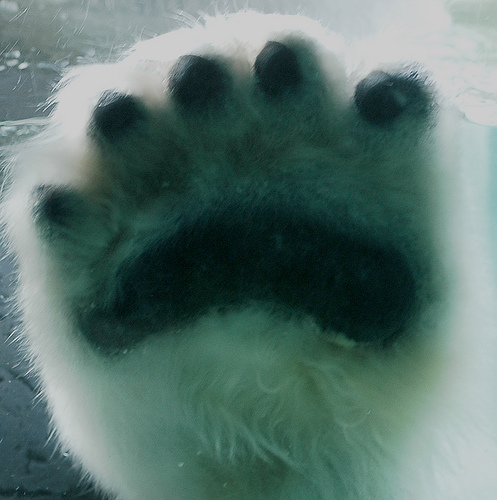
Polar Bear Paw by ucumari

Stories come to a conclusion when balance is restored to the main character. Sometimes that means a return from a journey, sometimes it means that a significant choice is made, sometimes it is a reclamation of something lost; always it means the character learns something and will never be the same because of the new knowledge. And hopefully, it also means we, the listener of the story, will know what to do in our lives when we are off balance and staring Doubt in the face.

Here’s the final chapter of the Polar Bear King:

IV. THE RETURN

One day passed. Then two. The great bear paced back and forth, looking south, awaiting the return of his great coat. How could he defend his crown without it? He paced and he paced and the third day came. The hundred gulls still had not returned with his skin.

All of the polar bears gathered outside the king’s cave. The time for the match was at hand. Woof was with them. He stamped around and boasted, saying “The bird-bear’s feathers will fly fast enough when I get my claws on them! Come out of your cave, bird-bear!”  All the other bears laughed and jeered. “Perhaps he is really a chicken-bear!” Woof shouted. The bears roared with laughter and snorted their delight.

Inside the cave the great king sat listening to their laughter, the gull queen perched by his side. “I don’t know what to do,” The king confessed.

The queen sighed and said, “It’s too bad that it is your skin that makes you a king. If your skin were here, we could ask it what to do!  As for me, I am only a bird. Covered in feathers, like you.

The Polar bear king looked deeply into her black eyes.

“Well, what would the King of the Polar Bears do?” the gull queen grinned.  The bear smiled, stood tall and ruffled his feathers, just like a bird would do, so that he appeared twice his normal size. “How do I look?” he asked the gull queen. “Like a king.” She smiled.

“Come out bird-bear!” Woof snorted. “Come out so I may pluck your plumes!”

The king of the polar bears walked slowly out of his cave, he was magnificent and proud, his white feathers glistened in the sun. Woof gulped. The king of the polar bears was enormous; he looked twice his normal size. Perhaps fighting this king was not going to be so easy after all. Perhaps fighting this king was silly! In fact, fighting this king was probably stupid! All the bears saw Woof shaking in fear – and then they started quaking because when he was done with Woof, he’d crush them all for sure!

The Polar Bear king gave an enormous growl and Woof’s little heart, for a moment, stopped beating. “Come, pluck my feathers if you dare!” the king snarled! Woof gulped. The king strode forward and raised his mighty paw, ready to strike Woof a deadly blow. Woof yelped and covered his eyes; he knew this breath would be his last. In his fear, poor Woof wet himself. Shivering, Woof cowered helpless in a bank of yellow snow.

The great king lowered his paw. He’d won without striking a single blow. And all the other bears, wanting to be back in the good graces of this most powerful king, laughed at poor Woof; they pointed and called him names like “Baby bear,” and “Pee-bear.” Woof hung his head low.

The great king roared and stopped them from laughing. He looked at them with piercing black eyes. Finally, shaking his head he said, “You shame yourselves by heaping shame on this bear. A moment ago this Woof was your champion. He was your friend.  Why do you choose now to hurt him when he most needs your support?”

Just then, the sky grew dark as hundred gulls flew down from above carrying the king’s great fur skin. They laid it at his feet and formed a perfect circle around him. The gull queen smiled and circled from above.

And all the polar bears saw that they’d made a grave mistake; a bear’s courage is not in its fur. They bowed low to their great polar bear king as he gathered his great coat. He looked to the queen of the gulls, winked a “thank you” and smiled. And then, she saw him, ever so slightly, go (clap, clap, shimmy-shimmy shake) and as he went back into his cave, he said, “Oh, yeah!”

Meet Beneath The Boardroom Table

“A single event can awaken within us a stranger totally unknown to us. To live is to be slowly born” Antoine de Saint-Exupery

Sam is an extraordinarily gifted facilitator and coach. His specialty is helping corporations have hard conversations. Let’s face it, people in organizations are no better than people in other forms of relationship at having difficult conversations. Like the rest of us they don’t want to feel uncomfortable so, when discomfort looms, they chatter, that is to say, they avoid, deny, pretend and ignore their distress. When their dis-ease swells to the point of silence, they call Sam.

One day Sam was working with an executive team at a multi-national corporation: people in power suits seated in high-back genuine leather chairs around a larger-than-life, acres-long, mahogany and oak boardroom table. And, although the coffee was served in china cups, the fruit plate was fresh and aesthetic, his clients paid no attention, employing every avoidance strategy in their arsenal: blackberries were clacking and cell phones were binging, assistants were beckoning; status toys are fantastic tools for avoidance. Sam tried everything in his arsenal to crack their citadel of “professionalism.” “Professionalism” is a favorite ruse of businesses to avoid meaningful contact:  under the guise of “professionalism” business folk posture and pretend that they are not comprised of people in relationship; they will, if pushed, cop to being ‘people’ as long as the definition of ‘people’ includes 1) compartmentalizing themselves so that their feelings do not interfere with their powers of reason (thereby rendering themselves less than human), and 2) pretending that they believe #1 is actually plausible; you know, “business is business,” “nothing personal,” and so on. With relationship comes responsibility and responsibility is the last thing most businesses want (the legal department has cautioned against it). To have a meaningful conversation, especially a difficult one, even “professionals” must first entertain the possibility of entering into a relationship. Do you see Sam’s dilemma?

After a morning of extreme executive evasion, in exasperation, Sam did the unthinkable. While the team yammered on about anything other than what they needed to discuss, Sam ever so slowly slid out of his leather power chair until he disappeared from view beneath the table. In the shocked silence that followed, Sam watched all the executive legs fidget until finally one curious face peaked beneath the table. Sam waved and motioned for that person to join him. Then another face, looked. Sam and his new ally waved and motioned and that person slid under the table, too. One by one, all of the power suits slid under the table and joined Sam, leaving their status toys behind. When they were all “under the table,” Sam whispered, “Now that we’re under the table, can we finally begin talking about what’s really going on in this organization?” They laughed together and began a very difficult and honest conversation that addressed the real issues impeding their growth, a conversation that included their feelings.  They left behind their individual stories of blame and victimization and began the process of creating a new narrative together, a narrative that included the possibility of feeling discomfort.

When Sam slid under the table, he cracked their masks of professionalism, neutralized all the roles being played, and removed for a while the status games being waged so that his clients, a group of people in relationship, could reach beyond their compartmentalization and grasp what was personal and relevant about their challenges and their lives. He made them aware of the destructive story they were playing and helped them imagine themselves playing a different story, one that included support and collaboration along with competition and success. I imagine the old story was lonely to play so the new story must have come as somewhat of a relief.

I think of Sam slowly sliding beneath the boardroom table every time my courage fails me and I think I “should do” something “because that’s what is expected” or “it’s the way things are done.” I think of Sam every time I cast a group I am about to engage in the role of “enemy” or convince myself that “they” will meet me with resistance. Any time I stereotype a person or diminish another’s point of view (or my own), I imagine myself sliding down my high-backed red leather chair, surrendering my status, and slipping into the unknown beneath the power table because that’s where the shoes can come off, the collars unbuttoned, and the humans – uncompartmentalized, vulnerable, and responsible to each other – can see beyond their dramas and find each other again.

The Polar Bear King (part 3)

Forgotten by (SD)

There is always a point in a story when the known world collapses. It is the moment when all of your superficial attachments fall away, when everything you thought you knew or believed is called into question. In many stories you leave behind all that you know (home) and journey to the place from which no one returns (where the monsters live). When you are living your passage story this place is often experienced as doubt (where the monsters live).

Within a caterpillar’s body, once cocooned, there begins a war between the known and the imaginal cells  – so called because these cells hold the encoding for the new form: butterfly. The caterpillars body reads the imaginal as a cancer and kills it back which only serves to make the imaginal stronger. Eventually, the imaginal cells overwhelm what is known and the caterpillar’s body dissolves to mush. This “mush phase” is the place of doubt and is as necessary to our transformation as it is to the caterpillar if it is to become a butterfly

Form-less-ness is never comfortable but as the old adage says, “you must lose yourself to find yourself.” This is how the Polar Bear King loses himself:

III. THE NECESSITY OF DOUBT

The two young polar bears ran from the king’s cave, laughing so loud that the other bears gathered to hear what was so funny. “Our great and mighty king has become… a bird!” they guffawed, “Who ever heard of a polar bear covered in feathers!”  In disbelief all the bears ran to see their king. They thought it must be a trick or a game but then they saw him and, sure enough, he was covered all over in feathers. They laughed and pointed and slapped their thighs in delight. They made bird sounds and flapped their big bear arms, running in circles around him.

The polar bear king sat in silence, his head lowered so they could not see the sorrow in his eyes.

Later that day, all the polar bears decided to have a meeting to discuss the great change that had come over their king. “He is no longer a bear,” said one. “He’s not a bird, either,” cried another. “He is half-bird, half-bear,” cried a third! And then a bear in the crowd shouted, “If he isn’t a bear then he is no longer fit to be our king!”  They all cheered and then grew quiet.

“Who shall take his place?”

“He who can defeat the bird-bear in battle will be our king. It is our custom!” said an enormous bear named Woof. “Only the strongest is fit to rule and I am the strongest bear here!” Woof stomped about and flexed his muscles.

There was silence for a moment and then all the bears nodded their assent. “It is our custom. You will fight him for surely now that he is a bird-bear you are the strongest of our race. Woof will be our king!” they all cried. So they sent a messenger to the Polar Bear king, telling him of the challenge, he must master Woof or resign his sovereignty. The match was to be fought in three days time.

The Polar Bear King was very sad. “Perhaps they are right, perhaps a bear with feathers is not a bear at all.”

“Perhaps.” Said the Queen of the gulls. She was hovering above him when the messenger came. “Perhaps they are wrong.”

“Only a bear with hair can hope to command their obedience,” snarled the King.

The queen of the gulls chuckled. “Oh, I see. Is it your hair that makes you strong? Is it your hair that gives you courage?

“You don’t understand!” growled the bear.

The gull queen sighed, “My friend, did you also lose your wisdom with your hair?” And then she said, “ I met an eagle yesterday that had just returned from the lands in the south. The eagle, while flying over a city, saw a huge big polar bearskin in the back of a carriage that rolled along the street. It must have been your skin. If you wish, I will send a hundred gulls to retrieve it for you.”

The great king jumped to his feet. “Are you sure? Can it be? Oh, please, send them now! Send them for me!” the great king pleaded. “I must have my skin before the match in three days time. Without it I shall be defeated.”

With a flick of her wing a hundred of her best gulls shot to the sky, straight as an arrow they flew to the south. “They will not disappoint you,” she said. (to be continued)

Step Out Of The Fog

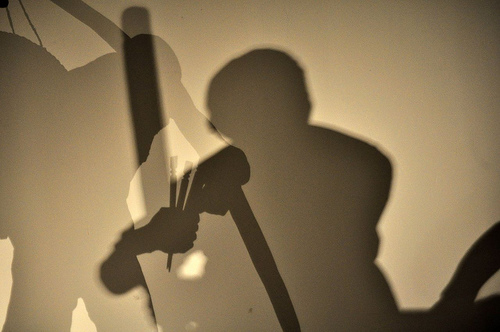
Shadows Of Imagination by Maggie's World

We are hardwired for story. We can’t help it; it is what we do. We interpret, we judge, we speculate, we remember, we ponder, we investigate, we justify we imagine,…we story. Meaning-making and interpretation are processes of story. We narrate each moment of our lives. I call this the-story-you-tell-yourself-about-yourself.

The-story-you-tell-yourself-about-yourself is often hard to see because, well, you don’t see it as a story.  It’s your life and you are so used to the inner-narrative that you stop recognizing your self as the narrator/interpreter of your life. Your thoughts, judgments, comparisons, expectations, investments, aspirations and fears are your story. As much as you want your point of view to be fact, it’s not. It is truth relative to you but not to anyone else. These stories you tell do not exist outside of you; they are your creation. Don’t let anyone tell you that you aren’t creative! We are, each of us, masterful storytellers.

Neil Postman writes,”Our genius lies in our capacity to make meaning through the creation of narratives that give point to our labors, exalt our history, elucidate the present and give direction to the future. To do their work, such narratives do not have to be “true” in a scientific sense…. The purpose of a narrative is to give meaning to the world, not to describe it scientifically.”

It’s when we confuse our story for truth that we get into trouble. There is an image that I love from the story of Sisyphus. It illuminates both the power and the problem of this inner storytelling:

Sisyphus has been taken to the underworld. He’s in trouble for making the gods look bad – twice. He has crossed the river Styx but isn’t yet allowed to get out of the boat. He has to wait and while he waits, he watches all the other souls file off the boat and mingle on the banks of the river. He is stunned when he realizes that each soul is so invested in their story that they don’t realize they are surrounded by other souls; even though they are in a crowd, each believes they are alone. Their story wraps around them like a blanket of fog, their inner chatter obscures them to the presence of others.

The-story-you-tell-yourself-about-yourself becomes an especially thick fog when used to belittle the teller (you). Using your story against yourself is guaranteed to isolate you. It is hell. Stories of “I’m not good enough” or “I have to be perfect.” Stories of “I am racing to get there,” stories of “past shames” and “future fears.” Stories act like a dense fog when they swirl around you and pull your focus from the present moment.

The lesson I most appreciated in art school came during the first class of the first semester. The professor, a short burley man who wore a walrus mustache and smelled of pipe tobacco asked us to examine a yellow #2 pencil. His simple question made us roll our eyes, “What color is the pencil?” We groaned and yawned in unison, “Yellow!” and acted as if the poor man was daft. He asked us to look again, to really look. He challenged us to see what was there and not what we thought was there. When I looked again, really looked beyond my thinking, I saw an explosion of color, reds, greens, and purples. I saw beyond my abstraction (story) and what was before me came to life. It was a festival of light and shadow all dancing in the form of a #2 pencil. For a few moments I suspended my story; I saw.

As Sisyphus sat in the boat, watching all the other souls wander lost and alone, wrapped in a fog of their own creation, he saw. He awoke to the story-he-tells-himself-about-himself and knew that it was not truth. He chose to tell a different story. The myth tells us that his new awareness transformed him. He became present in his life.

We are hardwired for story. We can’t help it; it is what we do. And, like Sisyphus, we have the capacity to recognize our story for what it is, and tell a different story. We have the ability to step out of the fog.

Open Your Symbol

Split Gate photo by rishwei

I’m preparing to tell the story of Sisyphus to educators in Hastings, Nebraska. Patti and I are helping them shift their perspective so they might consider some alternatives to the madness in which they find themselves. They, like educators everywhere, are desperate. They find themselves locked in a system that has less and less to do with learning and teaching. It’s no wonder. Our system of education was established in another time for reasons that no longer apply to the world in which we live. What they (we) are experiencing, a hyper emphasis on measurement and assessment is a fairly predictable pattern of behavior: it happens when the world changes, when the demands of a new circumstance collide with an antiquated system. Overemphasizing assessment and measurement is the strategy leaders take when they don’t know what to do; it is an attempt to fix something that isn’t broken (it’s antiquated); it is action for the sake of action in the hopes that something different will happen.  Rolling a rock up a hill in perpetuity would seem to be an apt metaphor.

It’s more apt then you might imagine because the metaphor, when you know the whole story, isn’t about punishment or meaningless action. Like all great stories, Sisyphus is a story about transformation of consciousness. The image of the man rolling the rock up the hill forever is only a horror story if the symbol is read literally (and taken out of context). Sadly, taking a symbol out of context and reading it as a literal “happening” is a symptom of a community that’s lost it’s guide star. Story is the glue that binds and the metaphors within the story provide the commons, the place where all the varying points-of-view can meet. By reducing metaphors to the literal the community closes the door on its capacity to unite and transform. Everything becomes political and economic. As Yeats wrote in The Second Coming, “The center cannot hold.”  The essentials are lost so we test.

In Bali you often pass through a “split gate” when you enter home compounds or temples. They are beautiful, ever present symbols. Two opposing towers that look like a single structure cleaved in two to form a gate. The halves are symbolic of the polarities, an architectural yin and yang reminding the Balinese of the polarities of our existence and the importance of balance in all things. Budi took me to a split gate and said, “The half on the left is the masculine, the half on the right is the feminine.” He asked me to pass through the gate and to turn and look back at him. Once I was on the other side he asked, “Now which is left and which is right? What was left in now right, what was right is now left!” He threw his head back and laughed (Budi has a great mischievous laugh, a broad Cheshire grin), saying, “What is important is that you remember that you must pass between!” He was teaching me about balance, about the middle way. This symbol for balance, this split gate is the metaphor for a life transformed, for how it is to be done.

The split gate and Sisyphus pushing a rock up a hill are the same symbol. If you knew the whole story and were capable of reading your metaphors as metaphors you’d know that the rock was symbolic of the masculine aspect and the hill is symbolic of the feminine. Sisyphus task is to bring into play the masculine rock with the feminine hill. His movement is between the two, which is to say that he lives and loves and labors in the field of dualities, just like me and just like you. The purpose of living is not in the achievement of the task but in the quality of the engagement, the dance between the poles.

When the masculine (objective, quantitative) hijacks the feminine (subjective, qualitative), balance is lost, the center cannot hold, the essential is lost. Which loops us back to education. No amount of measurement, testing, or forced performance standards will bring about the transformation of the system. They remove the teacher from the equation, reduce the child to something standardized and stifle the single, essential aspect necessary for genuine learning: a quality relationship engaged in genuine inquiry. Measurements, in this case, are actions meant to knuckle-down and control, to fix “what is.” That’s why the educators in Hastings are desperate. They know what is needed – especially now – is the kind of wild imaginings that are only possible when we step into unknown territory and create new structures that support learning (systems based on the latest brain science and learning theory – not the 19th century system that we still champion today), something relevant in today’s world.

Sisyphus is one of many stories that can show us the way.

The Polar Bear King (part 2)

A great story teller once told me that all stories are really about passages from one way of being to another way of being. This requires an “in-between” space; you are no longer what you once were and you are not yet what you will become. You are off balance and being off balance is uncomfortable. It is vulnerable. It’s also necessary.

When you are living your passage-story, many of your friends won’t recognize you and that will frighten them (if you can change, so might they); they will try to force you back into your old form; they will mock you, criticize you, ignore you – your discomfort will make them uncomfortable. Maintaining comfort is a powerful motivator – and also impossible to do.

Others will have the capacity to see beyond the surface to what is essential about you. They can see beyond the change, recognize the role of the discomfort and they will support you in walking into the change. They will not enable you. They will not protect you from the change nor support you in your tale of woe. They will, however, help you walk toward the discomfort because it is the path to your transformation. When working with groups, Patti and I ask, “How are you trying to remove the discomfort from your life (and keep yourself from transforming)?”

This is how the allies and the nay-sayers play their roles for the Polar Bear King:

II. HAVE COURAGE AND LIVE

When he awoke he was sore over every inch of his body. The queen of the gulls – a beautiful blue-grey bird, his best friend, stood beside him. She said, “I’m glad you are alive my friend. We feared you were dead.” The great king’s eyes were still blurry and his thoughts were spinning.

“What happened to me?” he asked, “Why do I ache over every inch of my body?”

The queen of the gulls breathed a heavy sigh. She hated to tell her dear friend the bad news.  Finally, she said, “The two-legged creatures thought you were dead and they cut away your great coat of hair. They carried it away with them to their ship. Your great silver coat is gone.” The king groaned in despair.

“We now know you are a great magician,” she said, “for not even the creatures with their fiery stick couldn’t harm you.” “Oh. No…,” was all the polar Bear King could say. He knew, without his great coat of fur, that he would very soon freeze to death.

“Do not worry great king,” said the queen of the gulls, “I have a plan to help you. You have been so kind to us, sharing your food and delighting us with your dance; we wish to repay your kindness by giving you as many feathers as we can spare.” The queen pointed to the sky.  The great bear looked up. High above, a thousand gulls circled and circled. One after another they plucked with their softest feathers, swooped down and dropped them gently onto the body of the Polar Bear king.

Soon he was completely covered in thick soft downy feathers. The queen of the gulls said to him, “Our feathers are soft and as beautiful as your own thick silver coat. They will guard you from cold winds and warm you while you sleep. Have courage, now, and live!” She imitated his dance, going (flap, flap, shimmy-shimmy shake) and cawed, “Oh, yeah!”

The king of the Polar Bears managed a smile and limped back to his cave. He had courage and he lived. His wounds healed and the feathers grew on his body as his own hair had done. The rest of the summer and all through the six months of night, the Polar Bear king lived in seclusion He was not ashamed of his feather covering, he was grateful for it as he would have frozen to death without it, but it felt strange to him. He was different now, so he avoided meeting the other bears.

When, finally, the moon fell away from the sky and the long winter night was over, two polar bears came to find their great king. They were young and wanted advice about hunting in the new season. They knocked at his cave and heard him say, “Enter.” They stepped inside, excited and anxious to hear what he’d say. They took one look at him and stopped dead in their tracks. Then, they jumped back in fright. Their great king was covered in feathers! And then, they began to snicker, trying hard not to laugh. It was too much! Finally they burst into great gales of laughter. They howled so hard they could not speak. The great king sat in silence, and bowed his head. (…to be continued)

Practice Consideration

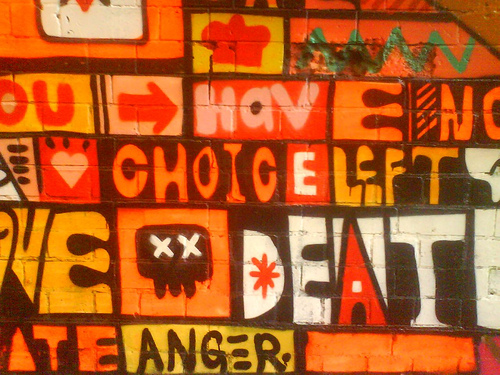
Photo by londonstreetart2

Listen to the mustn’ts, child. Listen to the don’ts. Listen to the shouldn’ts, the impossible, the won’ts. Listen to the never haves, then listen close to me… Anything can happen child. Anything can be.” Shel Silverstein

Todd was passing through Seattle on his way to Portland. He’s Canadian, an expansive thinker, and because he concerns himself with the happenings in the world he always has interesting perspectives. He’s also one of the funniest people I know and has a keen ear for imitation; ask him to do his Tom Waites impersonation and you’re in for a riotous time. He has a passion for wine and music and people and life. If you happen to be in a wine bar in Canada and sit next to a guy doing imitations of aging musicians, that’s Todd. Introduce yourself. He’ll change your life.

When I see him I like to ask for his point of view. We were in an endless election season on his last pass through so I asked him about what he saw as the single greatest challenge we face in the United States, the things that are hidden from us because we are too close to see them. “Oh, that’s easy,” he said.

“The great challenge facing America, particularly evident in this election season, is that you take positions too quickly. It’s almost impossible for you to have substantive debate about any issue because you rush to defend your positions before you’ve had the opportunity to consider the worth of the opposing point of view. In fact, listening to the opposition is treated as a sign of weakness, immediately branded as ‘wishy-washy.’ Basically, you can’t talk about anything in a meaningful way.”

Wow. Of course, Todd is also polite (I did say that he’s Canadian). What he didn’t say is that in addition to rushing too quickly to defend our positions, we also delight in obliterating the other point of view (before we’ve actually heard the other point of view). The simple presence of an opposing point of view is reason enough to pull out the big guns and fire. Wave a white flag of truce and see where that gets you.

This is a form of what Patti and I call a “negative direction of intention.” In short, a negative direction of intention is the act of moving away from what you don’t want (or running away from what you do want). In general, a negative direction of intention will inevitably lead to a destructive action. I know a man whose passion was playing the drums though you’d never know it because he stopped playing more than 30 years ago. “I felt like I had to make a choice,” he said, “I could either have a family or I could play the drums.” He chose to have a family so for some reason he could never articulate, that meant he had to put his drums in the attic. Either/Or thinking is a characteristic of a negative direction of intention. This thinking in Black/White is reductive and simplistic and only necessary if you need to see the world in absolute terms; this, not that.

His children are long since grown and his drums remain stowed away in the attic. “A choice is a choice,” he said.

Most people live their entire lives pushing against what they don’t want or what they are afraid to walk toward. There’s a lot of fear behind a negative direction of intention and with that fear comes the rigid absolutes expressed by drum-in-the-attic man and media constructs like red state/blue state, pro-life/pro-choice, for guns/against them. How you frame the question determines the possibilities that you see (or that you don’t see); in an either/or frame the choices are limited – obviously – and in such a unbending mindset it’s common to convince yourself that you have no choices; in a game of angel/devil it’s a coin toss, circumstances rule the day! Eventually in a negative direction of intention everything looks like an obstacle or an enemy. Planting flags, claiming territory, stuffing your fingers in your ears or shouting down the voices of opposing points of view is are all common traits of a negative direction of intention.

Conversely, a positive direction of intention is defined by moving toward something, it is a creative action. It inspires a walk into the unknown (that’s the point, the path of passion is always through the unknown: passion grows in the engagement or in the learning, two ways of saying the same thing). It requires embracing choice and the accompanying discomfort that owning your choices can bring, it implies taking personal responsibility for who you are and how you engage with what you desire. A positive direction of intention is characterized by Both/And thinking: you can be a drummer and have a family! You can consider many opposing perspectives because you not only expect them but you need them, you are not trapped in the belief that an opposing point of view negates your own (a sure sign of a negative direction of intention).

Are you living a negative or positive direction of intention? Listen to the story you tell yourself about yourself; count the number of times a day you engage in justifying your point of view, or how many times a day do you plant a flag in the sand to claim that you are right? How many times a day do you reduce someone because their perspective differs from yours? You can hear the language of choice in the words you use just as you can hear the language of victim-hood. Just listen.

And while you are listening, listen to someone who has an opinion that differs from yours. Ask them questions. Consider that their ideas and beliefs are just as valid as yours and rooted in experiences that are just as real to them as yours are to you. See what happens to you when you stop negating and start discussing. Practice consideration. What if you refused to fix anything (a negative direction of intention) or even better, what if you refused to justify or defend your point of view or negate any other point of view – and instead you practiced inquiring about others ideas and regarded their beliefs as valuable and as worthy as yours. What if, for a month, you practiced not knowing what you think and entertained the idea that there was something to discover.

As Todd suggested, we reduce our issues to be too simplistic, right vs. wrong, and in doing so we rob ourselves of the capacity for complex debate or considerations beyond the superficial. We rob ourselves of our capacity to create, locking ourselves in a pattern of ping-pong reactivity. And in the end, all we reduce is ourselves.

A wise old owl sat on an oak; the more he saw the less he spoke; the less he spoke the more he heard; why aren’t we like that wise old bird?” Anonymous