Take A Radical Step

532. Join me in inspiring truly powerful people. Each day I will add a new thought, story or idea to support your quest and mine.

I had a revelation today as Alan Seale and I facilitated a Transformational Leadership Coaching forum discussion. Our topic was the power of taking a radical step. Here’s a quote from Alan’s newsletter:

“Many people equate radicalism with violent extremism. However, if violent acts of extremism are at one end of the “radical” spectrum, the constructive power of radicalism lies at the other end. Religious movements as well as great social and scientific advances started out because someone was willing to take a radical stance…. The word “radical” comes from the Latin radix meaning “root.” A radical thought, position, or act is born out of a powerful root belief or value. It is the outward expression of a conviction rooted in the core of one’s being. Conviction turns to action when it can no longer be held silent.”

A radical act is seen as doing something counter to the main stream, going against what is popular. The kid who said, “The Emperor has no clothes!” was most likely shushed by his parents. The neighbors probably glared and the kid learned that speaking truth was not tolerated in polite society. His comment was not a radical act; however, when, as an adult, he is once again in polite society and can no longer hold his tongue, when he speaks the truth and knows that he might be ostracized…, that is a radical act. Rosa Parks knew that sitting at the front of the bus might get her killed and she did it anyway. That is a radical act.

Here’s my revelation: radical acts often look small in the doing. I coach people and everyday hear stories of immense courage and the necessary action, from an outside observer, appears small but the impact is enormous. Speaking your truth, putting down a cigarette for the last time, saying “no” (or “yes”), changing the-story-you-tell-yourself-about-yourself, seeing opportunity in an obstacle, allowing yourself to be seen: Rosa Parks sat on a bus. Every avalanche begins with a single pebble.

Truly Powerful People (444)

444.
Join me in inspiring truly powerful people. Each day I will add a new thought, story or idea to support your quest and mine.

Megan-the-brilliant, she that is far too wise for one so young (but does not yet know it – so kindly don’t tell her) takes me to task on the details of my posts. She asks for clarification, challenges me on the fine points of my rambling, and knits her brow with such ferocity of thought that it would knock the “P” off of most PhD’s. I count myself fortunate to have eschewed higher education, stopping with an M.A.; her thought ferocity has obliterated the “A” so I am left with a vapid “mmmmmmmm,” in response to many of her questions. “What does that mean?” she exclaims. I bite my lip – a stall tactic to give my synapsis a fair chance to fire. I wish my brain was better organized; clutter slows me down.

Recently I wrote something about discomfort being necessary for movement. Discomfort is a story starter. I can’t think of a single story worth telling that is about comfort. Comedy is not comedy without some serious discomfort. Tragedy is uncomfortable by definition. The Buddha tells us that the key to a good life is to participate joyfully in the sorrows of the world; sorrow is the premise of the story. Stories of illumination, adventure, mystery, love, historical, pastoral, historical-pastoral, hysterical-historical-pastoral are not known for comfort.

Megan-the-brilliant cautioned me that I was too general in my assertion. She knit her brow (there goes my “A”) and asked me to distinguish between movement to get out of the discomfort vs. using the discomfort to move the story forward. They are two entirely different intentions. Mmmmmmmmmmm. Actually, a synapse fired. It was close at hand. In fact, it was so close it is the name of this blog: The Direction of Intention. Moving to get out of the discomfort is to push against what you don’t want – a negative direction of intention. Movement fueled by discomfort that propels you toward what you want – is a positive direction of intention. She’s right!

It seems we have a choice in what we do with our discomfort and perhaps that is the point of every life story. Joyful participation, denial and frustration, pushing against the cage, giving up or finding a way to pick the lock are choices. They are directions of intention. We can choose to hate what we don’t understand and plant our heads in the sand or walk toward what we don’t know – and learn.

Even with the loss of my “A” I can see that Megan-the-brilliant is aptly named. Don’t tell her. Mmmmmmmmmmmmum’s the word.

Truly Powerful People (206)

206.

Join me in inspiring truly powerful people. Each day I will add a new thought, story or idea to support your quest and mine.


Shortly after meeting Patti I bought a black and red hardcover notebook in an attempt to contain my thoughts and notes from our conversations. My usual system of Post-it notes, index cards and loose college rule three hole punch pages proved inadequate for the task of capturing the idea cascade of our exchanges. Sticky yellow post-its overran my desk and spilled onto to the floor. It was too much for the old system to handle and there was no sign of our idea-flood drying up so I took the leap and bought a real notebook with heft and presence. It was the first of many.

Taped into the first page of the first black and red notebook is a Xerox copy of the Vicious and Virtuous Circles (we now call them “circumstance-driven” and “intention-driven”). We created them one morning, very early in our collaboration, sitting at Patti’s dining room table in North Carolina. The Circles spilled out amidst a mad volleyball-banter of concepts sparked by the likes of Parker Palmer, Charles Hampden-Turner and a few others I can’t remember. We were attempting to give coherence, direction and shape to the flood. We were trying to answer questions like, “How do you address the real issues inherent in organizations and communities without placing any of the participants in an untenable position? What are the conversations we as a community and as a culture are avoiding? What conversations are we incapable of having around issues of difference or diversity? How do you facilitate change in a system when change will upset the power structures and alter the essential identity of the system?” The Circles grounded our thinking and gave us direction and coherence and more importantly clarified a single guiding intention for our work together: to facilitate the journey from the Vicious Circle to the Virtuous Circle. The creation of the Circles helped us to ask better questions, “How can we, all of us, live expansively together and support each other in fulfilling our potential? How can race or age or gender become a horizon, something to step toward, instead of a barrier, something to move against?”

On the page facing the Xeroxed Circles I scribbled two notes. The first is derived from a book by Robert Fritz called The Path of Least Resistance; in blue ink I wrote: It is impossible to change behavior until you change the underlying structure, the path water (behavior) takes is always determined by the structure of the land. I underlined the words “behavior” and “structure.” I wrote the second note in black ink, it reads: Mastery is concerned with process not product. Master the process and the product takes care of itself.

We’ve yet to meet a person, a company, or an organization that isn’t running around on a Vicious Circle (a circle of reduction, driven by circumstance). Walking the path between the Circles – walking the path to becoming truly powerful – requires two things: 1) A willingness to look beyond behavior and see the underlying structures, and 2) A desire for mastery; focus on the process and let the outcomes take care of themselves.

Said simply, it is this: are you moving toward what you want to create or are you running from what you fear? It’s a choice.

Truly Powerful People (191)

191.
Join me in inspiring truly powerful people. Each day I will add a new thought, story or idea to support your quest and mine.

Today Lora and I hauled 7 sacks and 1 box of books to a used bookstore. Our shelves have never been this empty. This month we’ve cleaned out our closets, tossed mountains of paper and files from the office and I purged my studio. This need for space is primal. It’s as if we were possessed by a force – it makes no sense yet demands immediate response. We’re acting out of instinct; there is change in the wind and we can smell it. Space must be cleared.

The books we removed were not novels or pleasure reading, they were the “anchor” books, the source books necessary for work, the collected resource for a career. Taking them out of our apartment was the same as saying “I’m done with this part of my life now. I will never be that person again.” Of course, taking off one identity necessitates the creation of another. Now that space has been cleared, the question hanging in the air is, “Who will I/we become?” Are we on the edge or have we already stepped off?

Many years ago, before I left Los Angeles, I gave my theatre library to my friend Albert. Hundreds of plays, books on acting and directing, a collection that I’d spent years gathering; I had to rid myself of them. They morphed from treasure to burden in a matter of days. Once divested of my books I left LA feeling released, somehow. I drove into a future with no idea of where I would land or who I would become. I was exhilarated, standing squarely in the burning point of my life with no illusion of safety or security.

Almost twenty years later I enact the ritual again only this time I am not driving into a future looking for answers or the fulfillment of something that I don’t already possess. I am not running toward or away from anything. This is less about a new layer, a new suit of clothes, and more about a movement to the center. This is simplicity, a reveal-ation. This time I am not going some other place but sitting quietly as the burning point of my life.

Send Light Into The Human Heart

“The artist vocation is to send light into the human heart.” George Sand

The first of the Four Noble Truths of Buddhism is that all of life is suffering. In this context the predicament of the artist is no different than that of a plumber or a president though I’ve yet to find a plumber who considers suffering necessary to his or her vocation. With artists (in the US) suffering seems to be a prerequisite. Why do artists think they need to suffer or believe that suffering unlocks the door to their artistry?

As a nation we do not easily walk into our shadow and one of the roles of “artist” is to go where others choose not to go. A walk into the shadow may be uncomfortable but it is equally as liberating. An artist is supposed to see what others cannot and sometimes that is painful. An artist may act as a bridge between worlds of perception, living on the edge of the village, traveling into the netherworlds to retrieve a truth or a lost soul. This at times may be solitary or scary but it is always transforming. An artist rarely “fits” the social norms but always serves the health and growth of the pack.

The coaching work I do with artists (myself included) often requires a stroll into the misguided ideal or expectation of suffering. What are the underlying assumptions that make suffering or madness an erroneous precondition for artistry? This begins my ongoing series of mini-rants about suffering and the arts:

Rant #1.

Dear artist,

What if: you will never be understood. Consider: all great art lives beyond the rational, it transcends the linear sequential and reaches into places where words cannot go. You can’t measure it, quantify it, or contain it. You can engage with it. It seems to me the power of the arts is in NOT being understood; moving beyond understanding is the point, not the problem. Trying to be understood is really a mask covering the need to be liked or appreciated. As my mentor used to say, “You will know the power of your work by the size of the tide that rises against it.” Some people may appreciate you and your work, others will not. That is beyond your control. What is within your control is your capacity to do your work. You can cut your ears off investing in what others may or may not think about what you create or you can do your work and offer it to the world. Trying to be liked or understood will knock you off your artistic rails; you’ll lose sight of the essential and trade it for the superficial. It will make you timid. Stop trying to be understood and do your work. Stop trying to be liked and offer your work as if it might change someone’s life (because it might).

Rant #2.

Dear artist,

What if: you will never be valued (paid). Consider: We all want to be paid for what we do; it is how our culture demonstrates value. However, as an artist, the odds are against it regardless of the scope of your talent and dedication to your craft. Go to a casting call in NYC and you’ll see what I mean. It is the rare arts organization (or artist) that pays for itself through the sales of what it produces – in other words, ticket sales will never pay for cost of the play. Donations, grants, not-for-profit status and cheap payrolls make the arts viable in a free market economy. The artist is the last to be paid and is usually paid the least. We live and create in a culture that has managed to link morality to money, to make a commodity of it’s prophets and sacred days, and that has convinced itself that the greatest act of citizenship is to buy stuff. It is upside down and that is precisely why we need artists! Think about it, in this nation of immigrants we yammer on and on about things like family values as if those values were simple, absolute, articulated and expected from all people in every family, regardless of ethnicity, religious preference or sexual orientation. What we value as a culture is at best conflicted and complex, as artists we are meant to embody that conflict and complexity. So value your art and do your work. Stand in the conflict. Put your fingers around the complexity and begin to mold it. Launch your work out into the world because you value it – it’s your responsibility to maintain the balance between what you create and how it is offered. As Patti and I teach, focus on what you bring and not on what you get. The rest is out of your control and fretting about it takes energy that you could otherwise use to create.

Practice Consideration

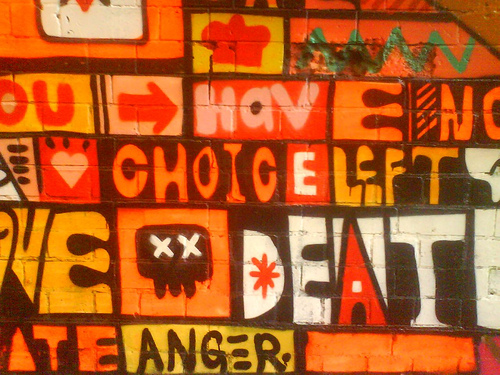
Photo by londonstreetart2

Listen to the mustn’ts, child. Listen to the don’ts. Listen to the shouldn’ts, the impossible, the won’ts. Listen to the never haves, then listen close to me… Anything can happen child. Anything can be.” Shel Silverstein

Todd was passing through Seattle on his way to Portland. He’s Canadian, an expansive thinker, and because he concerns himself with the happenings in the world he always has interesting perspectives. He’s also one of the funniest people I know and has a keen ear for imitation; ask him to do his Tom Waites impersonation and you’re in for a riotous time. He has a passion for wine and music and people and life. If you happen to be in a wine bar in Canada and sit next to a guy doing imitations of aging musicians, that’s Todd. Introduce yourself. He’ll change your life.

When I see him I like to ask for his point of view. We were in an endless election season on his last pass through so I asked him about what he saw as the single greatest challenge we face in the United States, the things that are hidden from us because we are too close to see them. “Oh, that’s easy,” he said.

“The great challenge facing America, particularly evident in this election season, is that you take positions too quickly. It’s almost impossible for you to have substantive debate about any issue because you rush to defend your positions before you’ve had the opportunity to consider the worth of the opposing point of view. In fact, listening to the opposition is treated as a sign of weakness, immediately branded as ‘wishy-washy.’ Basically, you can’t talk about anything in a meaningful way.”

Wow. Of course, Todd is also polite (I did say that he’s Canadian). What he didn’t say is that in addition to rushing too quickly to defend our positions, we also delight in obliterating the other point of view (before we’ve actually heard the other point of view). The simple presence of an opposing point of view is reason enough to pull out the big guns and fire. Wave a white flag of truce and see where that gets you.

This is a form of what Patti and I call a “negative direction of intention.” In short, a negative direction of intention is the act of moving away from what you don’t want (or running away from what you do want). In general, a negative direction of intention will inevitably lead to a destructive action. I know a man whose passion was playing the drums though you’d never know it because he stopped playing more than 30 years ago. “I felt like I had to make a choice,” he said, “I could either have a family or I could play the drums.” He chose to have a family so for some reason he could never articulate, that meant he had to put his drums in the attic. Either/Or thinking is a characteristic of a negative direction of intention. This thinking in Black/White is reductive and simplistic and only necessary if you need to see the world in absolute terms; this, not that.

His children are long since grown and his drums remain stowed away in the attic. “A choice is a choice,” he said.

Most people live their entire lives pushing against what they don’t want or what they are afraid to walk toward. There’s a lot of fear behind a negative direction of intention and with that fear comes the rigid absolutes expressed by drum-in-the-attic man and media constructs like red state/blue state, pro-life/pro-choice, for guns/against them. How you frame the question determines the possibilities that you see (or that you don’t see); in an either/or frame the choices are limited – obviously – and in such a unbending mindset it’s common to convince yourself that you have no choices; in a game of angel/devil it’s a coin toss, circumstances rule the day! Eventually in a negative direction of intention everything looks like an obstacle or an enemy. Planting flags, claiming territory, stuffing your fingers in your ears or shouting down the voices of opposing points of view is are all common traits of a negative direction of intention.

Conversely, a positive direction of intention is defined by moving toward something, it is a creative action. It inspires a walk into the unknown (that’s the point, the path of passion is always through the unknown: passion grows in the engagement or in the learning, two ways of saying the same thing). It requires embracing choice and the accompanying discomfort that owning your choices can bring, it implies taking personal responsibility for who you are and how you engage with what you desire. A positive direction of intention is characterized by Both/And thinking: you can be a drummer and have a family! You can consider many opposing perspectives because you not only expect them but you need them, you are not trapped in the belief that an opposing point of view negates your own (a sure sign of a negative direction of intention).

Are you living a negative or positive direction of intention? Listen to the story you tell yourself about yourself; count the number of times a day you engage in justifying your point of view, or how many times a day do you plant a flag in the sand to claim that you are right? How many times a day do you reduce someone because their perspective differs from yours? You can hear the language of choice in the words you use just as you can hear the language of victim-hood. Just listen.

And while you are listening, listen to someone who has an opinion that differs from yours. Ask them questions. Consider that their ideas and beliefs are just as valid as yours and rooted in experiences that are just as real to them as yours are to you. See what happens to you when you stop negating and start discussing. Practice consideration. What if you refused to fix anything (a negative direction of intention) or even better, what if you refused to justify or defend your point of view or negate any other point of view – and instead you practiced inquiring about others ideas and regarded their beliefs as valuable and as worthy as yours. What if, for a month, you practiced not knowing what you think and entertained the idea that there was something to discover.

As Todd suggested, we reduce our issues to be too simplistic, right vs. wrong, and in doing so we rob ourselves of the capacity for complex debate or considerations beyond the superficial. We rob ourselves of our capacity to create, locking ourselves in a pattern of ping-pong reactivity. And in the end, all we reduce is ourselves.

A wise old owl sat on an oak; the more he saw the less he spoke; the less he spoke the more he heard; why aren’t we like that wise old bird?” Anonymous