Step Out Of The Fog

Shadows Of Imagination by Maggie's World

We are hardwired for story. We can’t help it; it is what we do. We interpret, we judge, we speculate, we remember, we ponder, we investigate, we justify we imagine,…we story. Meaning-making and interpretation are processes of story. We narrate each moment of our lives. I call this the-story-you-tell-yourself-about-yourself.

The-story-you-tell-yourself-about-yourself is often hard to see because, well, you don’t see it as a story.  It’s your life and you are so used to the inner-narrative that you stop recognizing your self as the narrator/interpreter of your life. Your thoughts, judgments, comparisons, expectations, investments, aspirations and fears are your story. As much as you want your point of view to be fact, it’s not. It is truth relative to you but not to anyone else. These stories you tell do not exist outside of you; they are your creation. Don’t let anyone tell you that you aren’t creative! We are, each of us, masterful storytellers.

Neil Postman writes,”Our genius lies in our capacity to make meaning through the creation of narratives that give point to our labors, exalt our history, elucidate the present and give direction to the future. To do their work, such narratives do not have to be “true” in a scientific sense…. The purpose of a narrative is to give meaning to the world, not to describe it scientifically.”

It’s when we confuse our story for truth that we get into trouble. There is an image that I love from the story of Sisyphus. It illuminates both the power and the problem of this inner storytelling:

Sisyphus has been taken to the underworld. He’s in trouble for making the gods look bad – twice. He has crossed the river Styx but isn’t yet allowed to get out of the boat. He has to wait and while he waits, he watches all the other souls file off the boat and mingle on the banks of the river. He is stunned when he realizes that each soul is so invested in their story that they don’t realize they are surrounded by other souls; even though they are in a crowd, each believes they are alone. Their story wraps around them like a blanket of fog, their inner chatter obscures them to the presence of others.

The-story-you-tell-yourself-about-yourself becomes an especially thick fog when used to belittle the teller (you). Using your story against yourself is guaranteed to isolate you. It is hell. Stories of “I’m not good enough” or “I have to be perfect.” Stories of “I am racing to get there,” stories of “past shames” and “future fears.” Stories act like a dense fog when they swirl around you and pull your focus from the present moment.

The lesson I most appreciated in art school came during the first class of the first semester. The professor, a short burley man who wore a walrus mustache and smelled of pipe tobacco asked us to examine a yellow #2 pencil. His simple question made us roll our eyes, “What color is the pencil?” We groaned and yawned in unison, “Yellow!” and acted as if the poor man was daft. He asked us to look again, to really look. He challenged us to see what was there and not what we thought was there. When I looked again, really looked beyond my thinking, I saw an explosion of color, reds, greens, and purples. I saw beyond my abstraction (story) and what was before me came to life. It was a festival of light and shadow all dancing in the form of a #2 pencil. For a few moments I suspended my story; I saw.

As Sisyphus sat in the boat, watching all the other souls wander lost and alone, wrapped in a fog of their own creation, he saw. He awoke to the story-he-tells-himself-about-himself and knew that it was not truth. He chose to tell a different story. The myth tells us that his new awareness transformed him. He became present in his life.

We are hardwired for story. We can’t help it; it is what we do. And, like Sisyphus, we have the capacity to recognize our story for what it is, and tell a different story. We have the ability to step out of the fog.

Open Your Symbol

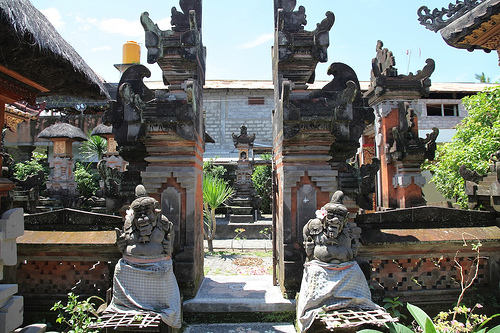
Split Gate photo by rishwei

I’m preparing to tell the story of Sisyphus to educators in Hastings, Nebraska. Patti and I are helping them shift their perspective so they might consider some alternatives to the madness in which they find themselves. They, like educators everywhere, are desperate. They find themselves locked in a system that has less and less to do with learning and teaching. It’s no wonder. Our system of education was established in another time for reasons that no longer apply to the world in which we live. What they (we) are experiencing, a hyper emphasis on measurement and assessment is a fairly predictable pattern of behavior: it happens when the world changes, when the demands of a new circumstance collide with an antiquated system. Overemphasizing assessment and measurement is the strategy leaders take when they don’t know what to do; it is an attempt to fix something that isn’t broken (it’s antiquated); it is action for the sake of action in the hopes that something different will happen.  Rolling a rock up a hill in perpetuity would seem to be an apt metaphor.

It’s more apt then you might imagine because the metaphor, when you know the whole story, isn’t about punishment or meaningless action. Like all great stories, Sisyphus is a story about transformation of consciousness. The image of the man rolling the rock up the hill forever is only a horror story if the symbol is read literally (and taken out of context). Sadly, taking a symbol out of context and reading it as a literal “happening” is a symptom of a community that’s lost it’s guide star. Story is the glue that binds and the metaphors within the story provide the commons, the place where all the varying points-of-view can meet. By reducing metaphors to the literal the community closes the door on its capacity to unite and transform. Everything becomes political and economic. As Yeats wrote in The Second Coming, “The center cannot hold.”  The essentials are lost so we test.

In Bali you often pass through a “split gate” when you enter home compounds or temples. They are beautiful, ever present symbols. Two opposing towers that look like a single structure cleaved in two to form a gate. The halves are symbolic of the polarities, an architectural yin and yang reminding the Balinese of the polarities of our existence and the importance of balance in all things. Budi took me to a split gate and said, “The half on the left is the masculine, the half on the right is the feminine.” He asked me to pass through the gate and to turn and look back at him. Once I was on the other side he asked, “Now which is left and which is right? What was left in now right, what was right is now left!” He threw his head back and laughed (Budi has a great mischievous laugh, a broad Cheshire grin), saying, “What is important is that you remember that you must pass between!” He was teaching me about balance, about the middle way. This symbol for balance, this split gate is the metaphor for a life transformed, for how it is to be done.

The split gate and Sisyphus pushing a rock up a hill are the same symbol. If you knew the whole story and were capable of reading your metaphors as metaphors you’d know that the rock was symbolic of the masculine aspect and the hill is symbolic of the feminine. Sisyphus task is to bring into play the masculine rock with the feminine hill. His movement is between the two, which is to say that he lives and loves and labors in the field of dualities, just like me and just like you. The purpose of living is not in the achievement of the task but in the quality of the engagement, the dance between the poles.

When the masculine (objective, quantitative) hijacks the feminine (subjective, qualitative), balance is lost, the center cannot hold, the essential is lost. Which loops us back to education. No amount of measurement, testing, or forced performance standards will bring about the transformation of the system. They remove the teacher from the equation, reduce the child to something standardized and stifle the single, essential aspect necessary for genuine learning: a quality relationship engaged in genuine inquiry. Measurements, in this case, are actions meant to knuckle-down and control, to fix “what is.” That’s why the educators in Hastings are desperate. They know what is needed – especially now – is the kind of wild imaginings that are only possible when we step into unknown territory and create new structures that support learning (systems based on the latest brain science and learning theory – not the 19th century system that we still champion today), something relevant in today’s world.

Sisyphus is one of many stories that can show us the way.

The Polar Bear King (part 2)

A great story teller once told me that all stories are really about passages from one way of being to another way of being. This requires an “in-between” space; you are no longer what you once were and you are not yet what you will become. You are off balance and being off balance is uncomfortable. It is vulnerable. It’s also necessary.

When you are living your passage-story, many of your friends won’t recognize you and that will frighten them (if you can change, so might they); they will try to force you back into your old form; they will mock you, criticize you, ignore you – your discomfort will make them uncomfortable. Maintaining comfort is a powerful motivator – and also impossible to do.

Others will have the capacity to see beyond the surface to what is essential about you. They can see beyond the change, recognize the role of the discomfort and they will support you in walking into the change. They will not enable you. They will not protect you from the change nor support you in your tale of woe. They will, however, help you walk toward the discomfort because it is the path to your transformation. When working with groups, Patti and I ask, “How are you trying to remove the discomfort from your life (and keep yourself from transforming)?”

This is how the allies and the nay-sayers play their roles for the Polar Bear King:

II. HAVE COURAGE AND LIVE

When he awoke he was sore over every inch of his body. The queen of the gulls – a beautiful blue-grey bird, his best friend, stood beside him. She said, “I’m glad you are alive my friend. We feared you were dead.” The great king’s eyes were still blurry and his thoughts were spinning.

“What happened to me?” he asked, “Why do I ache over every inch of my body?”

The queen of the gulls breathed a heavy sigh. She hated to tell her dear friend the bad news.  Finally, she said, “The two-legged creatures thought you were dead and they cut away your great coat of hair. They carried it away with them to their ship. Your great silver coat is gone.” The king groaned in despair.

“We now know you are a great magician,” she said, “for not even the creatures with their fiery stick couldn’t harm you.” “Oh. No…,” was all the polar Bear King could say. He knew, without his great coat of fur, that he would very soon freeze to death.

“Do not worry great king,” said the queen of the gulls, “I have a plan to help you. You have been so kind to us, sharing your food and delighting us with your dance; we wish to repay your kindness by giving you as many feathers as we can spare.” The queen pointed to the sky.  The great bear looked up. High above, a thousand gulls circled and circled. One after another they plucked with their softest feathers, swooped down and dropped them gently onto the body of the Polar Bear king.

Soon he was completely covered in thick soft downy feathers. The queen of the gulls said to him, “Our feathers are soft and as beautiful as your own thick silver coat. They will guard you from cold winds and warm you while you sleep. Have courage, now, and live!” She imitated his dance, going (flap, flap, shimmy-shimmy shake) and cawed, “Oh, yeah!”

The king of the Polar Bears managed a smile and limped back to his cave. He had courage and he lived. His wounds healed and the feathers grew on his body as his own hair had done. The rest of the summer and all through the six months of night, the Polar Bear king lived in seclusion He was not ashamed of his feather covering, he was grateful for it as he would have frozen to death without it, but it felt strange to him. He was different now, so he avoided meeting the other bears.

When, finally, the moon fell away from the sky and the long winter night was over, two polar bears came to find their great king. They were young and wanted advice about hunting in the new season. They knocked at his cave and heard him say, “Enter.” They stepped inside, excited and anxious to hear what he’d say. They took one look at him and stopped dead in their tracks. Then, they jumped back in fright. Their great king was covered in feathers! And then, they began to snicker, trying hard not to laugh. It was too much! Finally they burst into great gales of laughter. They howled so hard they could not speak. The great king sat in silence, and bowed his head. (…to be continued)

What Is The Story You Tell?

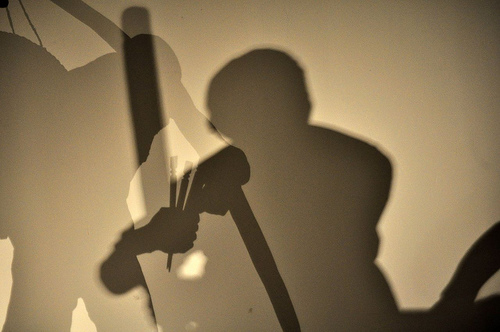
Untiltled Narrative by David Robinson

I feel it in my marrow, this impulse to story. It is the imperative that calls my name, the spirit that has accompanied me since my youth. It whispers, niggling my attention during the day; its’ murmur filling my dreams at night. Every chance encounter, every party conversation a beckoning to the primal place, an invitation to the fire of the ancients. “There is more here, a deeper story.” “Listen,” comes the call, “listen to the story beyond the words. Catch the story beneath the story, witness the face behind the mask.”

***

All stories are ancient. And, at the same time, all stories are new. If you listen very carefully to yourself, you’ll find that you’re telling yourself a story – and it is your story of being here, not just the story of reading these words, but here. It is a new story because it is yours. It is also an ancient story because it is your version of the very same challenges, questions, passages, celebrations and disappointments that all people have faced who have ever walked on this planet. It is your turn now.

People before us conveyed their deepest truths through their stories and their myths. Their stories helped them to know what to do, how to be, what to expect, where they belonged, what was valuable and right – and what was not. Their stories reassured them that they did not walk this path alone.

We don’t bother ourselves with things like stories anymore. We no longer open ourselves to our greater stories so they can no longer open for us.

***

When I was younger I experienced the world as an orchestra out of tune, each musician thumping their instrument, making sound and calling for attention. Parched lips blowing and calloused fingers plucking noisily along in a universe that had no notion of music. The conductor asleep at the base of the podium. Or perhaps, like me, the conductor only pretended to sleep; like an impetuous 5-year old I plugged my ears and sang, “La La La” over the din. I didn’t want to hear, I didn’t want to feel it, run all that sound (story) through my body. It was too much electricity through a small wire.  I closed my eyes as if that, too, would protect me from the clatter.

***

Where is the story that unites us? Story is the gravity that holds us together, pulls us into a common orbit. It is the irresistible cadence of invitation: come. Sit. It is singular and essential; it holds us in affirmation like a burgeoning pod: this is who you are. This is where you belong. This “story that unites us” is the nucleus, the artist’s obligation and most important role. I took my fingers from my ears when I finally recognized the call, not as an obligation, not as something I had to “do;” it was something that I already was. I recognized that I am an artist, not as a role or in the sense that I need to produce anything, nor in the sense that I need to comment on the politics of my world. I am an artist because I am aware, I am aware that I create my world in how I engage and interpret every moment. I create in every moment. And, because I am aware, I am capable of listening to the story behind the words. I understood the call when I began to ask, “What is the story that I am telling through my life (with my fingers jammed in my ears)?”  What is the story that I am telling my self about myself? I am an artist not through anything I do, but in how I choose to be, in what I choose to hear and see.

Story is the gravity that holds us together, this we’ve forgotten, I know. And like the musicians in the out-of-tune orchestra, when we no longer recognize our common story then the gravity reverses itself, we spin off into the void, alone in a cacophony of inner monologue. Hell is a community of individuals lost in the fog of their own story. Hell is the universe that has forgotten the existence of music. Hell is where you compare yourself to others (and the others always win), where you have to be perfect, where you are never good enough; Hell is where you invest in false notions of who you should be, have to be, could have been. In Hell there is no present moment because you are too invested in the fears of the future and regrets from the past. It’s a dense fog, an inner wasteland. Staying in hell takes a real commitment to the story that you tell!

Not only is story capable of holding us in a coordinated orbit and conversely, blinding us to each other, story also holds the power of guiding us through the wasteland and back to the garden. The old stories are like maps: this is how it will look and feel; these are the challenges you will face, this is what you can expect. Knowing the stories won’t save you from your trials but they will bring greater meaning to them. Stories connect (music, again). Every human that has ever walked the face of the earth has been born, grown to adulthood, wondered what was theirs to do, loved and lost, fulfilled themselves or not, grown old, and died; their advice comes to us in the form of a story. If we listen metaphorically, the wisdom it holds will spill its guts. Stories don’t need to be tortured to reveal their secrets, they are eager to share. However, treat them as fact and they will clench their jaws and clutch their fists and hold their breath until they pass out. Their treasure lives beyond the realm of facts, beyond the superficial. You have to listen deeply, engage it, feel it in your body. It requires a relationship with you. Reading a story factually is to cage what is wild, to shackle what is free. Reading a story as fact generates fog.

This principle holds true of people – because we are, each of us, storytellers. Believe that your thoughts are fact, that you are right, and you will impound your spirit.

Jay Griffiths writes in her delicious book, WILD, “To me, the human spirit is not a stain on wilderness as some seem to think. Rather the human spirit is one of the most striking realizations of wildness. It is as eccentrically beautiful as an ice crystal, as liquidly life-generous as water, as inspired as air.”

Yes.

What is the story you tell yourself about yourself?

The Polar Bear King (part 1)

All stories begin when the main character is knocked off balance. This is true in life, too. Change can only happen when you are knocked off balance. In our work together in The Circle Project, Patti and I always ask, “In what ways are you keeping yourself from being knocked off balance?” How are you protecting yourself from the change that will transform you?

Sometimes change comes to you. Sometimes you have to go to it. Here’s the first part of a story and how change comes to the Polar Bear King. :

I. Clap, Clap, Shimmy-Shimmy Shake

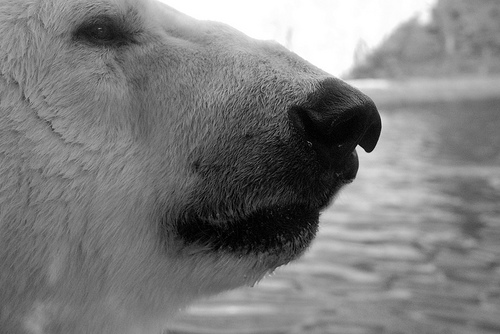
Photo by Michael Barrow

Way to the north, in the land of the tall icebergs and endless snow, lived the great King of the Polar Bears. He was mighty and old and wise and friendly to all who knew him. He was big, big, big, – bigger than all the other polar bears and he like to dance. It was not uncommon for the sea-grey sea gulls to see him doing this happy dance, he’d go (CLAP, CLAP, SHIMMY-SHIMMY-SHAKE). And then he’d say, “Oh Yeah!” His body was covered in thick long white hair that sparkled like silver under the rays of the midnight sun. His claws were strong and sharp so that he could dance easily over the snow and slippery-slidy ice. He was a hunter and ate well on salmon fish and sleek black seals. And when his belly was full of seals and fish, he’d go CLAP, CLAP, SHIMMY-SHIMMY-SHAKE. And he’d say, “Oh Yeah!”

The beautiful sea  gulls, those graceful scavenger birds, loved The King of the Polar Bears because he was always careful to leave them plenty of left-overs from his meals. When he did his shimmy-shimmy shake and said, “oh Yeah,” he’d signal his friends the birds to come and join the feast.  Because he was so considerate, the gulls never starved, and for that they were grateful. This great king knew there was plenty of life and food to go around. That’s why he danced!

The other polar bears felt good when they came to visit their king. They would come to see him for advice or when they were ill or in trouble or when there was a dispute over hunting grounds. Or when they just wanted to cheer up their day. He was always happy and fair and kept peace in the kingdom.

Now, the other animals where certain that the Polar Bear King had to be some kind of a great magician because nothing seemed able to harm him and he always had plenty to eat. Even in the lean times he seemed to always have plenty of food. And he was always so happy! When he went (CLAP, CLAP, SHIMMY-SHIMMY-SHAKE) the whole ground danced and his great good, “Oh, yeah!” made every heart swell with delight. He seemed to get bigger and stronger with every single passing year.

One day, the great good king was snoozing in his cave when he heard a sound outside in the water; a crinkley and crackley sound like the slow crunching of ice.  It was a sound he’d never heard before. He stood and stretched and went outside to investigate. In the water, slowly breaking forward through the ice, was an enormous wooden thing. It steadily broke its way through a narrow strip of shallow ice, made thin and uncovered by the steady summer sun. Standing in the wooden thing were several strange creatures, creatures that he’d never seen before. They stood on two legs. They looked scrawny and only had hair on the tops of their heads. The great bear had never seen anything like it so he moved toward the strange creatures standing in the wooden thing cracking through the summer ice. He lifted his great nose, sniffing the air and caught the strange scent of these funny looking creatures. He wondered if they would be friends or if he would have to fight with them. He already knew by their scent that they wouldn’t be good to eat.

When the king got near the water’s edge, one of the two-legged creatures yelped and raised something that looked like a straight shiny stick and pointed it at him. The stick made a loud “bang,” and the great bear felt a thump in his shoulder, his world began to spin, his mighty legs began to shake and his great body gave away beneath him. He fell hard onto the ice. He saw the two-legged creatures dance; they went (clap, clap, shimmy, shimmy shake) then everything went black. That was all he remembered. (…to be continued).