Truly Powerful People (133)

133.
Join me in inspiring truly powerful people. Each day I will add a new thought, story or idea to support your quest and mine.

If I can tell myself the story of not good enough, I am capable of telling myself the story of good enough.

If I am capable of holding myself hostage to a standard of “perfect,” I am capable of freeing myself to live in a world where everything is perfect just as it is.

If I am capable of imagining the worst, of assuming ill intent in others, I am also capable of imagining the best, of assuming positive intent.

If I am capable of judging myself and judging others, I am capable of forgiving myself and others, I am capable of offering compassion, of living in the center of my generous spirit.

If I am capable of seeing through the eyes of fear, I am capable of seeing through the eyes of love.

If I am capable of believing that I can’t, I am equally capable of believing that I can.

Stories of can’t, of not good enough, of hard-edged perfection, stories built on fear and assumptions of ill-intent, commitments to self-judgment, investments in self-loathing were most likely useful at some point in your past. You wouldn’t have created them if they weren’t useful. They are certainly stories of protection against feeling something, stories meant to keep you from wandering into the minefields of shame or punishment. They are story grooves cut by repetition, they became patterns of thinking; paths of least resistance for a stream of inner monologue meant to keep you quiet, still, and afraid to move.

You are equally capable of wearing a new path through the meadow. You are equally capable of creating a story of self-love as you are of maintaining as story of self-limitation.

Truly Powerful People (128)

128.
Join me in inspiring truly powerful people. Each day I will add a new thought, story or idea to support your quest and mine.

We see what we believe. Then, we search the world for the data (proof) that supports our belief. In this sense, truth is relative. What is true for you is not necessarily true for others. Like you, others are scouring the world for proof that what they believe is the truth. Everyone is telling themselves a story. Each story is beautiful, relevant, and unique to the teller and so they assume it is truth. What binds us is not a single truth but our capacity to story ourselves.

The difficulty is not in multiple truths, multiple stories; the challenge arises when there is the expectation of one truth. When I believe that your truth must match my truth, that my truth is the way and yours is inferior, that I must convert you to my truth, then we are on an untenable path.

We step into the dark woods and get lost with idea that there is one truth and it exists outside of us and we must find it out there somewhere. This notion separates us from our capacity for transformation; it requires us to doubt our inner truth while spending our days searching for something that is with us all along.

There are many ways. There are many truths. If there is a single story it is something we create together in our active search for proof that supports what we believe.

Truly Powerful People (127)

127.
Join me in inspiring truly powerful people. Each day I will add a new thought, story or idea to support your quest and mine.

Last night Michael told me that he used to run because of the head-space that he entered. He said, “I haven’t found that kind of meditative place in any other form of exercise or sport. It’s like the crap just fell off and I was clear and present and alive.” That’s why I used to run, too. The exercise was great but the presence was holy.

On the radio this morning I heard a surfer say that presence was the reason people surfed. He said, “Surfing requires a relationship with the present moment.” He added, “On the board is when you are most alive.”

It is in the present that you are most alive. I think this experience of presence (aliveness) is the meaning behind every religious symbol. It is the place beyond the-story-that-you-tell-yourself or as Michael said, the place where “the crap falls off.” It is the middle place, the middle way. It is the space between the pair of opposites like male/female, good/bad, right/wrong, heaven/hell: story is only possible when dualities (separations) are known. Presence is a kind of unity; it is the middle way, not past or future, not this or that, it is the place beyond story.

Parcival attains the grail (presence) when he sets aside his role and sees what is in front of him instead of what he thinks should be there. He is no longer striving to become, he is no longer invested in the past.

Many religious symbols are made of the intersection of two elements: the Star of David is the meeting place of two triangles, the cross is the intersection of a horizontal and vertical axis: at the place where striving meets becoming is a sweet spot called now. The bodhi tree has branches that reach to the heavens and roots that stretch to touch the center of the earth; the sitting place of illumination (presence) is between the two.

In the Garden of Eden there is a second tree, the tree of everlasting life (unity, presence). The first tree is, as we know, the tree of knowledge (duality, separation) and having been booted from the garden (birth) we spend our lives trying to find our way back to that place that knows no separation: life is what we do between this pair of opposites.

There are many paths to this state called presence. No amount of doctrine will get you there (doctrine requires separation). It is available to all people, all of the time. It is not a place of arrival. It is your natural state and is available when the crap falls off. Some people catch glimpses of it on a surfboard. Michael caught sight of it while running. Where do you find your middle way?

Truly Powerful People (109)

109.
Join me in inspiring truly powerful people. Each day I will add a new thought, story or idea to support your quest and mine.

It is Sunday morning, a hot day in the early 1990’s in Los Angeles. I walk to a corner gas station convenience store to buy a newspaper and milk. When I enter the store a customer is at the counter. He is angry and having a heated conversation with the owner. There are five other people in the store and I notice many have their items but are pretending to look for other things to buy. They are staying away from the counter until the angry man leaves.

I grab my paper and am opening the refrigerator door when the angry man escalates his violent diatribe. I get my milk and am closing the door when the sound, the BANG, drops me to the floor. It was an automatic response; I hit the deck and look around me; the other patrons have done the same thing. We are on the ground, arms over our heads. Eggs are broken. There is a puddle of juice and broken glass.

No shots were fired. The angry man slapped the counter with his hand before storming out of the store.

I hear it on the news every night: people killing other people for their shoes or because they are angry at the price of gas. What I didn’t realize is how deeply we carry that news in our bodies. It is always there. All of us hit the floor. We expect the violence. We are on guard all of the time. There is nothing on the spectrum between angry and murder on this day in Los Angeles – or on any other day, apparently.

I hear that it is human nature but I don’t buy it. That is a story. It is human nature to tell stories not kill for shoes. We have an infinite capacity to tell the story that we want to tell. But, we must first want to tell a different story. We have to believe that a different story is possible; we have to notice that the story does not happen to us. We author it and we enact it. Together we choose it.

When I left the store that morning I left Los Angeles (literally and metaphorically). I decided to carry a different story in my body. This other story I see daily (yet rarely on the news): it is the story of empowered people empowering others.

Truly Powerful People (108)

108.
Join me in inspiring truly powerful people. Each day I will add a new thought, story or idea to support your quest and mine.

The first time I understood stillness was in Bali. It was a very hot day. I’d been in the country for almost 5 weeks, long enough to leave behind my very American need to be someplace other than where I was. For the previous few weeks I’d been playing a game that morphed into a kind of practice: walk behind a Balinese man or woman and imitate their gait, their rhythm of walking. I started this practice because it seemed to me that the Balinese were never in a hurry to get anywhere. Walking was not primarily about getting from point A to point B. Walking was not about arriving. Walking was about walking. Walking was process, not outcome.

At first my game was hard to play. I found it nearly impossible to sustain, my body tensed and ached as if I was detoxing my hurry-up-and-get-there addiction. After a while, time began to change, it slowed and sometimes disappeared. I acquired the capacity to walk more on my heels than on my toes. And the real benefit: my thinking also went back on its heels. The pace of my thought slowed.

On that very hot day I no longer needed to follow a Balinese man or woman, the practice was incorporated in me. I walked a path that led through fields and occasional clusters of house compounds. Somewhere on that path, I recognized that I was no longer in a story; the story was in me. I could turn it on if necessary and it was rarely necessary.

Stillness is not the absence of action. Stillness can be very active.
Stillness is to act without story and is immediately available when you recognize that you are telling the story, the story is not telling you.

What Would You Put In Your Box?

Tom is what first nation’s people would call a ‘Rememberer.’ Within him he carries all of the family stories, stories that stretch back centuries. He knows them in vivid detail and you can feel the presence of his ancestors in him when he tells their stories. He is a living monument to those that came before him. Over many long nights sipping wine he’s told me the stories and now parts of them live on in me. One story in particular has become mine to tell.

It is about a little boy that died 125 years ago. The little boys name was Johnny Quiggle and he died of typhoid fever. At the time, 1885, people believed the fever could be passed through the possessions of the inflicted so Johnny’s doctor mandated that his mother, Isabelle, burn her little boy’s possessions; he asked her to erase any evidence that Johnny had lived. She couldn’t do it. In secret she packed his belongings in a trunk, wrote stories of Johnny’s life, and plastered the trunk into a wall for some distant descendent to find. Tom found the trunk in 1985 when he was restoring the ranch house.

Over our long nights sipping wine Tom and I have talked about Isabelle and Johnny, and about monuments and memorials. Why do people need to memorialize their departed loved ones? Why do we need to leave marks on the earth that say, “I was here” or “This happened on this day in this place?” “Remember me.”

Isabelle’s impulse was innate. Isabelle wanted Johnny to live into the future; she wanted someone to find the trunk and share his story. She wanted people in the future to know that her boy, Johnny Quiggle, lived.

We paint on the walls of caves. We pose for portraits and we erect pyramids and statues. We create altars and celebrate The Day Of The Dead. We bury time capsules and plaster treasure chests into the walls of our homes. We seek to connect with our ancestors and our descendents, we research family trees to know the root of our existence and explain our oddities and behavior. We fret about our legacy.

I’ve spent many hours in old graveyards reading the faded headstones and wondering about the people whose full rich lives are told in a few spare details carved in stone: birth and death date and perhaps a phrase like, “Devoted Mother” or “Civil War Veteran.” I will join them someday. I wonder about my life, what it is about, what I have achieved, who I have become and am becoming. I wonder what might be carved on my stone – what single phrase can possibly describe the fullness of my life. What is the story I want my life to tell? Who will tell it when I’m gone?

Sipping wine, Tom asked, “What would you put in your box? Better yet, what would others put in your box?” Beyond your awards and other fake social-face stuff, what would you put into your box that truly revealed who you were?

It’s a great question.

Carl Jung believed the human psyche was spiritual by nature and so do I. My friend Joe Shirley has taught me that the universe tends towards wholeness. What could I put in a box that would communicate these beliefs?

I believe we seek identification with something greater than our selves: god, nature, and community, work that truly matters. What is a life well lived? When I look at the things Isabelle packed into Johnny’s box, the stories she told about his brief life, I think he lived a life that truly mattered – not because of the stuff but because of her ceremonial act.

Someone once told me that the saddest thing they could imagine was a 40-year-old production assistant (someone who hadn’t achieved outward success). I’ve met some amazing people who have lived rich full lives, traveled and experienced all of the messiness of life and they mop floors for a living. Some of the saddest human beings I have met have achieved all outward success and are miserable in their very-safe-lives. What might go in their boxes?

For me, these questions always go into the mythic. We forget that in the story of the Garden of Eden there are two important trees: the tree of knowledge (apparently an apple tree) and the tree of everlasting life. Eat the fruit from the first tree and your consciousness splits; you see through the eyes of duality (me/you, him/her, us/them, black/white,). One bite from the apple of knowledge and you are no longer in the garden, you become distinct, separate, and alone. This is a birth metaphor. After a bite of apple, the ultimate quest in life is for unity (a return to the garden); it is a quest for greater connectivity, wholeness, and belonging. How do we get back to the garden and eat the fruit of the second tree, the tree of everlasting life? The transcendence of time is the transcendence of separation. This is a death metaphor, the return to unity: ashes to ashes, dust to dust. We live a life of cycles: spring, summer, autumn, winter, spring…. Birth, life, death. Rebirth. Every culture has a birth (separation) story and a death (unity) story. We make sense of our experiences of separation and transcendence through story – what else?  Separation and transcendence with all the happenings of life in between; this is the stuff of our lives and we make meaning of it through story. Memorials and monuments are forms of story. Isabelle was separated from her boy and she reached across 100 years to share the story of her boys’ life.

For many people their children represent their transcendence of time – they live on in their children’s children through memory and genetics. For others, their work is their legacy; Van Gogh’s paintings are his children.

Neither Tom nor I have children though Tom is deeply connected to his ancestors and in his old age he is concerned for his family’s legacy. His people have lived for generations in the Sacramento valley and on the same piece of land. The city of Sacramento will soon gobble up his property and so he will be the last of his line connected to his ancestral land. When he asks, “What am I going to do with Johnny’s trunk?” he is also asking, “what am I going to do when the land is paved over and the memory of my family is gone?”

Another great question.

Tom’s stories are more than histories. Through the telling his ancestors are transcending time and he is leaning toward them, leaning into belonging and wholeness: telling the stories of ancestors is the same as saying, “this is who I am.”  I feel that I know these people personally because they are present in Tom. And now, even though they are not my ancestors, I carry Tom’s stories within me. This is who I am.

The Invisible Silk Robe (Part 2)

The heroine or hero of a story, in order for the transformation to be possible, must take enormous risks – literally or metaphorically going to the place you’ve been warned never to go. This is the unknown place, filled with monsters or dangerous trials from which no one ever returns; in story (metaphoric) terms this means that if you do return from the adventure, you will be different – the person who went on the adventure is not the person who returns.

Stories are helpful – if you know how to read them – because they beg you to consider where in your life you are withholding your voice, not speaking your truth. How do you choose safety at the expense of your growth? What do you know in your gut that you need to do but are resisting? How bad does it have to get before you walk toward the place you are most afraid to go?

II. Speaking Truth

It was a special day. The King was to dine with their master that night. That’s why the cook let the young wife go without nicking to her face with the cleaver. All must be beautiful in the eyes of the king.  As she polished the finest china and silver, the young wife knew she had to find a way out of this hell.

The king was a renowned dandy and was given to fashion and high style. His closets were vast and full. He was known to change his clothes several times each day. He kept his designers and tailors busy and hated to be behind the trends. As far as he was concerned, one of his main duties as king was to set the fashion standards. Had there been photographers in his day he’d have legislated that only his photograph could grace the cover of the gentlemen’s fashion quarterly magazine.

Dining at the homes of his advisors was one of his favorite ploys to “be seen.” He thought himself quite clever to make his subjects think that he was a ruler of the people by occasionally gracing their homes with his presence – when actually he was designing opportunities to peacock his latest get-up.  So, the king arrived at the appointed time, sweeping out of his coach, the young wife’s master bowed deeply and gushed about the king’s appearance while hordes of onlookers peeped through the fence and from the rooftops.

All of the servants had been scrubbed and dressed and put on display for the royal welcome. As the king passed the house staff they bowed and averted their eyes after the appropriate gape at the king’s finery, of course. The stable staff followed suit and then, as the king swept passed the kitchen staff, all bowed except the young wife, who, for a moment stood looking in horror at the king. She gasped, “oh my,” and then attempted to bow like the others but could not help taking another look at the royal garments. The king, of course, stopped and glared at the young wife, who averted her eyes and blushed.

The king glowered at the young woman; clearly she was a foreigner. As the master of the house begged the king’s pardon and appealed to him to ignore the impertinent woman, the young wife stole another quick glance and visibly shuddered. The king was offended and demanded that the young woman step forward. She obeyed, keeping her eyes averted as the rest of the staff cowered at the royal disapproval. The king puffed himself up and in a wounded tone asked the young woman what on earth inspired her behave in such a manner. In a whisper, the young wife answered that, she wished to respond but did not wish to “embarrass my lord in front of the household.”

The king raised his eyebrows. Did she not know that he could have her killed? He swallowed hard and dismissed his attendants. The young wife asked that her master, also, leave them for a moment. Fuming, the master followed the servants into the house, leaving the young woman and the king all alone.

“Now,” hissed the king, “tell me why you shuddered at my appearance?”

The young wife replied, “My lord, I meant no disrespect. In my country I am considered a master weaver and have many times made beautiful clothes for the king. I have woven such beautiful clothes; my finest was a copper-colored silk robe for the king of my country. It was like the thin silk robes that must be worn in the divine world. In comparison to my king, my apologies, my lord but you look like one of his servants.”

The king was stunned into silence. The hot blood of rage rushed into his face.

(to be continued)

The Invisible Silk Robe (part 1)

photo by Tiikka

Stories are about change and change is never easy. Often in stories the tricksters (the outsiders) are truth tellers. They are the agents of change and are initially rejected or labeled as swindlers by the status quo. This is a story about people pretending to see, pretending not to see, or simply not being able to see because they are afraid of what they might see.

The Invisible Silk Robe

I. Invisibility

For months the young wife had been abused, pushed around and cursed.  Through it all she’d managed to maintain her calm. But now, as the cook backed her into a corner, a cleaver just a few inches from her face, she resolved that she must do something. She must fight back or leave. The cook was demanding that she “keep in her place,” in other words, she had to disappear. She was desperate to keep this job, regardless of how unpleasant it became.

Every day she was called a liar or a thief.  Every disaster in the kitchen would be blamed on her and she knew it. She was different, she was a foreigner. When the staff captain asked her to respond to the charges she always stood tall and looked directly into his eyes and quietly said that she was not a thief nor was she a liar. He believed her. He knew the fate of foreigners in the kitchens. Now, even he cautioned her to keep a low profile. “Not being seen” was the only solution anyone could offer her. Disappear and survive.

I don’t know why it is but when you are new to a country, even a country of prosperity and great riches, newcomers are rejected and treated poorly. They’re granted access only through the most menial forms of labor. And that was true of the young wife. Here, she was a foreigner. Her own country was suffering through a terrible war and she’d fled to the neighboring kingdom to save her life. She’d lost her husband and her child to the fighting; their land and all their possessions were confiscated to feed the endless hunger of the armies. She was a woman alone. In her country, at the end, she had to hide to survive and she knew that she would not survive long if she stayed there. Hiding was only a temporary solution. So, she fled looking for a better life.

She was well-educated. She was a master weaver, famous in her country, and assumed she would be able to find plenty of work in her adopted country but the natives ignored her or rejected her, sometimes physically. Local vendors would not sell her thread, at least not any thread that was useful. She didn’t know what was worse: being ignored by people pretending not to see her or being spat upon by people who didn’t want to see her.

She refused to become invisible even though she often found visibility to be as dangerous in her new country as it had been in her old one; she knew that the locals where adept at pretending not to see her, visibility was not always her choice, so she often had to remind herself that she was real, they were pretending not to see her.

Eventually, she found a job in the kitchens of a wealthy man, an advisor to the King. Her job was to scrub the pots and the dishes, to scrub the floors and to scrub the ovens; she worked her hands raw from before dawn until late at night. But, no matter how hard she worked, she could do no right in the eyes of the cooks; the counters were not clean enough, the pots were not clean enough, “these foreigners do not know what clean means!” they would rant. “They’re dirty people, they’re lazy, they’re stupid….” She knew her job was not about scrubbing but about taking blame. So, with each new accusation, she worked harder and harder, determined not to fulfill their expectations, determined not to disappear.

Because she worked harder and better than anyone in the kitchen, she was noticed by the staff captain and given a compliment, and that is what brought about her troubles this day. The cooks were incensed that she was noticed and they were not. The largest of the group, a thick woman with a vegetable face, waited for the captain to leave and then backed her into a corner with a cleaver. All the others watched and laughed as the young wife lowered her eyes and promised not to do so well in the future, preparing her self to receive the blow she knew would come, the blow meant to remind her to disappear.

The Polar Bear King (Part 4)

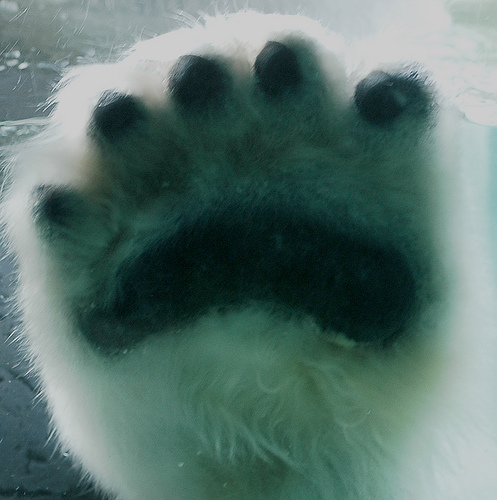
Polar Bear Paw by ucumari

Stories come to a conclusion when balance is restored to the main character. Sometimes that means a return from a journey, sometimes it means that a significant choice is made, sometimes it is a reclamation of something lost; always it means the character learns something and will never be the same because of the new knowledge. And hopefully, it also means we, the listener of the story, will know what to do in our lives when we are off balance and staring Doubt in the face.

Here’s the final chapter of the Polar Bear King:

IV. THE RETURN

One day passed. Then two. The great bear paced back and forth, looking south, awaiting the return of his great coat. How could he defend his crown without it? He paced and he paced and the third day came. The hundred gulls still had not returned with his skin.

All of the polar bears gathered outside the king’s cave. The time for the match was at hand. Woof was with them. He stamped around and boasted, saying “The bird-bear’s feathers will fly fast enough when I get my claws on them! Come out of your cave, bird-bear!”  All the other bears laughed and jeered. “Perhaps he is really a chicken-bear!” Woof shouted. The bears roared with laughter and snorted their delight.

Inside the cave the great king sat listening to their laughter, the gull queen perched by his side. “I don’t know what to do,” The king confessed.

The queen sighed and said, “It’s too bad that it is your skin that makes you a king. If your skin were here, we could ask it what to do!  As for me, I am only a bird. Covered in feathers, like you.

The Polar bear king looked deeply into her black eyes.

“Well, what would the King of the Polar Bears do?” the gull queen grinned.  The bear smiled, stood tall and ruffled his feathers, just like a bird would do, so that he appeared twice his normal size. “How do I look?” he asked the gull queen. “Like a king.” She smiled.

“Come out bird-bear!” Woof snorted. “Come out so I may pluck your plumes!”

The king of the polar bears walked slowly out of his cave, he was magnificent and proud, his white feathers glistened in the sun. Woof gulped. The king of the polar bears was enormous; he looked twice his normal size. Perhaps fighting this king was not going to be so easy after all. Perhaps fighting this king was silly! In fact, fighting this king was probably stupid! All the bears saw Woof shaking in fear – and then they started quaking because when he was done with Woof, he’d crush them all for sure!

The Polar Bear king gave an enormous growl and Woof’s little heart, for a moment, stopped beating. “Come, pluck my feathers if you dare!” the king snarled! Woof gulped. The king strode forward and raised his mighty paw, ready to strike Woof a deadly blow. Woof yelped and covered his eyes; he knew this breath would be his last. In his fear, poor Woof wet himself. Shivering, Woof cowered helpless in a bank of yellow snow.

The great king lowered his paw. He’d won without striking a single blow. And all the other bears, wanting to be back in the good graces of this most powerful king, laughed at poor Woof; they pointed and called him names like “Baby bear,” and “Pee-bear.” Woof hung his head low.

The great king roared and stopped them from laughing. He looked at them with piercing black eyes. Finally, shaking his head he said, “You shame yourselves by heaping shame on this bear. A moment ago this Woof was your champion. He was your friend.  Why do you choose now to hurt him when he most needs your support?”

Just then, the sky grew dark as hundred gulls flew down from above carrying the king’s great fur skin. They laid it at his feet and formed a perfect circle around him. The gull queen smiled and circled from above.

And all the polar bears saw that they’d made a grave mistake; a bear’s courage is not in its fur. They bowed low to their great polar bear king as he gathered his great coat. He looked to the queen of the gulls, winked a “thank you” and smiled. And then, she saw him, ever so slightly, go (clap, clap, shimmy-shimmy shake) and as he went back into his cave, he said, “Oh, yeah!”

The Polar Bear King (part 3)

Forgotten by (SD)

There is always a point in a story when the known world collapses. It is the moment when all of your superficial attachments fall away, when everything you thought you knew or believed is called into question. In many stories you leave behind all that you know (home) and journey to the place from which no one returns (where the monsters live). When you are living your passage story this place is often experienced as doubt (where the monsters live).

Within a caterpillar’s body, once cocooned, there begins a war between the known and the imaginal cells  – so called because these cells hold the encoding for the new form: butterfly. The caterpillars body reads the imaginal as a cancer and kills it back which only serves to make the imaginal stronger. Eventually, the imaginal cells overwhelm what is known and the caterpillar’s body dissolves to mush. This “mush phase” is the place of doubt and is as necessary to our transformation as it is to the caterpillar if it is to become a butterfly

Form-less-ness is never comfortable but as the old adage says, “you must lose yourself to find yourself.” This is how the Polar Bear King loses himself:

III. THE NECESSITY OF DOUBT

The two young polar bears ran from the king’s cave, laughing so loud that the other bears gathered to hear what was so funny. “Our great and mighty king has become… a bird!” they guffawed, “Who ever heard of a polar bear covered in feathers!”  In disbelief all the bears ran to see their king. They thought it must be a trick or a game but then they saw him and, sure enough, he was covered all over in feathers. They laughed and pointed and slapped their thighs in delight. They made bird sounds and flapped their big bear arms, running in circles around him.

The polar bear king sat in silence, his head lowered so they could not see the sorrow in his eyes.

Later that day, all the polar bears decided to have a meeting to discuss the great change that had come over their king. “He is no longer a bear,” said one. “He’s not a bird, either,” cried another. “He is half-bird, half-bear,” cried a third! And then a bear in the crowd shouted, “If he isn’t a bear then he is no longer fit to be our king!”  They all cheered and then grew quiet.

“Who shall take his place?”

“He who can defeat the bird-bear in battle will be our king. It is our custom!” said an enormous bear named Woof. “Only the strongest is fit to rule and I am the strongest bear here!” Woof stomped about and flexed his muscles.

There was silence for a moment and then all the bears nodded their assent. “It is our custom. You will fight him for surely now that he is a bird-bear you are the strongest of our race. Woof will be our king!” they all cried. So they sent a messenger to the Polar Bear king, telling him of the challenge, he must master Woof or resign his sovereignty. The match was to be fought in three days time.

The Polar Bear King was very sad. “Perhaps they are right, perhaps a bear with feathers is not a bear at all.”

“Perhaps.” Said the Queen of the gulls. She was hovering above him when the messenger came. “Perhaps they are wrong.”

“Only a bear with hair can hope to command their obedience,” snarled the King.

The queen of the gulls chuckled. “Oh, I see. Is it your hair that makes you strong? Is it your hair that gives you courage?

“You don’t understand!” growled the bear.

The gull queen sighed, “My friend, did you also lose your wisdom with your hair?” And then she said, “ I met an eagle yesterday that had just returned from the lands in the south. The eagle, while flying over a city, saw a huge big polar bearskin in the back of a carriage that rolled along the street. It must have been your skin. If you wish, I will send a hundred gulls to retrieve it for you.”

The great king jumped to his feet. “Are you sure? Can it be? Oh, please, send them now! Send them for me!” the great king pleaded. “I must have my skin before the match in three days time. Without it I shall be defeated.”

With a flick of her wing a hundred of her best gulls shot to the sky, straight as an arrow they flew to the south. “They will not disappoint you,” she said. (to be continued)