Face The Sun

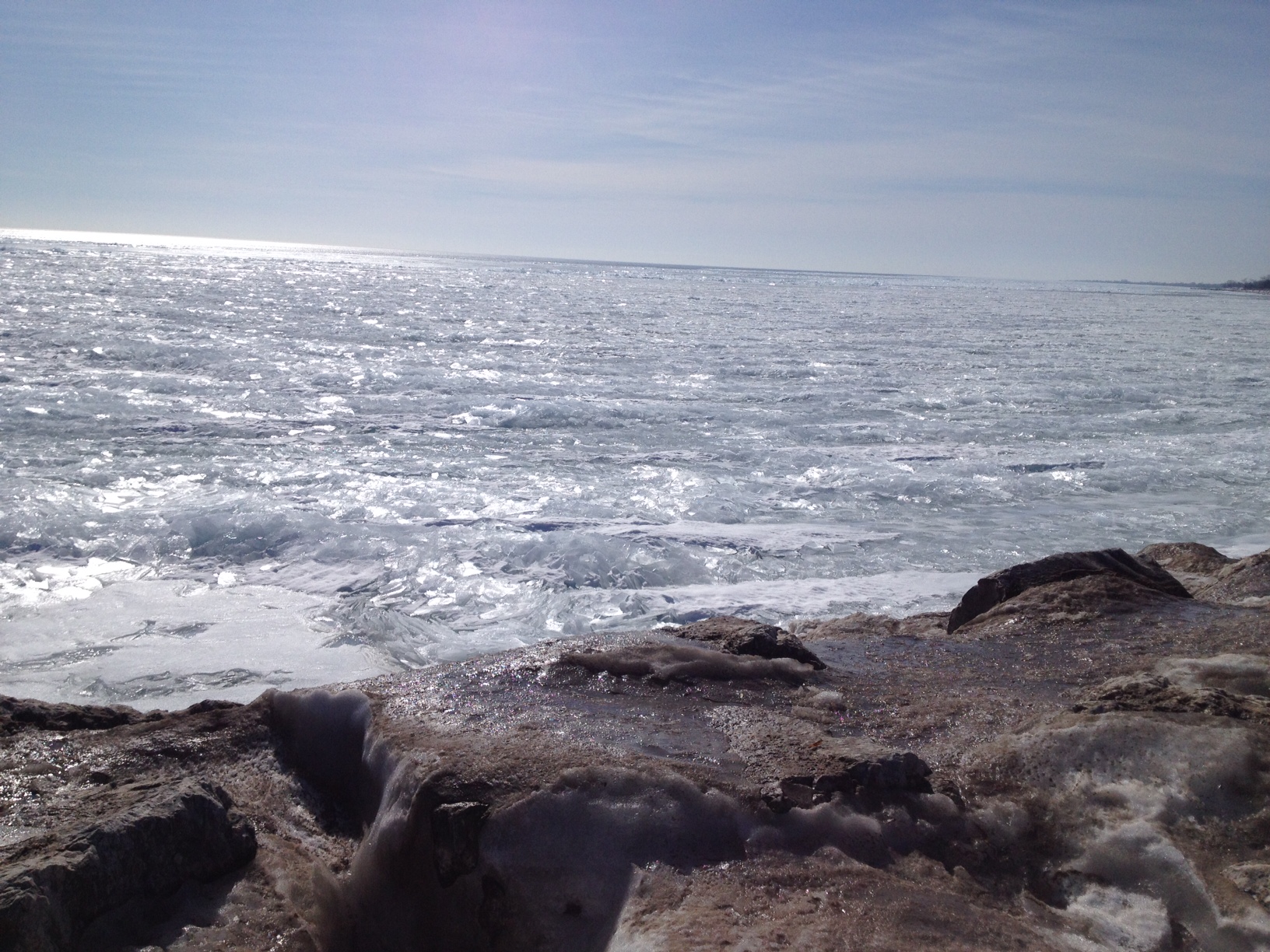
Lake Michigan frozen

Lake Michigan frozen

Standing on the sea wall, the sun on our faces, the frozen Lake Michigan looked like a vast field of broken glass, shards akimbo, glistening in the morning light. The shards popped and crackled, moaned and snapped; it was the first warm day in months. The birds frolicked. It was a small taste of spring, a gift before winter’s return tomorrow. I closed my eyes, faced the sun, and drank it in.

Kerri and I had just walked across the harbor. We watched the ice fishermen drill holes in the ice. The bit dropped more than two feet before breaking through. The fishermen assured us that the ice was very thick. “I’ve lived my whole life here and never seen the ice this deep,” the man said, sipping his coffee and looking at the lines he’d dropped in the water. We stepped out onto the ice, making a pact to rescue the other – and walked across the harbor.

The sea wall is on the far side of the harbor and usually requires a boat to reach. It is constructed of enormous boulders, some still encased in ice and looking like something the artist Christo might have created. On our water walk to the sea wall we snapped photographs, splashed in newly formed puddles, and left footprints in the snowy spots.  We laughed. We waltzed around an old fishing hole. We looked at each other and said over and over, “I can’t believe it!”

On the wall, listening to the ice chorus, my eyes closed and soaking up the sun, I photo-1remembered a conversation that I had years ago with Father Lauren when I was a student at The College of Santa Fe. We had great conversations because he knew I was not a believer in his faith. In many ways we saw the world from diametrically opposed points of view but rather than wrestle with winning the other to our perspective, we asked questions to try and understand. Father Lauren saw the earth as corrupt. I saw (and see) it as magnificent. We were talking about reincarnation and he’d just asked, “What kind of god would punish people by bringing them back to this place?” I responded with a phrase I’d recently heard in a lecture Joseph Campbell delivered about the gnostic gospels, “The kingdom of heaven is on earth and men just do not see it.”

Father Lauren closed his eyes and tried to spin his paradigm around. He asked, “So, we are already in heaven and simply need to open our eyes to the beauty of it all?”

“Yes,” I said. “That’s what I believe.”

He smiled, “I just can’t believe it.”

Standing on the sea wall, Kerri took my hand. The ice sang. She whispered, “I just can’t believe it.”  I wanted to reach back in time and tell Father Lauren, “Yes. That’s the thing! When you open your eyes and see heaven on earth, what you see is impossible to believe.” Heaven has nothing to do with belief and everything to do with what you choose to see.

“Me, too,” I whispered, the sun on my face. “It is unbelievable.”

Go here to get my latest book, The Seer: The Mind of the Entrepreneur, Artist, Visionary, title_pageSeeker, Learner, Leader, Creator…You.
Go here for hard copies (Amazon)

Hear Your Words

[continued from EAT WELL]

Craig originally wrote a post about the boxes people construct around themselves and the alternative choice of creating a stage.  After his post he challenge me to enter the fray and muck about with boxes and stage and I’ve been pleasantly surprised at how much I have to say – I’ve followed the thread for a few days and will probably keep following it for a few more. It’s a rich exploration!

Yesterday I mentioned that I had the opportunity to work with Skip’s Human Centered Design class at the Illinois Institute of Technology in Chicago. I tossed the group into several exercises and experiences designed to help them understand how people story themselves. Specifically, we took a look at language as the building block of perception. We captured on video portions of my time with the students so rather than write about it, here’s clip from the day. [Note: the real riches start about 2:30 minutes in but I thought the students questions might be of use to set the stage so I left it in the cut. They’d just completed an exercise of misnaming things]. Let me know if you find some juicy bits about the boxes we build around ourselves and our attempts to “step outside of the box.”

[to be continued]

Go here to get my latest book, The Seer: The Mind of the Entrepreneur, Artist, Visionary, title_pageSeeker, Learner, Leader, Creator…You.

Go here for hard copies (it’s Amazon…)

Look Beyond The Box

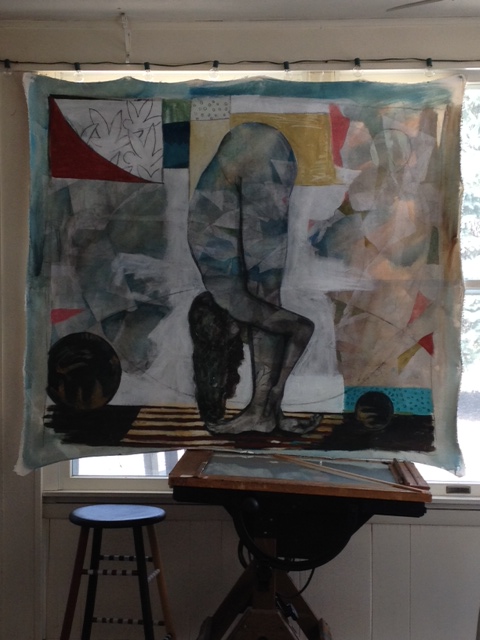
one of my paintings (untitled) from the Yoga series

one of my paintings (untitled) from the Yoga series

[continued from SEE THE BOX]

Craig’s question is bigger than a single post can accommodate. He’s both reflecting and asking several questions about the boxes people construct around themselves, about building personal “stages” and what becomes visible to us when we open ourselves to life without editor or inhibition. He’s asking deep river questions about the assumptions we make when we look at others through the lens of our own experience. He asked about what I see from my stage and when did I know to create my stage. And, here’s the kicker question, “When was the last time you stepped up and saw something you didn’t know was there?”

I want to start with the last question first because I believe it colors all of the other questions. At this point in my life, there isn’t a day that passes that I don’t see something surprising or new. I know that sounds like a superficial dodge until you consider that it wasn’t always the case. Like everyone else, I was schooled in a long series of mistaken notions: 1) that people need to know where they are going before they go there, 2) people need to know what they are doing before they do it, 3) knowing is something that happens in the head, and 4) that truth is singular and knowable; believers in right/wrong paradigms are especially fond of this point.

It took a few years (okay, decades) to realize that “knowing” is a process and not an arrival platform and, therefore, no body knows. People build boxes around themselves because they think they must know what is unknowable. People build boxes around themselves because they think they must look a certain way or think what others want them to think. People build boxes around themselves in an attempt to control what they can never control. No one really knows where they are going (well, everyone knows where they are going but dying is an existential question – a topic for another post). No one knows what tomorrow will bring. As Marshall McLuhan wrote, people step into the future with their eyes in the rearview mirror. We make sense of today through yesterday’s eyes so we can only “know” what happened, not what will happen. The day before September 11, 2001 people walked into airports to greet their friends and relatives at the gate. And then, the very next day, like millions of people, I sat in front of a television and watched a plane fly into the World Trade Center. That day I understood that what I thought I knew was basically useless.

Each of us has, at one time or another, had a personal September 11th. People learn. They grow. They have experiences and then make meaning of their experiences. People change. Life is a moving target. At one point in my life I started my own school within a school. It was experiential and filled with filmmaking and theatre and performance art. At the beginning of that era of my life I thought I would run that school until I the day I died. Three years later, I was done with my exploration in education and I surrendered my cushy tenured position and ran for the air of uncertainty. People story themselves according to inner imperatives through lenses of past experiences. The idea that we are primarily rational and reasonable is…not rational or reasonable.

At some point, when you cease thinking you know stuff, your eyes open. You see beyond what you think. Everything is surprising beyond the dull-wit of thinking. Thinking (a language-based activity) will always be an abstraction. Put a word on something and you delude yourself into thinking that you “know” what it is. This is especially heinous when applied to other people. People build boxes around themselves because of the words placed on them or the words they place on themselves.

Mostly, people build stages for the exact same reason. Saying, “I’m not going to be influenced by others; I’m going to act independent of others” is also a delusion constructed from notions of “knowing” or trying to determine how others will see you. Most stages are constructed from the desire to control. Sometimes the biggest box looks like a stage.

When you no longer need to know anything, you see surprising things everywhere you look.

[to be continued]

Go here to get my latest book, The Seer: The Mind of the Entrepreneur, Artist, Visionary, title_pageSeeker, Learner, Leader, Creator…You.

Go here for hard copies (it’s Amazon, don’t be afraid;-)


Take The One Action

a work in progress. I'll call it "Salutation"

a work in progress. I’ll call it “Salutation”

It is true that, at the end of the day, we are our own best obstacle. Nothing is better at blocking meaningful action toward a dream than our personal story of doubt and fear. It comes in many forms, like, “Who am I to think that…,” or “If I only had some time I’d…,” or “If I only knew how to start, I’d….”

Lately, I’m fascinated with a specific form of the best-personal-obstacle canon: why do we take any action EXCEPT the one action that matters. For instance, I hear often statements like this: “I want to be a writer, but….” Anything following the statement of desire is a self-generated obstacle. There’s not enough time. No one will like what I write. Fill in the blank. The single action that matters is to write. Sit down and write. That is how one becomes a writer. And, if the writing happens everyday, one will become a better and better writer. Anything else is a well-placed, self-generated obstacle.

The question is, “Why do we need our obstacles?” What does placing a boulder in the road do for us? There is an obvious answer: it keeps us from the scary prospect of fulfilling our dreams. Fulfilling a dream requires showing up and expressing a personal truth. Personal truth is, well, personal, and will always meet resistance because there are billions of personal truths walking around out there.

The refusal to take the single-action-that-matters applies to the everyday. How many times have you swam in a pool of overwhelm rather than pick up the phone and make the call that you know you need to make? Once, when I ran a theatre company, I knew I needed to fire an employee but I didn’t want to do it. She was a nice person. She wasn’t doing her job. We had countless meetings discussing why she wasn’t taking the one single action that mattered (doing her job). And, so, I didn’t take the one single action that mattered (letting her go). When I finally mustered the courage to fire her, she thanked me. She wanted to do something else with her life but didn’t have the courage. When I fired her, I pushed her out of the nest. I became the circumstance that pushed her into the one action that mattered.

I think that’s the point of not taking the one action that will actually matter. We allow circumstance to decide for us. We delay until the bill collector comes or until the boss fires us or until we are sitting in a rocking chair telling the story of why we never had time to write. If only….

Go here to get my latest book, The Seer: The Mind of the Entrepreneur, Artist, Visionary, title_pageSeeker, Learner, Leader, Creator…You.

Go here for hard copies

Stand With Hope

Untitled Narrative by David Robinson

Untitled Narrative by David Robinson

Here’s my gorgeous quote of the day. It came from Barney during a conference call with Skip. We were talking about yesterday’s striking quote, “lost is the new normal.” Barney reflected that being lost (not knowing) is a beginning. He said, “It necessitates that we stand in the presence of hope.”

Isn’t that elegant! Do you remember the last time you stood in uncertainty and whispered quietly to yourself, “I do not know what to do?”  Did you recognize the moment as a beginning? Why is “not knowing” what to do so frightful? What assumption set requires us at all times to know? Knowing what to do is, at best, an illusion.

“Not knowing” is the beginning of learning. Learning has nothing to do with knowing. Learning has to do with exploration. Life has nothing to do with knowing. Life has everything to do with experience and engagement. Every educator, mentor, guide, and leader should listen to Barney’s thought.

What if we understood that being lost was nothing more than a beginning and the gift of “not knowing” was that, for a moment, we might stand silently in the warm presence of hope? What if we understood the role of student to be a long walk in the presence of hope? Can you imagine who we might be as a society (and as individuals) if we understood the need to test for the presence of hope before we ran tests for knowing stuff?

Go here to get my latest book, The Seer: The Mind of the Entrepreneur, Artist, Visionary, title_pageSeeker, Learner, Leader, Creator…You.

Go here for hard copies of The Seer


Step Toward It

from the cartoon series, FLUB, by David Robinson

from the cartoon series, FLUB, by David Robinson

[continued from Expect The Possible]

Change processes are funky in a society wholeheartedly dedicated to maintaining comfort. Comfort and significant change are rarely bedfellows. Real change might include a sigh of relief or a temporary feeling of elation, but melting down an old form and forging it into something new requires plenty of heat and a sizeable hammer.

If the first Great Impossibility in transformation is the expectation of knowing “how to do it” before you do it, an insane expectation, the second Great Impossibility is insanity with thorns. It, too, is based upon a false expectation: the walk into the new thing will be a cakewalk. It won’t.

Pain plays a role in the body. It alerts us that something is wrong. Pain plays the same role in a psyche. It alerts us to discord. It wakes us up. It makes us look for options. It prompts us to seek health and the relief of pain. It motivates us to consider trying something new.

In story cycles, it is pain and discomfort that prompt the protagonist to step away from safety and the known and go on an impossible journey. Going into the belly of a whale is not supposed to be a party. Discomfort shakes the tree of perspective. It opens our eyes to whole new and previously unseen fields of opportunity.

To remove the discomfort is to stall growth and minimize potential.

In organizations there are people whose job it is to manage change. The change manager is supposed to make the change as painless as possible. It assumes the horse of change wears a rein. It doesn’t. Unless you are rearranging the deck chairs on the Titanic, change cannot be managed.

Often in organizational change, people lose their jobs and that is the equivalent of an identity loss.  In personal change, people lose their way. Being lost in the woods or not knowing who you are is rarely fun. It is, however, painful and there’s nothing like discomfort to fuel movement toward something new.

Expect it. Court it. Walking into a fear is never fun but slaying the dragon you find in the fear is triumphant. The walk into fear is necessary to find the dragon. They go together. Just as life is not vital without the knowledge of death, transformation is not possible without discomfort. You might find that most of the pain actually comes from the attempt to avoid the pain. Step toward it.

Go here to get my latest book, The Seer: The Mind of the Entrepreneur, Artist, Visionary, title_pageSeeker, Learner, Leader, Creator…You

Visit Amazon.com for hard copies: The Seer + David Robinson

Circle The Nutshell

An illustration from A Dragon's Tale by David Robinson

An illustration from A Dragon’s Tale by David Robinson

A few days ago someone asked me, in a nutshell, to describe my book. I am a circular thinker and nutshells are generally too tight for me. Also, I tend to rant (my apologies to the many of you who’ve had to sit through my bluster) even when I have no intention of ranting. Fortunately, I made concept maps as support material found at the back of the book; being required to practice concept brevity has helped me find some sense of concision.

Here is my answer to the question: The book is about how to flip into a creative mindset (actually, it’s about how to regain the fantastically creative mindset that we are all born with but that requires some explaining. It’s easier to say, “flip perspective into…” like you can change your clothes and become an innovator. And, actually, that might be true if you assumed the role that the clothes inspired. For instance, Keith Johnstone writes about a “creativity” study done in the 1960’s in which people scoring low on a creativity test were asked to dress and act like hippies. They were then asked to retake the test in their hippie role and scored much, much higher). I warned you – I’m a circular thinker.

The rest of the nutshell goes like this: The book follows 3 cycles and each cycle facilitates a perspective flip:

The first cycle is Pattern: the flip is from needing “to know” to embracing not knowing (orient to patterns of curiosity).

The second cycle is Story: the flip is from “Things happen to me” to “I make things happen” (orient as the teller of the story). This one is the big one: people become capable of fulfilling their extraordinary capacity when they see how they make things happen.

The third cycle is Choice: the flip is from identifying as a witness to life to identifying as a creator of life (orient as a participant – a bringer of life).

And, the meta-flip that runs through it is all: Have the experience first and make meaning second. This is how your brain actually works. When you fool yourself into believing that you bring meaning to an experience before you actually have it, you are either lying to yourself, dulling your senses, or protecting yourself from learning something. Innovators, artists, creators, leaders, seekers, visionaries, and learners make their meaning after they have an experience: they know that the world is new every day.

Go here to get my latest book, The Seer: The Mind of the Entrepreneur, Artist, Visionary, title_pageSeeker, Learner, Leader, Creator…You.

Go here for hard copies

Be Holy

Eve, by David Robinson

Eve, by David Robinson

Pastor Tom asked the question, “What does it mean to be holy?” It caught me by surprise because I was sitting in the choir loft reading Paulo Coehlo’s, The Zahir. For the record, I usually pay attention to Pastor Tom’s sermons; he’s a gifted storyteller and one of a handful of preacher’s I’ve met who is actually rooted in a greater spirituality and not the rules and restrictions that bind the religious. He’s not a judger; he’s a seeker and his sense-making lens is Lutheran Christianity. We are just beginning our friendship and since I have a remarkably different lens I look forward to all that we have to share. But, on this Sunday I was plagued by an odd and surprising inner imperative to take The Zahir to church and read the next sections. I’d stopped in the middle of a chapter and I awoke with my inner nag screaming, “Take it with you! Finish the chapter! Now!!” I’ve learned to listen to my inner nag.

Life is funny. I never in my wildest dreams thought I’d be hanging out in a church. Many years ago I used to hang out with Father Lauren and talk theology. I was not Catholic but attended a Christian Brother’s college; the college had a great theatre program. Father Lauren was a Franciscan and came into the theatre one day to find an artist to help him make some banners for a high mass. I was the artist he found and we were immediate fast friends. He was more interested in the mystic than the pious aspects of his faith and I, too, am drawn to the mystic in any faith tradition. I began attending mass so we could compare notes. I found (and find) my greater spirituality in rivers, the arroyos, and the wind; his faith was solidly grounded in the rituals of the church.

Father Lauren believed in original sin: it is the idea that nature is corrupt – particularly human nature – and must be controlled. I believe the opposite: nature is perfect and health comes when we align with our nature and stop trying to control it. We talked for hours about the differences in our orientation to life. I appreciated our conversations because we weren’t trying to sway the other or win a point. He was not trying to convert me and I was not invested in being right. We were trying to appreciate and understand the other point of view. We were asking the other, “From your point of view, what does it mean to be holy?” To Father Lauren, a human might become holy if they transcended their nature. To me, a human is holy because he or she is nature; the challenge is to recognize the truth of your nature. As someone once said, “There are many paths up the mountain.” Father Lauren and I were like travelers swapping stories from the road. I loved our exploration of faith and life.

I was sitting in the choir loft and had just finished reading this passage from The Zahir: “Yes, we are all cathedrals, there is no doubt about it; but what lies in the empty inner space of my cathedral?” If you saw yourself as holy, how might you fill your space and time? Paulo’s response to his question: we need, each day, to rebuild ourselves, to improve our structure as best as we can so that we might understand and accept this: we are capable of loving another person more than we love our selves. To be holy is to love another more than you love yourself. To be holy is to fill your personal cathedral with the love of another. That’s the exact moment Pastor Tom asked, “What does it mean to be holy?” My inner nag smiled and whispered, “Told you so.”

Go here to get my latest book, The Seer: The Mind of the Entrepreneur, Artist, Visionary, title_pageSeeker, Learner, Leader, Creator…You.

Water The Seed

Illustration 07 Illustration 08In 2004 I wrote and illustrated a children’s book, Lucy and the Waterfox. I could have sworn that Lucy was only 5 years old and was taken aback to realize that she’d been around for a decade. Time flies! I recently bought a copy of Lucy since I had nothing in the archives and I will soon release her in versions for ipad and kindle. She’s an old fox and is not available in digital form. It felt funny to buy my own book. I was delighted when she came in the mail! It was as if she was coming home.

It had been a few years since I’d read Lucy so I was taken aback (again) by the parallels in Lucy to the book I just released, The Seer. I’ve been chewing on these ideas for a long time! In The Seer there is a mysterious guide named Virgil who challenges the assumptions of the main character and helps him reorient to a healthier more powerful way of being. In Lucy, a mysterious storyteller emerges from the forest one night; his story stirs deep yearning in Lucy to own and fulfill her extraordinary capacity. Lucy, I recognized, was a seed for The Seer.

Ten years ago I was hired to tell a story in several installments at a conference of health care providers. The conference lasted 3 days and the story served as a thread that tied all the conference segments together. The story also provided a central metaphor for the participants; it served – as stories always do – as the force that forged the individuals into a community. The participants had deep, meaningful conversations because they didn’t get stuck in the superficial, literal levels of their topics. They went into the well through their metaphor and, instead of trying to fix problems they explored their choices and opened to new opportunities.

On the second night of the conference there was a talent show and the organizers approached me and asked if I would tell a simple short story. I had nothing prepared but knew I had a little ditty in my journal about a fox named Lucy. She had a gift and was hiding it because it made other foxes uncomfortable. I told her story and Lucy was such a big hit that night, I received such enthusiastic feedback, that I returned home, illustrated, and published her. The experience of publishing Lucy inspired me: I’d never before thought of myself as a writer. Publishing ideas and stories was nowhere on my personal radar.

A decade later, publishing ideas and stories is the only thing on my radar. I have so many ideas! I have so many stories to tell and more show themselves to me everyday.

I’m delighted that Lucy came home to remind me that in the decade since she was born that I have grown, too, and have a much expanded personal radar. I look forward to the day, a decade from now, that a copy of The Seer comes in the mail and I say, “Whoa. Look at that! I’ve been chewing on these ideas for a long, long time.”

Go here to get my latest book, The Seer: The Mind of the Entrepreneur, Artist, Visionary, title_pageSeeker, Learner, Leader, Creator…You.


End The Ambiguity

Photo by Paulo Brabo

Photo by Paulo Brabo

I’ve been reading books about training a puppy because I have a puppy who already knows how to train me. Whenever I need to level the playing field I buy a book. I’ve bought several on puppy training and still I’m being out-maneuvered at every turn.

The notion I’m reading over and over again in my books is that puppies are happy when there is no ambiguity (no grey zone – see yesterday’s post: Exit The Grey). Puppies don’t do well with debates. They require a clear and consistent message.

In this regard, people are no different than puppies. Children prosper when they know the boundaries. People play when they know they will be safe. Artistic freedom is often defined by the constraints. Doug Durham, a brilliant teacher of at-risk youth, once told me that his job was to draw boundaries and hold them: kids know they matter when the adults hold a clear, fair, and consistent line.

Coincidently, I’ve also been rereading The Mastery of Love by Don Miguel Ruiz and it turns out that fear stories (stories of enabling) are filled with ambiguous grey zones and the subsequent debates that weak boundaries breed. To master love is to practice love. To practice love is to eliminate the grey zone. Eliminating the grey zone requires knowing what is yours-to-do and what is not yours-to-do. It is puppy simple: taking responsibility for your happiness is yours-to-do.  Taking responsibility for the happiness of others is not yours-to-do. There’s no grey when the message to your self is clear and consistent. There is no grey zone when your message to others is clear and consistent. Life becomes the mastery of love.

Assuming ownership for your own happiness ends the ambiguity. Paradoxically, a black and white line opens life to a full range of color. When you understand that your happiness is your responsibility, there is no one else to blame. What remains is the recognition of love without condition; something my puppy knows without doubt and is diligently attempting to teach me.

Go here to get my latest book, The Seer: The Mind of the Entrepreneur, Artist, title_pageVisionary, Seeker, Learner, Leader, Creator…You.