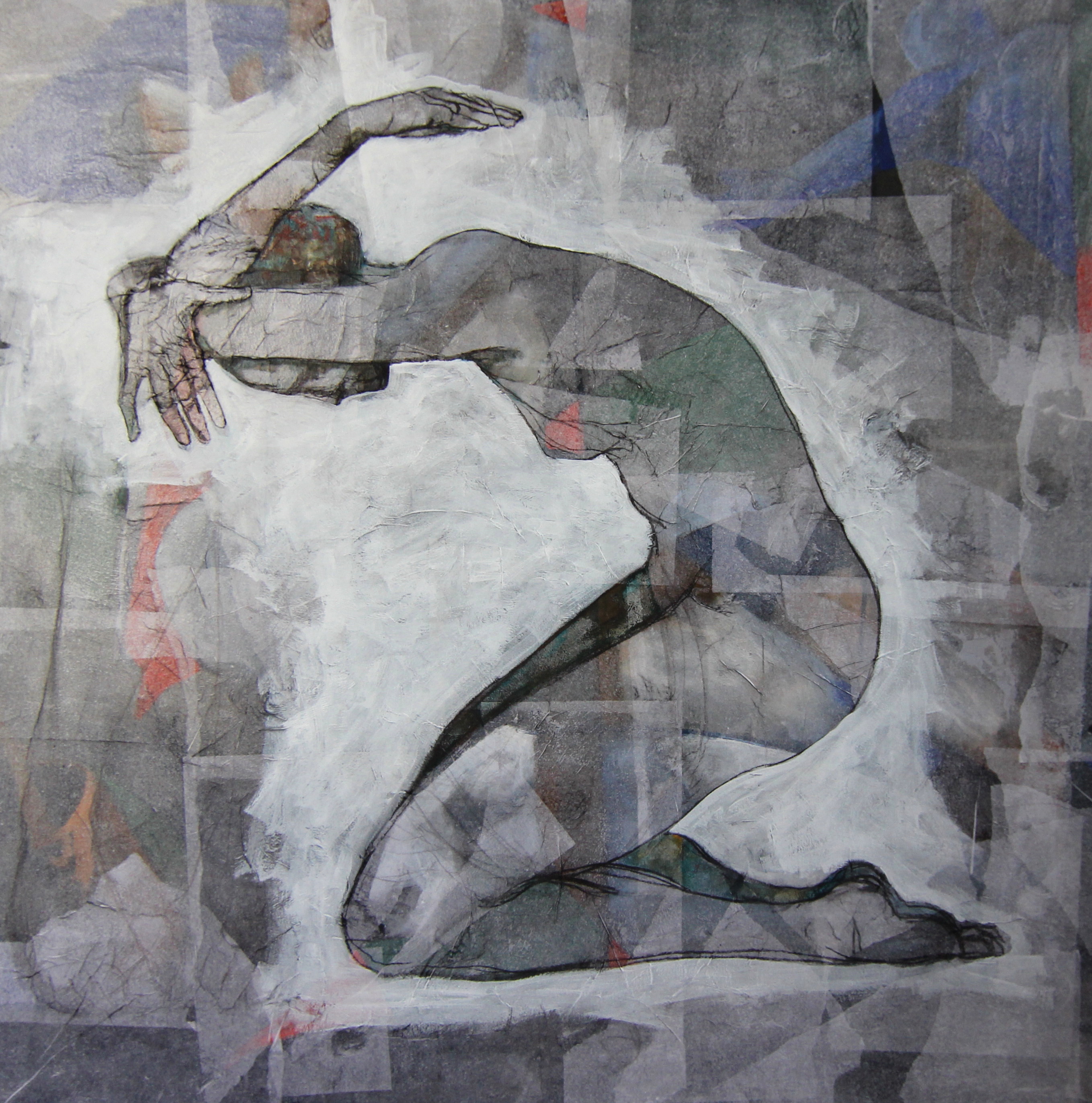
After hurricane Katrina I was invited to write and illustrate a children’s book. There is only one copy: the original went to a child displaced by the storm. This is the first plate. The book is called ‘Peri Winkle Rabbit Was Lost.’
Another of the revelations that tumbled through my mind yesterday concerned “splits.” I’ve written often about split intentions, a concept that the fabulous Viv McWaters encapsulated for me when she offered the Chinese proverb: Chase two rabbits and both will get away. Much of my organizational, educational and creative coaching life has been in service to clients who come to me when they have split their intention and are watching both their rabbits escape. I helped them unify their intention and, therefore, clarify their pursuit.
The dark side of the moon that I rarely talk about (and that came clear to me yesterday) is the necessity of a split intention at certain points in a process that make growth possible. The best example is the split that happens within a caterpillar’s body once it cocoons. The encoding for “butterfly” activates, the caterpillar’s body reads it as a cancer, and a battle ensues. A split occurs: to remain a caterpillar or to become a butterfly. Old systems do not easily let go so the caterpillar’s body fights and nearly defeats the inner butterfly intention. However, the resistance makes the butterfly code grow stronger and it fights back. This back-and-forth inner debate progresses until finally the caterpillar’s body collapses into mush (in story cycles, this “mush phase” is the step into the unknown). The mush slowly takes on a new shape and a new identity emerges. The final necessary battle is the newly formed butterfly’s struggle to exit the cocoon. Help a butterfly out of the cocoon and you will kill it; the final struggle is necessary for the wings to grow strong.
This necessary split plays out in humans, too. All change (all stories) begin when the main character (you) are knocked off balance by an event or an inner imperative. This is the moment of a necessary split intention: do I stay or do I go. After being knocked off balance we do the same thing that the caterpillar’s body does: we run to safety and grab onto what we know. We fight off the necessity of change, denying the imperative, grasping for the feeling of security we no longer possess. This is a necessary phase! This debate, running to the safety of home and hiding – and then walking to the edge of our known world and staring at the horizon – and running back home again, creates heat. It gets energy moving. This back and forth, this inner split intention is necessary. It makes the imperative grow impossible to ignore. It is the process necessary for the main character (you) to understand that what was once secure is now suffocating. The discomfort of the unknown becomes more attractive than the safety of the known because of this inner split, this tug-of-war. When, like the caterpillars body, everything goes to mush and there is no way to go back, the only way forward is to step into the present moment without form or identity. Letting go of the known, stepping into the unknown, is the beginning of reunifying the split. Stepping into the unknown is a commitment to a single rabbit to chase.
The split creates the heat necessary for change. At the right moment in every life story, just as in the caterpillar’s transformation, a split intention is essential. To rush through this phase is just as devastating as trying to help the butterfly out of the cocoon. Trying to eliminate the discomfort too soon is a sure way to stay split and ultimately kill the transformation.
 Seeker, Learner, Leader, Creator…You
Or, go here for hard copies (Amazon)
Filed under: Creativity, Energy, Identity, Story, Truly Powerful People | Tagged: growth, Self Growth, split intention, story | Leave a comment »

 Seeker, Learner, Leader, Creator…You