See Like Celeste

“The life of every man is a diary in which he means to write one story and writes another, and his humblest hour is when he compares the volume as it is with what he vowed to make it.” James Barrie

Celeste died last week. Megan gave birth to her first child, a daughter. Stephen graduated from high school. Sally had a life changing epiphany. Dado brought the mail as he does each weekday; you can set your clock to Dado yet he always seems to have plenty of time to talk. Bruce came to visit after a seven-year absence. Tess had her teeth pulled and then had a birthday. Lora sold her first photograph in a gallery. And then her second and her third. Amy shared her poems and also shared a dream. Pete made a collage and had it printed; he’s making a portfolio, his first. Harald and I each drank a Stone and later split an Arrogant Bastard. And that was before dinner. Lisa took a vacation, a trip with her son. She will marry Harry in July. Don walked to the bank on the first sunny day of the season. Arnie returned from travels abroad and left a message on the machine. Dane had a conversation with his friend Brian, a mechanic. They have rules about what they can talk about: no politics, no religion, no talking about wives. Tania and Chan bought their first house. Kate sent a hilarious limerick. Lorilee shared photos of her green wall. Gwyn wept. Rosemary and Lona sent poems for the tribute Judy was assembling. Carol resurfaced. Scott asked for advice. Mark prepared his ship for Alaska (seriously) after he went to drawing class. Makaela wore a dress to the opening of the museum she helped create. Patti wrote an obituary, prepared a eulogy, and helped Nina live more comfortably – all in a single day. Joe walked by the tide pools and laughed with delight. Stephen (another Stephen) rolled his paintings out for us to see; he had fire in his eyes. Nicole brought chocolate and shared it! Ana went home and faced her demons. They were not as big as she remembered. Theresa knew what coffee to make before I even ordered it. Made brought popsicles and comfort. Class met and embodied a purpose. Sue offered her thoughts. Kendy asked for prayers for Max. Max had surgery on his heart. We bumped into Diane in the hospital, to our great delight as we’d lost touch with her. Kathleen is off-loading the stuff of her life. Her sister came to help. Liz has a new garden. Duncan drank really good coffee and watched his first episode of LOST. Joyce interviewed Alan and is looking for others to interview. John is designing and building furniture for a restaurant because he’s never done it before. Beau catered a meal for 300. Margaret got lost in her thoughts. Ken sent his congratulations.

I could go on and on and on. This list barely touches the marvels of this week.

Celeste died quite suddenly. She was 82. Because she was so alive her death at age 82 came as a shock. She taught me that James Barrie had it all wrong. I think she would have rewritten his quote this way:

“The life of every person is a diary in which we mean to write one story and write another. Our humblest hour is when we realize the story we meant to write is not nearly as interesting as the story we actually lived, if only we had the eyes to see it.”

Celeste had the eyes to see it; she savored it – each and every moment. If you had met her, you’d have found yourself savoring a bit of life, too. Her enthusiasm and present-focus was infectious. Like me you’d be making a list of all the little moments and the big that happen each week in your life, a practice to remind yourself that the value of your life is not in the Academy Award that you may never win, it is in the relationships that that you probably discount; it is in the present moment that you miss because you are flailing yourself for not being something or somewhere else.

In response to my question, “What do you bring?” this is how Celeste replied:

“I bring a willingness to be open to whatever excitement is waiting!  I look into the eyes of each person I see, and have my arms ready if a hug is appropriate.”

Yes. That’s it.

Meet Beneath The Boardroom Table

“A single event can awaken within us a stranger totally unknown to us. To live is to be slowly born” Antoine de Saint-Exupery

Sam is an extraordinarily gifted facilitator and coach. His specialty is helping corporations have hard conversations. Let’s face it, people in organizations are no better than people in other forms of relationship at having difficult conversations. Like the rest of us they don’t want to feel uncomfortable so, when discomfort looms, they chatter, that is to say, they avoid, deny, pretend and ignore their distress. When their dis-ease swells to the point of silence, they call Sam.

One day Sam was working with an executive team at a multi-national corporation: people in power suits seated in high-back genuine leather chairs around a larger-than-life, acres-long, mahogany and oak boardroom table. And, although the coffee was served in china cups, the fruit plate was fresh and aesthetic, his clients paid no attention, employing every avoidance strategy in their arsenal: blackberries were clacking and cell phones were binging, assistants were beckoning; status toys are fantastic tools for avoidance. Sam tried everything in his arsenal to crack their citadel of “professionalism.” “Professionalism” is a favorite ruse of businesses to avoid meaningful contact:  under the guise of “professionalism” business folk posture and pretend that they are not comprised of people in relationship; they will, if pushed, cop to being ‘people’ as long as the definition of ‘people’ includes 1) compartmentalizing themselves so that their feelings do not interfere with their powers of reason (thereby rendering themselves less than human), and 2) pretending that they believe #1 is actually plausible; you know, “business is business,” “nothing personal,” and so on. With relationship comes responsibility and responsibility is the last thing most businesses want (the legal department has cautioned against it). To have a meaningful conversation, especially a difficult one, even “professionals” must first entertain the possibility of entering into a relationship. Do you see Sam’s dilemma?

After a morning of extreme executive evasion, in exasperation, Sam did the unthinkable. While the team yammered on about anything other than what they needed to discuss, Sam ever so slowly slid out of his leather power chair until he disappeared from view beneath the table. In the shocked silence that followed, Sam watched all the executive legs fidget until finally one curious face peaked beneath the table. Sam waved and motioned for that person to join him. Then another face, looked. Sam and his new ally waved and motioned and that person slid under the table, too. One by one, all of the power suits slid under the table and joined Sam, leaving their status toys behind. When they were all “under the table,” Sam whispered, “Now that we’re under the table, can we finally begin talking about what’s really going on in this organization?” They laughed together and began a very difficult and honest conversation that addressed the real issues impeding their growth, a conversation that included their feelings.  They left behind their individual stories of blame and victimization and began the process of creating a new narrative together, a narrative that included the possibility of feeling discomfort.

When Sam slid under the table, he cracked their masks of professionalism, neutralized all the roles being played, and removed for a while the status games being waged so that his clients, a group of people in relationship, could reach beyond their compartmentalization and grasp what was personal and relevant about their challenges and their lives. He made them aware of the destructive story they were playing and helped them imagine themselves playing a different story, one that included support and collaboration along with competition and success. I imagine the old story was lonely to play so the new story must have come as somewhat of a relief.

I think of Sam slowly sliding beneath the boardroom table every time my courage fails me and I think I “should do” something “because that’s what is expected” or “it’s the way things are done.” I think of Sam every time I cast a group I am about to engage in the role of “enemy” or convince myself that “they” will meet me with resistance. Any time I stereotype a person or diminish another’s point of view (or my own), I imagine myself sliding down my high-backed red leather chair, surrendering my status, and slipping into the unknown beneath the power table because that’s where the shoes can come off, the collars unbuttoned, and the humans – uncompartmentalized, vulnerable, and responsible to each other – can see beyond their dramas and find each other again.

Step Out Of The Fog

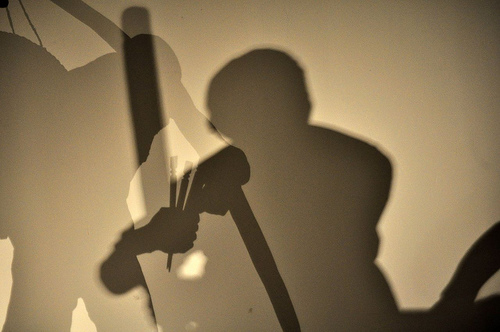
Shadows Of Imagination by Maggie's World

We are hardwired for story. We can’t help it; it is what we do. We interpret, we judge, we speculate, we remember, we ponder, we investigate, we justify we imagine,…we story. Meaning-making and interpretation are processes of story. We narrate each moment of our lives. I call this the-story-you-tell-yourself-about-yourself.

The-story-you-tell-yourself-about-yourself is often hard to see because, well, you don’t see it as a story.  It’s your life and you are so used to the inner-narrative that you stop recognizing your self as the narrator/interpreter of your life. Your thoughts, judgments, comparisons, expectations, investments, aspirations and fears are your story. As much as you want your point of view to be fact, it’s not. It is truth relative to you but not to anyone else. These stories you tell do not exist outside of you; they are your creation. Don’t let anyone tell you that you aren’t creative! We are, each of us, masterful storytellers.

Neil Postman writes,”Our genius lies in our capacity to make meaning through the creation of narratives that give point to our labors, exalt our history, elucidate the present and give direction to the future. To do their work, such narratives do not have to be “true” in a scientific sense…. The purpose of a narrative is to give meaning to the world, not to describe it scientifically.”

It’s when we confuse our story for truth that we get into trouble. There is an image that I love from the story of Sisyphus. It illuminates both the power and the problem of this inner storytelling:

Sisyphus has been taken to the underworld. He’s in trouble for making the gods look bad – twice. He has crossed the river Styx but isn’t yet allowed to get out of the boat. He has to wait and while he waits, he watches all the other souls file off the boat and mingle on the banks of the river. He is stunned when he realizes that each soul is so invested in their story that they don’t realize they are surrounded by other souls; even though they are in a crowd, each believes they are alone. Their story wraps around them like a blanket of fog, their inner chatter obscures them to the presence of others.

The-story-you-tell-yourself-about-yourself becomes an especially thick fog when used to belittle the teller (you). Using your story against yourself is guaranteed to isolate you. It is hell. Stories of “I’m not good enough” or “I have to be perfect.” Stories of “I am racing to get there,” stories of “past shames” and “future fears.” Stories act like a dense fog when they swirl around you and pull your focus from the present moment.

The lesson I most appreciated in art school came during the first class of the first semester. The professor, a short burley man who wore a walrus mustache and smelled of pipe tobacco asked us to examine a yellow #2 pencil. His simple question made us roll our eyes, “What color is the pencil?” We groaned and yawned in unison, “Yellow!” and acted as if the poor man was daft. He asked us to look again, to really look. He challenged us to see what was there and not what we thought was there. When I looked again, really looked beyond my thinking, I saw an explosion of color, reds, greens, and purples. I saw beyond my abstraction (story) and what was before me came to life. It was a festival of light and shadow all dancing in the form of a #2 pencil. For a few moments I suspended my story; I saw.

As Sisyphus sat in the boat, watching all the other souls wander lost and alone, wrapped in a fog of their own creation, he saw. He awoke to the story-he-tells-himself-about-himself and knew that it was not truth. He chose to tell a different story. The myth tells us that his new awareness transformed him. He became present in his life.

We are hardwired for story. We can’t help it; it is what we do. And, like Sisyphus, we have the capacity to recognize our story for what it is, and tell a different story. We have the ability to step out of the fog.