Truly Powerful People (104)

104.
Join me in inspiring truly powerful people. Each day I will add a new thought, story or idea to support your quest and mine.

I’m having the oddest experience and am a little off balance. I opened a time capsule today – a capsule that I packed with great care and attention more than a decade ago. A few moments ago, I opened the lid. There was lots of stuff in the box but nothing that I remember putting in it – instead I found many things that I remember leaving out precisely because they were not essential. What happened?

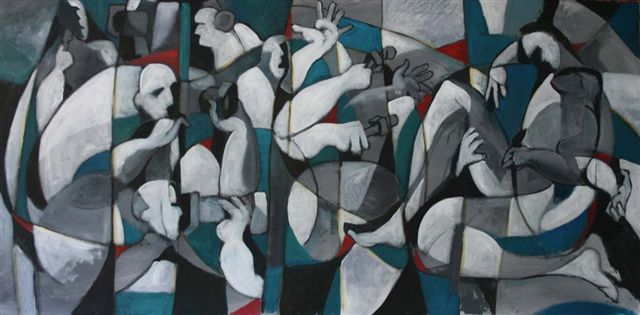
Many years ago I burned most of my paintings but before I did, I carefully chose 20 or so of my favorites, rolled them, sealed them in a box, and sent them to a friend. He promised I would never have to see them again. Recently, after more than a decade, I was ready to reclaim those paintings and my friend sent them back to me. This was the box I opened the today.

The paintings that I found rolled in the box were not the great paintings I remember selecting, in fact, most were pieces, had I not burned them, I would have painted over – only the canvas was worth saving!

I burned the paintings on a beach at a fire pit and people helped me – people I did not know, walking by, recognized what I was doing and wordlessly helped me. They held vigil with me by the flames. They helped me stack the paintings on the fire. An elderly man helped me carry a painting from my truck – it was the last painting in the truck that day – I remember it vividly – and together we set it on the flames. Today, I pulled this painting from the box.

The universe is a trickster that reminds me to laugh, to not attach too strongly to what I remember, to let my gods run like sand through my hands. Over three long days in 2000 I let go of my paintings and my idea of myself. Today, I let go of those things all over again – only this time there was no need for fire. I can laugh.

Truly Powerful People (102)

102.
Join me in inspiring truly powerful people. Each day I will add a new thought, story or idea to support your quest and mine.

I know why there are so many artists and poets in Nebraska. It is the sky. There is a lot of it and it changes dramatically by the minute. I’ve been here almost a week and I can no longer count the times that I’ve been stopped in my tracks by the ballet that happens there.

All the way down 2nd Avenue, P-Diddy and I screamed like we were kids on a roller coaster, the lightning storm was a terrifying and brilliant ride. The clouds help me understand the Greek plays, the grey roiling angry power of Zeus and moments later all is forgiven, pink roses blossom and I am breathless. The base thunder shook my hotel and by the time I got outside to stand in it the sun was on my face and I wondered if I had imagined it.

Patti and I stood by the rental car long after the gas pump had turned off and watched the sky flicker and crackle with lightning too far away to hear. It went on and on and on, I held my breath for several minutes of sky dancing. It was the best fireworks display I’d ever seen, so brilliant, in fact, that we didn’t speak a word. We couldn’t. It was beyond words, beyond our capacity to capture or contain. It demanded our presence.

It is the sky, this “beyond” quality, this requirement of presence that inspires so many artists and poets in Nebraska. Presence and Beyond; It is the artist’s job to stand in the midst of such awesome power and open the trail for others.

Truly Powerful People (100)

100.
Join me in inspiring truly powerful people. Each day I will add a new thought, story or idea to support your quest and mine.

If you’ve ever doubted the power of the arts it is worth your time to investigate the Mark Morris Dance Group. In addition to being a world-class dance company, the MMDG has started a unique collaboration that began with the Brooklyn Chapter of The National Parkinson Foundation and is now in 40 communities around the world. It’s called Dance For Parkinson Disease.

These are not professional dancers dancing to raise awareness of Parkinson disease. These are people with Parkinson disease dancing, taking dance classes, with the members of the Mark Morris Dance Group. And, while dancing, the symptoms of the disease lessen or in some cases go away.

The body loves to move. The human spirit loves to express (or, perhaps love is the human spirit expressing). In this dance there are no limits.

There is no better example of empowered people empowering others. Visit their site and take a look at the short PBS piece. It will lift your spirits.

markmorrisdancegroup.org/the_dance_center/outreach

Send Light Into The Human Heart

“The artist vocation is to send light into the human heart.” George Sand

The first of the Four Noble Truths of Buddhism is that all of life is suffering. In this context the predicament of the artist is no different than that of a plumber or a president though I’ve yet to find a plumber who considers suffering necessary to his or her vocation. With artists (in the US) suffering seems to be a prerequisite. Why do artists think they need to suffer or believe that suffering unlocks the door to their artistry?

As a nation we do not easily walk into our shadow and one of the roles of “artist” is to go where others choose not to go. A walk into the shadow may be uncomfortable but it is equally as liberating. An artist is supposed to see what others cannot and sometimes that is painful. An artist may act as a bridge between worlds of perception, living on the edge of the village, traveling into the netherworlds to retrieve a truth or a lost soul. This at times may be solitary or scary but it is always transforming. An artist rarely “fits” the social norms but always serves the health and growth of the pack.

The coaching work I do with artists (myself included) often requires a stroll into the misguided ideal or expectation of suffering. What are the underlying assumptions that make suffering or madness an erroneous precondition for artistry? This begins my ongoing series of mini-rants about suffering and the arts:

Rant #1.

Dear artist,

What if: you will never be understood. Consider: all great art lives beyond the rational, it transcends the linear sequential and reaches into places where words cannot go. You can’t measure it, quantify it, or contain it. You can engage with it. It seems to me the power of the arts is in NOT being understood; moving beyond understanding is the point, not the problem. Trying to be understood is really a mask covering the need to be liked or appreciated. As my mentor used to say, “You will know the power of your work by the size of the tide that rises against it.” Some people may appreciate you and your work, others will not. That is beyond your control. What is within your control is your capacity to do your work. You can cut your ears off investing in what others may or may not think about what you create or you can do your work and offer it to the world. Trying to be liked or understood will knock you off your artistic rails; you’ll lose sight of the essential and trade it for the superficial. It will make you timid. Stop trying to be understood and do your work. Stop trying to be liked and offer your work as if it might change someone’s life (because it might).

Rant #2.

Dear artist,

What if: you will never be valued (paid). Consider: We all want to be paid for what we do; it is how our culture demonstrates value. However, as an artist, the odds are against it regardless of the scope of your talent and dedication to your craft. Go to a casting call in NYC and you’ll see what I mean. It is the rare arts organization (or artist) that pays for itself through the sales of what it produces – in other words, ticket sales will never pay for cost of the play. Donations, grants, not-for-profit status and cheap payrolls make the arts viable in a free market economy. The artist is the last to be paid and is usually paid the least. We live and create in a culture that has managed to link morality to money, to make a commodity of it’s prophets and sacred days, and that has convinced itself that the greatest act of citizenship is to buy stuff. It is upside down and that is precisely why we need artists! Think about it, in this nation of immigrants we yammer on and on about things like family values as if those values were simple, absolute, articulated and expected from all people in every family, regardless of ethnicity, religious preference or sexual orientation. What we value as a culture is at best conflicted and complex, as artists we are meant to embody that conflict and complexity. So value your art and do your work. Stand in the conflict. Put your fingers around the complexity and begin to mold it. Launch your work out into the world because you value it – it’s your responsibility to maintain the balance between what you create and how it is offered. As Patti and I teach, focus on what you bring and not on what you get. The rest is out of your control and fretting about it takes energy that you could otherwise use to create.

Drawing A Line

I rarely write  statements about paintings – especially my paintings. I come from the school of thought that says, “if you want to insult someone, tell them what the painting is about.” I believe people should have their own experience of art.  My interpretation is mine. What’s yours?

Twenty something years ago, during my first solo show at the Alan Short Gallery in Stockton, California, I followed two old men through the gallery. They paid me the greatest compliment I have ever received – to this day no one has topped it. They did not know who I was. I was the artist and at that time I was deeply invested in hiding; it was painful for me to be the artist.

The Alan Short Gallery was a converted Victorian house; there were many rooms to fill; I’d pulled out every drawing and painting I had and was desperately shy about my work.  The two men (one wore red suspenders, no lie) carefully considered each piece. They’d move in for a closer look then back away. Grunting and nodding, “Uh-hummm.” They’d move on to the next piece.

Suspender man would squint, purse his lips and offer, “Hmmm!”

“Mmmm,” his companion would reply, nodding.

Taking in every painting, they’d chew on it, each a savory bite fully tasted. And then they’d move on to the next with me as their shadow. I loved their experience because it was distinctly different from my own. They were seeing things I had never seen, interpreting the paintings from their experience, through their eyes, not through any abstract notion I might have placed between them and their seeing.

Following them opened my eyes to the power of art; they were creating it anew. It was theirs as well as mine. It was satisfying – as if they were painting the paintings.

We arrived in the final room, the last piece in the exhibit. At last, sated, red suspender man turned to his compadre and spoke the first words I’d heard pass between them. He said, “Do you think this Robinson is insane?” His friend nodded and said, “All the good ones are.”

As compliments go, it’s hard to beat that one. It’s never been topped.

In May I’ll have a piece in a group show at the ArtsWest Gallery in Seattle. One of the requirements of participation breaks my rule, I had to write a statement about the piece. The show is called (dis)connect. I painted this piece specifically for the show and call it Pieta and Paparazzi.

Pieta with Paparazzi

This is what I wrote:

In the introduction to his 1985 book, Amusing Ourselves To Death, Neil Postman writes that contemporary society is more oppressed by “their addiction to entertainment” than by any form of state control. He argues that the forms of our media can only support a minimal level of ideas; what can we really know or say about our politics, our religious beliefs, our values when expressed in sound bytes, ticker-tape news, and 140 character messages?

We live in an age in which the line between substantive information and entertainment, news and opinion, is blurred. What do we become when there is no distinction between the sacred and commodity, money and morality? What is our destiny when we take seriously the plea from our leaders, that the best thing we can do for our society is to consume?

I share this statement because I realized while writing it that  I’m asking myself these questions in one form or another a lot these days. Not many people move through a gallery like red suspender man and his companion – they did not consume the art, they participated with it. They engaged in a relationship with the paintings – I would have followed them through the gallery even if it had been another artist’s paintings; these two old men were magnetic. They weren’t consuming the art, they fulfilled it.