

“Listen to the mustn’ts, child. Listen to the don’ts. Listen to the shouldn’ts, the impossible, the won’ts. Listen to the never haves, then listen close to me… Anything can happen child. Anything can be.” Shel Silverstein
Todd was passing through Seattle on his way to Portland. He’s Canadian, an expansive thinker, and because he concerns himself with the happenings in the world he always has interesting perspectives. He’s also one of the funniest people I know and has a keen ear for imitation; ask him to do his Tom Waites impersonation and you’re in for a riotous time. He has a passion for wine and music and people and life. If you happen to be in a wine bar in Canada and sit next to a guy doing imitations of aging musicians, that’s Todd. Introduce yourself. He’ll change your life.
When I see him I like to ask for his point of view. We were in an endless election season on his last pass through so I asked him about what he saw as the single greatest challenge we face in the United States, the things that are hidden from us because we are too close to see them. “Oh, that’s easy,” he said.
“The great challenge facing America, particularly evident in this election season, is that you take positions too quickly. It’s almost impossible for you to have substantive debate about any issue because you rush to defend your positions before you’ve had the opportunity to consider the worth of the opposing point of view. In fact, listening to the opposition is treated as a sign of weakness, immediately branded as ‘wishy-washy.’ Basically, you can’t talk about anything in a meaningful way.”
Wow. Of course, Todd is also polite (I did say that he’s Canadian). What he didn’t say is that in addition to rushing too quickly to defend our positions, we also delight in obliterating the other point of view (before we’ve actually heard the other point of view). The simple presence of an opposing point of view is reason enough to pull out the big guns and fire. Wave a white flag of truce and see where that gets you.
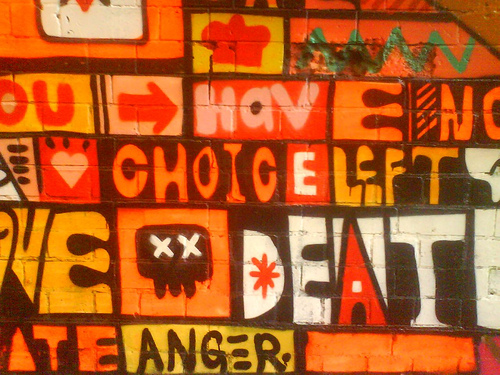
This is a form of what Patti and I call a “negative direction of intention.” In short, a negative direction of intention is the act of moving away from what you don’t want (or running away from what you do want). In general, a negative direction of intention will inevitably lead to a destructive action. I know a man whose passion was playing the drums though you’d never know it because he stopped playing more than 30 years ago. “I felt like I had to make a choice,” he said, “I could either have a family or I could play the drums.” He chose to have a family so for some reason he could never articulate, that meant he had to put his drums in the attic. Either/Or thinking is a characteristic of a negative direction of intention. This thinking in Black/White is reductive and simplistic and only necessary if you need to see the world in absolute terms; this, not that.
His children are long since grown and his drums remain stowed away in the attic. “A choice is a choice,” he said.
Most people live their entire lives pushing against what they don’t want or what they are afraid to walk toward. There’s a lot of fear behind a negative direction of intention and with that fear comes the rigid absolutes expressed by drum-in-the-attic man and media constructs like red state/blue state, pro-life/pro-choice, for guns/against them. How you frame the question determines the possibilities that you see (or that you don’t see); in an either/or frame the choices are limited – obviously – and in such a unbending mindset it’s common to convince yourself that you have no choices; in a game of angel/devil it’s a coin toss, circumstances rule the day! Eventually in a negative direction of intention everything looks like an obstacle or an enemy. Planting flags, claiming territory, stuffing your fingers in your ears or shouting down the voices of opposing points of view is are all common traits of a negative direction of intention.
Conversely, a positive direction of intention is defined by moving toward something, it is a creative action. It inspires a walk into the unknown (that’s the point, the path of passion is always through the unknown: passion grows in the engagement or in the learning, two ways of saying the same thing). It requires embracing choice and the accompanying discomfort that owning your choices can bring, it implies taking personal responsibility for who you are and how you engage with what you desire. A positive direction of intention is characterized by Both/And thinking: you can be a drummer and have a family! You can consider many opposing perspectives because you not only expect them but you need them, you are not trapped in the belief that an opposing point of view negates your own (a sure sign of a negative direction of intention).
Are you living a negative or positive direction of intention? Listen to the story you tell yourself about yourself; count the number of times a day you engage in justifying your point of view, or how many times a day do you plant a flag in the sand to claim that you are right? How many times a day do you reduce someone because their perspective differs from yours? You can hear the language of choice in the words you use just as you can hear the language of victim-hood. Just listen.
And while you are listening, listen to someone who has an opinion that differs from yours. Ask them questions. Consider that their ideas and beliefs are just as valid as yours and rooted in experiences that are just as real to them as yours are to you. See what happens to you when you stop negating and start discussing. Practice consideration. What if you refused to fix anything (a negative direction of intention) or even better, what if you refused to justify or defend your point of view or negate any other point of view – and instead you practiced inquiring about others ideas and regarded their beliefs as valuable and as worthy as yours. What if, for a month, you practiced not knowing what you think and entertained the idea that there was something to discover.
As Todd suggested, we reduce our issues to be too simplistic, right vs. wrong, and in doing so we rob ourselves of the capacity for complex debate or considerations beyond the superficial. We rob ourselves of our capacity to create, locking ourselves in a pattern of ping-pong reactivity. And in the end, all we reduce is ourselves.
“A wise old owl sat on an oak; the more he saw the less he spoke; the less he spoke the more he heard; why aren’t we like that wise old bird?” Anonymous
Filed under: The Direction of Intention, Uncategorized |




 The Direction of Intention
Leave a comment