

I rarely write statements about paintings – especially my paintings. I come from the school of thought that says, “if you want to insult someone, tell them what the painting is about.” I believe people should have their own experience of art. My interpretation is mine. What’s yours?
Twenty something years ago, during my first solo show at the Alan Short Gallery in Stockton, California, I followed two old men through the gallery. They paid me the greatest compliment I have ever received – to this day no one has topped it. They did not know who I was. I was the artist and at that time I was deeply invested in hiding; it was painful for me to be the artist.
The Alan Short Gallery was a converted Victorian house; there were many rooms to fill; I’d pulled out every drawing and painting I had and was desperately shy about my work. The two men (one wore red suspenders, no lie) carefully considered each piece. They’d move in for a closer look then back away. Grunting and nodding, “Uh-hummm.” They’d move on to the next piece.
Suspender man would squint, purse his lips and offer, “Hmmm!”
“Mmmm,” his companion would reply, nodding.
Taking in every painting, they’d chew on it, each a savory bite fully tasted. And then they’d move on to the next with me as their shadow. I loved their experience because it was distinctly different from my own. They were seeing things I had never seen, interpreting the paintings from their experience, through their eyes, not through any abstract notion I might have placed between them and their seeing.
Following them opened my eyes to the power of art; they were creating it anew. It was theirs as well as mine. It was satisfying – as if they were painting the paintings.
We arrived in the final room, the last piece in the exhibit. At last, sated, red suspender man turned to his compadre and spoke the first words I’d heard pass between them. He said, “Do you think this Robinson is insane?” His friend nodded and said, “All the good ones are.”
As compliments go, it’s hard to beat that one. It’s never been topped.
In May I’ll have a piece in a group show at the ArtsWest Gallery in Seattle. One of the requirements of participation breaks my rule, I had to write a statement about the piece. The show is called (dis)connect. I painted this piece specifically for the show and call it Pieta and Paparazzi.
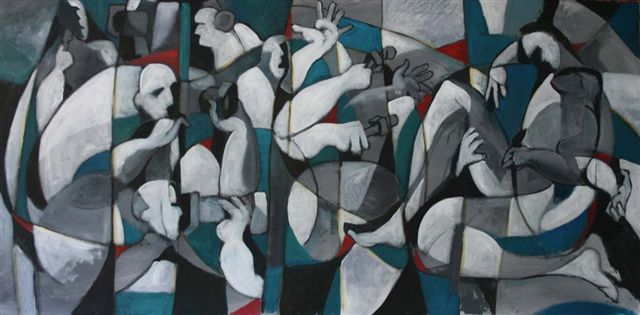
Pieta with Paparazzi
This is what I wrote:
In the introduction to his 1985 book, Amusing Ourselves To Death, Neil Postman writes that contemporary society is more oppressed by “their addiction to entertainment” than by any form of state control. He argues that the forms of our media can only support a minimal level of ideas; what can we really know or say about our politics, our religious beliefs, our values when expressed in sound bytes, ticker-tape news, and 140 character messages?
We live in an age in which the line between substantive information and entertainment, news and opinion, is blurred. What do we become when there is no distinction between the sacred and commodity, money and morality? What is our destiny when we take seriously the plea from our leaders, that the best thing we can do for our society is to consume?
I share this statement because I realized while writing it that I’m asking myself these questions in one form or another a lot these days. Not many people move through a gallery like red suspender man and his companion – they did not consume the art, they participated with it. They engaged in a relationship with the paintings – I would have followed them through the gallery even if it had been another artist’s paintings; these two old men were magnetic. They weren’t consuming the art, they fulfilled it.
Filed under: Art |




 The Direction of Intention
Leave a comment